Categories
Exodus Devotions

The God who pitched his tent among us

The cloud covered the tent of meeting, and the glory of the Lord filled the tabernacle.

Moses was unable to enter the tent of meeting because the cloud rested on it, and the glory of the Lord filled the tabernacle. (Exodus 40:34-35)

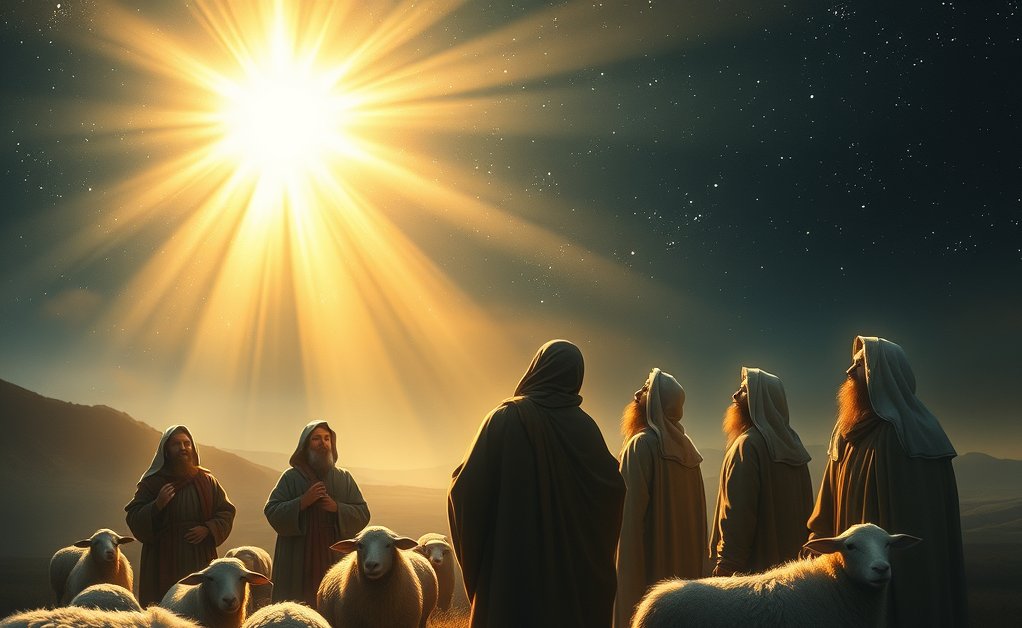
This being Christmas season, I couldn’t help but think of the story of the shepherds in Luke 2.

In the same region, shepherds were staying out in the fields and keeping watch at night over their flock.

Then an angel of the Lord stood before them, and the glory of the Lord shone around them, and they were terrified. (Luke 2:8-9)

The same glory that filled the tabernacle now shone around the shepherds.

No wonder the shepherds were terrified.

Even Moses wouldn’t enter the place where God’s glory shone.

And yet the angel said to the shepherds,

Don’t be afraid, for look, I proclaim to you good news of great joy that will be for all the people: Today in the city of David a Savior was born for you, who is the Messiah, the Lord. (Luke 2:10-11)

Through Jesus, the shepherds gained access to God that even Moses didn’t have. And so have we.

John tells us,

The Word (i.e. God) became flesh and dwelt among us. (John 1:14)

The word “dwelt” has the idea of “pitching one’s tent.”

In Jesus becoming human, God “pitched his tent” among us, just as God did for the Israelites.

Because he did, John tells us that,

We observed his glory, the glory as the one and only Son from the Father, full of grace and truth. (John 1:14b)

And just as God was Immanuel to the Israelites, “throughout all the stages of their journey,” Jesus is Immanuel to us throughout all the stages of our journey through life, promising,

I am with you always, to the end of the age. (Matthew 28:20)

Categories
Exodus Devotions

Let everything I do…

Everyone whose heart was moved and whose spirit prompted him came and brought an offering to the Lord. (Exodus 35:21)

Moses then said to the Israelites, “Look, the Lord has appointed by name Bezalel son of Uri, son of Hur, of the tribe of Judah.

He has filled him with God’s Spirit, with wisdom, understanding, and ability…” (Exodus 35:30-31)

Father, let everything I do for you be from my heart. Not obligation. Not duty. Not others’ expectations of me. But from a heart that has been touched by your love and grace and is filled with gratitude.

So often I see mixed motives in myself. Help me to give my whole heart to you.

Father, you have appointed me by name.

I’m weak. I often feel inadequate. And yet you appoint me by name.

Fill me with your Spirit. Fill me with wisdom, understanding, and the ability to do what you’re asking of me.

Without you, I can do nothing. With you, I can bear much fruit. And I want to bear much fruit for you. In Jesus’ name, amen.

Categories
Exodus Devotions

Immanuel

“Now if I have indeed found favor with you, please teach me your ways, and I will know you, so that I may find favor with you. Now consider that this nation is your people.”

And he replied, “My presence will go with you, and I will give you rest.”

“If your presence does not go,” Moses responded to him, “don’t make us go up from here.” (Exodus 33:13-15)

I was thinking this morning, “How often do I have Moses’ heart?”

“Father, I don’t even want to leave this house unless you go with me. If I have found favor with you, walk with me. Teach me your ways and I will know you so that I may find favor with you.”

The amazing thing is that God says to us, “I will do this very thing you have asked, for you have found favor with me, and I know you by name. My presence will go with you and I will give you rest.” (Exodus 33:17, 14)

Ultimately, that’s what Christmas is about.

Jesus is Immanuel, God with us.

He not only walks with us and talks with us as he did with Moses, he reveals his glory to us, and we receive grace upon grace upon grace. (John 1:14, 16-18)

That’s awesome to ponder.

Glory to God in the highest heaven,
and peace on earth to people he favors! (Luke 2:14)

Categories
Exodus Devotions

The gravity of our sin

The following day Moses said to the people, “You have committed a grave sin.” (Exodus 32:30)

Moses’ words really struck me this morning. “You have committed a grave sin.”

It made me think, “How seriously do I take my sin? Do I ever take it too lightly?”

Paul tells us that the wages of sin is death. (Romans 6:23)

The Israelites learned that lesson that day, with 3000 dying and more gettting struck by plague.

Our sin is so grave, that Jesus had to go to a cross to “settle our accounts.”

And only when we realize the gravity of our sin can we understand the depth of joy David had when he wrote,

How joyful is the one
whose transgression is forgiven,
whose sin is covered!

How joyful is a person whom
the Lord does not charge with iniquity… (Psalm 32:1-2)

Father, help me to never take my sin lightly. And let me never take your awesome grace for granted.

Categories
Exodus Devotions

Old covenant, new covenant

Moses took half the blood and set it in basins; the other half of the blood he splattered on the altar.

He then took the covenant scroll and read it aloud to the people.

They responded, “We will do and obey all that the Lord has commanded.”

Moses took the blood, splattered it on the people, and said, “This is the blood of the covenant that the Lord has made with you concerning all these words.” (Exodus 24:6-8)

Having taken communion yesterday, it’s hard not to think of Jesus’ words at the last supper.

This cup is the new covenant in my blood. Do this, as often as you drink it, in remembrance of me. (1 Corinthians 11:25)

In a lot of ways, the old covenant was a covenant of grace. It brought an undeserving people into a relationship with God.

But in a lot of ways, it was an imperfect covenant.

It was built on promises by the people to obey God’s law, something they could never do perfectly. (Hebrews 8:7-9, 10:1-4)

Morever, even with the blood sprinkled on them, they could not draw near to God. Only Moses, the priests, and the elders could eat and drink in God’s presence.

And even then, only Moses could truly approach God on Sinai.

But the new covenant is not based on our efforts to keep God’s law. It’s not based on any vows we make to “be good.”

It’s based on Jesus’ work on the cross for us and his blood that he shed for us.

A blood that cries out, not for vengeance, as Abel’s did (Genesis 4:10), but a blood that cries out, “Father, forgive them.”

And because of Jesus, all of us can draw near to God, joyfully, boldy, and without fear. (Hebrews 10:19-22)

The writer of Hebrews sums up the difference between the Old and New covenant this way.

For you have not come to what could be touched, to a blazing fire, to darkness, gloom, and storm, to the blast of a trumpet, and the sound of words.

Those who heard it begged that not another word be spoken to them, for they could not bear what was commanded: If even an animal touches the mountain, it must be stoned.

The appearance was so terrifying that Moses said, I am trembling with fear.

Instead, you have come to Mount Zion, to the city of the living God (the heavenly Jerusalem), to myriads of angels, a festive gathering, to the assembly of the firstborn whose names have been written in heaven, to a Judge, who is God of all, to the spirits of righteous people made perfect, and to Jesus, the mediator of a new covenant, and to the sprinkled blood, which says better things than the blood of Abel. (Hebrews 12:18-24)

That’s awesome to think about.

Therefore, since we are receiving a kingdom that cannot be shaken, let us be thankful.

By it, we may serve God acceptably, with reverence and awe, for our God is a consuming fire. (Hebrews 12:28-29)

Categories
Exodus Devotions

What we all need

“What you’re doing is not good,” Moses’s father-in-law said to him.

“You will certainly wear out both yourself and these people who are with you, because the task is too heavy for you. You can’t do it alone.” (Exodus 18:17-18)

“You can’t do it alone.”

I found it interesting that Jethro told Moses that not long after the battle against the Amalekites.

Moses literally couldn’t keep his hands up as he was interceding for the Israelites before God, but Aaron and Hur supported him until victory was achieved. (Exodus 17:8-16)

And now Jethro was telling him again, “You can’t do God’s work alone.”

That’s something we all need to remember.

Our leaders may seem like “super-Christians,” but they can’t do their jobs alone.

They certainly need our prayers and encouragement. But they also need us to do our part in ministry as well.

God has given each of us gifts to minister to others. Ministry is not just the job of the leaders. It’s the job of every Christian. (Ephesians 4:11-16)

But beyond that, all of us need support in our Christian lives.

Our personal ministries to our families and those around us can get heavy. Life itself can get heavy.

So let’s not try to live our Christian lives on our own.

Let’s support and encourage each other so that our load will be lightened and we’ll be able to endure. (Exodus 18:22-23)

As Paul put it,

Carry one another’s burdens; in this way you will fulfill the law of Christ. (Galatians 6:2)

Categories
Exodus Devotions

Hurting? Or defiant?

He named the place Massah and Meribah, because the Israelites complained, and because they tested the Lord, saying, “Is the Lord among us or not?” (Exodus 17:7)

As I was reading those words, it struck me that there are two ways the Israelites could have been saying those words.

They could have been hurting, and saying, “God, I don’t get it. Are you really with us? We have no water. Unless you do something, we’re going to die. Please help us.”

Or they could have been defiant, saying, “Well, God, are you with us or not? What? Are you just going to let us die out here? What kind of God are you, anyway?”

From the way that Moses responded, it seems that the Israelites were speaking more from defiance.

In fact, he warned them against that kind of attitude later. (Deuteronomy 6:16)

When we go through trials, it’s easy to get tossed around by our emotions. And in our hurt, it’s okay for us to express our doubts, our pain, and our fears.

David did this all the time in the Psalms.

But one thing we must guard against is a defiant attitude. To feel like we are in a position to judge God.

We are not. There is so much he knows that we don’t.

And so when we’re hurting, when we don’t understand, we need to take a humble attitude with God.

Satan would have us question God’s goodness, and he would use our trials to destroy our trust in God.

Don’t let him do it.

Instead let’s remember Peter’s words, clinging to God’s goodness, his faithfulness, and his love toward us.

Humble yourselves, therefore, under the mighty hand of God, so that he may exalt you at the proper time, casting all your cares on him, because he cares about you.

Be sober-minded, be alert.

Your adversary the devil is prowling around like a roaring lion, looking for anyone he can devour.

Resist him, firm in the faith, knowing that the same kind of sufferings are being experienced by your fellow believers throughout the world.

The God of all grace, who called you to his eternal glory in Christ, will himself restore, establish, strengthen, and support you after you have suffered a little while.” (1 Peter 5:6-10)

Categories
Exodus Devotions

Finding God’s rest and peace

Yet on the seventh day some of the people went out to gather, but they did not find any.

Then the Lord said to Moses, “How long will you refuse to keep my commands and instructions? Understand that the Lord has given you the Sabbath…” (Exodus 16:27-29)

“The Lord has given you the Sabbath.”

Those words struck me. God wanted to give the Israelites rest. It was a gift to them.

But they couldn’t find that rest as long as they refused to trust and obey him.

It’s so amazing how quickly they forgot God’s goodness. One moment, they’re singing,

Lord, who is like you among the gods?
Who is like you, glorious in holiness,
revered with praises, performing wonders…

With your faithful love, you will lead the people
you have redeemed;
you will guide them to your holy dwelling
with your strength. (Exodus 15:11, 13)

The next moment, they’re complaining and wishing they were back in Egypt.

I don’t want to be like that, crying out, “How great is our God!” on Sunday, but failing to trust and obey him the rest of the week.

Not only does it sadden my Father, but I lose out on the gift of rest and peace he wants to give me.

Father, I want to know your rest and peace. And the thing is, you want me to experience your rest and peace. So help me to trust you and obey.

You are good. You are trustworthy. And you deeply love me.

Help me to always remember that. In Jesus’ name, amen.

Categories
Exodus Devotions

The One who goes ahead of us

The Lord went ahead of them in a pillar of cloud to lead them on their way during the day and in a pillar of fire to give them light at night, so that they could travel day or night.

The pillar of cloud by day and the pillar of fire by night never left its place in front of the people. (Exodus 13:21-22)

Father, you are the one that goes before me. Night or day, you never leave your place in front of me.

Lead me by your wisdom. You know me better than I know myself. You know what I can handle and what I can’t. (Exodus 13:17-18)

May I have the faith of Joseph, confident that what you have said, you will do. (Exodus 13:19)

May I have the faith of Moses, following wherever you lead.

In Jesus’ name, amen.

Categories
Exodus Devotions

What makes us different

The blood on the houses where you are staying will be a distinguishing mark for you; when I see the blood, I will pass over you.

No plague will be among you to destroy you when I strike the land of Egypt. (Exodus 12:13)

What made the Israelites different from the Egyptians? Why were the Israelites spared God’s judgment and not the Egyptians?

As we’ll see later in Exodus, it wasn’t because the Israelites were somehow morally superior to the Egyptians.

Rather, it was the blood of the sheep or goat that was shed for them.

It’s the same with us.

We deserve God’s judgment as much as anyone.

What distinguishes us and saves us from God’s judgment is not how good or faithful we are.

Rather, it is Jesus’ blood shed on the cross for us.

Perhaps David was thinking of the Israelites using hyssop to brush the blood on their doorposts when he prayed,

Purify me with hyssop, and I will be clean;
wash me, and I will be whiter than snow. (Psalm 51:7)

God told the Israelites to always remember what he did for them that day. (Exodus 12:24-27)

In the same way, let us always remember what Jesus did for us on the cross, and like the Israelites, fall down in worship.

It’s your blood that cleanses me.
It’s your blood that gives me life.
It’s your blood that took my place in redeeming sacrifice.
And washes me whiter than the snow.
My Jesus, God’s precious sacrifice. — Michael Christ

Categories
Exodus Devotions

Stubborn

How long will you refuse to humble yourself before me? (Exodus 10:3)

It’s easy to criticize Pharaoh for his stubbornness.

But how often do we cling to ours?

We know we’re wrong.

But we refuse to humble ourselves.

I know I’m guilty of that at times.

How often does God wonder at my stubborn heart?

How often does he say to me, “How long will you refuse to humble yourself before me?”

Abba, Father, help me to keep a soft, humble heart.

Categories
Exodus Devotions

Fearing God’s words

Those among Pharaoh’s officials who feared the word of the Lord made their servants and livestock flee to shelters, but those who didn’t take to heart the Lord’s word left their servants and livestock in the field. (Exodus 9:20-21)

Father, do I fear your Word? Do I take it to heart?

Solomon said the fear of the Lord is the beginning of wisdom. (Proverbs 9:10)

Do I really believe that?

Yours are the words that give me life. (John 6:68)

Forgive me for the times I don’t fear your Word.

It’s one thing to say that I honor your Word.

It’s another thing to let it shape my actions. My heart. My attitudes.

Let your Word do just that: shape my heart, attitudes, and actions.

In Jesus’ name amen.

Categories
Exodus Devotions

That the world may know

You must say whatever I command you; then Aaron your brother must declare it to Pharaoh so that he will let the Israelites go from his land…

The Egyptians will know that I am the Lord when I stretch out my hand against Egypt and bring out the Israelites from among them. (Exodus 7:2, 5)

Moses and Aaron were to speak God’s words so that Pharaoh and all the Egyptians would know he was the Lord.

As I read those words, it struck me that we too are to speak God’s words to those around us that they might know he is the Lord.

But whereas Moses’ and Aaron’s words were mostly words of judgment, ours is a message of reconciliation.

Paul put it this way,

Everything is from God, who has reconciled us to himself through Christ and has given us the ministry of reconciliation.

That is, in Christ, God was reconciling the world to himself, not counting their trespasses against them, and he has committed the message of reconciliation to us.

Therefore, we are ambassadors for Christ, since God is making his appeal through us. We plead on Christ’s behalf, “Be reconciled to God.”

He made the one who did not know sin to be sin for us, so that in him we might become the righteousness of God. (2 Corinthians 5:18-21)

So let’s take God’s message of reconciliation to those around us that they may know he is God…and be reconciled to him.

Categories
Exodus Devotions

Who am I?

God spoke further to Moses and said to him, “I am Yahweh; and I appeared to Abraham, Isaac, and Jacob, as God Almighty, but by My name, Yahweh, I was not known to them.” (Exodus 6:2-3, LSB)

Father, you are El Shaddai, God Almighty. You are Yahweh.

You are the God that was with Abraham, Isaac, and Jacob.

You are the God that was with Moses.

And you are with me.

Who am I that you would care about me?

That you would hear my groanings?

That you would save me and redeem me?

That you would take me to be your own?

That you would bring me into your kingdom?

That you would be my God and reveal yourself to me?

That in Jesus you have revealed yourself to me in a way that even Abraham, Isaac, Jacob, and Moses didn’t know.

And so I choose to trust you, even in my struggles.

You were faithful then. You are faithful now. And you will be faithful throughout all eternity.

I love you, Abba.

In Jesus’ name, amen.

Categories
Exodus Devotions

Do I believe You?

I wonder.

Did Moses tell the Israelites everything God had said?

Did he tell them that Pharaoh would harden his heart against them?

Or did he only tell them that God would deliver them?

I wonder.

Did Moses himself take God’s warning seriously?

He certainly didn’t seem prepared in his heart when Pharaoh said no and the Israelites got upset with him.

How about us? Do we believe God?

Do we believe Jesus when he says, “In this world you will face suffering?” (John 16:33)

Do we believe Paul when he says hard times will come? (2 Timothy 3:1-5)

Do we believe Peter? (1 Peter 4:12)

More importantly, when we do face trials, do we keep believing God is good, that Jesus has overcome this world, and that God will keep his word and ultimately will deliver us?

The question I’m asking today, that all of us need to ask is, “God, do I believe you?”

Categories
Exodus Devotions

Though God is patient

Our God is patient. That is true.

But ultimately, there is one thing he will not tolerate: willful disobedience.

We see that twice in this passage.

When God first called Moses to go to Pharaoh, Moses started making all kinds of excuses about why he couldn’t go.

But in the end, those excuses were merely excuses. And when God answered each one, Moses finally said, “I don’t want to go. Send someone else.”

At that, God got upset.

Now, by his grace, God made allowance for Moses’ weaknesses, allowing Aaron to be his spokesman.

But he did not allow Moses to simply walk away from this task he had given him.

Then we have this curious incident where God is about to kill Moses. Why?

Apparently, God had commanded Moses to circumcise his son. It was something God had commanded Abraham and all his descendants to do (Genesis 17:9-14).

And as Israel’s leader, Moses had to set an example for the people.

But for whatever reason, he didn’t. From his wife’s reaction, it’s possible she had been against her son being circumcised.

Again, God is patient and gracious. But never mistake his patience and grace for indifference to our sin.

He does not take willful disobedience lightly.

Neither should we.

Categories
Exodus Devotions

Having our Father’s heart

Years later, after Moses had grown up, he went out to his own people and observed their forced labor. He saw an Egyptian striking a Hebrew, one of his people…

After a long time, the king of Egypt died. The Israelites groaned because of their difficult labor, and they cried out, and their cry for help because of the difficult labor ascended to God.

God heard their groaning, and God remembered his covenant with Abraham, with Isaac, and with Jacob; and God saw the Israelites, and God knew. (Exodus 2:11, 23-25)

Moses was a flawed man. And yet, I think God saw in Moses a heart similar to his own. A heart that not only saw the groanings and struggles of others, but wanted to help.

Moses saw the suffering of his own people and refused to stand by and do nothing.

His murdering a man was of course wrong, but his desire to help his suffering brothers was not.

He later saw some shepherdesses also being bullied, and despite his failure the time before, he still couldn’t stand idly by.

And when God saw the suffering of his own people, he couldn’t just stand by and watch either. He had compassion on his people and determined to help them.

And so he chose to use a man who had the same kind of heart he had.

God still chooses to use the same kind of people today.

I don’t know about you, but I want to be such a man.

Categories
Exodus Devotions

Remembered and honored

It’s very interesting to me that the king of Egypt is never named, but two “insignificant” midwives are.

God remembered and honored Shiphrah and Puah for their faithfulness to him, and their names are commemorated in Scripture to this day.

The king of Egypt…not so much.

You may feel like you’re insigificant and unimportant in God’s kingdom.

But if we are faithful, we will be remembered and honored by God just as Shiphrah and Puah were.

It reminds me of what God said through the prophet Malachi.

At that time those who feared the Lord spoke to one another. The Lord took notice and listened.

So a book of remembrance was written before him for those who feared the Lord and had high regard for his name.

“They will be mine,’ says the Lord of Armies, ‘my own possession on the day I am preparing.” (Malachi 3:16-17)

Categories
Exodus Devotions

Celebration Sunday!

Okay, it doesn’t quite have the alliteration of Throwback Thursday, but anyway…

Happy Resurrection Sunday! He is risen indeed!

God’s redemption plan is imperturbable.

No matter how badly we sin, no matter how badly we fall, no one is beyond God’s ability to save.

That’s the hope of Easter.

Categories
Exodus Devotions

Doing things God’s way

Let’s be honest: chapters 36-39 can make for a lot of dry reading. Especially when you consider that much of it is a repetition of what was written about in chapters 25-30.

Chapters 25-30 were the instructions.

Chapters 36-39 were the Israelites following those instructions.

That seems to be the main point in chapter 39.

Again and again, we see the words, “just as the Lord had commanded Moses.” (1, 5, 7, 21, 26, 29, 31, 32, 43)

God had given the Israelites all the wisdom, understanding, and skill necessary to do the job. (Exodus 35:31-36:2)

But they didn’t just do things as they saw fit. They didn’t do what simply seemed expedient.

They did things God’s way.

No shortcuts. No compromise.

Can we say the same about ourselves in our work? In our ministry? In everything we do?

Categories
Exodus Devotions

What God desires

Let everyone whose heart is willing… (Exodus 35:5)

Everyone whose heart was moved and whose spirit prompted him… (21)

And all the women whose hearts were moved… (26)

all the men and women whose hearts prompted them… (29)

What does God want from us?

Have you ever wondered that?

I think the above words make the answer crystal clear.

More than anything else, God wants our hearts.

When it comes to giving, when it comes to serving, in everything we do, God wants our hearts.

Does he have yours?

Lord, you have done so much for me. You have shown your love and mercy to me time and again. You are so good.

May your love and joy be at the root of everything I do. In Jesus’ name, amen.

Categories
Exodus Devotions

God’s character

“The LORD—the LORD is a compassionate and gracious God, slow to anger and abounding in faithful love and truth, maintaining faithful love to a thousand generations, forgiving iniquity, rebellion, and sin.

But he will not leave the guilty unpunished, bringing the consequences of the fathers’ iniquity on the children and grandchildren to the third and fourth generation.” (Exodus 34:6-7)

This is one of the most famous passages in the Old Testament and is constantly repeated throughout it.

Why? Because it shows the Lord’s character.

It’s easy to look at some of the stories in Exodus and the other books of the Old Testament and to see God as a God of wrath.

There is some truth to that. God hates sin and he will punish it.

After all, can a good God love sin? Can a just God leave sin unpunished?

But God is also “compassionate and gracious, slow to anger and abounding in faithful love and truth.”

Have you ever noticed that for all the times that God judges people, he always tells his people about it first?

He did that with Abraham (Genesis 18).

He did that with Moses. (Exodus 32).

Why tell them? Simply so that they could observe God’s justice?

No, he told them so that they could intercede. And both of them did.

In both cases, justice still came. The unrepentant were judged.

But in both cases, people were saved because of Abraham and Moses.

God will judge evil. But he would much rather show mercy than judge.

That’s why he sent Jesus. Jesus paid the price for our sin so that God could show us mercy.  

So like Moses, let us boldly draw near to God with unveiled faces.

We don’t need to fear his judgment and wrath as we approach him.

Instead, as we draw near to him, by his grace, God transforms us more and more into the likeness of his Son. (2 Corinthians 3:12, 18)

Categories
Exodus Devotions

Taking a breath

The Israelites must observe the Sabbath, celebrating it throughout their generations as a permanent covenant.

It is a sign forever between me and the Israelites, for in six days the Lord made the heavens and the earth, but on the seventh day he rested and was refreshed. (Exodus 31:16-17)

Interesting phrase there at the end: The Lord rested and was refreshed.

It almost sounds as if he was tired and needed to recharge.

But of course, him being God, that was not the case.

Rather, he simply ceased his work and took a breath, not because he was tired, but to enjoy his creation.

How often do we stop what we’re doing, take a breath, and enjoy our Creator?

Of course it’s good to do that every day. But it’s especially good to do it on Sunday.

Sometimes people ask, “Do I have to go to church every Sunday?”

But that question shows a wrong way of thinking.

Going to church isn’t a “got to.” It’s a “get to.”

For a couple of hours every Sunday, we get to step away from our work, from our studies, from the drudgery of every day life, and enjoy our Creator. To remember his goodness toward us.

More, we get the chance to bless and be blessed by others in God’s family.

What is church to you?

A “got to?”

Or a “get to?”

Categories
Exodus Devotions

Our mercy seat

Very detailed instructions for the tabernacle, aren’t they?

Why all the detail? What does it matter? The writer of Hebrews tells us.

These serve as a copy and shadow of the heavenly things, as Moses was warned when he was about to complete the tabernacle.

For God said, “Be careful that you make everything according to the pattern that was shown to you on the mountain.” (Hebrews 8:5)

What did the author of Hebrews mean by “these serve as a copy and shadow of heavenly things?”

There are several examples we can take from Exodus 25, but the one that struck me most today was verse 22.

I will meet with you there above the mercy seat, between the two cherubim that are over the ark of the testimony; I will speak with you from there about all that I command you regarding the Israelites. (Exodus 25:22)

Inside the ark were the ten commandments God had given the people. (16)

The ten commandments were a reminder of God’s holiness. They were a reminder that we are to be holy as God is holy. And they were a reminder of how far short we fall of that holiness.

It’s a good thing we don’t meet God on the basis of our keeping of the ten commandments.

Rather we meet him above the mercy seat.

In the Old Testament, once a year, a sacrifice of atonement was made and the blood from that sacrifice was sprinkled on that mercy seat, providing forgiveness for the people. (Leviticus 16)

But now Paul says this,

God presented (Jesus) as the mercy seat, by his blood…(Romans 3:25)

Jesus is our mercy seat.

Through his blood, our sins are forgiven. And by his blood we can now draw near to God.

So as you read this passage, remember Paul’s words…and rejoice!

For all have sinned and fall short of the glory of God; they are justified freely by his grace through the redemption that is in Christ Jesus.

God presented him as the mercy seat, by his blood…(Romans 3:23-25)

Categories
Exodus Devotions

Sprinkled by his blood

Moses took the blood, splattered it on the people, and said, “This is the blood of the covenant that the Lord has made with you concerning all these words. (Exodus 24:8)

Whenever I see those words, I can’t help but think of Jesus’ words to his disciples at the last supper.

For this is my blood of the covenant, which is poured out for many for the forgiveness of sins. (Matthew 26:28)

Because they were sprinkled with blood, Moses, the priests, and the elders could have fellowship with God without fear of judgment. (9-11)

So with us. Not just Christian leaders. But all believers.

According to Peter, we are chosen by the Father, sanctified by the Spirit, and sprinkled with the blood of Christ. And because of that we have grace and peace with God. (1 Peter 1:1-3)

It’s worth reading Hebrews 9 together with this passage because the author of Hebrews quotes it and explains some of what we read in Exodus 24.

But if nothing else, it’s good to meditate on these awesome words:

For if the blood of goats and bulls and the ashes of a young cow, sprinkling those who are defiled, sanctify for the purification of the flesh, how much more will the blood of Christ, who through the eternal Spirit offered himself without blemish to God, cleanse our consciences from dead works so that we can serve the living God? (Hebrews 9:13-14)

Categories
Exodus Devotions

Seeing beyond the written law

It’s easy to see all the laws in Exodus and Leviticus and think, “What do these laws have to do with me?”

Take verses 4-5, for example.

If you come across your enemy’s stray ox or donkey, you must return it to him.

If you see the donkey of someone who hates you lying helpless under its load, and you want to refrain from helping it, you must help with it. (Exodus 23:4-5)

What do you  think the odds are that you’re ever going to see any stray ox or donkey on the road, no less an enemy’s one?

But it’s important to see beyond the letter of the law to the principle behind it. What’s the principle behind it?

Jesus tells us.

But I say to you who listen: Love your enemies, do what is good to those who hate you, bless those who curse you, pray for those who mistreat you…

But love your enemies, do what is good, and lend, expecting nothing in return.

Then your reward will be great, and you will be children of the Most High. For he is gracious to the ungrateful and evil.

Be merciful, just as your Father also is merciful. (Luke 6:27-28, 35-36)

So as we look at all these commands in the Old Testament, look beyond the actual words, going to their heart.

And then most importantly, ask God, “What are you trying to tell me?”

Categories
Exodus Devotions

Not a tame God

Moses responded to the people, “Don’t be afraid, for God has come to test you, so that you will fear him and will not sin.” (Exodus 20:20)

A paradoxical statement to be sure.

“Don’t be afraid,” Moses says.

But in the next breath, he says, “Fear God.”

How do we balance the two statements?

Perhaps the best way to balance them is with this truth: God is good. But he is not a tame God.

We cannot control him.

We cannot manipulate him.

When dealing with a holy and all-powerful God, people should be afraid. We don’t dare take him lightly.

For the day will come when he will judge all those who hate and rebel against him. (5)

And when we see that judgment fall on people, we should fear. Because all of us have sinned. All of us deserve that judgment.

But God is also good. He is never capricious. He is never malicious.

More, he sent his Son so that we don’t have to be judged.

Now to those who love God and receive his Son, God shows his faithful, never-ending love. (6)

When we sin, God may discipline us, but as with Solomon, he will never take his love away from us. (2 Samuel 7:14-15)

And because of that, we don’t have to be like the Israelites, standing at a distance from God, fearing his judgment.

Rather, like Moses, we can draw near. (18, 21)

So let us fear God. But let us not be afraid of him.

Instead, let us draw near. As John said,

In this, love is made complete with us so that we may have confidence in the day of judgment, because as he is, so also are we in this world.

There is no fear in love; instead, perfect love drives out fear, because fear involves punishment. (1 John 4:17-18)

Categories
Exodus Devotions

Remembering who we are

“Now if you will carefully listen to me and keep my covenant, you will be my own possession out of all the peoples, although the whole earth is mine, and you will be my kingdom of priests and my holy nation.”

These are the words that you are to say to the Israelites. (Exodus 19:5-6)

Amazing words, aren’t they?

But over a thousand years later, Peter took God’s words to the Israelites and applied them to us.

But you are a chosen race, a royal priesthood, a holy nation, a people for his possession, so that you may proclaim the praises, of the one who called you out of darkness into his marvelous light.

Once you were not a people, but now you are God’s people; you had not received mercy, but now you have received mercy. (1 Peter 2:9-10)

Let us always remember who we are.

We are God’s chosen, beloved people.

But not only that, we are priests of the great King, called to proclaim his praises.

Not just so that God is blessed. But so that those around us might hear our story and that they too may come out of darkness into his marvelous light.

So I say it again: “Remember who you are.”

Categories
Exodus Devotions

He took the blow

How often do we question God, “Are you really with me or not?”

That’s what the Israelites did with God in the desert.

And so for the first and only time in the Old Testament, God stands before the people to be tried.

Usually in a trial, the people would stand before God to be tried (Deuteronomy 19:17).

But this time, it is God who stands on the rock (possibly symbolized by the pillar of cloud) before Moses and the elders of Israel.

And there, since a cloud cannot be struck, the rock on which God stands is struck and he gave them water, proving to the people he was truly with them.

God didn’t deserve to be struck. The people did for their sin of disbelief. But God took the blow, and in doing so, gave them life.

According to Paul, that rock was a symbol of Christ. (1 Corinthians 10:4)

And over a thousand years later, in Jesus, God became a man and stood before men to be judged again.

Once again, he stood trial, not because of any sin of his, but because of the sins of the people.

There on the cross, he took the blow once more. And now through his blood shed on the cross, we have life.

What struggles are you going through now? Are you questioning if God is truly with you or not?

Look to the cross. Remember what he did there for you. And believe.

He is Immanuel.

He is “God with us.”

So let us sing as David did when remembering this incident.

Oh come, let us sing to the LORD;
let us make a joyful noise to the rock of our salvation! (Psalm 95:1)

Categories
Exodus Devotions

Give us this day our daily bread

Then the LORD said to Moses, “I am going to rain bread from heaven for you. The people are to go out each day and gather enough for that day.

This way I will test them to see whether or not they will follow my instructions.” (Exodus 16:4)

I couldn’t help but think that Jesus was referring to this passage when he told his disciples to pray,

Give us today our daily bread. (Matthew 6:11)

It never really struck me before what we’re really saying when we pray that.

Not only are we asking God to provide our needs. But we are praying, “Lord teach me to trust you daily. Teach me to trust you enough that I will obey you in everything.”

Lord, thank you for rescuing me from slavery to sin. Each day, may I know you more deeply, seeing your glory. (6-7)

And as I do, teach me to daily trust and obey you…in everything.

Give me today my daily bread.

In Jesus’ name, amen.

Categories
Exodus Devotions

A time to pray. A time to move.

The Lord said to Moses, “Why do you cry to me? Tell the people of Israel to go forward. (Exodus 14:15)

In our lives, there are times we face things that are too big for us. And our natural response is to cry out to God, “Help!”

There is, of course, a time for that.

But the time also comes when we must simply trust God and his promises and move forward. To do the things that he has told us to do, believing that ultimately we will see his salvation.

That does not mean we will always see that deliverance here on earth.

Jesus never promised to take all our problems away. There are many people who have suffered and even died for his sake.

But Jesus won the ultimate victory on the cross.

And because of that victory, no matter what sufferings we may go through on this earth, we can be assured that we will eventually see his salvation.

So let us move forward in faith, doing all God has called us to do.

As Paul said,

But thanks be to God, who gives us the victory through our Lord Jesus Christ!

Therefore, my dear brothers and sisters, be steadfast, immovable, always excelling in the Lord’s work, because you know that your labor in the Lord is not in vain. (I Corinthians 15:57-58)

Categories
Exodus Devotions

Sealed

The blood on the houses where you are staying will be a distinguishing mark for you; when I see the blood, I will pass over you.

No plague will be among you to destroy you when I strike the land of Egypt. (Exodus 12:13)

Throughout the Bible, you see this theme of God judging people for their sin, and yet keeping his own people from that judgment.

You see it in Ezekiel 9:4. You see it also in Revelation 7:3 and 9:4.

But it is here that we see a picture of what that mark is which separates us from those being judged. It’s the blood of an innocent lamb.

For us, Jesus is our Passover lamb. (1 Corinthians 5:7)

You and I have been sealed with his blood shed for us on the cross.

And when this world is judged, God in his grace will pass over us.  

So each day, let us draw near to him with no fear of punishment, but rather in full assurance of his love and grace toward us. (1 John 4:17-18, Hebrews 10:19-22)

Categories
Exodus Devotions

Angry

And (Moses) went out from Pharaoh’s presence fiercely angry. (Exodus 11:8)

Those words struck me today.

Why was Moses angry?

He was angry at Pharaoh’s hardened heart. He was angry at how Pharaoh had treated God’s people.

Was Moses’ anger purely righteous?

It’s hard to say. He was human. And his anger did get him into trouble more than once. (Exodus 2:11-12, Numbers 20:10-12)

There is room for anger in a Christian’s life. When we see people’s hardened hearts. When we see injustice in this world.

Jesus got angry. (Mark 3:5, 11:15-17)

The question is: what do we do with our anger?

Paul wrote,

Be angry and do not sin., Don’t let the sun go down on your anger, and don’t give the devil an opportunity. (Ephesians 4:26-27)

I think the thing to remember is that when we see the hardness of people’s hearts and the injustice that’s in this world, God still has a plan in it all.

And ultimately, it’s a plan to save.

We see that with Pharaoh and the Israelites.

We also see it when because of the hardness of the Jewish leaders’ hearts, Jesus was crucified for our salvation.

So what do we do?

Be angry. But do not sin. Don’t give the devil an opportunity to use your anger in wrong ways.

Rather, join in with God’s work of salvation.

Salvation does not come by arguing politics, railing at the falling standards of morality in society, or screaming at the hardened hearts of people.

It comes by taking the love of God into the lives of the people around us.

And we do that by following Jesus’ example of grace and truth.

Jesus never compromised on truth. He pointed out people’s sins (John 4:16-18).

He pointed out when they were ignorant of or twisted God’s word (Matthew 5:43-44, 22:29).

And yet, he was the friend of sinners. (Matthew 11:19)

Can the same be said of us?

What are we more known for? Our anger? Our political positions?

Or for being the friend of sinners?

Categories
Exodus Devotions

Empty repentance

Pharaoh urgently sent for Moses and Aaron and said, “I have sinned against the Lord your God and against you.

Please forgive my sin once more and make an appeal to the Lord your God, so that he will just take this death away from me.” (Exodus 10:16-17)

That seemed like pretty sincere repentance didn’t it?

And yet, ultimately, it was but empty words.

Why?

Because it didn’t accompany a heart that would humbly and gladly hear and obey God.

All Pharaoh wanted was relief from God’s judgment.

Repentance is more than just saying, “I’m sorry.”

It’s more than just saying, “Please forgive me.”

It’s a true turning of one’s heart toward God in love and obedience.

And without that turning, repentance is not truly repentance.

How about you? Do you have a true heart of repentance?

Categories
Exodus Devotions

God’s wrath and mercy

For this time I am about to send all my plagues against you, your officials, and your people. Then you will know there is no one like me on the whole earth.

By now I could have stretched out my hand and struck you and your people with a plague, and you would have been obliterated from the earth.

However, I have let you live for this purpose: to show you my power and to make my name known on the whole earth. (Exodus 9:14-16)

This passage really struck me today.

For all the judgment that God poured out on the Egyptians, he also showed mercy.

He could have wiped them out in an instant for their sin. And yet, he didn’t.

More, he gave them warning on how they could save their own lives from the hail he was going to send. (19)

For all the wrath that God pours out on people for their sin, he still shows mercy.

He’s patient. He gives them time to repent.

Ultimately, his desire is that people will come to know and love him.

Pharaoh had said mockingly to Moses, “I don’t know the Lord.” (Exodus 5:2)

So God showed him the kind of God he was. That he is a God of justice who punishes sin. But also that he is a God of mercy to those who will fear him.

But even more interesting to me, we see the truth of God’s words in the life of Rahab.

By letting the Pharaoh live, he showed his power and made his name known to the surrounding nations, particularly when he split the Red Sea.

The result? Rahab and her family were saved. (Joshua 2:8-14, 6:25)

So even in the wrath God poured out on Pharaoh on his army at the Red Sea, the result was mercy shown to Rahab and her family.

Not only that, Rahab ended up in the family tree of Jesus. (Matthew 1:5)

God shows mercy to us all in a sense. He shows mercy to all in not wiping us out right now.

But mercy that leads to salvation comes only with repentance.

God warns us. God gives us time to repent.

The question is what will you do with it?

For he says:

At an acceptable time I listened to you,
and in the day of salvation I helped you.

See, now is the acceptable time; now is the day of salvation! (2 Corinthians 6:2)

Categories
Exodus Devotions

When we’re discouraged

Moses told [all God’s promises] to the Israelites, but they did not listen to him because of their broken spirit and hard labor. (Exodus 6:9)

Let’s be honest. When we’re discouraged, when we’re feeling beaten up by the world, we often don’t want to hear it when people try to give us God’s words of encouragement.

It’s so easy to get jaded because we think, “I’ve heard these promises before, but I’m worse off than I ever was.”

But the thing we need to remember is God is Yahweh.

God’s name itself implies that he is the one who never changes. That he is the one who always keeps his promises. And that he is the one who is always faithful.

That was his point in saying, “I am the LORD; I am Yahweh.” (2, 6, 8)

So if you’re struggling right now, meditate on that truth: “I am the LORD; I am Yahweh.”

And know that the God who was with Abraham, Isaac, and Jacob, the God who was with Moses and the Israelites…this same God is with you.

He was faithful then. He is faithful now. And he will be faithful for all eternity.

Categories
Exodus Devotions

Rejecting our Lord’s authority

Who is the Lord that I should obey him…? I don’t know the Lord… (Exodus 5:2)

I doubt many Christians would be so bold as Pharaoh was in outright rejecting the Lord’s authority in their lives and saying, “Who is the Lord that I should obey him? I don’t know him!”

But how quick are we to make excuses as to why we won’t obey him?

To reject what he has so clearly said in his word?

To ignore his Spirit when he convicts us of sin in our lives?

We might as well say, “Who is the Lord that I should obey him? I don’t know the Lord.”

If there are two words that do not fit together, they are “No, Lord.”

If Jesus truly is our Lord, how can we say no to him?

Categories
Exodus Devotions

What God asks of us

But Moses replied to the Lord, “Please, Lord, I have never been eloquent—either in the past or recently or since you have been speaking to your servant—because my mouth and my tongue are sluggish.”

The Lord said to him, “Who placed a mouth on humans? Who makes a person mute or deaf, seeing or blind?

Is it not I, the Lord?

Now go! I will help you speak and I will teach you what to say.” (Exodus 4:10-12)

We all have weaknesses and limitations. And when God asks us to do something, it’s easy to use those weaknesses and limitations as an excuse not to obey.

But God is not limited by our limitations. He only asks of us two things: our availability and our obedience.

And by relying, not on ourselves, but on him, we can do anything he has asked of us.

Lord, you made me the way I am, with all my weaknesses and limitations. But you are not limited by my limitations.

So I simply offer myself to you as I am and say, “Here I am. Send me.”

Categories
Exodus Devotions

He hears. He remembers. He sees. He knows.

God heard their groaning, and God remembered his covenant with Abraham, with Isaac, and with Jacob, and God saw the Israelites, and God knew (Exodus 2:24-25)

In what way were the Israelites groaning? Perhaps Asaph’s words in Psalm 77 reflected their feelings.

Will the Lord reject forever
and never again show favor?

Has his faithful love ceased forever?
Is his promise at an end for all generations?

Has God forgotten to be gracious?
Has he in anger withheld his compassion?” (Psalm 77:7-9)

How often do we feel that way?

Wondering if God has rejected us?

Wondering if we have exhausted his love, patience, and grace?

But God hears us.

He remembers the new covenant in Jesus’ blood that was poured out for us. And in all our struggles, he sees us and knows what’s happening.

But most importantly, he saves.

He proved it in Egypt. And he proved it at the cross.

So let us reflect on what he has done.

Let us meditate on all his actions.

And as spiritual descendants of Abraham, Isaac, Jacob and Joseph, let us sing with Asaph,

God, your way is holy.
What god is great like God?

You are the God who works wonders;
you revealed your strength among the peoples.

With power you redeemed your people… (Psalm 77:13-15)

Categories
Exodus Devotions

God’s imperturbable plans

Then beginning with Moses and all the Prophets, Jesus interpreted for them the things concerning himself in all the Scriptures. (Luke 24:27)

When Jesus began with Moses’s writings, I wonder if he pointed to Moses and how Moses’s life itself pointed to Jesus’.

Like Jesus, Moses was born to be a savior.

Like Jesus, his life was endangered from the start because of a king’s command (Matthew 2:8, 16).

And as in Jesus’ case, people disobeyed the king’s order and obeyed God so that God’s plans of salvation might prevail. (Matthew 2:12-15)

I recently read a quote that went something like this: “God’s plan of redemption is imperturbable.”

Satan certainly fought against it from the beginning.

He fought it from the time God expelled Adam and Eve from the garden. And at the cross, Satan thought he had finally won.

But God’s redemption plan is imperturbable.

Though Jesus died on the cross, God raised him from the dead.

And through Jesus’ death and resurrection, we now have forgiveness and eternal life.

Even now God’s redemption plan is imperturbable.

No matter how badly we sin, no matter how badly we fall, no one is beyond God’s ability to save.

That’s the hope of Easter.

Let us stand each day on that hope.

Categories
Exodus Devotions

Entering God’s rest

Tell the Israelites: You must observe my Sabbaths, for it is a sign between me and you throughout your generations, so that you will know that I am the LORD who consecrates you.

Observe the Sabbath, for it is holy to you.

Whoever profanes it must be put to death. If anyone does work on it, that person must be cut off from his people. (Exodus 31:13-14)

The penalties for breaking the Sabbath were stiff according to God’s law. Why?

The major reason was that it was a constant reminder to the people that they belonged to God. That he had consecrated them for himself.

Another word for “consecrated” is “sanctified.” Both words have the idea of being made pure and set apart for God.

But what strikes me is that God tells them, “I am the one who consecrates you. I am the one that purifies you. I am the one that sets you apart for myself.

“It’s not what you do that makes you holy in my sight. It’s what I do.”

The writer of Hebrews carries that idea over to us as believers.

He talks about another Sabbath rest, the one that the Old Testament Sabbath and the “rest” that came from entering the Promised Land pointed to. (Joshua 21:44, Hebrews 4:1-11)

Just as God made the original creation by his own power and invited his people to join in his rest, Jesus has made us new creations by his own work on the cross and invites us to join in his rest.

We no longer try to establish our own righteousness. (Romans 10:3)

Rather we rest in what Jesus has done for us. He’s the one who consecrates us and makes us holy in his sight through his work on the cross, not us.

Anyone, then, who breaks the Sabbath rest established by Jesus by trying to establish his own righteousness is cut off from God’s people and suffers eternal death.

So let us heed the words of the author of Hebrews.

Therefore, a Sabbath rest remains for God’s people. For the person who has entered his rest has rested from his own works, just as God did from his.

Let us, then, make every effort to enter that rest… (Hebrews 4:9-11)