

Categories
John John 19 Luke Luke 23 Mark Mark 15 Matthew Matthew 27

That scripture would be fulfilled

One thing that becomes crystal clear as we look at these passages is that Christ’s death was no accident. It was no mistake on the part of God. Rather, he had planned it from the beginning of time for our salvation.

The irony was that when the chief priests asked for a sign from Jesus to prove that he was the Messiah, Jesus did give them a sign. They were just too blind and deaf to perceive it.

They demanded he come down from the cross. He pointed them to prophecy.

He couldn’t have been more clear when he cried out,

My God, my God, why have you forsaken me? (Matthew 27:46)

The priests thought he was calling for Elijah. But Jesus was actually pointing them to Psalm 22. Why? If they had only seen, they would have understood that Jesus was fulfilling many of the things that David had written.

He was scorned, despised, mocked, and insulted. In fact, the chief priests themselves used virtually the very words that David prophesied they would say.

He trusts in the LORD; let the LORD rescue him. Let him deliver him, since he delights in him. (Psalm 22:8)

He trusts in God. Let God rescue him now if he wants him, for he said, ‘I am the Son of God.’ (Matthew 27:43)

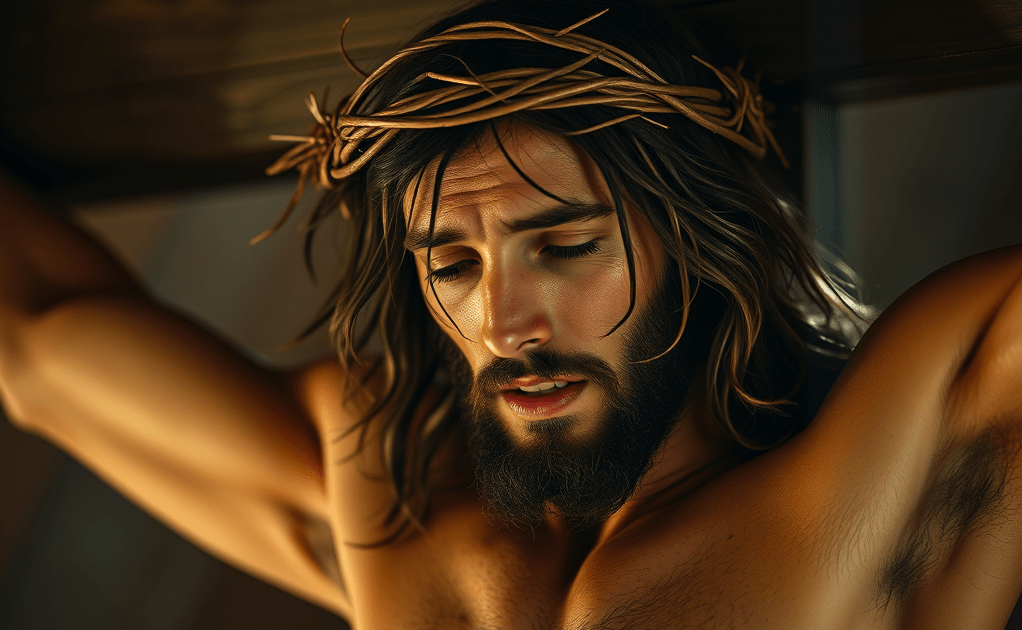
David also gave a graphic description of suffering on the cross. He said,

All my bones are out of joint. (Psalm 22:14a)

This disjointing of the bones is what often happened to people hanging on a cross.

David then said,

My heart has turned to wax; it has melted away within me. (Psalm 22:14b)

John records that when the soldiers pierced Jesus’ side, water and blood flowed out, which doctors today say is a sign that he had suffered heart failure.

David prophesied Jesus’ great thirst upon the cross, saying,

My tongue sticks to the roof of my mouth. (Psalm 22:15)

And he prophesied Jesus’ hands and feet being pierced. (Psalm 22:16).

More, a person hanging on a cross could probably see his ribs pressing against his flesh, thus David saying,

I can count all my bones. (Psalm 22:17)

And of course, David prophesied the casting of lots for Jesus’ clothing, saying,

They divide my garments among them and cast lots for my clothing. (Psalm 22:18)

All these pointed to Jesus as the Messiah, but the chief priests who knew the scripture, couldn’t see it.

John points to other scriptures, Psalm 34, Psalm 69, and Zechariah 12, all of which point to the cross.

And of course, Isaiah 53 describes even more.

Jesus being pierced for our sin and taking our punishment for us.

Being silent in front of his accusers.

Interceding for those who killed him.

Being originally assigned a grave with the wicked, but instead being buried in a rich man’s tomb.

And of course, being resurrected from the dead.

In short, again, this was no accident. It was planned and purposed by the Father for our salvation from the beginning of time.

So let us never take the cross for granted. Instead let us praise God with hearts full of thanksgiving for the price his Son paid for our salvation.
Categories
John John 19 Luke Luke 23 Mark Mark 15 Matthew Matthew 27

Paid in full

If there is one thing I hate to do, it’s pay taxes.

Every year, I have to go down to the tax office to declare my income, and then a month later, I collect my refund…only to have to give all of that refund back and more to pay my property taxes as well as my city and prefectural taxes.

Nowadays, I tend to pay these taxes all at once. We have the option to pay in installments, but it’s nice to get it all over with. And when I pay, my tax bill is stamped, to show that my tax debt is paid in full.

And that is exactly the picture Jesus invoked when saying his final words at the cross.

At around 12:00 p.m., the gospels tell us that it became dark, and that the sun did not shine its light.

I doubt that it was an eclipse because those last only a few minutes, and this darkness lasted 3 hours. But however God did it, a darkness fell on the land.

My guess is it was a picture of God placing all of our sin upon Jesus. That all the darkness in this world that comes from sin, was put on Jesus during that time.

Then at around 3 p.m. Jesus cried out,

My God, my God, why have you forsaken me? (Matthew 27:46)

At that moment, I believe that God the Father turned his face aside from Jesus because of the sin that had been placed upon him.

If so, it was the first time ever that the relationship between the two had ever been broken, and Jesus suffered what all of us deserve: separation from the Father.

Separation from he who is love. Separation from he who is joy. Separation from he who is life.

That’s what hell is. And so in that sense (and that sense alone), Jesus suffered hell. He took upon himself the punishment that we deserved.

And having suffered that, he looked up for the last time, and said,

“It is finished. Father, into your hands, I commit my spirit.” (Luke 23:46, John 19:30)

It is finished.

Those were the words that were often printed on the bill of those who paid their taxes in Jesus’ day. And they literally meant, “paid in full.”

And by Jesus’ death on the cross, he paid in full the debt we owed because of our sin.

What’s the result? We can have a new relationship with God.

God tore the curtain that hung between the Holy Place and the Most Holy Place. (Mark 15:38). And by doing so, he was telling us, “The barrier that stood between me and you is gone. You have now free access to me through my Son.”

We no longer have to stay at a distance from God as the Israelites once did. (Exodus 20:18-21)

We can draw near. So let us draw near.

As the writer of Hebrews exhorts us,

Therefore, brothers, since we have confidence to enter the Most Holy Place by the blood of Jesus, by a new and living way opened for us through the curtain, that is, his body, and since we have a great priest over the house of God, let us draw near to God with a sincere heart in full assurance of faith, having our hearts sprinkled to cleanse us from a guilty conscience and having our bodies washed with pure water. (Hebrews 10:19-22)

Categories
John John 19 Luke Luke 23 Mark Mark 15 Matthew Matthew 27

Railing at God, humbling ourselves before him

This is one of the most famous stories from the cross. Along with Jesus, two robbers were crucified by his side. And at first, both mocked him. In the ESV, it says,

One of the criminals who were hanged railed at him, saying, “Are you not the Christ? Save yourself and us!” (Luke 23:39)

Somehow, that word, “railed,” really strikes me. It makes me think about how many people rail at God when they face the consequences for their sin.

Here was this criminal who had done wrong and was being punished for it, but far from being repentant, it seems he felt that he was being wronged.

Perhaps he felt justified in the things that he had done, and so as he railed at Jesus, he said, “Are you really the Christ? Then save me from this! I don’t deserve this!”

Apparently, according to the other gospels, the second criminal joined in with the first in railing at Jesus, at least at first.

But perhaps as Jesus refused to answer, but instead only looked with pity upon his abusers, the second criminal started to quiet down.

He saw the dignity of Jesus in a situation where all dignity had seemingly been stripped away from him.

He saw the compassion, love, and forgiveness Jesus had for those who had crucified him.

And as he did, perhaps he remembered all the stories he had heard about Jesus. Perhaps, he had even gone to listen to Jesus at one time and seen him perform all those miracles.

As he considered all these things, perhaps he then looked at himself, and for the first time, admitted, “I was wrong. I made all these excuses for what I did. But ultimately, those were just excuses. I was wrong. I deserve this.”

And so after hearing again the railings of the man beside him, he said,

Don’t you fear God…since you are under the same sentence?

We are punished justly, for we are getting what our deeds deserve. But this man has done nothing wrong. (Luke 23:40-41)

Then he turned to Jesus, and pled with him,

Jesus, remember me when you come into your kingdom. (Luke 23:42)

I’m not sure, but perhaps for the first and only time on the cross, Jesus smiled. And he said,

I tell you the truth, today you will be with me in paradise. (Luke 23:43)

And in that moment, the man was saved. In death, he found life.

As I said, so many people are like the first man on the cross. They do wrong, but when they are caught in their sin and suffer for it, instead of admitting their wrong, they rail at God.

Sometimes, people wonder how God could allow eternal punishment.

I think part of it is because there is no repentance in hell. Rather, there is an eternal railing against God.

They rail that they were justified in their actions. And they rail that God would punish them for what they know deep in their heart is wrong.

And part of hell is the knowing they are wrong and are getting what they deserve but being too proud to admit it.

But for those who will only recognize their sin, humble themselves, and repent, as the second criminal did, there is forgiveness and there is life.

But that time is now. Because once you are dead, it is too late. As the apostle Paul wrote,

I tell you, now is the time of God’s favor, now is the day of salvation. (2 Corinthians 6:2)

How about you? Have you humbled yourself before Jesus? Have you received his salvation?

Categories
Luke Luke 23

Forgive them

Forgiveness is one of the most difficult things people struggle with. The reason is that the hurts we experience go straight to the depths of our hearts. And as deep as our wounds go, they can be very difficult to heal.

For a simple prick of the finger, healing is generally quick; for a deliberate knifing, healing takes much more time.

That’s what makes Jesus’ response to his enemies so remarkable. He said,

Father, forgive them, for they do not know what they are doing. (Luke 23:34)

Think about that for a minute.

Obviously, it’s easier to forgive someone who literally doesn’t know what they’re doing. They accidentally hurt you and when they find out, they’re quick to apologize. That kind of wound is relatively easy to forgive.

But what of the person who knows exactly what they’re doing. That type of person is much harder to forgive.

Which category do the Pharisees and chief priests fall into. Did they say, “Oh, Jesus, how in the world did you end up on that cross. My bad. Let me help you get off of there.”

No. From the very beginning, all their actions were quite deliberate.

They paid Judas to betray him. They got false witnesses to lie about him in the Sanhedrin. They then lied to Pilate and Herod about Jesus. They incited the crowd against him. And now with him on the cross, they ruthlessly mocked him.

How in the world could Jesus say, “They don’t know what they’re doing.”

They knew exactly what they were doing.

And yet they didn’t. They were blinded by their own jealousy. They were blinded by their own pride. They were blinded by their own sin. They were blinded by Satan himself.

Just as we all were at one time.

When people hurt you, no matter how deliberately, they do it because they are blind. They can’t see how their actions could be hurtful. Or perhaps they can’t see the value you have as a person in God’s eyes.

It’s also possible that they have their own hurts that they’ve never come to grips with, and those hurts cause them to lash out in ways that even they can’t understand sometimes.

I know of a man who really struggled with forgiving his father for all the physical and emotional abuse he had poured out on his family.

But the day came when God opened his eyes and he realized that his father had been abused too. That because of the hurt his father had experienced as a child, and his inability to deal with it, he grew up to be the man he had become.

And because he could finally understand his father, he suddenly felt compassion for him and was able to forgive.

That’s what we need to pray for when we’re struggling to forgive. That God would help us get our eyes off of ourselves and our hurts. That he would help us to understand the hurts and needs of those who have hurt us so that we can have compassion on them.

That’s what Jesus did. Jesus saw beyond his own hurt to the utter need of those who hated him. They never ever repented for what they did. But he was able to forgive.

Though God gives you understanding of those who hurt you, they may never change.

But as you start to understand them, you will change. You’ll start to focus on their hurts and needs instead of your own. And because of the compassion God puts in your heart for them, you will be able to forgive.

Is there someone you’re struggling to forgive.

Pray for understanding for why they act the way they do. And as he gives you that understanding, pray for them as Jesus did,

Father forgive them. They don’t know what they’re doing.

Categories
John John 19 Luke Luke 23 Mark Mark 15 Matthew Matthew 27

What has been written

The interaction between Pilate and the chief priests is very interesting. Pilate put up the “charge” against Jesus, calling him the “King of the Jews.”

The priests immediately went up to Pilate, asking him to change it to, “He claimed to be king of the Jews.” But Pilate simply replied, “What I have written, I have written.” (John 19:21-22)

It strikes me that many people take the same kind of attitude toward Jesus that the Jews did.

They don’t want to recognize Jesus as their king. They don’t want to admit that he’s God’s Son. They don’t want to admit he’s the only way of salvation.

So they complain to Christians saying, “He just claimed to be the king. He just claimed that he was God’s Son. He just claimed that he’s the only way. But don’t go telling us that he really is all these things. We don’t believe it.”

But unlike Pilate, we have a higher authority than ourselves to point to. And we simply have to say, “What God has written in his Word, he has written. You cannot change what he has said. Nor can you convince him to change his mind.

What he has said is fixed for all eternity. And all your unbelief will not change it.”

People won’t like to hear that. The chief priests certainly didn’t. But the question is not whether you like it or not. The question is whether it’s true.

And the question is whether you will bend your heart to that truth or attempt to bend the truth to what you want to believe.

But if you try to do the latter, it’s not the truth that will shatter, but you.

Jesus said of himself,

Have you never read in the Scriptures: ‘The stone (that is, Jesus) the builders (the chief priests and other religious leaders) rejected has become the capstone; the Lord has done this, and it is marvelous in our eyes’…

He who falls on this stone will be broken to pieces, but he on whom it falls will be crushed. (Matthew 21:42, 44)

The chief priests rejected Jesus, and as a result their whole world was shattered. Jerusalem was conquered, their temple destroyed, and worse, they will find themselves condemned before God on judgment day.

The same will happen to anyone who rejects Christ. What God has written is written.

The only question is, “What will you do with what he has said?”

Categories
Luke Luke 23

The heart of Jesus

If there is one thing that always astonishes me, it’s the heart of Jesus. And it is as he goes to his death, that we see the compassion that caused him go to the cross in the first place.

On his way up the hill, he saw the women weeping for him, and he said to them,

Daughters of Jerusalem, do not weep for me; weep for yourselves and for your children.

For the time will come when you will say, “Blessed are the barren women, the wombs that never bore and the breasts that never nursed!”

Then “they will say to the mountains, ‘Fall on us!’ and to the hills, ‘Cover us!'”

For if men do these things when the tree is green, what will happen when it is dry? (Luke 23:27-31)

Here Jesus looked beyond his circumstances to what would happen to the Jews because they had rejected him.

He was basically telling them, “If the Romans are willing to do such things to me, though I am full of the life of God, how much worse will they treat those who are withered spiritually?

“The days will come when you will wish for death, and envy those without children because of what they do to you.”

And that’s what happened when Rome destroyed Jerusalem in some 35 to 40 years later.

The point is, however, that Jesus didn’t want that, even for those who hated him. He longed for them to be saved. He longs for us to be saved. And that’s why he went to the cross.

Jesus died because he looked beyond himself to us and our needs.

The old hymn captures the wonder I feel at such a thought.

And can it be that I should gain
An interest in the Savior’s blood?

Died He for me, who caused His pain—
For me, who Him to death pursued?

Amazing love! How can it be,
That Thou, my God, shouldst die for me?

Amazing love! How can it be,
That Thou, my God, shouldst die for me?
–Wesley

Categories
John John 19 Luke Luke 23 Mark Mark 15 Matthew Matthew 27

If we were forced to bear the cross Christ bore

We know very little of this man of Cyrene, this Simon. It is conjectured that he is the father of the Rufus mentioned in Romans 16:13, the only other Rufus mentioned in the Bible.

In all probability, he was a pilgrim from Northern Africa, a Jew who had come to Jerusalem to celebrate the Passover, perhaps for the first time ever.

But when he arrived, he got more than he expected. He saw the true Passover lamb sacrificed for him. (I Corinthians 5:7).

For a time, though, Simon had to bear the cross Jesus was eventually crucified on.

As Jesus was going up the hill, the physical strain, the loss of blood, the scourging, the beating he had taken at the hands of the soldiers, and the emotional strain, of being betrayed and abandoned by those he loved most dearly, became too much and he fell under the weight of the cross. He could no longer bear it.

And so Simon had to carry it for him.

And it makes me think. What would have happened if Jesus had said to us at Calvary, “Enough. I can’t bear this anymore. You carry the cross. You die on that cross. You deserve it, after all, not me. I’ve never sinned. You have.”

In a sense, Simon had to experience that, if only for a short time. A cross that he should have been carrying anyway because of his sin, was put on him because Jesus simply couldn’t do it anymore.

Did he realize later, “I was doing Jesus no favor by taking up that cross for him. I was carrying the cross I deserved anyway.

It was he who was doing me the favor by trying to carry my cross up to Calvary. It was he who helped me, he who saved me by dying on that cross when I should have been the one hung there.

But what if he had chosen not to? What if he had simply felt like he could not bear it any longer? Where would I be now?”

The answer? Hell. Because that’s what we all deserve. Hell.

But Jesus did bear the cross. He loved us so much that he died there, and by doing so he took the punishment we deserved upon himself.

And now, because of what he did, our sins can be forgiven, and we can find life as we were meant to have it. A life in relationship with the God who loves us more than any other.

So let us never take the cross for granted. And when we look at it, may we look to the One who died there with hearts full of gratitude.

Jesus Christ,
Praise your name,
Lord, I sing
Without shame.

You bore the cross.
So much love.
All my life, all I need is you.
–James Gabriel

Categories
Luke Luke 23

Those to whom Jesus has nothing to say

We now see in this passage Herod’s response to Jesus. Perhaps, though, it would be better to call it Jesus’ response to Herod.

This was the same Herod that had beheaded John the Baptist, and had wondered if Jesus was John raised from the dead. (Matthew 14:1-12; Luke 9:7-9)

When Herod had first heard of Jesus, he had tried to see him, and failed. If the Pharisees weren’t lying, it’s also possible that he had even tried to take Jesus by force, but failed. (Luke 13:31-33)

Now at long last, Herod had Jesus before him. But though he asked him many questions and tried to get him to perform some miracles, Jesus said nothing.

Why not? I think Jesus knew that no matter what he said or what he did, Herod would never believe.

Herod had had John before him many times after he had imprisoned him. But though he had been intrigued by John, and “liked to listen to him,” he refused to repent. (Mark 6:20)

He treated Jesus the same way. As a curiosity. As a person of perhaps some interest. As a person who could perhaps provide some entertainment.

But he certainly didn’t look at Jesus as someone to obey. And he most certainly didn’t see him as someone he should take seriously. And so Jesus said nothing.

The warning for us is this: If we harden our hearts to him, Jesus will have nothing to say to us.

Jesus is no genie to perform for us. Nor is he one to be treated as a curiosity that we can take lightly.

He is God himself. He is the King. He is the Lord.

How about you? How do you see Jesus?

Categories
John John 18 John 19 Luke Luke 23 Mark Mark 15 Matthew Matthew 27

When we have nothing to stand on

I will start by saying that it’s a bit hard to harmonize these passages. Here’s how I see it, but I encourage you to look at it yourself, and come to your own conclusions.

  • The priests and council members bring Jesus in front of Pilate with their initial accusations. (Luke 23:1-2, John 18:29-31)
  • Pilate then talks to Jesus the first time. (John 18:33-38 gives us the most details of this conversation while the other gospels give the briefest of summaries).
  • Pilate proclaims Jesus innocent but after further accusations, decides to send him to Herod. (Mark 15:3-5; Luke 23:4-12)
  • Herod returns Jesus, and Pilate proclaims him innocent again. (Luke 23:13-17)
  • Pilate proposes releasing Jesus or Barabbas, and the crowd demands Barabbas. (All the gospels.)
  • Pilate releases Barabbas, but then proposes punishing Jesus instead of crucifying him. Ultimately, he has Jesus flogged. (Mark 15:16-20; Luke 23:21; John 19:1-7)
  • Pilate makes one last appeal, but ends up giving Jesus over to be crucified. (John 19:7-14)

With that background, over the next few days, I think I’ll go over the main characters in these events.

Today, I want to look at Pilate. You can read about Pilate in history, but I want to stay with what we see here. And what I see is someone who had nothing to stand on when it came to how he made decisions and how he lived his life.

When Pilate first called Jesus in for a private interrogation, his main concern was whether Jesus was truly an insurrectionist or not. So he asked point blank whether Jesus was a king or not.

When he found out that Jesus did claim to be a king, but that this kingdom was “not of this world,” and was certainly no threat to the Roman empire, that was all that mattered to Pilate. (John 18:36-37).

But Jesus would not let things rest there. Instead he challenged Pilate, by saying,

In fact, for this reason I was born, and for this I came into the world, to testify to the truth. Everyone on the side of truth listens to me. (John 18:37b)

Basically, Jesus was asking Pilate, “What about you? Are you on the side of truth? Are you a lover of truth? Are you willing to stand on truth? If you are, then you must listen to me and believe it.”

It’s the challenge that faces all of us. What do we base our lives on? Do we base it on truth? Do we believe that Jesus himself is truth?

Pilate faced that question in that moment. His response?

What is truth? (John 18:38)

I really wish that we could know the tone behind his words. Did he say this with the implication of, “Who do you think you are? You think you know better than everyone else?”

Or did he say it with a voice dripping with irony? “Truth? There is no truth. Truth is what people in power say it is.”

Or did he say it with despair. “Is there really any truth out there? Is it really possible to find?”

Whatever his feeling, his ultimate response was to reject the idea of absolute truth. Specifically he rejected Jesus as the source of truth. The result?

He had no foundation by which to make his decisions. Instead, he was tossed and blown by the winds of the words of others and the pressures they put upon him.

The pressure of facing a riot. (Matthew 27:24)

The pressure of being reported to Caesar. (John 19:12)

The pressure, ultimately, of his own fears. And because of this, he made a decision he knew was wrong.

The same will happen to us. If we refuse to make truth the foundation of our lives, if we refuse to make Jesus himself the foundation of our lives, then we will be blown and tossed by the opinions of others and by our own fears. And we’ll end up making decisions we know are wrong.

How about you? What do you rest your decisions on? What do you rest your life on?

Do you seek God’s counsel? And do you have the faith to believe that what he has said is true?

James tells us,

If any of you lacks wisdom, he should ask God, who gives generously to all without finding fault, and it will be given to him.

But when he asks, he must believe and not doubt, because he who doubts is like a wave of the sea, blown and tossed by the wind.

That man should not think he will receive anything from the Lord; he is a double-minded man, unstable in all he does. (James 1:5-8)