Categories
Zechariah

The bringer of victory, life, and light

As we come to the conclusion of Zechariah, we see the second coming of Christ and the time of the Millennium.

It starts once again with the nations rising up against Jerusalem to crush it, and in so doing, half of its inhabitants will be sent into exile.

But then, Jesus will return, and as he sets foot on the Mount of Olives, it will split in two.

The lights will dwindle, but God himself will bring light to the earth, so that even at night, it will be light. As it says in Revelation,

The city does not need the sun or the moon to shine on it, for the glory of God gives it light, and the Lamb is its lamp. (Revelation 21:23)

Not only that, but from Jerusalem will flow living water. This is probably the same thing that was written about in Ezekiel 47:3–11 which we have looked at earlier.

God will then fight for Israel, casting down its enemies through plagues.

I kind of wonder from verse 12 if God will turn the nations’ nuclear weapons against themselves. It certainly sounds like some kind of nuclear disaster, anyway. But this is pure speculation on my part.

But anyway, from that point on, people from all over the earth will acknowledge him as King, rejoicing in his goodness.

The Feast of Tabernacles was one of rejoicing out of gratefulness towards God. Rejoicing in how God brought his people out of slavery to Egypt, and gratefulness for his presence with them as he kept them safe through their time in the desert.

We too, will rejoice at how God brought us out of slavery to Satan’s kingdom, and brought us through the trials of life until the day he finally makes all things new.

For all those who refuse to turn to God, however, they will only find judgment.

What can we get from all this?

God is the bringer of victory. Though Satan fights against God and us, God will triumph.

He actually has already triumphed. He triumphed when Jesus died on the cross, but Satan just doesn’t want to admit it.

But whatever trials we may go through, we know that we have victory. And not only will we have victory over our trials, but we’ll have victory over sin and death itself.

As Paul said,

But thanks be to God! He gives us the victory through our Lord Jesus Christ. (1 Corinthians 15:57)

God is the giver of life. Just as the water will flow out from Jerusalem and make even the Dead Sea fresh and alive, God’s Spirit will flow into our lives and give us life.

But for all those who are apart from God, they will be cut off from life, and find only misery.

Finally, God is the giver of light. When all is dark, and we have no hope, he gives us light to see and restores our hope once more. When we can’t see our way and which path we should take, he shines the light on the right path.

Lord, thank you that you give us victory, life, and light.

Let us cling to you every day, and as we do, make us holy unto you. May we be pure before you, set apart for your purposes as we live our lives each day. In Jesus’ name, amen.

Categories
Zechariah

Purified

In this passage, it continues talking about the repentance of the Jews. That during the last days, by God’s grace and the blood of the one they had pierced two thousand years ago, they will be purified and cleansed from their sins.

All idolatry and all the false prophets will be wiped out from the land, and it will truly be a land holy to the Lord.

But before that could happen, the Good Shepherd had to be struck, and the flock scattered.

That’s exactly what happened to Jesus. He was arrested, and all his followers fled. He was mocked, whipped, beaten, and ultimately crucified.

And because the Jews had rejected their Savior, God’s hand fell against them, and their nation was destroyed.

Even so, God’s grace continues to shine through. Though many Jews will perish, there will be a remnant of those who will follow the Messiah, and God says of them,

This third I will put into the fire;
I will refine them like silver
and test them like gold.

They will call on my name
and I will answer them;
I will say, ‘They are my people,’
and they will say, ‘The Lord is our God.’ (Zechariah 13:9)

God never does promise that we won’t go through times of trial and trouble. In fact, Jesus warned us, “In this world you will have trouble.” (John 16:33)

But God will use them to refine us and make us into the pure ones he created us to be. And when we call on him, he will answer.

Categories
Zechariah

That we may see

In this passage, we see a glimpse of Israel’s future.

Sometimes people think that God has abandoned Israel, and that God’s promises to them have all been transferred to the church. But that’s not true. As Paul said concerning Israel,

As far as election is concerned, they (the Jews) are loved on account of the patriarchs, for God’s gifts and his call are irrevocable. (Romans 11:28–29)

And so in this passage we see how the blinders will be taken off their eyes that they might see again.

It starts with God’s protection over the Jews in the final days when the nations come against Israel to destroy it. But God says that when that happens, the nations will be the ones hurt and sent reeling. (Zechariah 12:2–3)

That will begin the taking off of the blinders, as all Israel will realize that it is God who is protecting them. The day will come when they will say,

The people of Jerusalem are strong, because the Lord Almighty is their God. (Zechariah 12:5)

And as they continue to see God’s salvation in their lives, they will make another realization. The Messiah that they have been longing for has already come. That two thousand years ago, they crucified him.

And I will pour out on the house of David and the inhabitants of Jerusalem a spirit of grace and supplication.

They will look on me, the one they have pierced, and they will mourn for him as one mourns for an only child, and grieve bitterly for him as one grieves for a firstborn son. (Zechariah 12:10)

At that time, Israel will repent and recognize Jesus as the Messiah, and all Israel shall be saved. (Romans 11:26)

As I look at this, I marvel at the grace of God. Though Israel will not be looking for him, or at least will be looking for him in all the wrong directions, nevertheless they will find him.

Not because they deserve it, nor because they are better than anyone else, but because of God’s love and mercy.

It’s the same with us. He pours out his Spirit of grace and mercy on us that we may see and repent. And when we see Jesus as our Messiah, our Savior, then we like the Jews will find salvation.

As the old song goes,

Amazing grace
How sweet the sound
That saved a wretch like me.

I once was lost,
But now I’m found.
Was blind, but now I see.

Categories
Zechariah

When we reject the Savior

God loves word pictures. Jesus showed this through his parables. You also see this throughout the prophets.

And in this chapter, we see yet another example of this.

It starts with a picture of the devastation of Israel represented by the falling of the forests and trees.

From the forest of Lebanon to the oaks of Bashan to the thickets of the Jordan, all would fall and be ruined.

(The forest of Lebanon is linked by rabbis with the second temple that was built in Ezra’s time as it was built of cedars from Lebanon. Bashan was a land east of the Jordan, which had been taken over by the Israelites after the king of that land, Og, had attacked them.)

Why? The answer is given in the rest of the chapter. The people had rejected their Messiah. Zechariah apparently took on the role of a shepherd to illustrate all of this to the people.

God told him to take charge of a flock marked for slaughter, which represented Israel. They were marked for judgment because they had rejected God.

This judgment is probably seen in the intertestamental period all the way down through the Roman empire.

And then in the midst of this, appears the Messiah, as represented by Zechariah. He comes wielding two staffs, “Favor” referring to God’s favor on the people, and “Union” representing the unity of Israel as a nation.

He gets rid of the bad shepherds that had hurt the flock (perhaps the false prophets, priests, and wicked kings that Israel had had), and looks after the flock, especially the oppressed.

But his flock detests him, and so he lets them go their own way. He takes away his favor from them, and the result is the destruction of the nation under Titus in A.D. 70.

In pay for his services, he is paid thirty pieces of silver, the price for a slave, and considered a trifling amount. (When it says “a handsome price,” it’s said sarcastically).

This was then thrown to the potter at the house of the Lord.

All of this, of course, points to the betrayal of Jesus and how he was sold for thirty pieces of silver, and how that silver was used to buy a potter’s field that was used for a burial ground.

The unity of the nation was thus shattered and not restored until the twentieth century. And the time will come, when another false shepherd will arise who cares nothing for the flock.

This probably refers to Antichrist, who will eventually be cast down and punished for his treatment of Israel.

In this passage, we see not only the results of Israel’s rejection of the Messiah, our Savior, but what happens when we do so.

God reached down to us through Jesus to save us from Satan’s oppression. But if we reject him, he will leave us to the consequences of our sin, and judgment will come.

We will not know his favor, nor the strength that comes from the unity of his people. Instead, there will only be destruction and death.

The writer of Hebrews puts it this way,

If we deliberately keep on sinning after we have received the knowledge of the truth, no sacrifice for sins is left, but only a fearful expectation of judgment and of raging fire that will consume the enemies of God.

Anyone who rejected the law of Moses died without mercy on the testimony of two or three witnesses.

How much more severely do you think someone deserves to be punished who has trampled the Son of God underfoot, who has treated as an unholy thing the blood of the covenant that sanctified them, and who has insulted the Spirit of grace?

For we know him who said, “It is mine to avenge; I will repay,” and again, “The Lord will judge his people.”

It is a dreadful thing to fall into the hands of the living God. (Hebrews 10:26–31)

Categories
Zechariah

All of God

In this passage, Zechariah talks further about the salvation of Israel. But the thing that I notice here more than anything else are these words…

It is the Lord who…

The Lord Almighty will…

I (the Lord) will…

In his name…

In other words, all that we have is from God and God alone.

It is from God that we receive the spring rains and food from the earth. (Zechariah 10:1)

It is the Lord who will punish those who would lead his people astray, and it is the Lord who will take care of his flock. (Zechariah 10:3)

It is the Lord who will strengthen, save, and restore us. It is the Lord who will answer us when we call. (Zechariah 10:6)

It is the Lord who will call us, gather us to himself, and redeem us. (Zechariah 10:8)

And it is in his name that we will live securely. (Zechariah 10:12)

Why does he do all these things for us? Is it because we’re so deserving of it all? No, it is all because of his grace.

Everything that we have, everything that we are, it is all of God and all of grace.

Categories
Zechariah

The Prince of Peace

In this passage, we see more prophecies of Jesus, some of which were fulfilled in his first coming, while others are yet to come.

It says in verse 9,

Rejoice greatly, Daughter Zion! Shout, Daughter Jerusalem!

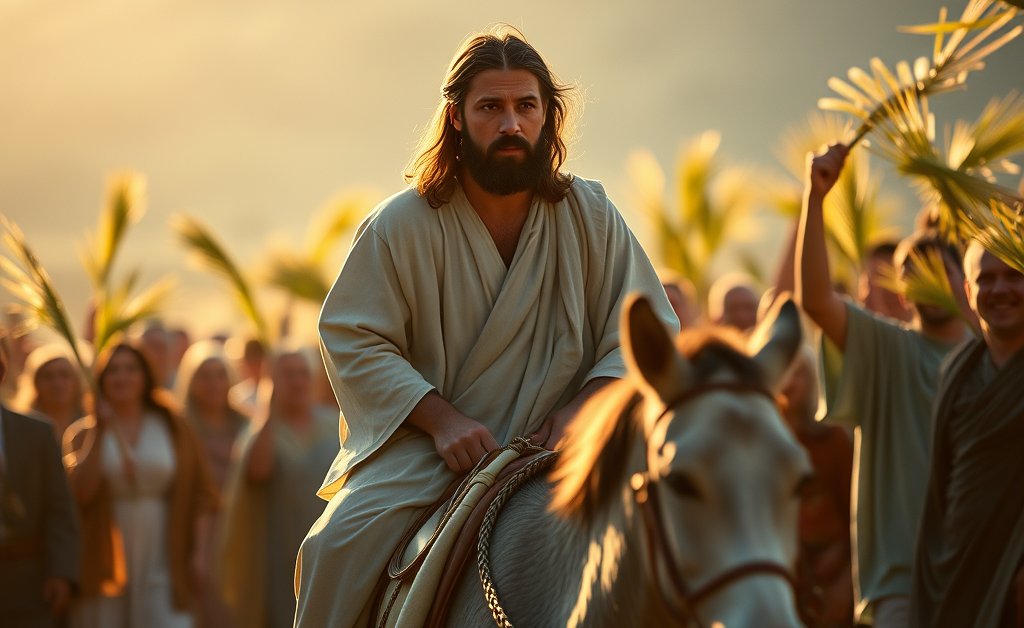
See, your king comes to you, righteous and victorious, lowly and riding on a donkey, on a colt, the foal of a donkey. (Zechariah 9:9)

This was fulfilled, of course, when Jesus came into Jerusalem shortly before he was crucified.

Why a donkey, and not a horse? Basically, in those days, a king rode horses during times of war, while they would ride donkeys in times of peace.

Jesus came into Jerusalem not as a conquering king, but as the Prince of Peace.

And when Jesus comes again, he will come in defense of his people, and bring war to a final end.

In verse 10, it says,

I will take away the chariots from Ephraim and the warhorses from Jerusalem, and the battle bow will be broken.

He will proclaim peace to the nations. His rule will extend from sea to sea and from the River to the ends of the earth. (Zechariah 9:10)

To those who are held captive and in despair, he will bring freedom and hope. Why?

Because of the blood of my covenant with you. (Zechariah 9:11)

This is probably pointing back to the covenant made under Moses, which is all the Jews in Zechariah’s time knew.

But it’s worth pointing out that the sacrifices under the old covenant were shadows of the new covenant made in Christ’s blood.

And it is through Christ’s blood that all of us who were held captive in Satan’s kingdom were set free and given hope.

And so God says of his people Israel, but also of us,

The Lord their God will save his people on that day as a shepherd saves his flock. They will sparkle in his land like jewels in a crown.

How attractive and beautiful they will be! Grain will make the young men thrive, and new wine the young women. (Zechariah 9:16–17)

Categories
Zechariah

The God who watches over all

This passage starts with the people’s eyes upon the Lord, looking to see what he would do.

And here we see how God would bring Alexander the Great to bring judgment upon Syria, Tyre and Sidon, and Philistia.

The prophecies here detail the route Alexander took in his campaigns. He started with Hadrach (probably a place in Syria) and Damascus. Then he conquered Tyre and Sidon.

Tyre had been a place that even the Assyrians and Babylonians could not conquer, despite sieges of five and thirteen years respectively. But Alexander managed to conquer it within seven months.

Alexander then went on to conquer the Philistines (Gaza, Ashkelon, Ekron, and Ashdod were all cities there).

He ended the Philistine monarchy, and depopulated the cities before bringing in other people to live there in the Philistines’ place.

But then it says in verse 8,

But I will encamp at my temple to guard it against marauding forces.

Never again will an oppressor overrun my people, for now I am keeping watch. (Zechariah 9:8)

In the midst of Alexander’s campaigns, Jerusalem was spared.

Josephus tells the account of how God appeared to the high priest in a dream and told him not to fear but to open the city gates and to go meet Alexander when he came.

The high priest went out with purple and gold clothing, while the rest of the priests went out in white linen.

When they did, Alexander approached the high priest, and kissed the name of God that was on the golden plate that was on the priest’s headpiece.

When asked why he did so, he said that he had had a dream in which he had seen a person wearing the same clothing bidding him to cross Asia and conquer the Persian empire.

Alexander then allowed the Jews to keep living according to their own laws, and also made them exempt from taxes every seven years.

What can we get from this? God is truly the one who watches over all and is in control.

To those who defy him will eventually come judgment. But to those who humble themselves before him, he will protect them.

He did so for the Jews and he will do so for us. As David wrote,

The angel of the Lord encamps around those who fear him, and he delivers them.

Taste and see that the Lord is good; blessed is the one who takes refuge in him. (Psalm 34:7–8)

Categories
Zechariah

Saved to be a blessing

The book of Zechariah is full of warnings and admonitions. But as we have seen, it also has words of encouragement as well. And in this passage we see a bit of both.

God starts with words of encouragement, telling the people that Jerusalem would indeed be restored and that it would become a place of joy and safety for those who lived there.

More, he told them that those who had been scattered would be brought back, and that they would be his people and he would be their God once again.

For those who had a hard time imagining it, he reminded them that he is the God that can do all things, saying,

It may seem marvelous to the remnant of this people at that time, but will it seem marvelous to me? (Zechariah 8:6)

And so he charged the people,

Let your hands be strong so that the temple may be built. (Zechariah 8:9)

God tells us the same. That through his power, we have been saved. And now, we are to take courage, even in the face of opposition, and to become the temple that God intended us to be, holy and set apart for his use as he dwells within us.

But then he said,

Just as you, Judah and Israel, have been a curse among the nations, so I will save you, and you will be a blessing. (Zechariah 8:13)

Before we were saved, our lives were cursed by sins, and we cursed others by the sins we committed against them. But God tells us that now that we have been saved, we will become a blessing to them instead.

That’s the same promise that God gave to Abraham. That he would bless him and make him a blessing to those around.

God wants the same for us. So he tells us,

These are the things you are to do: Speak the truth to each other, and render true and sound judgment in your courts; do not plot evil against each other, and do not love to swear falsely.

I hate all this, declares the Lord. (Zechariah 8:16–17)

In short, he calls us to love our neighbors as ourselves. And as we do, people will be drawn to us and to him.

Zechariah closes the chapter by saying,

Many peoples and powerful nations will come to Jerusalem to seek the Lord Almighty and to entreat him.

This is what the Lord Almighty says: In those days ten people from all languages and nations will take firm hold of one Jew by the hem of his robe and say, ‘Let us go with you, because we have heard that God is with you.’ (Zechariah 8:22–23)

One day, people will say that of the Jews.

But may the same be said of us, as we live our lives each day.

Categories
Zechariah

False piety

Many people criticize Christians for hypocrisy, warranted or not. But to God, it is a serious issue.

In this passage, we see the returnees who had been exiled to Babylon coming before Zechariah and asking if they should continue fasting in the fifth and seventh months as they and their parents had done for the previous seventy years.

But God replied to Zechariah,

Ask all the people of the land and the priests, “When you fasted and mourned in the fifth and seventh months for the past seventy years, was it really for me that you fasted?

And when you were eating and drinking, were you not just feasting for yourselves?” (Zechariah 7:5–6)

In other words, “You did these religious rituals, but it meant nothing because it didn’t come from your heart. It was just a show.”

The word “hypocrite” originally meant a “stage actor.” And that’s what these exiles were. They pretended to be pious, but in reality, they were not.

Then God reminded them of what he had commanded their forefathers before the exile.

This is what the Lord Almighty said:

‘Administer true justice; show mercy and compassion to one another. Do not oppress the widow or the fatherless, the foreigner or the poor. Do not plot evil against each other.’

But they refused to pay attention. (Zechariah 7:9–11)

And God warned them that it was because they had hardened their hearts that they had been sent into exile in the first place.

‘When I called, they did not listen; so when they called, I would not listen,’ says the Lord Almighty. (Zechariah 7:13)

What do we take from all of this?

God isn’t impressed with our pious religious rituals. He’s more concerned with our daily lives. How do we treat others? Do we show mercy and compassion to others? And are we concerned with true justice?

I was watching a movie today, Amazing Grace, about William Wilberforce’s efforts to get the slave trade banned in Great Britain.

As I think of Wilberforce’s life, I think that’s the kind of thing God wants from all of us. Wilberforce had compassion on those who were being shipped and dying as slaves, and worked hard for its abolishment.

We may not have the same kind of influence on a country-wide scale as Wilberforce did. But we do have influence with every single person that we touch. At home. At work. In our neighborhoods.

Do people see the compassion and mercy of Christ in our lives?

That’s what God wants from us. And that’s what’s ultimately going to change this world: the body of Christ showing his love and compassion to all we come in contact with.

Let us not be hypocrites who merely go to church, read the Bible, and pray.

Let us be people who are filled with God’s compassion and mercy. And let’s make a difference in this world that God has put us in.

Categories
Zechariah

He who will come again

One of my favorite Easter songs is “Rise Again,” by Dallas Holm. In the last verse of the song, it says,

Go ahead
Say I’m dead and gone.
But you will see that you were wrong.

Go ahead,
Try to hide the Son.
But all will see that I’m the one.

’Cause I’ll come again.
Ain’t no power on earth can keep me back.
’Cause I’ll come again.
Come to take my people back.

In this passage, we see something of Christ’s return.

In verses 1–8, we see the judgment that will come upon the earth and its kingdoms.

If we compare this passage to Revelation 6, we see that the white horses represent war; the red horses, violence and bloodshed; the black horses, famine and death.

The dappled horses probably correspond to the pale horses of Revelation, perhaps symbolizing death by plagues.

But terrible as these things are, God is in control.

Until now, believe it or not, this judgment has actually been held in check by the hand of God.

But the time will come when he fully releases it upon all the earth and we’ll experience a time of trouble beyond what we’ve ever known.

But after all this, Jesus will come again, and he is represented here by someone of the same name, Joshua (which as I’ve mentioned before is the Hebrew version of the Greek name Jesus).

Joshua, as we’ve seen, was the high priest at the time. But Zechariah was told to make a crown for him and to put it on his head. And as he did, he was to make a prophecy of the one he symbolized, the coming Messiah.

Unlike Joshua, who was merely a priest, and unlike Zerubbabel who was merely a governor (not even a king, though he was of royal blood), one was coming who would be both king and high priest.

Zechariah said of him,

It is he who will build the temple of the Lord, and he will be clothed with majesty and will sit and rule on his throne. And he will be a priest on his throne.

And there will be harmony between the two. (Zechariah 6:13)

The temple mentioned here is probably the temple written about in Ezekiel 40–43, not the one Joshua and Zerubbabel were building. And Zechariah says that at the time this new temple is built, Jesus will be the perfect king and priest.

What do we take from all this? Hope.

We look at the world around us and see all the trouble surrounding us. We look at our political leaders, and we see people that cannot be fully trusted. The words “honest politician” are seen as an oxymoron.

Ministers of Christ don’t always have the greatest reputations either. Many are often scoffed at with all the scandals that we have seen in the church, and people often look for the first sign of hypocrisy in them.

But when Jesus comes, he will reign in righteousness, and his holiness will be beyond reproach. Through him, we will all see what the Father is truly like.

So let us not get discouraged by all the wars, disease, famines, and natural disasters that we see. God is in control.

And let us not be disheartened by the corrupt political and spiritual leaders that we see either. Jesus is coming back.

So let us focus on him, rather than all these other things. If we focus on these other things, it’s easy to lose hope. But when we focus on him, our hope can never be taken from us.

Categories
Zechariah

The purging of all evil

Happy Easter for those of you across the international date line. I celebrated Easter yesterday in what turned out to be a very long (but great) day, so I didn’t get around to doing this blog.

Anyway, the visions kept coming to Zechariah, and this one concerns the purging of evil from Israel.

In the first vision, Zechariah saw a flying scroll that on one side listed the curses for stealing, and on the other listed the curses for swearing falsely.

Although it lists only two of the ten commandments God had given Moses, those two commandments are probably representative of all the commandments. For as James put it,

For whoever keeps the whole law and yet stumbles at just one point is guilty of breaking all of it. (James 2:10)

Perhaps these two sins were particularly representative of the Israelites of that time. Or perhaps, it had a broader meaning of hurting your neighbor (stealing) and despising the holiness of God (using his name to make false oaths).

Two things to note from this vision. First, because of the size of the scroll, there was no excuse for anyone not to know judgment was coming. Anyone could easily read it.

Second, judgment is certain. God said,

I will send [the curse] out, and it will enter the house of the thief and the house of anyone who swears falsely by my name.

It will remain in that house and destroy it completely, both its timbers and its stones. (Zechariah 5:4)

In the second vision, God shows Zechariah how he would purge all evil from the land.

Zechariah saw a basket that represented evil in the land. And within it, we see the source of the wickedness (represented by a woman) trying to rise out, only to be pushed back in by the angel.

Then two women carried it out of Israel to bring wickedness to a place where it would be more welcome, the land of Babylonia.

What can we get from all of this? First, the day is coming when evil will be dealt with. Satan will fight God to the bitter end, but no matter how hard he fights, he will be overcome.

Second, let us purge ourselves from the evil that is within us. God has made it crystal clear how he feels about sin, and that judgment is coming because of it. We have no excuse for not knowing.

So as Paul said,

Let us purify ourselves from everything that contaminates body and spirit, perfecting holiness out of reverence for God. (2 Corinthians 7:1)

There is a balance in this of course. We do not purify ourselves by our own efforts alone. In our own strength it would be impossible.

But God does give us the strength and ability to live holy lives for him (2 Peter 1:3–4).

And as he carried away evil from Israel in Zechariah’s vision, so he will carry evil from our lives as we follow him. This is the process called “sanctification.”

As Paul also wrote,

May God himself, the God of peace, sanctify you through and through.

May your whole spirit, soul and body be kept blameless at the coming of our Lord Jesus Christ.

The one who calls you is faithful, and he will do it. (1 Thessalonians 5:23–24)

Categories
Zechariah

Filled to do His work, in his power

The more I’m reading Zechariah, the more I’m starting to love it. This is another great passage that’s rich in meaning.

The temple was still under construction at this time, and the people were still facing opposition.

It was uncertain whether Darius would continue to allow the rebuilding project, and perhaps Zerubbabel, the governor of Judah at that time, was growing discouraged.

But at that time, God gave Zechariah a vision of a golden lampstand, like that of those found in the temple.

But while the lampstands in the temple constantly needed to be refilled by the high priest, these lampstands were filled by two olive branches.

And then the angel gave Zechariah this message:

This is the word of the Lord to Zerubbabel: “Not by might nor by power, but by my Spirit,” says the Lord Almighty.

“What are you, mighty mountain?

Before Zerubbabel you will become level ground. Then he will bring out the capstone to shouts of ‘God bless it! God bless it!’”

Then the word of the Lord came to me: “The hands of Zerubbabel have laid the foundation of this temple; his hands will also complete it. Then you will know that the Lord Almighty has sent me to you.” (Zechariah 4:6–9)

In other words, God was saying, “Don’t worry. You’re not going to complete this project because of your own strength or by the power of those who support you. Instead this project will be done by my Spirit working in you.

And though you may face giant obstacles, they will become level before you. Thus, when you bring out the capstone to this temple, you will know that it was by my grace that it happened.”

The NASB puts verse 7 this way,

He will bring forth the top stone with shouts of ‘Grace, grace to it!’ (Zechariah 4:7)

To those who were discouraged by the slow start, and by how pale this temple seemed in comparison to the one built by Solomon, God said,

Who dares despise the day of small things, since the seven eyes of the Lord that range throughout the earth will rejoice when they see the chosen capstone in the hand of Zerubbabel? (Zechariah 4:10)

In other words, “What you have done, and what you are doing may seem small and insignificant. But don’t despise small beginnings.

And don’t despise the things that I have called you to do, no matter how small they may seem. For I rejoice when my people do my work, and you will be rewarded.”

Zechariah then closes with an explanation of the lamp and the two olive trees at the beginning of the vision.

When he asked about them, and particularly the two olive branches beside the two gold pipes pouring out golden oil, the angel replied,

These are the two who are anointed to serve the Lord of all the earth. (Zechariah 4:14)

This is in reference to Joshua the high priest and Zerubbabel, two men that God had chosen to serve him and to complete the project of the temple he had given them.

But to me, the most significant thing is this: Oil is often used as a symbol of God’s Spirit. And here we see two men of God whom the Spirit filled and from whom his Spirit poured out to do his work.

In the same way, God fills us up with his Spirit by his grace. And through us, his Spirit pours out to do his work: to touch the lives of the people around us and to make a difference in this world.

As we do, God’s will will be accomplished not by our own might and power, but by his Spirit flowing through us.

So let us do his work, not despising the day of small things. And through his Spirit constantly pouring in us and through us, we will make a difference in this world.

Categories
Zechariah

Free from accusation

This is probably one of my favorite passages in the entire Old Testament, basically because of how rich in meaning it is for us who are Christians.

In this passage, Joshua, the high priest was standing before the Lord, and Satan was hurling accusations against him.

What’s more, they were probably true accusations, for Joshua was standing before the Lord with clothes stained with sin.

But at that point, the Lord said,

The Lord rebuke you, Satan! The Lord, who has chosen Jerusalem, rebuke you!

Is not this man a burning stick snatched from the fire? (Zechariah 3:2)

Very interesting to me that it says, “The Lord said, ‘The Lord rebuke you, Satan.’” Could it be that this messenger (angel actually just means “messenger”) was Jesus himself?

At any rate, the Lord rebukes Satan, saying, “This is a man I’ve already saved. How dare you accuse him!”

The messenger then tells those around to take off the filthy clothes from Joshua, and he said to Joshua,

See, I have taken away your sin, and I will put fine garments on you. (Zechariah 3:4)

He then charged Joshua,

If you will walk in My ways and if you will perform My service, then you will also govern My house and also have charge of My courts, and I will grant you free access among these who are standing here. (Zechariah 3:7, NASB)

The interesting thing here is that He first cleansed Joshua, and then He charged him to follow after and serve Him.

God promised that if he did, Joshua would continue as the high priest for His people. Not only that, he would have free access before God.

One final thing. It’s ironic, but then is it really ironic for the God who knows and plans everything?

He tells Joshua of another Joshua that would come. (Jesus is simply the Greek form of the Hebrew name Joshua).

He said that this “Joshua” would come in all the wisdom of God (the seven eyes on the stone) and in a single day, he would wipe out sin forever by his death on the cross.

And when Jesus comes back and reigns, we shall finally find true peace. (Zechariah 3:8–10)

What can we get from all of this? We all, like Joshua, stood before God, stained with sin. Satan stood against us hurling accusations against us.

But when we turned to Christ, Jesus became our advocate, defending us, and rebuking Satan.

He then took off our filthy garments and clothed us with righteousness, not because of anything we had done, but because of what he had done on the cross.

And now, having already been cleansed, we are urged to follow him and serve him as his priests. As we do, we find that we have free access to Him along with all the saints.

Paul put it this way,

Once you were alienated from God and were enemies in your minds because of your evil behavior.

But now he has reconciled you by Christ’s physical body through death to present you holy in his sight, without blemish and free from accusation — if you continue in your faith, established and firm, and do not move from the hope held out in the gospel. (Colossians 1:21–23)

Categories
Zechariah

Wall of fire, glory within

This message, along with all the others in the rest of this book, came to Zechariah during the rebuilding of the temple.

Here, we see a vision of horsemen going out to see the state of things in the world. What they saw were nations at peace and at ease, which may have been disturbing to God’s people, since God had talked of shaking the nations.

As a result, an angel of the Lord asked,

Lord Almighty, how long will you withhold mercy from Jerusalem and from the towns of Judah, which you have been angry with these seventy years? (Zechariah 1:12)

And the Lord spoke words of comfort to him (and to all the Jewish people) that indeed he would bless the people, that his house would be rebuilt, and that the towns would once again prosper. (Zechariah 1:13–17)

He then promised judgment on the nations that had conquered Israel, saying,

I am very jealous for Jerusalem and Zion, and I am very angry with the nations that feel secure. I was only a little angry, but they went too far with the punishment. (Zechariah 1:14–15)

Thus in verses 18–20, he promises to strike down the four nations (horns) that had come against and scattered his people.

There’s some dispute on who these horns represent, but it seems to make sense that it is the nations of Assyria, Egypt, Babylon, and Persia.

But it is chapter 2 that really strikes me.

The Lord continues to talk about the restoration of his people, and he says that they would be so prosperous, they wouldn’t be able to set up walls around the city because of the sheer number of people and animals that would live there.

But beyond that, the Lord said,

I myself will be a wall of fire around it, declares the Lord, and I will be its glory within…whoever touches you touches the apple of my eye. (Zechariah 2:5, 8)

And again,

Shout and be glad, Daughter Zion. For I am coming, and I will live among you. (Zechariah 2:10)

I love these words. God himself is a wall of fire around us. He is our protection and our shield. He fights those who come against us.

And he is our glory within. The Holy Spirit himself lives within us and shines through us.

As David put it,

But you, Lord, are a shield around me, my glory, the One who lifts my head high. (Psalm 3:3)

Categories
Zechariah

Learning from the past

Zechariah started his ministry at the same time as Haggai, and together they helped the Israelites get back on track with the rebuilding of the temple. As well as being a prophet, he was also a priest.

By the way, just a quick historical note, when it says this happened in the time of Darius (and this goes for Haggai too), this was not the Darius mentioned in Daniel. This is Darius the Great as known in history.

Anyway, Zechariah starts his ministry by reminding the Israelites of their past. He told them,

The Lord was very angry with your ancestors. Therefore tell the people:

This is what the Lord Almighty says: ‘Return to me,’ declares the Lord Almighty, ‘and I will return to you,’ says the Lord Almighty.

Do not be like your ancestors, to whom the earlier prophets proclaimed: This is what the Lord Almighty says: ‘Turn from your evil ways and your evil practices.’

But they would not listen or pay attention to me, declares the Lord.

Where are your ancestors now? And the prophets, do they live forever? But did not my words and my decrees, which I commanded my servants the prophets, overtake your ancestors?

Then they repented and said, ‘The Lord Almighty has done to us what our ways and practices deserve, just as he determined to do.’ (Zechariah 1:2–6)

Here Zechariah recounts how time and again, God had called their forefathers to return to him, and turn away from their sins, but they ignored him.

Many thought that the prophets were speaking empty words, but in the end, judgment fell on them until they finally repented and admitted they were wrong.

Now God was saying, “Learn from your past. My words were not empty when I spoke to your forefathers. They are not empty now. Repent and turn from your sins lest judgment fall upon you again.”

God tells us the same. We all sin sometimes. But the question we need to ask is if we are learning from the mistakes that we make, or are we just repeating the same destructive patterns in our lives.

Let us not be people who repeat our mistakes of the past. Let us instead be wise, walking in repentance and the grace of God.