Categories
John Devotionals

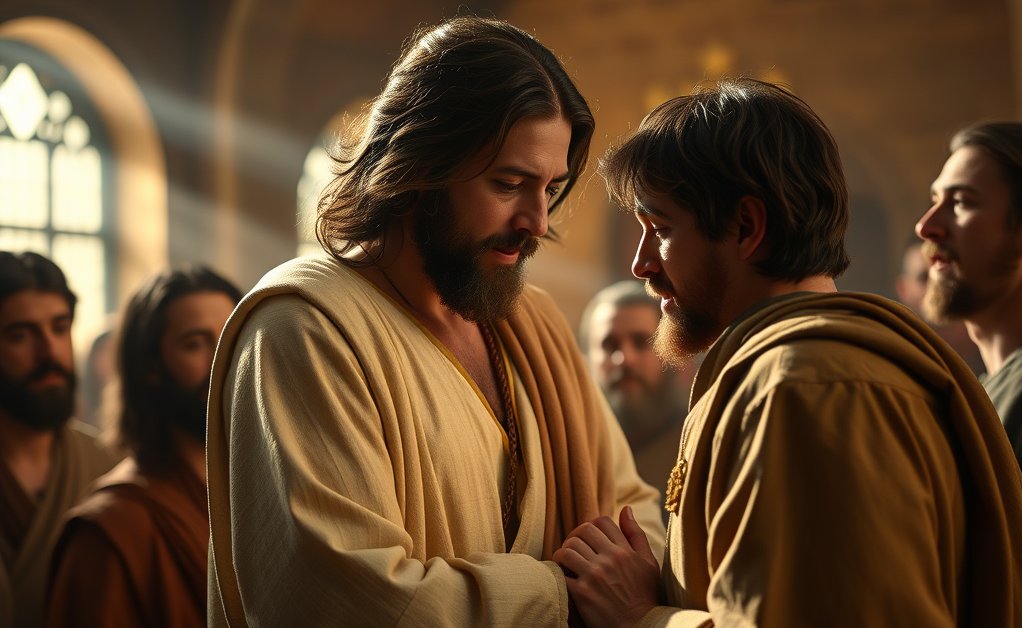
Peace be with you

Peace be with you. (John 20:19)

That was a pretty common greeting in those days and still is among Jews.

But was that all it was? Considering Jesus said it twice, I’m kind of thinking not.

The disciples were in hiding, afraid of the future. And even Jesus appeared to them, how much angst did they have because they had failed him.

But Jesus said, “Peace be with you. I’m here. And despite your failings, I accept you.”

He then sent them out to bring his peace to people without it.

But it’s hard to bring peace into people’s lives if we don’t have God’s Spirit of peace living in us. And so he breathed on them and said, “Receive the Holy Spirit.”

Jesus wants to send you out too.

But do you have peace yourself? Or are you constantly worried about the future? Are you constantly worrying about what God thinks of you?

Remember: Jesus looks at you, and says, “Peace be with you.”

Jesus has already given you his Spirit. Not a spirit of fear, but one that cries out with us, “Abba, Father.”

We have peace with God now. (Romans 5:1, 5; 8:15)

So rest in his peace. And let’s take that peace out to those living without it.

Categories
Luke Devotionals

Though we are weak and sinful

“Go away from me, because I’m a sinful man, Lord!”…”Don’t be afraid,” Jesus told Simon. “From now on you will be catching people.” (Luke 5:8, 10)

There are many similarities between this story and John 21, namely, the miraculous catch of fish.

But it’s the feeling of Simon and Jesus’ response in both stories that really struck me.

Simon sees his own sinfulness and says, “Jesus, I’m not worthy to be with you.”

And Jesus tells him, “Hey, don’t be afraid. I see your sinfulness, but I still want to be with you and use you for my work.”

Fast forward to after the resurrection. More than ever, Simon sees his own weakness and sinfulness. After all, he had denied Jesus three times, just hours after he had promised to be faithful to Jesus.

And though he doesn’t say, “Go away from me, I’m a sinful man,” there are probably even stronger feelings of unworthiness in Peter. “Can Jesus still use me? Does he even want to use me?”

And yet Jesus reassures him.

“Do you love me? Yes? Good. Feed my lambs.”

“Do you love me? Yes? Good. Take care of my sheep.”

“Do you love me? Yes? Good. Feed my sheep.”

Then he told Peter, “Follow me.”

That’s awesome to me. Jesus sees my weaknesses. He sees my sin.

But while I would cry out, “Depart from me, I’m a sinful man. I’m unworthy of you,” he says, “Don’t be afraid. I’ve accepted you despite your weaknesses, despite your failures. Now follow me. And join me in touching others with the grace and love I’ve given you.”

Categories
Romans

Judging your brothers and sisters

If there is one problem within the church, it’s brothers and sisters judging each other.

Now I want to be clear, this has nothing to do with black or white issues.

Paul had no problems with judging others when it came to issues that were clear cut right or wrong. You only have to look at I Corinthians 5 to see that.

But we’re talking about issues that the Bible either says nothing about or says is up to each individual Christian. And here we see two of the latter.

Among the Christians in Paul’s day, there were arguments about eating meat and vegetables.

People who ate vegetables were condemning those who ate meat, perhaps because the meat had been offered to idols before being served as food at the dinner table.

Others argued about religious holidays, most probably the Jewish ones and whether Christians should continue to observe them or not. The Sabbath was probably a particular issue they faced.

The key thing here is that Paul did not consider them black and white issues. And Paul says here not to get into arguments over “disputable matters.” (Romans 14:1)

These were issues that were purely matters of conscience.

Some Jews felt that they should continue to observe the Sabbath and other Jewish holidays. And for them, to suddenly stop observing these special days seemed dishonoring to God.

The Gentiles, on the other hand, probably felt that it was a purely a Jewish tradition and had nothing to do with them.

Paul condemns neither. He said,

One person considers one day more sacred than another; another considers every day alike.

Each of them should be fully convinced in their own mind.

Whoever regards one day as special does so to the Lord. (Romans 14:5-6)

In other words, if you consider a day special because of your faith, then celebrate it. God will honor that. But if every day is alike to you, that’s fine too.

For those who felt bad about eating meat offered to idols, Paul said,

I am convinced, being fully persuaded in the Lord Jesus, that nothing is unclean in itself.

But if anyone regards something as unclean, then for that person it is unclean. (Romans 14:14)

Paul was telling the Romans, “I personally feel that even if food has been offered to idols, it’s okay to eat it. But if you feel bad about doing that, then by all means, don’t eat it.”

But then he said,

The one who eats everything must not treat with contempt the one who does not, and the one who does not eat everything must not judge the one who does, for God has accepted them.

Who are you to judge someone else’s servant? To their own master, servants stand or fall.

And they will stand, for the Lord is able to make them stand. (Romans 14:3-4)

And again,

You, then, why do you judge your brother or sister? Or why do you treat them with contempt?

For we will all stand before God’s judgment seat. It is written: “‘As surely as I live,’ says the Lord, ‘every knee will bow before me; every tongue will acknowledge God.’”

So then, each of us will give an account of ourselves to God.

Therefore let us stop passing judgment on one another. (Romans 14:10-13)

I really don’t think there’s much that needs to be added to this. It’s about as clear as you can make it.

The main point is that God is our master. He is the one we have to answer to. So we have no business judging one another on things that are a matter of conscience. Instead, we are to leave judgment to God.

When I was a teenager, I was working with other teens teaching Bible clubs to kids. For the first two weeks, we went through a training camp. But in between our classes, sometimes people played cards.

Now we weren’t gambling or anything, but there was one person there that was bothered by it. She had always been taught it was wrong.

Now when one of the other teens heard this, he said, “That’s so stupid!”

He didn’t say it, but if he had been an adult, he probably would have said, “That’s so legalistic.”

But another guy said, “Hey, it’s how she feels. Respect that.”

So we never touched cards again for the rest of camp.

We refused to judge her for her beliefs. And she, though she did say our playing bothered her, didn’t condemn us for thinking it was okay to play cards.

The end result was that we kept harmony, and we were able to do great things for God that summer.

That’s what Paul is saying here. We will not always agree.

But on issues where God says it’s up to us, or on issues where God says nothing at all, let us accept one another.

And if we do, we will make a difference in this world for Christ.

Categories
Romans

Loved and called by God

And so we hit Romans, perhaps the most important book in the New Testament, because it so clearly sets out what the gospel is.

It was written by Paul to the church in Rome before he had had the chance to visit there.

And unlike many of his other letters, he is not addressing any church-specific problems or issues. Instead, all his focus is on the gospel God had set him apart from birth to preach.

In his greeting, Paul talks about how God had called him to be an apostle and set him apart to specifically reach out to the Gentiles.

It would be easy to take this almost as boasting. “God chose me! God loves me!”

But then Paul wrote,

And you also are among those who are called to belong to Jesus Christ.

To all in Rome who are loved by God and called to be saints. (Romans 1:6-7)

You also.

I love those words.

You also.

Paul told the Romans, “You also are called to belong to Jesus Christ. It’s not just us Jews. It’s not just us ‘special people.’

You too are special. You also are loved by God. You also are called to be his saints.”

Sometimes, we wonder how God could possibly love us. We’re nothing special. Why would God even bother with us?

And yet God looked down upon us, even before time began, and said, “I choose you. I love you.”

He saw all our faults, all our sins, all our weaknesses, and despite all that, said, “I set you apart for myself.”

And that’s actually what “saint” means. It means “people set apart for God.”

A lot of us look at the word, “saints,” and we think, “Me? A saint? I’m no saint?”

We think that because we picture saints as people with this halo over our heads who live perfect lives.

But you are a saint not because you are intrinsically better or purer than anyone else, but because God has loved you and chosen you.

That’s grace: the imparting of God’s love to you though you did nothing to earn it. Though you are no better than anyone else. And because God has bestowed his love upon us by grace, we have peace with God.

We don’t have to worry about whether God accepts us or not. We’d only have to worry about that if we had to earn God’s acceptance. But we don’t.

Before the creation of the world, he already chose you and accepted you. And if we could only understand that, how different would our lives be?

No longer striving, no longer fearful. But resting in the love, grace, and mercy of God.

Categories
Acts

Grace alone

This was probably the biggest theological debate the early church faced, and it was a critical one.

Paul and Barnabas had been taking the gospel to the Gentiles, but not everyone was happy about the gospel they were preaching. Paul and Barnabas were telling the Gentiles (and Jews),

Therefore, my brothers, I want you to know that through Jesus the forgiveness of sins is proclaimed to you.

Through him everyone who believes is justified from everything you could not be justified from by the law of Moses. (Acts 13:38-39)

But not all the Jewish believers, particularly those who belonged to the party of the Pharisees, could fully accept this.

Yes, they believed in the forgiveness of sins through Christ, but they added an additional requirement, that Gentiles be circumcised as Jews and follow all the requirements of the law.

I like how the ESV puts the situation.

Paul and Barnabas had no small dissension and debate with them. (Acts 15:2)

I can bet there was no small dissension between these men.

And so a great council was held in Jerusalem to discuss the question.

First, Paul and Barnabas talked about all that God had done among the Gentiles. Then the Pharisees stood up and basically said, “That’s all well and good, but they still have to be circumcised and follow all the Jewish laws.”

That set off a round of heated discussion.

I can only imagine the conflict going on in Peter’s heart.

On one hand, he had been born and raised a Jew, following as best as he could the law of Moses. It was still probably hard for him to accept completely God’s message of grace to the Gentiles, and he probably sympathized with these Pharisees.

But it was he who had opened this can of worms in the first place by taking the gospel to Cornelius.

And through these discussions, he probably went through the same war in his mind that he had when God first told him in a vision to kill and eat from the unclean animals and to not call, “unclean” what God had made clean.

But ultimately, it was those words, and the lesson that God shows no distinction between Jew and Gentile (Acts 10:34-35) that swayed Peter.

Finally, he spoke out.

God, who knows the heart, showed that he accepted them by giving the Holy Spirit to them, just as he did to us. He made no distinction between us and them, for he purified their hearts by faith.

Now then, why do you try to test God by putting on the necks of the disciples a yoke that neither we nor our fathers have been able to bear?

No! We believe it is through the grace of our Lord Jesus that we are saved, just as they are. (Acts 15:8-11)

That quieted everyone, and lent more impact to Paul and Barnabas’ words when they reiterated their experiences with Gentiles.

Finally, James confirmed everything they had been talking about by quoting from scripture. With that, all objections died.

What can we get from this? Simply this: it is by the grace of God alone that we are saved.

We’re not saved by Christ’s work and our work. We are not saved, as the Mormons would put it, “by grace after we’ve done all we can do.”

Nor are we saved by grace plus all we can do.

We are accepted by God because of Christ’s work alone.

Like Peter, though, we often struggle with this idea. And because of it, we find ourselves struggling with God’s acceptance of us because we’re not “good enough.”

Or worse, we start looking down on others because they’re not “good enough.”

The truth is that none of us are worthy of salvation.

That is in fact the whole point of grace. That though none of us are worthy, through the blood Christ shed on the cross, we are made right with God.

We don’t have to worry about making ourselves worthy before God. We are already acceptable in his eyes.

Do you believe that? Do you really believe God accepts you?

Never forget the words of Paul who said,

For it is by grace you have been saved, through faith–and this not from yourselves, it is the gift of God–not by works, so that no one can boast. (Ephesians 2:8-9)

Categories
John John 13 Luke Luke 22 Mark Mark 14 Matthew Matthew 26

A God who knows our weakness and accepts us anyway

When Jesus told the disciples that he was leaving for a place they could not follow, it must have really troubled them. He was their teacher, and they couldn’t imagine life without him.

As usual, it was Peter who spoke out, saying,

Lord, where are you going… why can’t I follow you now? I will lay down my life for you. (John 13:36-37)

Jesus then stunned Peter and the rest of the disciples by saying,

Will you really lay down your life for me? I tell you the truth, before the rooster crows, you will disown me three times! (John 13:38)

He then said,

Simon, Simon, Satan has asked to sift (all of) you as wheat.

But I have prayed for you, Simon, that your faith may not fail. And when you have turned back, strengthen your brothers. (Luke 22:31-32)

Again, Peter declared,

Lord, I am ready to go with you to prison and to death. (Luke 22:33)

But again Jesus replied,

I tell you, Peter, before the rooster crows today, you will deny three times that you know me. (Luke 22:34)

Perhaps, at that point, the other disciples thought that Peter was the betrayer that Jesus had talked about earlier. Perhaps even Peter was wondering.

So Jesus said,

You will all fall away… for it is written: ‘I will strike the shepherd, and the sheep will be scattered.’

But after I have risen, I will go ahead of you into Galilee. (Mark 14:27-28)

Still Peter continued to insist,

Even if all fall away on account of you, I never will. (Matthew 26:33).

So Jesus made his declaration even stronger and more specific saying,

I tell you the truth… today—yes, tonight—before the rooster crows twice you yourself will disown me three times. (Mark 14:30)

Even then, Peter refused to believe it, and insisted with all the other disciples that he would never do such a thing, even if it meant death. (Mark 14:31)

In the end, of course, they all did as Jesus had predicted. All of them ran away when Jesus was arrested, and Peter ended up denying Jesus three times.

What’s my point? Jesus knows us better than we know ourselves. He knows our weaknesses, even when we can’t see them ourselves. And yet, he accepts us.

That’s the amazing thing of all of this. He never condemned Peter.

Rather, he tried to encourage him saying, “I’ve been praying for you that your faith will not fail. You will fall, but you will get up again. And when you do, encourage the others.”

In the same way, Jesus knows our weakness. Yet he doesn’t condemn us.

Rather, he, as our great high priest, prays for us daily. He reaches out to pull us up when we fall down. And when we get up again, he tells us to have mercy on the others we see around us who have fallen as well.

So in our weakness, in our failures, let us always remember,

Therefore, there is now no condemnation for those who are in Christ Jesus. (Romans 8:1)