Categories
Isaiah Devotionals

Shepherds’ song?

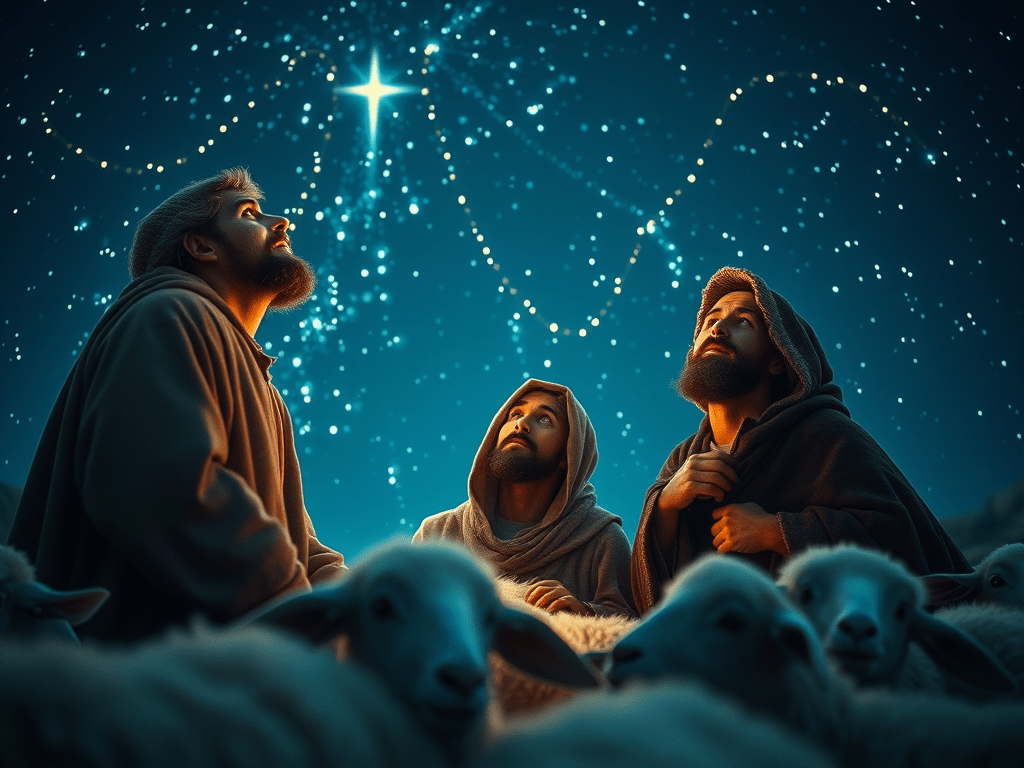
I was reading a Christmas advent devotional today and thinking about the shepherds. I was thinking about how they felt when they saw the angel.

Luke tells us they were terrified. Why?

God had been silent for 400 years. Now he was breaking that silence. For what? To bring judgment on his people?

No. To bring good news.

His anger was ended. And now he was bringing salvation through his Son.

Did the shepherds think of Isaiah 12 when they heard the angels?

Probably not. But if they had, I think they would have been singing it.

I will give thanks to you, Lord,
although you were angry with me.

Your anger has turned away,
and you have comforted me.

Indeed, God is my salvation;
I will trust him and not be afraid,
for the Lord, the Lord himself,
is my strength and my song.
He has become my salvation. (Isaiah 12:1-2)

Jesus, the root of Jesse had come. (Isaiah 11:1-5, 10)

And after seeing Jesus, the shepherds went and told everyone what they had seen and heard. (Luke 2:16-18)

Cry out and sing, citizen of Zion,
for the Holy One of Israel is among you
in his greatness. (Isaiah 12:6)

Categories
Hebrews

What Christmas is all about (part 2)

What’s wrong with the world today? Until we answer that question, we can’t really answer what Christmas is about. And that’s what the author of Hebrews addresses here.

He says in verse 5 that in the world to come, when all things are made new, the earth will not be made subject to angels, but to the human race. And like the psalmist, he marvels, saying,

“What is man that you are mindful of him, the son of man that you care for him?

You made him a little lower than the angels; you crowned him with glory and honor and put everything under his feet.” (Hebrews 1:6-8)

Here it seems the psalmist and the writer of Hebrews is speaking not of Jesus, but of people.

They both marvel at the grace of God that though we are but dust, lower at this time than the angels, that the day will come when we will be crowned with glory and honor, and rule over all things, even the angels.

Paul told us in 1 Corinthians 6:3 that the day will come when we will even judge the angels.

That’s what God meant for us from the very beginning. When he created Adam and Eve, he said,

Be fruitful and increase in number; fill the earth and subdue it.

Rule over the fish of the sea and the birds of the air and over every living creature that moves on the ground. (Genesis 1:28)

And the writer of Hebrews says,

In putting everything under him, God left nothing that is not subject to him. (8b)

And yet. Is that how things really are? The writer continues,

Yet at present we do not see everything subject to him. (8c)

Why not? Because of sin.

Sin is what’s wrong with the world. Sin corrupted everything. It broke our relationship with God. It broke this world. And it broke us. Because of that, we see natural disasters, disease, and death.

And that’s why Jesus had to come.

The writer continues,

But we see Jesus, who was made a little lower than the angels, now crowned with glory and honor because he suffered death, so that by the grace of God he might taste death for everyone. (9)

Jesus left heaven, and became one of us. He lived among us, taking our form that was lower than the angels. A form that was mortal. A form that could get sick and die.

But through his death on the cross, he paid for our sin so that we would not have to pay for it ourselves.

And now, Jesus is crowned with glory and honor. He has become the “author of our salvation.”

That word “author” is now translated in the new NIV, “pioneer.”

Jesus went ahead of us, living a perfect life, and then suffering and dying for us. And now we follow the path of salvation he blazed for us.

We don’t have to find the path to salvation. The path has already been made. He’s done all the hard work. All we have to do is trust in and follow after him.

Why did Jesus come to this earth as a baby 2000 years ago?

Since the children have flesh and blood, he too shared in their humanity so that by his death he might destroy him who holds the power of death–that is, the devil–and free those who all their lives were held in slavery by their fear of death. (14-15)

But not only we have been set free from the power of sin and death, now the way has been paved for us to be crowned with glory and honor and to rule this world as coheirs with Christ as God intended from the very beginning.

That’s what Christmas is all about.

So this Christmas, let us praise God not just for what he did 2000 years ago in Bethlehem, but praise him for what he is doing now, and what he will do in the world to come.

Categories
Hebrews

What Christmas is all about

As I write this, Christmas season is well in swing and is in fact just around the corner.

And in Hebrews, we find out just what Christmas is all about. Who is this Christ that came? And why is he so important?

The writer of Hebrews starts by telling us,

In the past God spoke to our forefathers through the prophets at many times and in various ways, but in these last days he has spoken to us by his Son, whom he appointed heir of all things, and through whom he made the universe. (Hebrews 1:1-2)

In other words, while there were many prophets throughout the centuries, now in these last days, we find one that was greater than them all. Greater than even Isaiah and Jeremiah, and Daniel.

While these men spoke many things clouded in mystery, these mysteries were all revealed in Jesus Christ. He is, as John put it, the very Word of God made flesh (John 1:1, 14), and all the scriptures find their fulfillment in him.

But who is he, really?

Jehovah’s Witnesses claim he is the archangel Michael. But the writer of Hebrews flatly denies this.

Instead, he said,

The Son is the radiance of God’s glory and the exact representation of his being, sustaining all things by his powerful word. (3a)

The picture here is of a signet ring that was put into wax and then pressed onto paper. And Jesus is the exact representation of the very nature of God.

All that God is can be seen in Jesus. Jesus himself is the radiance of God’s glory.

The writer then says,

After he had provided purification for sins, he sat down at the right hand of the Majesty in heaven. (3b)

Here we see the why of Jesus’ coming. To die on a cross that our sins may be forgiven. But after he died, he rose again, and now is sitting at the right hand of God the Father in glory.

And on the day Jesus rose from the dead, the Father said,

“You are my Son; today I have become your Father.” (Verse 5, but also see Acts 13:32-34 where Paul uses this passage in reference to the resurrection.)

In ancient times, a king who was over another had a “father-son” relationship with the king who was subject to him. God himself said that of his relationship with Solomon (2 Samuel 7:14)

And the writer of Hebrews makes very clear, “No angel ever had this said to them. Only Jesus.” (4-5)

More, when God brought Jesus into the world, he said,

Let all God’s angels worship him. (6)

We see that during the angel’s worship in front of the shepherds. And on the day Jesus returns to earth, God will again command, “Let all the angels worship him.”

That’s significant, because only God is worthy of worship. The Father could not say that if Jesus were not one with Him. (Luke 4:8)

And while angels are compared to things created things like wind and fire (7), Jesus is called the eternal God himself, and the creator of all things. (2, 8-12)

Finally, no angel had the position of authority that Jesus has. Rather their job is to serve those who will be saved because of the work Jesus did. (13-14)

In short, as glorious as angels are, Jesus is so much more. He is God himself in human flesh. And when he came, he revealed to us who God really is.

Not only that, but through him and him alone we find salvation from our sins and the gift of eternal life.

That’s what Christmas is all about.

More on this tomorrow.