Somehow in 35 years of reading scripture, it never really occurred to me that the events in Matthew 28 and Acts 1 were two separate events. One happened in Galilee and the other on the Mount of Olives.
It was perhaps here in Galilee that Jesus appeared not only to the 11, but to 500 other followers of Jesus as well, as mentioned in 1 Corinthians 15:6.
It would also perhaps explain why “some doubted,” not the 11 disciples who had already seen him before, but the others who had come and who had yet to see the risen Lord.
Whatever the case may be, there was no doubt remaining once Jesus appeared and started speaking to them. He said,
All authority in heaven and on earth has been given to me.
Therefore go and make disciples of all nations, baptizing them in the name of the Father and of the Son and of the Holy Spirit, and teaching them to obey everything I have commanded you. (Matthew 28:18-20)
It’s significant to me that Jesus didn’t simply say to go out and preach the gospel, although they were to do that too.
He told them to make disciples. Not of themselves, but of Jesus.
How were they to do that?
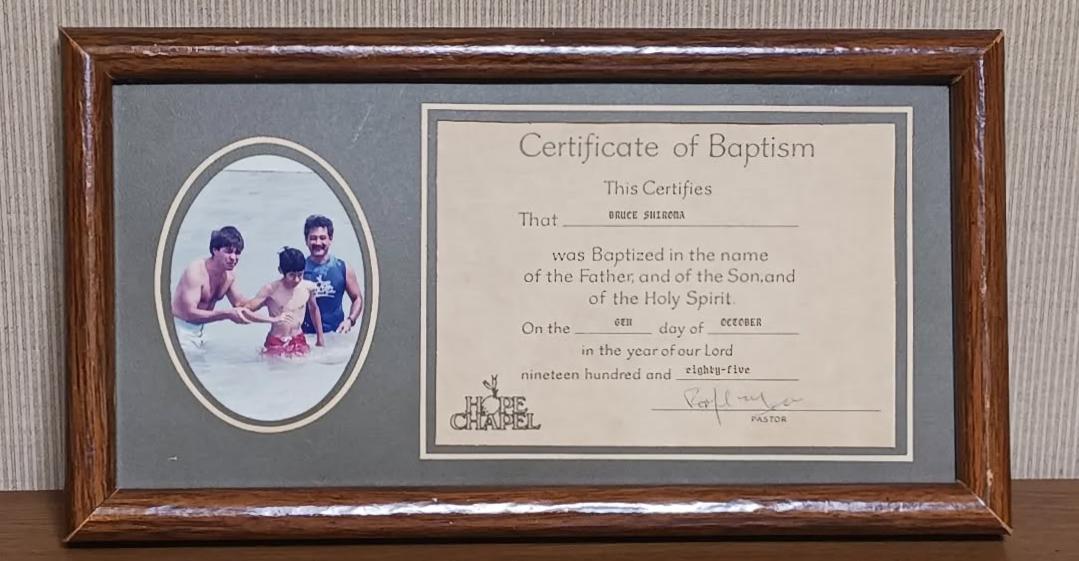
They were to baptize new believers first, as a sign of their commitment to Jesus.
What is baptism? What does it mean? It basically identifies you with Christ.
It’s saying, “Just as Christ died and rose again, I am dying to my old way of life, and rising up as a new person. And one day, after I die here on this earth, I will rise up and be with Christ forever.”
I think it’s very interesting that here in Japan, in some sense, even the non-Christians have a stronger idea of the implications of baptism than believers in the States do.
I have heard many stories of how parents have told their (adult) children, “Well, you can go to church, but don’t get baptized.”
That’s one of the biggest struggles that young believers face here. Will I take that step of baptism at the risk of alienating my family?
I think for many of the Jews, they faced the same kind of pressure from their families.
But if we are going to become true disciples of Christ, we need to get to the point where Jesus is more important to us than anything else. And baptism is a very visual and public way of proclaiming that.
Jesus also told his disciples that they were to teach people everything that he had taught them. And not only that, to teach them to obey.
A lot of Christians feel uncomfortable with that idea. After all, doesn’t it smack of legalism? And aren’t we saved by grace?
Yes, we are saved by grace. And no, we shouldn’t be presenting Christianity as a series of dos and don’ts.
But what we should be doing is reminding people that God really does love us. That he desires the very best for us.
And if we trust him enough for our salvation, shouldn’t we also trust him enough to believe that his way is best and to follow that way?
More, if we truly love him, shouldn’t we do the things that we know will please him?
In short, we need to be teaching people to draw closer to God in a relationship where they learn to love and trust him more every day.
It is, unfortunately, an area that the church all too often fails at.
As a result, we have a bunch of baby Christians that never really grow up. Christians who though they say they love God, nevertheless never really learn to trust God.
And because of that, their lives remain an utter mess.
Let us not make that mistake.
Let us not just preach the gospel, but teach young believers to be disciples of Christ, so that they will become people who love, trust, and obey him, growing in the grace and knowledge of our Lord Jesus Christ.






 Moment to Moment (Bible blog)