Categories
Joshua Devotionals

Judgment day

So Joshua conquered the whole region—the hill country, the Negev, the Judean foothills, and the slopes—with all their kings, leaving no survivors.

He completely destroyed every living being, as the Lord, the God of Israel, had commanded. (Joshua 10:40).

Let’s be honest, words like these are tough to swallow. Why would God command such a thing?

In a word: judgment.

What were the Amorites being judged for?

Their sin.

God goes into great description of that in Leviticus 18, telling the Israelites that the land was “vomiting” out the Amorites for their sin. (Leviticus 18:24-25)

That said, God was patient with them. He waited 400 years for them to repent. (Genesis 15:13-16)

They never did.

And when their sin reached their “full measure,” judgment came, with God instructing Joshua and the Israelites to wipe them out.

I mentioned in my last article that the Bible is not all encouraging and comforting words about God’s love and mercy. It also has hard words about judgment too.

God is patient. He desires all to come to repentance. (2 Peter 3:9)

But if like the Amorites, people refuse to repent, judgment will come.

So let us never take our sin lightly. Remember that a day of judgment is coming as it came for the Amorites. And always keep in mind the words of Peter.

But the day of the Lord will come like a thief; on that day the heavens will pass away with a loud noise, the elements will burn and be dissolved, and the earth and the works on it will be disclosed.

Since all these things are to be dissolved in this way, it is clear what sort of people you should be in holy conduct and godliness as you wait for the day of God and hasten its coming. (2 Peter 3:10-12)

Categories
Joshua Devotionals

Casting crowns

When Joshua was near Jericho, he looked up and saw a man standing in front of him with a drawn sword in his hand. Joshua approached him and asked, “Are you for us or for our enemies?”

“Neither,” he replied. “I have now come as commander of the Lord’s army.”

Then Joshua bowed with his face to the ground in homage and asked him, “What does my lord want to say to his servant?” (Joshua 5:13-14)

This chapter has so many awesome things in it.

I love the idea of the rolling away of our past. (9)

I was also thinking about how failing to trust and obey God will lead us to wandering around the desert instead of finding the life God desires for us. (6)

But for some reason, whenever I read this chapter, I always gravitate toward verses 13-14. This is now the fifth article I’m writing on it.

I love how the English translation of the Jewish Bible describes Joshua’s response to the commander of the Lord’s army.

Joshua threw himself face down to the ground and, prostrating himself, said to him, “What does my lord command his servant?” (14, Tanakh)

Here was Joshua, the leader of God’s people. But when the commander of the Lord’s army shows up (who many Bible scholars believe is actually Jesus), he throws himself down before him, and asks, “What do you want of me?”

It reminded me of the response of the 24 elders in Revelation 4.

Whenever the living creatures give glory, honor, and thanks to the one seated on the throne, the one who lives forever and ever, the twenty-four elders fall down before the one seated on the throne and worship the one who lives forever and ever.

They cast their crowns before the throne… (Revelation 4:9-10)

Just as the twenty-four elders cast their crowns before the throne of God, so did Joshua before his commander, submitting to God’s authority in his life.

And that was my response to Jesus today.

Jesus, I cast my crown before you. You are my King. I surrender reign over my life to you. What do you want me to do?

Categories
Joshua Devotionals

What does this mean to you?

In the future, when your children ask you, ‘What do these stones mean to you?’ you should tell them, ‘The water of the Jordan was cut off in front of the ark of the Lord’s covenant. When it crossed the Jordan, the Jordan’s water was cut off.’

Therefore these stones will always be a memorial for the Israelites.” (Joshua 4:6-7)

Last Sunday, my pastor was talking about Abraham’s circumcision, and how it was a constant reminder to Abraham of his relationship with God.

The stones in today’s passage served a similar function. They reminded the Israelites of their relationship with God and all he had done for them.

But getting back to my pastor’s message, he asked, “What things serve as memorials for you?”

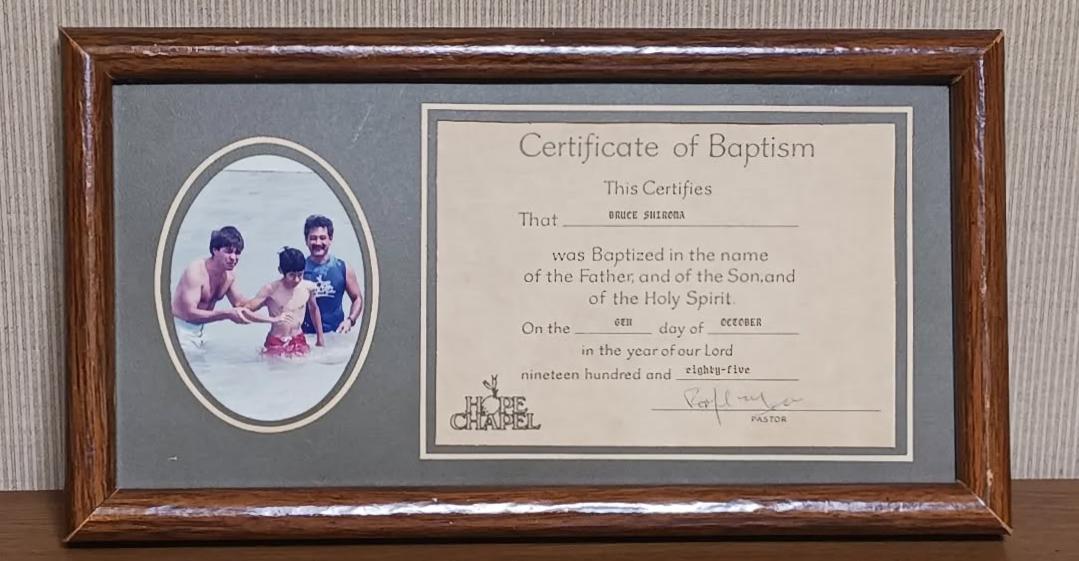
I was thinking of my baptism picture today. It’s in a box in my closet right now. I think the glass for the frame is broken, but the picture is intact.

And I was thinking, “What does that picture mean to me? Why is it stuck in that box in the closet?”

That picture actually represents a lot. It represents a turning point for me in my walk with God.

I can’t say I totally understood everything baptism represented that day. But I vividly remember my pastor asking me, “Why do you want to get baptized.”

I answered, “I want to know God better.”

An imperfect answer, to be sure.

But God honored that request. And as I look back, it wasn’t long before he started to make himself more real to me.

Maybe it’s time for me to pull that picture out of the box.

How about you? What are the things that remind you of your relationship with God? Which remind you of all he’s done for you?

What do you need to pull out of the box and put on display?

Categories
Joshua Devotionals

Because we’re on untraveled ground

When you see the ark of the covenant of the Lord your God carried by the Levitical priests, you are to break camp and follow it.

But keep a distance of about a thousand yards between yourselves and the ark. Don’t go near it, so that you can see the way to go, for you haven’t traveled this way before…”

Come closer and listen to the words of the Lord your God.” (Joshua 3:3-4, 9)

As I read those words, I couldn’t help but think of some verses I’ve been memorizing over the past week from Psalm 143.

Let me hear in the morning of your steadfast love, for in you I trust.

Make me know the way I should go, for to you I lift up my soul.

Deliver me from my enemies, O Lord! I have fled to you for refuge.

Teach me to do your will, for you are my God! Let your good Spirit lead me on level ground! (Psalm 143:8-10, ESV)

That could have been the song of the Israelites entering Canaan.

But it’s also my prayer now.

The future is all untraveled ground for me. There’s so much I don’t know.

And Satan would lay so many traps for me that I can’t see.

But God knows everything that lies ahead.

And so I want…I need to draw closer. To listen to His words. To learn to do his will. To be led by his Spirit moment to moment, day to day.

What does that look like practically? I’m still trying to figure it out, to be honest. But that’s my prayer.

Let me hear in the morning of your steadfast love, for in you I trust.

Make me know the way I should go, for to you I lift up my soul.

Deliver me from my enemies, O Lord! I have fled to you for refuge.

Teach me to do your will, for you are my God! Let your good Spirit lead me on level ground! (Psalm 143:8-10)

Categories
Acts Devotionals

In all good conscience (2)

I always strive to have a clear conscience toward God and men. (Acts 24:16)

This is the second time in two chapters that Paul talks about keeping a clear conscience before God. (Acts 23:1)

Why was that important to him?

I think there were three reasons.

First, he knew there was a resurrection and that he would stand before God’s judgment seat someday. (15)

He once told the Corinthians,

Therefore, whether we are at home or away, we make it our aim to be pleasing to him.

For we must all appear before the judgment seat of Christ, so that each may be repaid for what he has done in the body, whether good or evil. (2 Corinthians 5:9-10)

But as much as he knew the fear of the Lord, he also knew the love of the Lord, and that also drove him. He said,

For the love of Christ compels us, since we have reached this conclusion, that one died for all, and therefore all died.

And he died for all so that those who live should no longer live for themselves, but for the one who died for them and was raised. (2 Corinthians 5:14-15)

But I think a final reason is that he knew keeping a clear conscience had an effect on his testimony.

When Paul talked to Felix about judgment, it scared Felix to death. (Acts 24:25)

I half-wonder if one reason Felix was hoping for a bribe from Paul was to diminish his testimony. After all, if Paul accepted a bribe, how afraid of judgment could Paul really be?

But Paul kept a clean conscience, and his testimony stood.

How important is keeping a clear conscience to us?

Father, help me to always keep a clear conscience before you. For fear of you. For love of you. And for an unstained witness that might draw the people I love to you.

Categories
Acts Devotionals

Three questions

When Philip ran up to it, he heard him reading the prophet Isaiah, and said, “Do you understand what you’re reading?” (Acts 8:30)

Phillip’s question is very striking.

Imagine you’re having your daily devotions, reading God’s word. Phillip walks up to you and asks, “Do you understand what you’re reading?”

How would you answer?

It’s perfectly okay to answer, “No.”

But do we care enough to seek understanding of the parts we don’t understand?

The Ethiopian eunuch did, inviting Phillip to sit with him, and humbly asking him to explain what he was reading.

Perhaps the most important question, though, is, “What do I do with what I do understand?”

Through Phillip’s teaching, the eunuch came to understand, “I need to put my faith in Jesus. And the first step is to get baptized.”

So immediately, he asked Phillip to baptize him.

Jesus said,

Therefore take care how you listen. For whoever has, more will be given to him… (Luke 8:18)

Put another way, if we not only seek understanding, but also act on what we do know, Jesus will enlighten his word to us even further.

That’s what happened with the eunuch.

How about us? Sure, there may be many things that we don’t understand in the Bible. And yes, it’s important to seek understanding.

But what do we do with what we do understand? Are we saying yes to Jesus and obeying him?

So here’s the challenge. The next time you read your Bible, ask yourself these three questions:

  1. Do I understand what I’m reading?
  2. Do I care enough to seek understanding?
  3. What am I doing with what I do understand?
Categories
John Devotionals

That everything I do would be pleasing to you

There were many words that hit my heart this morning. Perhaps none more so than verse 29 when Jesus said, “I always do what pleases the Father.”

I wish I could say that.

But there were other words too.

If you continue in my word, you really are my disciples. You will know the truth, and the truth will set you free. (John 8:31-32)

Truly I tell you, everyone who commits sin is a slave of sin. A slave does not remain in the household forever, but a son does remain forever. So if the Son sets you free, you really will be free. (34-36)

…my teaching makes no progress among you. (37, NET)

The one who is from God listens to God’s words. (47)

I honor my Father and you dishonor me. (49)

And so my prayer for the day.

Lord Jesus, I want to be like you. I wish I could say with you that all I do pleases the Father. But that is not so. There are many things I do that are displeasing to him.

Forgive me. Help me to never dishonor the Father or you by my words or my actions.

Instead, let there always be room in my heart for your Word. Let it progress in my heart. Help me to understand it better. Not only that, help me to obey it better.

Help me to be like Abraham, listening to the truth of your Word, believing and accepting the truth, and following the truth.

Jesus, thank you for your grace. Because of you, I am no longer a slave to sin. By your blood shed on the cross, you have set me free. Thank you for making me a child of God.

Categories
John Devotionals

Rivers of living water

On the last and most important day of the festival, Jesus stood up and cried out, “If anyone is thirsty, let him come to me, and drink. The one who believes in me, as the Scripture has said, will have streams of living water flow from deep within him.”

He said this about the Spirit. Those who believed in Jesus were going to receive the Spirit, for the Spirit had not yet been given because Jesus had not yet been glorified. (John 7:37-39)

Somehow, whenever I read this passage, my very first thought is how when I come to Jesus, his Spirit quenches my spiritual thirst.

But what God reminded me today was that he doesn’t simply give me his Spirit to quench my thirst. He wants his rivers of living water to flow out from me so that those dying of spiritual thirst around me may also find life.

So this was my prayer today.

Holy Spirit, I have received you and you have quenched my thirst. But I pray that you would be like a river flowing out from me so that those thirsting around me might also drink and find life too.

Categories
John Devotionals

Three questions

So when Jesus looked up and noticed a huge crowd coming toward him, he asked Philip, “Where will we buy bread so that these people can eat?”

He asked this to test him, for he himself knew what he was going to do. (John 6:5-6)

I was thinking this morning what it meant that Jesus was testing Phillip.

What was he asking Phillip?

I’m not sure, but I imagine he was asking, “Do you know who I am yet? Do you know what I’m capable of doing? How much do you trust me?”

If that’s what Jesus was asking, Phillip failed the test on all three counts.

All he could see was the disciples’ inadequacy in meeting the needs of the crowd.

But Jesus already knew what he was going to do. And in his grace, he used what little Phillip and the disciples had to feed thousands.

Sometimes, I am like Phillip. Jesus sees people around me he wants to minister to. He already knows what he’s going to do. But he turns to me and asks, “Do you know who I am yet? Do you know what I’m capable of? How much do you trust me?”

But instead of seeing who Jesus is and what he can do, all I can see is my own weaknesses and inadequacies.

The truth is, my weaknesses and inadequacies are irrelevant. What’s important is who Jesus is. What he can do.

The only question is will I trust him and do what he asks.

Because Jesus is more than able to take what little I have to touch those around me with his love.

So maybe I need to think on those questions more.

“Do you know who I am yet?”

“Do you know what I’m capable of doing?”

“Do you trust me?”

Categories
John Devotionals

A world that needs light

In him was life, and that life was the light of men. That light shines in the darkness, and yet the darkness did not overcome it…

The true light that gives light to everyone was coming into the world. (John 1:4-5, 9)

Last week, I was reading the news and it said that 527 students from elementary school to high school committed suicide in Japan last year.

Just one is too many.

John tells us that in Jesus is life, and that he is the light-giver to those walking in darkness.

There are so many people living in that darkness. So many people living without hope.

And they need that light.

In my church, we’ve been talking recently about our Father’s eyes, and the importance of understanding how God sees us.

That understanding brings light to our darkness.

That’s what Jesus did for everyone he touched. Whenever people looked into his eyes, they saw the Father’s eyes. And it brought light into their darkness.

My prayer is that people would see Jesus in me. That when people look into my eyes, my wife, my daughter, my students, my coworkers, everyone I meet, they would see my Father’s eyes.

And that through me, God would bring his light into their darkness.

May we all have our Father’s eyes.

Categories
Numbers Devotionals

Guarding our hearts against sin

Let’s be honest. There are things in Numbers that are hard to read. Especially when it comes to God’s judgment.

But according to the apostle Paul, there is a reason God recorded all these things. He wrote this in 1 Corinthians 10.

Now these things took place as examples for us, so that we will not desire evil things as they did.

Don’t become idolaters as some of them were; as it is written, The people sat down to eat and drink, and got up to party.

Let us not commit sexual immorality as some of them did, and in a single day twenty-three thousand people died. Let us not test Christ as some of them did and were destroyed by snakes.

And don’t grumble as some of them did,, and were killed by the destroyer.

These things happened to them as examples, and they were written for our instruction, on whom the ends of the ages, have come. (1 Corinthians 10:6-11)

The first event Paul mentions happened in Exodus 32. The rest occured in the chapters we’ve been reading in Numbers, including today’s chapter.

Why did God record all these things?

For our instruction.

What can we learn?

1. God takes sin seriously, especially willful, rebellious sin.

We saw this in chapters 15-17, and we see it again here in verse 6.

While the people are weeping over their sin and God’s judgment, a man brashly brings into his tent a Midianite woman to sleep with her, probably as part of a religious ritual.

2. The wages of sin, particularly willful, rebellious, and unrepentant sin is death.

Because of that we dare not take sin lightly in our lives. Rather we are to flee from it.

And so Paul warns us:

So, whoever thinks he stands must be careful not to fall. (1 Corinthians 10:12)

We need to constantly be on our guard against sin.

But the good news is that God is with us to help us stand against sin and be victorious over it.

As Paul says,

No temptation has come upon you except what is common to humanity.

But God is faithful; he will not allow you to be tempted beyond what you are able, but with the temptation he will also provide the way out so that you may be able to bear it. (1 Corinthians 10:13)

Categories
Numbers Devotionals

How God sees us

How can I curse someone God has not cursed?

How can I denounce someone the Lord has not denounced? (Numbers 23:8)

As I read those words, I thought about what Paul said to the Roman Christians.

Who can bring an accusation against God’s elect? God is the one who justifies.

Who is the one who condemns? Christ Jesus is the one who died, but even more, has been raised; he also is at the right hand of God and intercedes for us. (Romans 8:33-34)

Satan would denounce us before the Father for all our sins and failures.

Sometimes, we even denounce ourselves.

But how can we denounce someone our Father has not denounced?

Our Father justifies us by the blood Jesus shed for us on the cross. And Jesus himself stands by the Father’s side and defends us.

God foreknew us. He predestined us to be his children and to be like Jesus. He called us. He justified us. And he glorified us in his sight.

That’s how he sees us. He sees us as our loving Father.

And the good news is, he won’t change his mind. I love Numbers 23:19.

God is not a man, that he might lie, or a son of man, that he might change his mind.

Does he speak and not act, or promise and not fulfill?

God is determined to bless us and he will. (Numbers 23:20)

We may face his discipline at times for our sins, but he will never abandon us.

And because he never changes his mind, nothing can separate us from his love. (Romans 8:38-39)

God is with us. So let’s rejoice in our King. (Numbers 23:21)

And every day, let’s cry out, “What great things God has done for me!” (Numbers 23:23)

Categories
Numbers Devotionals

Only words?

As I was reading Balaam’s story, I couldn’t help but think of Jesus’ rebuke of the Pharisees and scribes:

This people honors me with their lips, but their heart is far from me. (Matthew 15:8)

At times, Balaam sounded very pious.

“I can’t possibly go against God’s command, small or great.” (Numbers 22:18)

Bu though he honored God with his lips, his heart was apparently far from God.

Because of his greed, it seems he was trying to find some way circumvent God’s command to him. (2 Peter 2:15-16)

But God saw his heart and made sure Balaam knew that he was not fooled. Only then did Balaam refrain from cursing the Israelites.

But even then, Balaam later found a way to bring trouble on the Israelites. (Numbers 25:1-5, 31:16)

It’s easy on Sunday to sing songs saying, “Yes, Lord. Yes, Lord. Yes, yes, Lord. Amen!”

But is it just words?

Or is it our heart?

A heart that is fully given to God, not just on Sunday, but all week, moment to moment, day to day?

Do we wholeheartedly follow him? Or do we try to find ways to get around his commands?

Father, I don’t want to be like Balaam. May my heart be completely yours.

Categories
Numbers Devotionals

Breaking faith with God

Because you did not believe in me, to uphold me as holy in the eyes of the people of Israel, therefore you shall not bring this assembly into the land that I have given them. (Numbers 20:12)

I was thinking on those words God spoke to Moses and Aaron this morning.

“You did not believe in me.”

Instead of believing God’s instructions and doing things God’s way, Moses did things his own.

In doing so, he showed the same lack of honor to God that the people had with all their complaining and rebelliousness.

Later Moses paraphrased what God had told him. “You broke faith with me. You betrayed my trust. You were unfaithful and disloyal to me.” (Deuteronomy 32:51)

Here was a man that God had spoken to face to face, as a man does with a friend. (Exodus 33:11).

And Moses had betrayed that trust.

How much did that pain the heart of the Father?

Father, how often am I like Moses? How often do I fail to believe in you? Instead of believing your instructions and doing things your way, I do things my own?

By your grace, you saved me. By your grace, you made me your own and call me “friend.”

I never want to look into your eyes knowing that I have betrayed your trust.

Help me to always honor you as holy in my life. To give you the honor you are so worthy of in everything I say and do. And when other see me, let them see you.

In Jesus’ name, amen.

Categories
Numbers Devotionals

What cannot be forgiven

In these chapters, we see some harsh punishments that God laid on the Israelites.

For a lot of people, including Christians, that’s hard to understand, but it comes down to a truth that God laid out in chapter 15.

There is a huge difference between unintentional sins and willful, and more importantly, unrepentant rebellion.

There were sacrifices that could be made for the former.

There were no sacrifices for the latter.

Where there is unrepentant rebellion, any sacrifices would be totally meaningless. (Numbers 15:22-30)

We see this truth played out in the person who willfully and unrepentantly broke the Sabbath. (Numbers 15:32-36)

We see it also in Korah and his followers. (Numbers 16)

A rebellious heart is an ugly thing.

But when it is combined with a heart that refuses to repent, it becomes unforgivable.

All of us sin. But let us never get to the point where we willfully and unrepentantly rebel against God.

Instead, let us have the heart of David, who certainly knew willful sin, but also knew true repentance as well.

Who perceives his unintentional sins?
Cleanse me from my hidden faults.

Moreover, keep your servant from willful sins;
do not let them rule me.
Then I will be blameless
and cleansed from blatant rebellion.

May the words of my mouth
and the meditation of my heart
be acceptable to you,
Lord, my rock and my Redeemer.” (Psalm 19:12-14)

Categories
Numbers Devotionals

Lead your heart

Speak to the Israelites and tell them that throughout their generations they are to make tassels for the corners of their garments, and put a blue cord on the tassel at each corner.

These will serve as tassels for you to look at, so that you may remember all the Lord’s commands and obey them and not prostitute yourselves by following your own heart and your own eyes.

This way you will remember and obey all my commands and be holy to your God.

I am the Lord your God who brought you out of the land of Egypt to be your God; I am the Lord your God. (Numbers 15:38-41)

Last year at my church, we talked about not following our hearts, but rather leading our hearts to follow God.

That’s not a new idea.

Moses told the Israelites the same thing. “Don’t just follow your hearts, setting them on the things you see, and so prostitute yourself. Lead your hearts to follow God and his ways.”

Why? Because God had first loved them. He had saved them from slavery in Egypt and made them his people.

And so now, they were to be holy to him.

In the same way, God first loved us, setting us free from slavery to Satan’s kingdom.

We are God’s beloved people now, and we are to be holy to him, not prostituting ourselves to sin again.

But how do we lead our hearts?

God gave the Israelites one way.

He told them to make a tassel with a blue cord attached to each corner of their garments. Every time they put on their clothes, they were to remember to lead their hearts to follow God.

We don’t need to do that, but it is good to find ways to remind ourselves whose we are and who we are to follow.

Recently, someone at my church moved into a new apartment, and he showed me a picture of its cornerstone. It says, “The LORD our God is one LORD.” (Deuteronomy 6:4)

Every time he walks into his apartment building, that can be his “tassel.”

My “tassel” is a prayer I pray every morning from Revelation 4:11.

Our Lord and God,
you are worthy to receive
glory and honor and power,
because you have created all things,
and by your will
they exist and were created.

By your will, you created me, and I have breath for another day. Be glorified in my life.

What’s your tassel? If you don’t have one, find one!

Categories
Numbers Devotionals

Eyes of faith. Eyes of fear.

When Moses sent them to scout out the land of Canaan, he told them, “…Be courageous.” (Numbers 13:17, 20)

Those words really stuck out to me this morning.

One of the things Moses told the twelve scouts before they went out to spy out Canaan was to be courageous.

But only two of them, Joshua and Caleb, came back courageous.

Why? Because they had eyes of faith. They saw how big God is.

The rest of them came back with eyes filled with fear.

Why? They could only see how big the Canaanites were.

How often do we fear the future, how often do we fear where God is leading us because we forget how big he is?

And just as importantly, how good he is.

I happened to be praying through Psalm 16 today, and verses 5-8 seemed particularly appropriate.

Lord, you are my portion and my cup of blessing; you hold my future.

The boundary lines have fallen for me in pleasant places; indeed, I have a beautiful inheritance.

I will bless the Lord who counsels me—even at night when my thoughts trouble me.

I always let the Lord guide me. Because he is at my right hand, I will not be shaken. (Psalm 16:5-8)

Categories
Numbers Devotionals

That I might honor you

Listen to what I say: If there is a prophet among you from the Lord, I make myself known to him in a vision; I speak with him in a dream.

Not so with my servant Moses; he is faithful in all my household. (Numbers 12:6–7)

Therefore, holy brothers and sisters, who share in a heavenly calling, consider Jesus, the apostle and high priest of our confession.

He was faithful to the one who appointed him, just as Moses was in all God’s household.

For Jesus is considered worthy of more glory than Moses, just as the builder has more honor than the house…

Moses was faithful as a servant in all God’s household, as a testimony to what would be said in the future.

But Christ was faithful as a Son over his household. And we are that household. (Hebrews 3:1-6)

Lord Jesus, Moses was faithful in the Father’s household as a servant. As such, he was worthy of glory and honor.

But you were faithful in the Father’s household as a Son. And because of that you are worthy of even more glory and honor than Moses.

So let me honor you in all my words and my actions. You are worthy of my obedience and respect.

Forgive me for the times I fail to honor you in that way.

Thank you for continuing to be my high priest who faithfully intercedes for me despite the times I fail to honor you. Thank you for your awesome grace. In your name I pray, amen.

Categories
Colossians Devotionals

Letting Christ’s word dwell in us

Let the word of Christ dwell richly among you, in all wisdom teaching and admonishing one another through psalms, hymns, and spiritual songs, singing to God with gratitude in your hearts. (Colossians 3:16)

I’ve always loved the words, “Let the word of Christ dwell richly among you.”

But today I noticed how it was to dwell richly among us. Not just through Bible reading and Sunday messages, though that’s important. But Paul specifically says through psalms, hymns, and spiritual songs.

And it just made me think how much songs have shaped my Christian life. Not just worship songs. But other Christian songs as well.

Some songs came straight from scripture so that I was singing (and praying) things like Psalm 121, Romans 12:1, Romans 8:14-21, and Matthew 11:28.

Some songs didn’t quote scripture, but were scripture-based.

They taught me what it means that God is my Father. They taught me how God sees me.

They challenged me not to let my heart be hardened, but to keep a soft heart towards God.

They taught me to praise God in the midst of trial.

They taught me that worship is not just singing songs, but that our whole lives are to be praise to God.

Songs are powerful tools to let God’s word richly dwell in you.

Do you listen to music? If so, what kind of music are you listening to? Do you pay attention to what those lyrics are really saying?

If you want to let Christ’s word richly dwell in you, start looking for songs centered on Scripture. Not just “love songs” to God. But songs that communicate God’s truth.

They can be songs from church. They can be songs from Christian artists.

But sing them. Pray them. And let those words encourage, challenge, and admonish you. Pass those words on to others.

And Christ’s word will richly dwell in you.

Categories
Colossians Devotionals

That you might be first

He is the image of the invisible God, the firstborn over all creation.

For everything was created by him, in heaven and on earth, the visible and the invisible, whether thrones or dominions or rulers or authorities— all things have been created through him and for him. He is before all things, and by him all things hold together.

He is also the head of the body, the church; he is the beginning, the firstborn from the dead, so that he might come to have first place in everything. (Colossians 1:15-18)

Lord Jesus, I was created by you. I was created through you. I was created for you. Have first place in my life. You are worthy to be first in my life.

Fill me with the knowledge of your will in all wisdom and spiritual understanding so that I may walk worthy of you, fully pleasing to you, bearing fruit in every good work, and growing in my knowledge of you.

Strengthen me with all power so that I may have great endurance and patience, filled with joy and thanksgiving.

Your grace to me is incredible. You have given me an inheritance with your people. You rescued me from the domain of darkness and brought me into your kingdom.

By your death on the cross, you present me before the Father holy, faultless, and blameless.

By your grace, let me remain grounded and steadfast in faith, never shifted from the hope I have through your gospel.

In your name I pray, amen.

Categories
Philippians Devotionals

Working out our salvation

Therefore, my dear friends, just as you have always obeyed, so now, not only in my presence but even more in my absence, work out your own salvation with fear and trembling… (Philippians 2:12)

I was thinking today on what it means to work out our salvation.

I think Paul explains his meaning more clearly in chapter 3.

He’s not talking about trying to become righteous by his own efforts to keep the law. His righteousness came by faith in Christ’s work on the cross for him. (Philippians 3:9)

So what does he mean by working out his salvation?

  1. Pursuing his relationship with Jesus. Knowing Christ became his ultimate pursuit in life above all other things.
  2. Becoming more and more like Jesus. Paul wanted to experience Jesus’ resurrection power in his life, becoming like his Lord.

    But before he could be raised with Jesus, he had to die with Jesus. Just as Jesus suffered and died to sin once for all time, Paul needed to learn to die to sin once and for all so that he could live for God (Romans 6:10-11).

    And by Paul joining in Christ’s sufferings, he showed that he was through with sin, no longer living for himself, but for God’s will. (1 Peter 4:1-2)

That’s what it means to work out our salvation. And it’s an ongoing process. A process that Paul admitted he had not fully completed yet.

He still fell short. He still hadn’t arrived.

But Jesus in his grace had taken hold of him. And so Paul strove to take full hold of the salvation he had received, working out his salvation with fear and trembling.

I marvel at the fact that this same Jesus that took hold of Paul has taken hold of me. And so like Paul, I’m striving to take full hold of the salvation I have received, working out that salvation with fear and trembling.

I still fall short. I still haven’t arrived. But with full confidence in the grace and love God has given me, I say with Paul,

Forgetting what is behind and reaching forward to what is ahead, I pursue as my goal the prize promised by God’s heavenly call in Christ Jesus. (Philippians 3:13-14)

Categories
Philippians Devotionals

With fear and trembling

Therefore, my dear friends, just as you have always obeyed, so now, not only in my presence but even more in my absence, work out your own salvation with fear and trembling. (Philippians 2:12)

With fear and trembling.

I was meditating on those words this morning.

What do they mean?

Three times, Paul uses that exact phrase, and each time it’s in the context of obedience to the Lord.

In 2 Corinthians 7:15, the Corinthians received Timothy with fear and trembling because of Jesus who he represented and who they obeyed.

In Ephesians 6:5, Paul told slaves to obey their masters with fear and trembling just as they obeyed Jesus with fear and trembling.

And here in Philippians 2:12, he tells the Philippians that as they have always obeyed, to work out their salvation with fear and trembling.

Of course, Jesus fully accomplished our salvation on the cross, but as we follow and serve him, we more fully experience the benefits of that salvation. And the greatest benefit is a restored relationship with the God who deeply loves us.

So a large part of working out our salvation is learning to walk in that restored relationship with God, moment to moment, day to day.

But why do so with fear and trembling?

Because Jesus has been given the name above all names. Every knee shall bow and every tongue confess that he is Lord.

I can’t help but think that Paul was not only thinking of Isaiah 45:23 which he quotes, but Psalm 2.

Psalm 2 is a Messianic psalm in which God essentially does what Paul talks about in Philippians 2: he establishes Jesus as king over all. And all who rage against him and rebel will be destroyed. Such people should be afraid of his wrath.

But on the other hand, all who take refuge in Jesus will find joy. (Psalm 2:12)

And so, the psalmist writes,

Serve the LORD with fear, and rejoice with trembling. (Psalm 2:11, ESV)

Sound familiar? I think that’s what Paul is alluding to when he says work out your salvation with fear and trembling.

We are not Jesus’ equals. Jesus is King of kings and Lord of lords. He is worthy of our obedience. And he will judge all those who rebel against him.

Because of that, we dare not take him lightly.

And yet, when we acknowledge his lordship in our lives, we need not live in constant fear of his punishment. Punishment is for his enemies, not us.

Rather with reverential awe, not only that, with gladness and joyful songs, we serve him. (Psalm 2:11 (CSB), Philippians 2:13 NLT, Psalm 100:2)

In our trembling, we rejoice at the grace God has given us. We rejoice that he works in us to will and work according to his good purpose. (Philippians 2:13)

I think another psalmist sums up the meaning of working out our salvation with fear and trembling.

Acknowledge that the LORD is God. He made us, and we are his— his people, the sheep of his pasture.

Enter his gates with thanksgiving and his courts with praise. Give thanks to him and bless his name.

For the LORD is good, and his faithful love endures forever; his faithfulness, through all generations. (Psalm 100:3-5)

So this year, let us not take our Lord or the salvation he has given us lightly. Rather, let us work out our salvation with fear and trembling. And rejoicing.

Categories
Ephesians Devotionals

Put all of your armor on

Put on the full armor of God so that you can stand against the schemes of the devil…

For this reason take up the full armor of God, so that you may be able to resist in the evil day, and having prepared everything, to take your stand. (Ephesians 6:11, 13)

“The full armor.”

Those are the words God impressed on me this morning.

Put on the full armor. Take up the full armor. Not just part of it. All of it.

Satan schemes against us and uses different strategies to get at us, not just one. And if we don’t put on the full armor every day, we’re vulnerable.

Rephrasing Paul’s words, if you don’t put on the full armor, you can’t stand against the devil’s schemes.

If you don’t take up the full armor, you won’t be able to resist, you won’t be able to take your stand.

So put on truth. The truth of God’s word. Make it foundation of your thinking. Let truthfulness also mark your speech. And put away the masks. Don’t be two-faced, one person at church, another person outside the church.

Put righteousness over your heart. Deal rightly with the people around with you. And when Satan accuses you for your failings, put on Christ’s righteousness which is ours by faith in him.

Put on the gospel of grace on your feet, so that you don’t slip into constant self-condemnation, nor legalism, nor willful sin.

Take up the shield of faith. But don’t just stand alone. Stand together with other Christians.

Make fellowship with them a priority so that your shield becomes part of a mighty turtle shell that protects not only you, but the Christians around you from Satan’s attack.

Receive the helmet of salvation. Welcome it with thanksgiving, knowing that you received it freely by God’s grace.

And swing the sword of God’s word whenever the enemy comes against you with his lies.

How about you? Are you putting it all on every day? Or are you leaving some of it on the floor?

Categories
Ephesians Devotionals

Drawn near

At that time you were without Christ, excluded from the citizenship of Israel, and foreigners to the covenants of promise, without hope and without God in the world.

But now in Christ Jesus, you who were far away have been brought near by the blood of Christ…

For through him we both have access in one Spirit to the Father. So, then, you are no longer foreigners and strangers, but fellow citizens with the saints, and members of God’s household. (Ephesians 2:12-13, 18-19)

This is perhaps my favorite passage in Ephesians. And it perfectly encapsulates Christmas and why Jesus came.

We were outsiders to God’s family, foreigners to all of God’s promises of blessing to Abraham and his descendants. But now in Jesus, we who were once far away have been brought near.

We see this in Jesus’ own family tree.

Tamar was a Canaanite, a people that God would ultimately order the Israelites to destroy because of their sin. (Matthew 1:3; Genesis 10:15-18, 15:16; Leviticus 18:24-28; Deuteronomy 7:1-4)

Rahab also was a Canaanite and a prostitute as well. (Matthew 1:5)

Ruth was a Moabite, another group that was supposed to have been excluded. (Matthew 1:5 Deuteronomy 23:3-4)

All of them perfectly fit what Paul talked about: excluded from the citizenship of Israel, foreigners to the covenant of promise, without hope and without God in the world.

But they were brought near, fellow citizens with the saints and members of God’s household.

And so are we.

Meditate on those words this Christmas. Chew on them.

And rejoice.

I know I am.

Categories
Ephesians Devotionals

Lavished on

Blessed is the God and Father of our Lord Jesus Christ, who has blessed us with every spiritual blessing in the heavens in Christ.

For he chose us in him, before the foundation of the world, to be holy and blameless in love before him.

He predestined us to be adopted as sons through Jesus Christ for himself, according to the good pleasure of his will, to the praise of his glorious grace that he lavished on us in the Beloved One. (Ephesians 1:3-6)

I love the translation of verse 6. God has “lavished” his grace on us.

The word translated “lavished” is used only one other time in the New Testament, when Gabriel visited Mary. Gabriel told her,

Greetings, favored woman! The Lord is with you.(Luke 1:28)

He was basically saying to her, “Mary, God has lavished his grace upon you.”

You may think that Mary must have been pretty special for the angel to say that to her.

And yet, God says the same thing to us.

“I have lavished my grace upon you through my Son. I chose you before the foundation of the world to be adopted into my family.”

The words God spoke to Mary are for you. God has lavished his grace on you. And in Jesus, he is Immanuel, “God with us.”

Categories
2 Thessalonians Devotionals

Be an example? Me?

For you yourselves know how you should imitate us…we did it to make ourselves an example to you so that you would imitate us. (2 Thessalonians 3:7, 9)

Those words really hit me this morning. Paul’s words are pretty bold: “You yourselves know how you should imitate us.”

Honestly, I don’t know if I feel that bold.

I see all my flaws. I see all the areas I still need to grow.

Why would people want to imitate me?

But God calls all of us to make disciples. Not just the pastors. Not just the church leaders. All of us. He calls all of us to make ourselves examples to the people in our lives so that they would imitate us.

And I suppose that means them not only seeing our strengths and imitating them, but seeing us working on our flaws as well.

And to see us moment to moment, day by day, walking in God’s grace, not under condemnation for our flaws, but with full confidence as children of God.

Father, I desire to be someone others want to imitate. In a lot of ways, I feel unworthy of that.

But as people watch me, let them see not only my admirable qualities that they want to imitate, let them also see the grace I walk in each day as I’m working on my flaws. In Jesus’ name, amen.