Categories
Hebrews

Why all this blood?

One of the key points for this passage that we’ve been talking about is shadows and copies.

And in the midst of all this, we’ve been talking about all the sacrifices of bulls and goats that were made as a shadow of the ultimate sacrifice Jesus would make on the cross.

But that begs the question: why do we need a sacrifice at all? Why couldn’t God simply just forgive our sins without the need for blood? Couldn’t there have been another way?

Really the only way I can answer that is to look at what Jesus went through. To look at Jesus’ prayer in Gethsemane when he cried out, “If there’s any other way, please take the cross from me.” (Matthew 26:39)

If there truly was another way, wouldn’t have God found it?

But for reasons that are truly known only to him, a sacrifice was needed. The writer of Hebrews tells us that without the shedding of blood there is no forgiveness. (9:22)

We see the seeds of this from God’s commands in Leviticus 17:11. There, God said,

For the life of the creature is in the blood, and I have given it to you to make atonement for yourselves on the altar; it is the blood that makes atonement for one’s life.

The idea is that blood represents life. And so for one person’s life to be spared, another life had to be taken.

In the Old Testament, it was the life of a bull, sheep, goat, etc. But as we’ve seen, they were imperfect sacrifices.

For one thing, an animal’s life does not have the worth of a human’s life. For another thing, the animal’s death was not voluntary on its part.

But when Jesus came, he was not just fully human, he was fully God, and thus his life was sufficient to pay for our sins. And as we saw yesterday, it was a truly voluntary act on Jesus’ part. He told the Father,

“Here I am — I have come to do your will, O God.” (Hebrews 10:9)

There are two other things, however, that the writer of Hebrews points out that may help us to understand the need for blood in our atonement.

First, he calls Christ the ransom that set us free from sins we committed by breaking God’s law (Hebrews 9:15).

In other words by dying on the cross he paid the price necessary to set us free from the domain of darkness and bring us into God’s kingdom of light. (Colossians 1:13)

Second, he compares the new covenant with a will (the words for covenant and will are actually the same in Greek, so there seems to be a wordplay here).

And just as a will does not come into effect until the one who makes it dies, so the new covenant could not come into effect until God the Son died.

However you look at it, God deemed it necessary that Christ die in order for us to live. And now that Christ has done so, the Holy Spirit comes into those who put their trust in Christ and he transforms their hearts.

He writes the law of God in their hearts so that it become only natural that they start to do the things that please him. And as for their sins committed in the past, he says,

Their sins and lawless acts I will remember no more. (Hebrews 10:17)

And so the writer of Hebrews concludes,

And where these have been forgiven, there is no longer any sacrifice for sin. (Hebrews 10:18)

As Jesus himself said, “It (the work of salvation) is finished.” (John 19:30)

I don’t know about you, but I marvel at it all.

Did Jesus have to die? In a sense, no. He could have let us perish and saved himself. But he loved us so much that he sacrificed everything you and me.

So let us always look upon the cross and the blood Jesus shed with awe. Jesus paid a terrible price, but he did it out of his love for us.

As one song puts it,

Amazing love!
How can it be?
That you my king should die for me?

Amazing love!
I know it’s true.
And it’s my joy to honor you.

In all I do, I honor you.

— Chris Tomlin
Categories
Matthew Matthew 27

His blood upon us

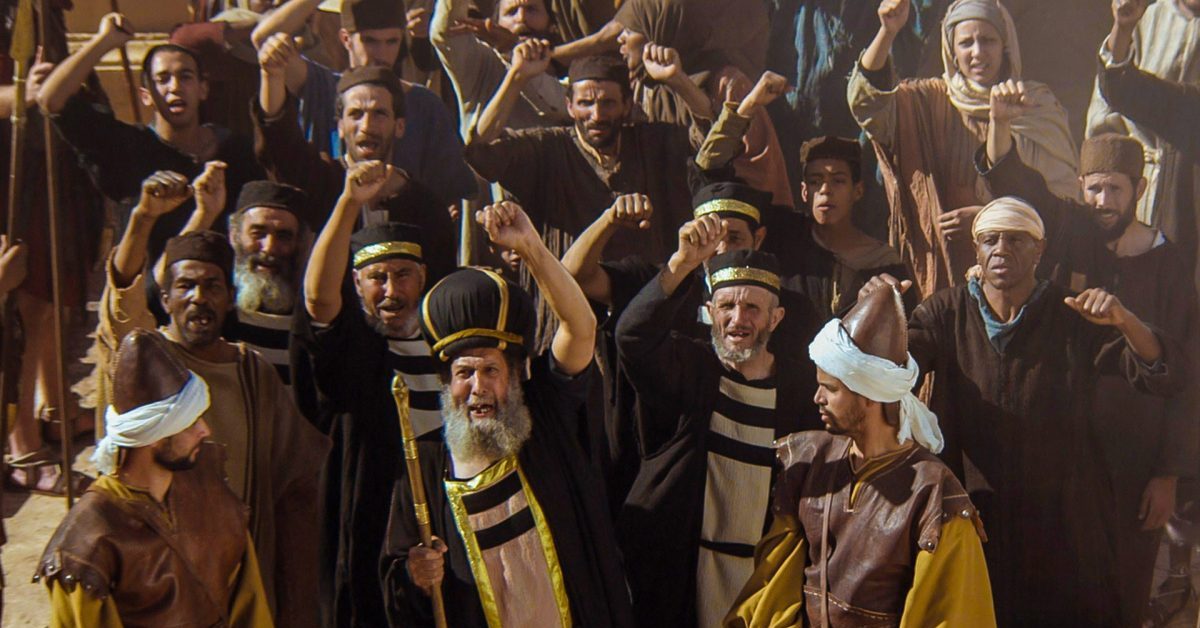
As I look at all the gospel accounts, the cries of the crowd shouting “Crucify! Crucify!” resonate with me.

How it must have broken the heart of Jesus to see the ones he loved reject him so.

Pilate, in his utter despair of the situation, finally washed his hands in front of them, and said,

I am innocent of this man’s blood…It is your responsibility! (Matthew 27:24)

To which the people responded,

Let his blood be on us and on our children! (Matthew 27:25)

Ultimately, that’s what happened. Because of their rejection of Christ, they and their children perished when Titus came to destroy Jerusalem in AD 70.

But as I reflect on Pilate’s words and the crowd’s, two things strike me.

First, it is our responsibility that Jesus died. It was because of us that he died.

Had we never rejected God, had we never sinned, Jesus would never have had to die. And so his blood is not only on the Jews of that time, it is on us as well.

Paul says,

For all have sinned and fall short of the glory of God. (Romans 3:23)

Because of this, there is no one who can say as Pilate tried to, “It is not my responsibility.”

We are all responsible.

But there’s another way to look at the phrase, “his blood be upon us,” and this is the second thing.

Certainly, the crowd meant that they were responsible when they said it. But the irony is, it is now his blood upon us that cleanses us from our sin.

When we put our faith in Jesus, his blood covers our sin and makes us righteous before him.

The writer of Hebrews tells us,

Jesus entered the Most Holy Place (in the heavenly tabernacle) once for all by his own blood, having obtained eternal redemption.

The blood of goats and bulls and the ashes of a heifer sprinkled on those who are ceremonially unclean sanctify them so that they are outwardly clean.

How much more, then, will the blood of Christ, who through the eternal Spirit offered himself unblemished to God, cleanse our consciences from acts that lead to death, so that we may serve the living God! (Hebrews 9:12-14)

So let us cry out to the Savior, “Your blood is upon us. We are responsible for your death because of our sin. But now may your blood be upon us, and by your grace and mercy, cleanse us, forgive us, and make us whole.”

Categories
2 Kings

Disobedience, blood, and defeat

At this point, we’ll take a brief break from Isaiah and stick up our heads to see where we are in the book of 2 Kings.

In short, it was the beginning of the end for the northern kingdom of Israel.

Jeroboam II was now dead, and with his death, ended Israel’s prosperity.

They went through 5 kings over the next 32-33 years or so.

Considering that one of the kings managed to reign for 10 years, and a second for 20, you can see the massive instability they went through as a nation.

Of the remaining three kings, one reigned six months, the next one month, and after ten years under the next king, the fourth king lasted only 2 years.

This period in Israel’s history was marked by three things.

First, it was marked by disobedience.

The account of each reign started basically the same way for four of the five kings, and probably the only reason nothing is said about the fifth is that his reign lasted only one month.

But for each king, it’s noted that they did evil in the eyes of the Lord and that they continued in the sins of Jeroboam I.  That is, they continued their worship of the golden calves.

In doing so, the people worshiped as they saw fit.  Put another way, they rejected God’s law, doing what was right in their own eyes.

This resulted in the second thing that marked the northern kingdom:  blood.

Four of the five kings were assassinated during this time.

The only king that succeeded his father was assassinated within two years, and the length of their “dynasty” was a mere twelve years.

There was no respect for the king (although admittedly there was little to respect), and anarchy was the result.

The third thing that marked the northern kingdom was defeat.

Assyria started to attack Israel, first exacting tribute from them and then ultimately capturing Israelite towns and deporting them to Assyria.

What can we learn from this?

When we turn our backs on God and start living our own way, it leads to chaos and defeat in our lives.

You only have to look at the divorce rate, the poverty rate, and the instances of child abuse, crime, and violence in our country to see that.

Because we have turned our backs on God and instead live according to what we think is right, our society is going to hell.  Literally.

And the result is many defeated, broken people.  People whose lives are torn apart by sin and are captive to the kingdom of darkness.

This was what God told Isaiah would happen.  That the people would close their eyes and ears to him until their lives were absolutely devastated.  (Isaiah 6:11-12)

How about you?  Are you living in disobedience to God, and find yourself with a life that’s broken?

It doesn’t have to be that way.  If you turn to him, you will find forgiveness and healing for your life.

It is not God’s desire that anyone perish, but that they should find life.

But it starts with one simple step.  Turning to God and saying, “I’m done with doing things my way.  Forgive me for my sins.  I want to start living your way.  Be Lord of my life.”

And as Paul wrote,

If you confess with your mouth, “Jesus is Lord,” and believe in your heart that God raised him from the dead, you will be saved.  (Romans 10:9)