Categories
Matthew Devotionals

This is my blood

Then he took a cup, and after giving thanks, he gave it to them and said, “Drink from it, all of you. For this is my blood of the covenant, which is poured out for many for the forgiveness of sins.” (Matthew 26:27-28)

Just thinking about how much those words must have meant to Peter every time he took communion after Jesus’ resurrection.

He had boasted that he would never fall away, that he would always be faithful to Jesus.

And yet not long after, he falls asleep when Jesus had asked him to watch and pray with him.

When Jesus woke him up, Peter was probably cursing himself, vowing to do better.

But then he falls asleep not only a second time, but also a third.

Then Judas comes to betray Jesus, and Peter attacks a servant, but instead of Jesus’ praise, he receives Jesus’ rebuke.

And then he denies three times that he even knew Jesus. He probably didn’t even realize what he was doing until that rooster crowed. And he weeps bitterly at his failure.

How much did Jesus’ words mean to him every time he took communion? Every time he felt the sting of his failures?

“This is my blood poured out for the sins of many. Poured out for your sins, Peter.”

I can’t count the times I’ve failed Jesus. Broken vows. Done the wrong thing despite my best intentions. Or denied Jesus if not by my words, by my actions.

And yet Jesus says to me, “This is my blood poured out for the sins of many. For your sins, Bruce.”

Remember those words every time you take communion. Remember them, every time you feel the sting of your sin, the bitterness of your failures. And as you remember them, rest in his grace.

This is my blood poured out for you…poured out for the forgiveness of your sins.

Categories
Psalms Devotionals

Commanded to rejoice

Verses 4-5 of Psalm 81 were very interesting to me when I read them.

In verses 1-3, Asaph says things like, “sing aloud,” “shout for joy,” and “raise a song” to God.

Then he gives the reason in verses 4-5. It is a statute, a rule, a decree. One which God gave the Israelites after he rescued them from Egypt.

Why was it important to God that they did this? So that they would remember all he had done to save them. How he had lifted away their burdens, delivered them from slavery to Egypt, and led them through the desert to the promised land.

In the same way, God commands us to rejoice as well.

Rejoice that he has lifted from us our burden of sin and set us free from Satan’s kingdom. Rejoice that he is always with us, leading us to his eternal kingdom.

Why is it so important for us to remember that? So that we will trust him, obey him, and open our mouths wide to his Word (verse 10, see also Ezekiel 3:1-3 and Jeremiah 15:16).

And as we do that, we find his blessing in our lives (16).

How much more would we trust and obey him if we would remember he loves us and desires to bless us.

And how much more would we remember that truth if we remembered what he did to save us and rejoiced in it?

That’s one reason why communion is important. It’s a time to remember and rejoice.

I know in this time of pandemic, many churches haven’t been able to do that. I’m looking forward to remembering and rejoicing with all God’s people in that way again.

Categories
1 Corinthians

Searching our hearts

As I’ve mentioned earlier, God does call us to search our hearts whenever we take communion.

Paul says,

Whoever eats the bread or drinks the cup of the Lord in an unworthy manner will be guilty of sinning against the body and blood of the Lord.

A man ought to examine himself before he eats of the bread and drinks of the cup.

For anyone who eats and drinks without recognizing the body of the Lord eats and drinks judgment on himself.

That is why many among you are weak and sick, and a number of you have fallen asleep. (1 Corinthians 11:27-30)

That’s kind of a scary passage, especially that last part.

Apparently, because of their sin at the communion table, many of the Corinthians got sick and even died.

We don’t see that kind of judgment much, if at all nowadays, but I think God was trying to drive home to the early church just how seriously he took this problem.

Jesus died for our sins, but that does not mean we can just sin with impunity. And if we take his sacrifice on the cross lightly, we will be disciplined.

So while we are to take special note of our own hearts at the communion table, I think it’s very important to take note of our hearts every day. To pray as David once did.

Search me, O God, and know my heart; test me and know my anxious thoughts.

See if there is any offensive way in me and lead me in the way everlasting. (Psalm 139:23-24)

Let us never take the cross of Christ for granted. Let us never treat it as a doormat to wipe off our dirty feet.

Rather let us fall on our knees in gratitude for what he has done for us.

And as we come to him, and he shows us the sin in our hearts, let us have hearts of contrition and repentance, not only at the communion table, but throughout our lives.

Categories
1 Corinthians

Until Jesus returns

One other thing that strikes me as I read this passage concerning communion is the last part of verse 26. Paul writes,

For whenever you eat this bread and drink this cup, you proclaim the Lord’s death until he comes. (1 Corinthians 11:26)

“Until he comes.”

It’s something that most people don’t think about much as they take communion, but I think it’s important to remember.

Jesus is coming back. And as we take communion, it should make us think about what we are doing with our lives until Jesus returns.

What should we be doing? Paul tells us: “Proclaim Jesus’ death to the people around us.”

One way we do that is through the communion service itself as we saw in my last blog.

But as we go out into the world, as we go into the workplace, into our schools, and into our neighborhoods, we need to be taking the gospel out to the people around us. And we are to do this until Jesus returns.

As we get wrapped up in the things of this world, it can become so easy to forget that Jesus will come back one day. That this world will not last forever.

So communion is a way to remind us that all this is temporary. And now we need to use the time we have left to share his gospel with those around us.

How about you? Are you proclaiming the Lord’s death with those around you?

Categories
1 Corinthians

Proclaiming the Lord’s death

One of the things I wonder is how Paul would view communion as it is taken in the church today, particularly churches that are fifty people or more in size.

Why do I ask? Because of the great controversy on whether to allow unbelievers to take communion or not.

Many churches say that unbelievers shouldn’t take it. Others say it’s okay. The church I attend goes with the latter judgment.

If I could go back in time, one thing I’d like to see is who was attending these communion feasts. Was it only Christians? Or were non-Christians there as well?

When I first wrote this post, I originally wrote that because of persecution, there were probably no non-Christians there when the Christians gathered to worship (at least no professing non-Christians).

But then I got to chapter 14, and Paul talks there about the possibility of non-Christians coming to their churches.

So I’m not so sure anymore. It’s very possible that non-Christians were visiting the churches in Corinth.

With that in mind, it’s very interesting what he says in verse 26 of 1 Corinthians 11. He says,

For as often as you eat this bread and drink the cup, you proclaim the Lord’s death until he comes.

What’s interesting is that word “proclaim.”

Almost every time it is used in the New Testament, it’s talking about the preaching of Christ and the gospel. And it seems to have the same sense here.

When we take communion, we are proclaiming the gospel to people.

But to whom? To ourselves? I suppose that’s possible. All of us need the milk of the gospel from time to time.

But it’s also possible that Paul is recognizing that there were unbelievers in the congregation taking communion as well.

So when we take communion, not only are we remembering what Christ has done for us, but we are also proclaiming his death to the unbelievers among us.

We’re saying to them, “Jesus died for you. He is being offered to you now, that your sins might be forgiven and that you may have new life. What will you do with him?”

And what does Paul say about the person who takes that bread and wine but in their hearts reject the offer behind it?

Therefore, whoever eats the bread or drinks the cup of the Lord in an unworthy manner will be guilty of sinning against the body and blood of the Lord. (1 Corinthians 11:27)

Why? Because they have clearly been presented with the gospel and have rejected it.

Now to be clear, I don’t think this was Paul’s original meaning.

The whole context of this passage is Paul dealing with Christians who are abusing the communion table to indulge in their fleshly desires while despising the poor among them.

Paul makes that especially clear in verse 32 where he distinguishes between the discipline of the Lord for believers taking communion wrongly and the condemnation of the whole world for rejecting Christ.

Moreover, he never questions their salvation, but continues to call them brothers.

What Paul means by his words, then, is, “Examine yourself. Make sure that you take communion rightly.

Treat your brothers rightly at the communion table so that you don’t drink the Lord’s discipline on yourself. By sinning against your brothers in this way, you are sinning against the body and blood of the Lord.” (1 Corinthians 11:27-34)

But now as we consider the possibility of non-Christians also taking communion (an issue that strangely enough, Paul never directly addresses), here’s what I think the church needs to recognize: that if we offer communion to the unbeliever, it acts as both an invitation and a warning to them.

By sharing communion with unbelievers, we are literally saying to them, “Here’s the gospel: Jesus died for you that your sins might be forgiven and have eternal life. Will you accept it?”

For those who take the bread and wine in faith, they will be saved.

But for those who don’t and persist in that unbelief, they are basically saying, “I understand exactly what Jesus has done for me. I reject it, and I now eat and drink judgment upon myself.” (1 Corinthians 11:29)

And so when the unbeliever examines himself, the question is not, “What will I do with my brother,” but, “What will I do with Christ?”

Perhaps then, that’s how the church should approach communion in a congregation in which unbelievers attend. As a challenge we give to them: “Here’s what Christ has done for you. What will you do with him?”

Categories
1 Corinthians

Communion with Christ and each other

This is a passage that people often hear during communion. Paul writes,

For I received from the Lord what I also passed on to you: The Lord Jesus, on the night he was betrayed, took bread, and when he had given thanks, he broke it and said, “This is my body, which is for you; do this in remembrance of me.”

In the same way, after supper he took the cup, saying, “This cup is the new covenant in my blood; do this, whenever you drink it, in remembrance of me.” (1 Corinthians 11:23-25)

It can be easy for us to take communion mindlessly, to treat it as a simple religious ritual. And for the Corinthians, that’s exactly what they did, leading them to defile the communion table by how they treated the poor among them.

But Jesus said, “When you do this, when you take the bread and drink the wine, remember me.

Remember that I gave up everything for you. Remember that I poured out my blood so that your sins could be covered and we could be reconciled.”

As we remember what he did for us, though, we need to remember that he also died for our brothers and sisters as well. That they are precious in his sight too.

So then, communion should be a time that not only brings us closer to Jesus, but closer to each other as well.

And while we should remember that Christ died to reconcile us to God, we should also remember that Jesus died to bring us reconciliation with one another, that we should be all one.

Paul wrote in Ephesians,

For he himself is our peace, who has made the two one and has destroyed the barrier, the dividing wall of hostility. (Ephesians 2:14)

Now to be clear, Paul was talking about the barrier between Jew and Gentile, the barrier being the law of Moses and all its requirements.

But the principle still stands, there should be no division between any Christian, whether it’s because of race, social status, or whatever.

Paul goes on to say,

His purpose was to create in himself one new man out of the two, thus making peace, and in this one body to reconcile both of them to God through the cross, by which he put to death their hostility. (Ephesians 2:15-16)

Again, Paul’s point is that whether Jew or Gentile, all now come to God through the cross, not the law. And because of that there should be no division between Jew and Gentile.

But it is no stretch to say that Christ not only died so that Jews and Gentiles would be one, but that all believers would be one.

For through him we both have access to the Father by one Spirit.

Consequently, you are no longer foreigners and aliens, but fellow citizens with God’s people and members of God’s household. (Ephesians 2:18-19)

None of us should be considered outsiders in the church of Christ.

Whether Jew or Gentile, as Paul is primarily saying here, whether rich or poor, whether high in social status or low, Christ died that we might be one with God, and with each other.

Part of our remembering Christ during communion is remembering this one crucial truth.

Do you? When you take communion, are you only thinking about your relationship with God? Or are you thinking about your relationship with others?

As you take communion, how is your relationship with your brothers and sisters in the church? Not just in the local congregation you attend, but with all the brothers and sisters you are in contact with?

I’m not just talking about discrimination. I’m asking if your relationships are right with the Christians around you? Or are you holding hurts or bitterness towards anyone?

If so, you need to get it right. To not do so, and then to take communion would be to eat and drink judgment on yourself. (1 Corinthians 11:27-29)

How about you? Are you one, not only with Christ, but with your brothers and sisters as well?

Categories
1 Corinthians

The divisiveness that comes from pride and selfishness

In this passage, Paul once again addresses divisiveness in the Corinthian church.

We have already seen one example of this from chapter 1 where the Corinthians were arguing about which leader they were following. (1 Corinthians 1:10-15)

But here in chapter 11, we see the divisiveness that springs up from pride and selfishness. Paul writes,

In the following directives I have no praise for you, for your meetings do more harm than good.

In the first place, I hear that when you come together as a church, there are divisions among you, and to some extent I believe it.

No doubt there have to be differences among you to show which of you have God’s approval. (1 Corinthians 11:17-19)

Many Bible teachers seem to take verse 19 as teaching that we need all our disputes over scripture (leading to all the denominations we have) in order to understand the truth as it really is in the Bible.

While there may be some germ of truth to that, I have always tended to think that Paul was being quite sarcastic here.

“Of course you HAVE to have differences among you. After all, you need to show which of you have God’s approval over all the others.”

In other words, I believe he was scathing them for their divisions because it was springing up from their pride. In trying to prove their own spiritual superiority, they started looking down on others.

Part of that perhaps went back to the old way of thinking the Jews had which said that riches were a sign of God’s blessing.

And so during the communion feasts they would celebrate as a church, the rich would charge in ahead of the poor and gorge themselves on the food, probably because they were the ones who had bought it in the first place.

Their thinking probably was, “Hey, I bought this food, so I should be able to eat it. If there are any scraps left after I’m done, then these others can take those, but I’m getting mine first.”

But Paul wrote,

Don’t you have homes to eat and drink in? Or do you despise the church of God and humiliate those who have nothing?

What shall I say to you? Shall I praise you for this?

Certainly not! (1 Corinthians 11:22)

Paul was saying, “What are you guys doing? You are despising the very body of Christ that you’re supposedly celebrating by humiliating those of you who are poor.”

How were they despising Christ’s body? By their pride and selfishness.

How about you? Are you by your pride and selfishness causing division in Christ’s body?

Do you look down on others because they have less than you?

Do you despise others because they are less spiritual than you?

Are you always comparing your gifts to the ones others have, and selfishly hold on to “your territory?”

These kinds of attitudes can tear apart a church.

How do you see the people in your church?

Categories
1 Corinthians

Participating with demons

In Japan, one of the things that many Christians struggle with is how to deal with Buddhist funerals and memorial services.

There is some disagreement in how to handle it. Some people avoid the funerals and memorial services entirely.

Others attend but will not offer incense or follow the other outward rituals of prayer.

I can see both sides, and for the most part, I think attendance is a matter of conscience. But I do think we need to be very careful about how far we go.

Whereas a person may go from one drink of wine and slip into becoming drunk or even becoming alcoholic, I think it can become easy to slide into compromise when attending these services.

Some might start to think, “Well, I may be offering incense, or follow the outward rituals of prayer at the Buddhist altar, but I don’t really mean it. And after all, they are just things, not really gods.”

The Corinthians had a similar issue. Paul had told the Corinthians it was perfectly okay to eat meat offered to idols.

But some had perhaps taken it a step further. Not only were they buying meat from the market or eating meat at friends’ houses, they were also actually participating in the feasts celebrating these idols.

Perhaps they were thinking, “Well, I’m not really worshiping the idols. I’m just having fun with my friends and family.”

Some may have even used the excuse, “I’m just showing love to my family and friends by celebrating with them. And besides, these idols are nothing anyway. They’re not really gods.”

But Paul says,

My dear friends, flee from idolatry. (1 Corinthians 10:14)

He then points out two things.

He points to communion first, and says, “When you are joining in these communion feasts, aren’t you participating in the blood and body of Christ?” (1 Corinthians 10:16)

In other words, “By taking the bread and the wine, are you not showing the communion that you have with Christ? That you now have a relationship with him through his sacrifice on the cross?”

He then points to the sacrifices the Israelites gave in the Old Testament.

One of the offerings they gave was the “peace offering.” They would actually take part of the burnt sacrifice home and the family would eat it together, as a sign of the peace and communion they now had with God.

So, Paul says, when you take part in these feasts, are you not doing the same? Are you not showing that you are having communion with these idols?

What was the real problem with these idols? They were just metal or wood after all.

Paul tells us, saying,

Do I mean then that a sacrifice offered to an idol is anything, or that an idol is anything?

No, but the sacrifices of pagans are offered to demons, not to God, and I do not want you to be participants with demons. (1 Corinthians 10:19-20)

In other words, when they participated in these feasts, they were really having communion with demons.

And when people offer incense and pray at Buddhist altars, they really do so to demons. Can we do that?

Paul’s answer is an emphatic no.

You cannot drink the cup of the Lord and the cup of demons too; you cannot have a part in both the Lord’s table and the table of demons.

Are we trying to arouse the Lord’s jealousy? Are we stronger than he? (1 Corinthians 10:21-22)

I think we would do well to remember to be careful whenever we deal with spiritual things, to think about what we are really dealing with. God? Or something else?

Not only with idols, but with things like astrology, Ouija boards, or tarot cards.

Some Christians think they are just games. But in reality, they are participating with demons.

Let us not do that. Rather, as Paul would say in another letter,

Let us purify ourselves from everything that contaminates body and spirit, perfecting holiness out of reverence for God. (2 Corinthians 7:1)

Categories
Acts

Despising the body of the Lord

As I continue thinking about the “Dones” (see the previous two blogs), there is another issue I think that’s easy to forget: communion. And we forget it because we don’t really think about all that communion means and symbolizes.

It says in Acts 2:42,

They devoted themselves to…the breaking of bread.

You could make the argument, I suppose, that the breaking of bread just meant eating meals together as seen in verse 46. But if you look at 1 Corinthians 11, a lot of that dining together was an extension of sharing communion together.

What is communion? It is remembering the night before Jesus was crucified, where upon taking the bread and breaking it, he said,

This is my body, which is for you; do this in remembrance of me. (1 Corinthians 11:24)

And again, when taking the wine, he said,

This cup is the new covenant in my blood; do this, whenever you drink it, in remembrance of me. (1 Corinthians 11:25)

Here’s the thing to note about this: communion was meant to be taken with other believers. The bread was meant to be broken and shared.

Why? I think one reason is it’s a sign that we all have a part in the body of Christ. He died for each one of us who believe in him, not just the Christians you happen to like, or enjoy being with.

One wonders. At the first communion table, how much did each of the disciples actually like each other right at that moment?

They had just finished arguing with each other about who was the greatest. They had refused to wash each other’s feet, leaving Jesus to do it.

Also think of the personalities. A person like Simon the Zealot trying to deal with a guy like Matthew. One person who had sought the overthrow of the Roman government, while the other had actually worked for the Roman government before they both dropped all to follow Jesus.

Such was the relationship between the disciples that he actually commanded them to love each other. Had all of them had the closest of relationships, would he have actually had to say that to them?

Yet by taking communion together, it was a reminder, “We all have a part in Jesus. We are all one in Christ.”

That’s why Paul got so upset with the Corinthians. There were divisions among them with people arguing about which leader they followed.

In addition, the well off among them despised those who were poor, and in so doing, despised the church of God. (1 Corinthians 11:22)

They were despising people who were part of the same body that they were in.

And so Paul said,

Therefore, whoever eats the bread or drinks the cup of the Lord in an unworthy manner will be guilty of sinning against the body and blood of the Lord. (1 Corinthians 11:27)

What does it mean that they were guilty of sinning against the body and blood of Jesus? Basically, it means they were sinning against Christ, by despising the body and blood that he sacrificed for us.

They were saying, “I know that you died for this person. But what you did for them doesn’t matter to me. I personally have no part with them.”

And with that attitude, we sin against the body of Christ that is the church. Because other Christians, whether you like them or not, are part of his body.

When you are in a church with people that you are upset with, with people you don’t like, with people you violently disagree with, communion, taken correctly, forces you to reevaluate your attitudes toward your brothers and sisters.

For Paul wrote,

A man ought to examine himself before he eats of the bread and drinks of the cup. (1 Corinthians 11:28)

And primarily, in the context of 1 Corinthians 11, that means examining your relationships with your brothers and sisters in Christ.

The “Dones” don’t do this. If they take communion at all, they take it with those they like. With those they agree with. And they never examine their relationships with those they don’t.

They never make their peace with them. Instead, they simply avoid them. And in doing so, they despise the body and blood of Christ.

If you’re a “Done” that claims to follow Christ, here’s the test for you: Would you take communion one on one with each person you used to be in church with?

And as you take it, can you say to that person, “We are one as Jesus and the Father are one. We are in complete unity that the world may know that Jesus was sent by the Father.” (John 17:21-23)

Even if you’re not a “Done”, how do you take communion?

Are your relationships with those you take it with right? Are your relationships with your brothers and sisters at your local church right?

Or in your heart, are you despising the body and blood of the One who loved you so much that he gave his life, not only for you, but for those you despise as well?

Categories
Luke Luke 22 Mark Mark 14 Matthew Matthew 26

Pictures of the cross

The Old Testament is rich with pictures of Christ. And in this passage, we see the fulfillment of them in Christ.

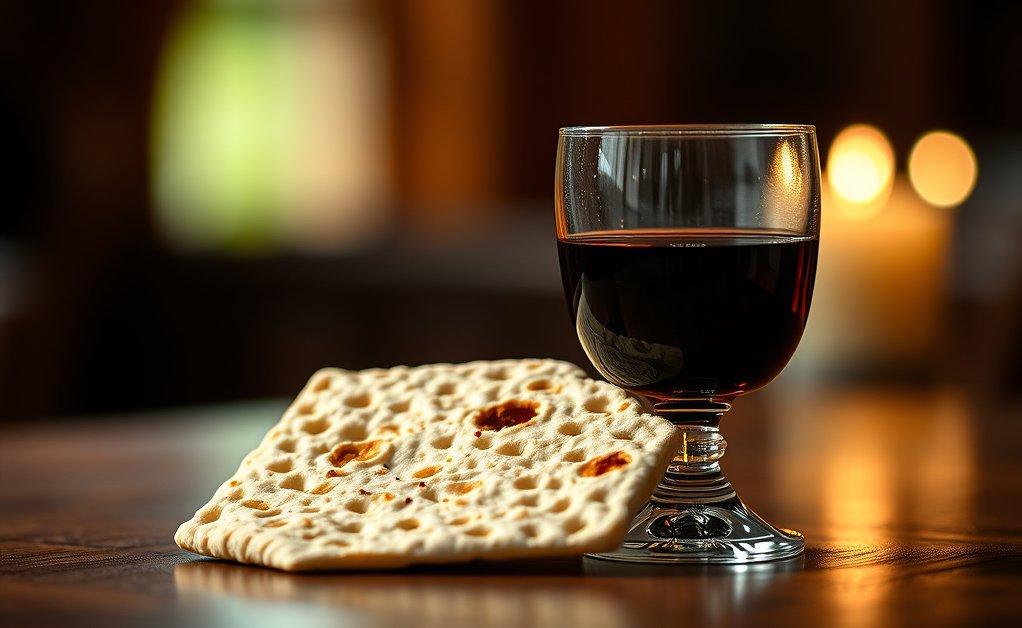
The disciples were having the Passover meal, and after the first cup of wine, Jesus pulled out a piece of bread from a bag, a bread called matzah.

There were actually three pieces of bread in this bag, which were put into three different compartments.

Why three? Some people said it represented Abraham, Isaac, and Jacob. Others said it represented the priests, Levites, and the people.

During the meal, the second piece was pulled out and broken. And for the first time in any Passover meal, Jesus gave his disciples the true meaning of the bread. He said,

This is my body given for you; do this in remembrance of me. (Luke 22:19)

Jewish Christians tell us now that they believe the three pieces of bread represent the Father, Son, and Holy Spirit. But it was Jesus who came out and lived among us. And in the matzah, we see what he was like.

Matzah was made without yeast. In the Bible, yeast is always a picture of sin, and so the bread was a picture of Jesus’ sinless nature.

The bread was also pierced, so that the bread would stay unleavened during the cooking process. In the same way, Jesus was pierced for our sins.

And then the bread was broken, just as Jesus’ body was on the cross.

Then Jesus took the cup, and the cup he took was what the Jews called the “Cup of Redemption.”

It was a reminder of how God had bought the Jews out of slavery to Egypt and set them free.

But Jesus, instead of pointing back to the past, pointed to the future, saying,

This is my blood of the covenant, which is poured out for many for the forgiveness of sins. (Matthew 26:28)

Luke, in his gospel, adds the word “new” to covenant.

What did Jesus mean by new covenant? Well, when God brought the Jews out of Egypt, he gave them a covenant. An agreement. That if they would obey his laws, he would be their God and they would be his people.

But there was a problem. No one could keep those laws perfectly.

And so God promised in the book of Jeremiah that he would make a new covenant that would not depend on our effort.

He said,

I will put my law in their minds and write it on their hearts. I will be their God and they will be my people.

No longer will a man teach his neighbor or a man his brother saying, ‘Know the Lord,’ because they will all will know me from the least of them to the greatest.

For I will forgive their wickedness and remember their sins no more. (Jeremiah 31:33-34)

In this new covenant, God made several promises.

First, he would change us from the inside, changing our hearts and minds so that we can obey him.

Second, we would have a new relationship with him. We don’t need priests or pastors to stand between us and God. We can have a close intimate relationship with God himself.

And third, all our sins would be wiped away. He will remember our sins no more.

Now Jesus was saying, “The time for the new covenant has come. My blood will be poured out for you so that your sins may be forgiven and you may find new life.”

So because of Jesus and what he did for us,

Let us draw near to God with a sincere heart in full assurance of faith, having our hearts sprinkled to cleanse us from a guilty conscience and having our bodies washed with pure water.

Let us hold unswervingly to the hope we profess, for he who promised is faithful. (Hebrews 10:22-23)