
Categories
Galatians

What the law is and isn’t. What the law does and doesn’t do. (Part 2)

We talked yesterday about what the law does not do, namely, it doesn’t replace the covenant God made with Abraham.

God’s covenant with Abraham was a one-way contract solely based on God’s promise, not on anything Abraham or any of his descendants did. Because of this, nothing could ever supersede it.

Paul continues this theme on why this is so in verses 19-20. He said,

The law was put into effect through angels by a mediator. A mediator, however, does not represent just one party; but God is one. (Galatians 3:19-20)

When Moses went up the mountain to get the ten commandments, the people were so frightened by God that they told Moses,

Speak to us yourself and we will listen. But do not have God speak to us or we will die. (Exodus 20:19)

And so while Moses approached God, the people stayed at a distance from God. (Exodus 20:21)

All the words God spoke to them had to go through Moses.

God spoke to Moses, saying “Tell them to do this, this, and this. If they do, they will have life. If they don’t, they will die.”

And Moses passed on all this information to them.

But think about this a minute. Why did God need a mediator to pass on any information at all?

It was because the law was a two-way contract. Both sides had their part to fulfill. And if the Israelites did not keep their part, all the blessings promised to them in this covenant would be void.

Ultimately, that’s what happened. Because they repeatedly broke the covenant, God did away with it. It was an utterly fragile covenant.

Paul then says, “But God is one.”

That is to say, God is only one party and the only party responsible for doing anything in the covenant he made with Abraham and his descendants. Abraham didn’t have to do a thing to obtain his blessings.

So the covenant with Abraham was totally different from the covenant based on law. It was totally unbreakable because it wasn’t dependent on what we did, but on what God did.

In short, a fragile, breakable covenant can never supersede one that can never be broken.

What, then, was the purpose of the law? (Galatians 3:19)

Logical question. Paul answers,

It was added because of transgressions until the Seed to whom the promise referred had come. (Galatians 3:19)

In other words, it was a temporary way to deal with sin until Christ came.

Hundreds of years passed between the time of Moses and the time Christ came. And God needed a way to deal with sin until then. The law was that way.

But in saying that, Paul makes something very clear. He asked,

Is the law, therefore, opposed to the promises of God? (Galatians 3:21)

Put another way, “Is the law then an alternative way to salvation?”

Answer:

Absolutely not! For if a law had been given that could impart life, then righteousness would certainly have come by the law. (Galatians 3:21)

Paul’s saying here that the law is not an alternative way to salvation because if it were, there would have been no need for Christ. All we would have needed to do is keep the law.

But the truth is, no one can keep the law, and so it has no power to give life to anyone in itself. Rather, all it does and is meant to do is lead us to Him who can truly save us from our sin.

How does it do that? We’ll continue on this theme tomorrow.
Categories
Genesis

A covenant of mercy

Steak for dinner! Well, maybe not. It’s a bit pricey in Japan.

Anyway, it occurs to me that we probably won’t have steaks in heaven. And any barbecues we may have will probably be vegetarian.

At least, that’s what life was like before the flood. It was only after that, that eating meat was permitted by God.

Hmm…think we can have any meat substitutes in heaven? I’m sure some people won’t miss it too much, but I think even the Japanese would miss their sushi and sashimi.

Genesis 9 is a time of firsts. The first steak, for one thing. The first barbecue. I don’t know about you, but I don’t know how people lived without these things.

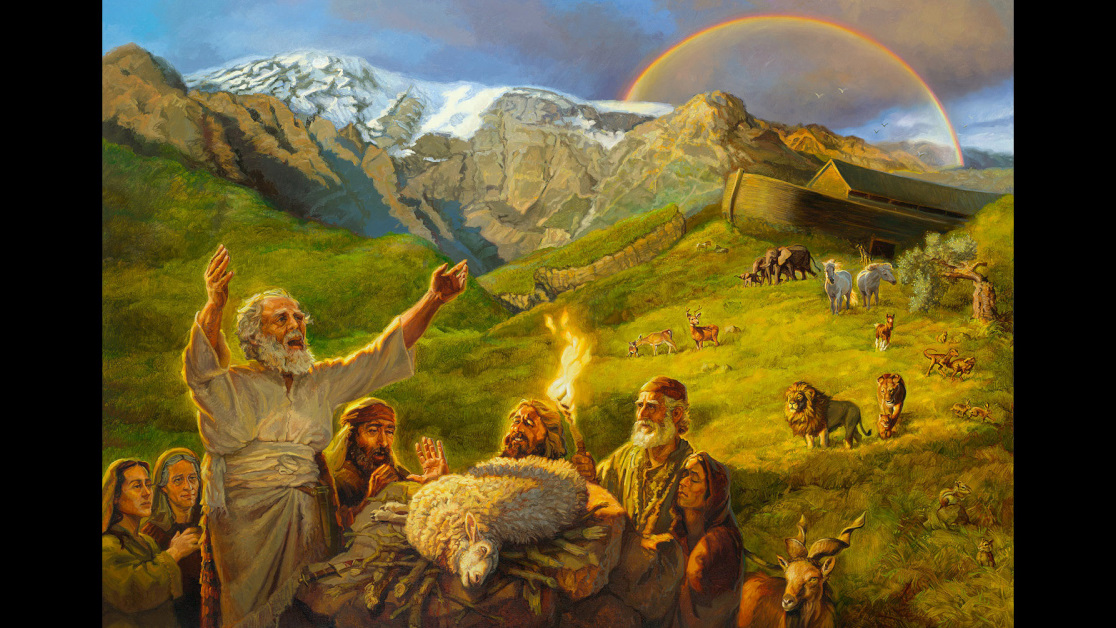
But it was also the first time fear entered the relationships between humans and animals, and I would guess also between animals and animals. The lion would no longer live with the lamb, and will not until Jesus comes back.

Finally, it also saw the first covenant made between God and man. And it was a one-sided covenant. It was a very rare thing when God made a two-way covenant in the Bible where both sides had to do something to fulfill it.

I think God knew that if he made covenants two-sided, they would quickly be broken, because with us being human, we are weak and sinful, and can’t keep our side of the deal. That’s what happened in his two-sided covenant with Israel.

But the first covenant was one-sided. The humans didn’t have to do anything at all. It was all on God. And he said, “Never again, will I ever send a flood to wipe out all of mankind again.”

It’s probably a good thing this covenant wasn’t two-sided, and dependent on how good humans behaved, because it didn’t take very long before mankind became corrupted again.

And God knew that. He knew we were weak. He knew things would get really bad in a very short period of time. Maybe it was because he knew how corrupt we would become that he made this covenant.

As I’ve mentioned before, God does not take any pleasure in the death of the wicked. He weeps over it.

I think you could say that every drop of rain that destroyed the earth came from the eyes of God. And maybe he didn’t have the heart to do it again no matter how bad things got.

The awesome thing is that the covenant of mercy that God set in place thousands of years ago still holds. And things have gotten pretty bad in this world. Yet the rainbow is a continuing sign of his mercy.

And yet as great as that covenant of mercy is, there is another covenant of mercy that’s even greater.

The covenant God first made with mankind when the flood ended is limited in that it only prevents judgment by water.

But on the final day of judgment, judgment will come to each man and woman. And this time, it won’t be a judgment by water, but a judgment by fire. (2 Peter 3:6–7)

The covenant of mercy God made to Noah will not apply on that day.

But there is another covenant of mercy that God has made that will see us through the judgment of fire. It’s a covenant where through the blood of Jesus, our sins may be forgiven if we’ll just put our trust in him and his work on the cross.

Paul says,

But when the kindness and love of God our Savior appeared, he saved us, not because of righteous things we had done, but because of his mercy. (Titus 3:4–5)

Noah and his family were spared from the flood by the mercy of God. We’ve been spared from being wiped out from this earth by that same mercy.

And on the day of judgment, when we see God face to face, those who have put their trust in Jesus will find mercy on that day.

May you know the mercy of God in your life.