Categories
Psalms Devotionals 2

If I didn’t believe…

Where would I be if I did not believe I would experience the Lord’s favor in the land of the living? (Psalm 27:13, NET)

That’s essentially how the Hebrew reads.

If I didn’t believe God is truly good and that he deeply loves me, where would I be in this broken world where so much is outside of my control?

I’d despair.

I’d be bitter.

I’d be angry.

I’d be fearful.

I’d find it hard to trust Jesus.

I’d find it difficult to keep following him.

But I do believe.

So I choose to lead my heart and sing with David,

Wait for the Lord;
be strong, and let your heart be courageous.
Wait for the Lord. (Psalm 27:14, CSB)

Categories
1 Samuel Devotionals

A beacon of hope

In addition, every man who was desperate, in debt, or discontented rallied around him, and he became their leader. About four hundred men were with him. (1 Samuel 22:2)

I was thinking today about why all these people without hope gravitated to David.

David had as many problems, if not more, than they did. They were in more danger with him than living on their own.

But there was something in David that gave them hope.

He certainly wasn’t a perfect leader. His decision to lie cost the lives of 85 priests plus their families.

Yet these people saw in David a faith and hope that they didn’t have. And I think it inspired faith and hope in them.

I want to be such a man. To my daughter, my wife, my coworkers, my friends, to everyone around me.

Honestly, I don’t feel like I’ve done such a good job with that this week, but that’s what I desire to be.

Father, let me be a beacon of hope to everyone around me. Draw them to you through me.

Categories
1 Samuel Devotionals

Faith injector

Then all the world will know that Israel has a God, and this whole assembly will know that it is not by sword or by spear that the Lord saves, for the battle is the Lord’s. He will hand you over to us.” (1 Samuel 17:46-47)

David’s words really hit me this morning.

His heart was that all nations would know the God he served. That as they saw God work through him, they would know how awesome he is.

But he also wanted to inject his own people with faith. They had lost their courage when faced with Goliath and the Philistines. And he wanted to help restore their faith.

That’s what I want. That’s my prayer.

I pray that those around me who don’t know God would see him working in me, and know that I have a God. A God who is powerful. And more importantly, a God who is good.

I pray that as they see God for who he is, that they would want to know him too.

But I also pray that I can inject the Christians around me with faith. That when they’re discouraged, they can see God working in me, and realize “God really is here. There is hope.”

Father, use me to inject faith and hope into those around me.

Categories
Psalms Devotionals 2

When you seem far

Lord, why do you stand so far away?
Why do you hide in times of trouble? (Psalm 10:1)

Father, sometimes it seems you stand far away. Sometimes it feels like you’re hiding yourself. Especially when I’m struggling.

But the truth is, you are my good King, and you reign forever and ever. (16)

The truth is, you don’t ignore me when I cry. You bend down and you listen carefully to me. (17)

And the day will come when you will make all things right. (18)

So even though you may feel far at times, help me to not trust my feelings, but you, my good King.

Categories
Psalms Devotionals 2

When God seems slow to answer

I cry aloud to the Lord,
and he answers me from his holy mountain. (Psalm 3:4)

This past Sunday, I heard a message on Luke 18 and the parable of the unjust judge.

I wonder how much confidence the widow had that the judge would respond to her cries. She had to know that he really didn’t care about her. Yet she had no alternative but to keep crying out to him.

But David had confidence that God cared. That when he cried out, God would answer.

And so though God may have seemed slow at times to answer, he kept praying and didn’t give up.

I was just thinking: When God is “slow” to answer my prayers, how confident am I that he will answer?

I want to have David’s faith.

I cry aloud to the Lord,
and he answers me from his holy mountain. (Psalm 3:4)

Categories
1 Thessalonians Devotionals

Faith, hope, love

We remember your works springing from faith, your toil springing from love, and endurance springing from hope. (1 Thessalonians 1:3)

Faith, hope, and love.

Father, let everything I do spring from these things.

Not from obligation. Not from feelings of having to “gaman”.

But faith. Faith that you are a good God. That you love me. That you know and desire my best.

Love. Love for you. Love for others.

Hope. Knowing that this world’s problems, that my problems…they are but a blink in the face of eternity. A hope that I have because of you, Jesus.

Through you, I am forgiven. God is not punishing me somehow through my problems.

Rather, through you, I have free access to the Father. And just as you were, I am chosen and beloved by him.

Help me to always keep that perspective, moment to moment, day to day.

I wait on you, Jesus. I wait on you.

Categories
Judges Devotionals

Hasn’t the Lord gone before you?

Then Deborah said to Barak, “Go! This is the day the Lord has handed Sisera over to you. Hasn’t the Lord gone before you?” (Judges 4:14)

Just thinking on those words today: “Hasn’t the Lord gone before you?”

God never tells me to go somewhere where he’s not leading the way. And the longer I live, the more I see that in my life.

Sometimes taking steps of faith is scary. It was scary for Barak. It’s scary for me.

But as I think on Deborah’s words, my prayer is this:

Father, you have proven to me that you are good. You’ve proven that you always go before me. So help me to keep taking steps of faith forward, following you. And lead on.

Categories
Joshua Devotionals

Judgment day

So Joshua conquered the whole region—the hill country, the Negev, the Judean foothills, and the slopes—with all their kings, leaving no survivors.

He completely destroyed every living being, as the Lord, the God of Israel, had commanded. (Joshua 10:40).

Let’s be honest, words like these are tough to swallow. Why would God command such a thing?

In a word: judgment.

What were the Amorites being judged for?

Their sin.

God goes into great description of that in Leviticus 18, telling the Israelites that the land was “vomiting” out the Amorites for their sin. (Leviticus 18:24-25)

That said, God was patient with them. He waited 400 years for them to repent. (Genesis 15:13-16)

They never did.

And when their sin reached their “full measure,” judgment came, with God instructing Joshua and the Israelites to wipe them out.

I mentioned in my last article that the Bible is not all encouraging and comforting words about God’s love and mercy. It also has hard words about judgment too.

God is patient. He desires all to come to repentance. (2 Peter 3:9)

But if like the Amorites, people refuse to repent, judgment will come.

So let us never take our sin lightly. Remember that a day of judgment is coming as it came for the Amorites. And always keep in mind the words of Peter.

But the day of the Lord will come like a thief; on that day the heavens will pass away with a loud noise, the elements will burn and be dissolved, and the earth and the works on it will be disclosed.

Since all these things are to be dissolved in this way, it is clear what sort of people you should be in holy conduct and godliness as you wait for the day of God and hasten its coming. (2 Peter 3:10-12)

Categories
Joshua Devotionals

Casting crowns

When Joshua was near Jericho, he looked up and saw a man standing in front of him with a drawn sword in his hand. Joshua approached him and asked, “Are you for us or for our enemies?”

“Neither,” he replied. “I have now come as commander of the Lord’s army.”

Then Joshua bowed with his face to the ground in homage and asked him, “What does my lord want to say to his servant?” (Joshua 5:13-14)

This chapter has so many awesome things in it.

I love the idea of the rolling away of our past. (9)

I was also thinking about how failing to trust and obey God will lead us to wandering around the desert instead of finding the life God desires for us. (6)

But for some reason, whenever I read this chapter, I always gravitate toward verses 13-14. This is now the fifth article I’m writing on it.

I love how the English translation of the Jewish Bible describes Joshua’s response to the commander of the Lord’s army.

Joshua threw himself face down to the ground and, prostrating himself, said to him, “What does my lord command his servant?” (14, Tanakh)

Here was Joshua, the leader of God’s people. But when the commander of the Lord’s army shows up (who many Bible scholars believe is actually Jesus), he throws himself down before him, and asks, “What do you want of me?”

It reminded me of the response of the 24 elders in Revelation 4.

Whenever the living creatures give glory, honor, and thanks to the one seated on the throne, the one who lives forever and ever, the twenty-four elders fall down before the one seated on the throne and worship the one who lives forever and ever.

They cast their crowns before the throne… (Revelation 4:9-10)

Just as the twenty-four elders cast their crowns before the throne of God, so did Joshua before his commander, submitting to God’s authority in his life.

And that was my response to Jesus today.

Jesus, I cast my crown before you. You are my King. I surrender reign over my life to you. What do you want me to do?

Categories
Joshua Devotionals

What does this mean to you?

In the future, when your children ask you, ‘What do these stones mean to you?’ you should tell them, ‘The water of the Jordan was cut off in front of the ark of the Lord’s covenant. When it crossed the Jordan, the Jordan’s water was cut off.’

Therefore these stones will always be a memorial for the Israelites.” (Joshua 4:6-7)

Last Sunday, my pastor was talking about Abraham’s circumcision, and how it was a constant reminder to Abraham of his relationship with God.

The stones in today’s passage served a similar function. They reminded the Israelites of their relationship with God and all he had done for them.

But getting back to my pastor’s message, he asked, “What things serve as memorials for you?”

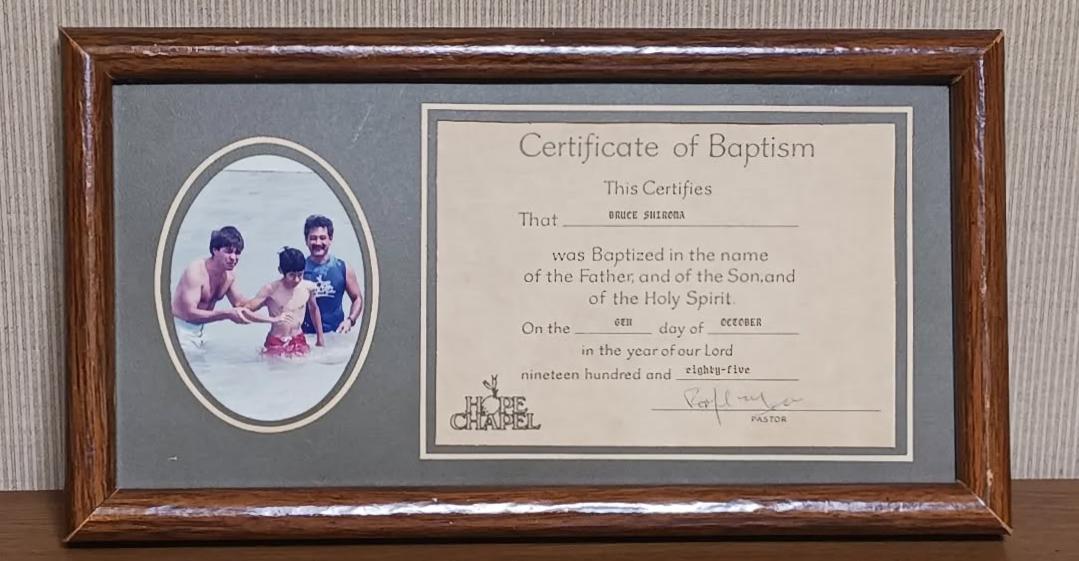
I was thinking of my baptism picture today. It’s in a box in my closet right now. I think the glass for the frame is broken, but the picture is intact.

And I was thinking, “What does that picture mean to me? Why is it stuck in that box in the closet?”

That picture actually represents a lot. It represents a turning point for me in my walk with God.

I can’t say I totally understood everything baptism represented that day. But I vividly remember my pastor asking me, “Why do you want to get baptized.”

I answered, “I want to know God better.”

An imperfect answer, to be sure.

But God honored that request. And as I look back, it wasn’t long before he started to make himself more real to me.

Maybe it’s time for me to pull that picture out of the box.

How about you? What are the things that remind you of your relationship with God? Which remind you of all he’s done for you?

What do you need to pull out of the box and put on display?

Categories
Joshua Devotionals

Because we’re on untraveled ground

When you see the ark of the covenant of the Lord your God carried by the Levitical priests, you are to break camp and follow it.

But keep a distance of about a thousand yards between yourselves and the ark. Don’t go near it, so that you can see the way to go, for you haven’t traveled this way before…”

Come closer and listen to the words of the Lord your God.” (Joshua 3:3-4, 9)

As I read those words, I couldn’t help but think of some verses I’ve been memorizing over the past week from Psalm 143.

Let me hear in the morning of your steadfast love, for in you I trust.

Make me know the way I should go, for to you I lift up my soul.

Deliver me from my enemies, O Lord! I have fled to you for refuge.

Teach me to do your will, for you are my God! Let your good Spirit lead me on level ground! (Psalm 143:8-10, ESV)

That could have been the song of the Israelites entering Canaan.

But it’s also my prayer now.

The future is all untraveled ground for me. There’s so much I don’t know.

And Satan would lay so many traps for me that I can’t see.

But God knows everything that lies ahead.

And so I want…I need to draw closer. To listen to His words. To learn to do his will. To be led by his Spirit moment to moment, day to day.

What does that look like practically? I’m still trying to figure it out, to be honest. But that’s my prayer.

Let me hear in the morning of your steadfast love, for in you I trust.

Make me know the way I should go, for to you I lift up my soul.

Deliver me from my enemies, O Lord! I have fled to you for refuge.

Teach me to do your will, for you are my God! Let your good Spirit lead me on level ground! (Psalm 143:8-10)

Categories
Acts Devotionals 2

Too small?

Why do any of you consider it incredible that God raises the dead? (Acts 26:8)

Those words stood out to me today. Not because I don’t believe God can raise the dead. But it made me wonder, “Are there other ways in which I make God too small?”

I was praying for someone today, and the thought occurred to me, “Do I really think this can happen? Or am I just expressing a wish, a hope for something that I don’t think will really happen?”

I don’t want to be that way. My God is big. And I want to see him that way.

It made me think of an old worship song.

I have made you too small in my eyes.
O Lord, forgive me.

And I have believed in a lie
that you were unable to help me.

But now, O Lord, I see my wrong.
Heal my heart and show yourself strong.

And in my eyes and with my song,
O Lord, be magnified.
O Lord, be magnified. — Don Moen

Categories
Acts Devotionals

In all good conscience (2)

I always strive to have a clear conscience toward God and men. (Acts 24:16)

This is the second time in two chapters that Paul talks about keeping a clear conscience before God. (Acts 23:1)

Why was that important to him?

I think there were three reasons.

First, he knew there was a resurrection and that he would stand before God’s judgment seat someday. (15)

He once told the Corinthians,

Therefore, whether we are at home or away, we make it our aim to be pleasing to him.

For we must all appear before the judgment seat of Christ, so that each may be repaid for what he has done in the body, whether good or evil. (2 Corinthians 5:9-10)

But as much as he knew the fear of the Lord, he also knew the love of the Lord, and that also drove him. He said,

For the love of Christ compels us, since we have reached this conclusion, that one died for all, and therefore all died.

And he died for all so that those who live should no longer live for themselves, but for the one who died for them and was raised. (2 Corinthians 5:14-15)

But I think a final reason is that he knew keeping a clear conscience had an effect on his testimony.

When Paul talked to Felix about judgment, it scared Felix to death. (Acts 24:25)

I half-wonder if one reason Felix was hoping for a bribe from Paul was to diminish his testimony. After all, if Paul accepted a bribe, how afraid of judgment could Paul really be?

But Paul kept a clean conscience, and his testimony stood.

How important is keeping a clear conscience to us?

Father, help me to always keep a clear conscience before you. For fear of you. For love of you. And for an unstained witness that might draw the people I love to you.

Categories
Acts Devotionals

Being God’s intersection point (3)

Whenever I read Acts 6, the words that describe Stephen always strike me.

“Full of the Holy Spirit.”

“Full of wisdom.”

“Full of faith.”

“Full of grace.”

“Full of power.”

And it made me think, if I truly want to be God’s intersection point to those around me, I need all those things.

But it made me ask, “Why was he that way?”

Among other things, I’m guessing that he like the other Christians were “devoted to the Word and to prayer.” (Acts 2:42)

Those two things were at the core of the 12 apostles’ ministry. (Acts 6:4)

By knowing God’s word well, Stephen grew in wisdom.

By devoting himself to prayer, he formed a strong connection with the Holy Spirit who filled him with grace, power, and faith.

And so I’m thinking, I probably need to spend a little more time in both. Maybe much more time.

Obviously, I have work obligations, family obligations, and other things.

But I think God is saying to me, “Just a little more time. Give me just a little more time. A little less time on the computer. A little less time on Youtube. A little less time on podcasts. And a little more time with me.”

What’s God saying to you?

Categories
John Devotionals

Three questions

So when Jesus looked up and noticed a huge crowd coming toward him, he asked Philip, “Where will we buy bread so that these people can eat?”

He asked this to test him, for he himself knew what he was going to do. (John 6:5-6)

I was thinking this morning what it meant that Jesus was testing Phillip.

What was he asking Phillip?

I’m not sure, but I imagine he was asking, “Do you know who I am yet? Do you know what I’m capable of doing? How much do you trust me?”

If that’s what Jesus was asking, Phillip failed the test on all three counts.

All he could see was the disciples’ inadequacy in meeting the needs of the crowd.

But Jesus already knew what he was going to do. And in his grace, he used what little Phillip and the disciples had to feed thousands.

Sometimes, I am like Phillip. Jesus sees people around me he wants to minister to. He already knows what he’s going to do. But he turns to me and asks, “Do you know who I am yet? Do you know what I’m capable of? How much do you trust me?”

But instead of seeing who Jesus is and what he can do, all I can see is my own weaknesses and inadequacies.

The truth is, my weaknesses and inadequacies are irrelevant. What’s important is who Jesus is. What he can do.

The only question is will I trust him and do what he asks.

Because Jesus is more than able to take what little I have to touch those around me with his love.

So maybe I need to think on those questions more.

“Do you know who I am yet?”

“Do you know what I’m capable of doing?”

“Do you trust me?”

Categories
John Devotionals

First loved

For God loved the world in this way: He gave his one and only Son, so that everyone who believes in him will not perish but have eternal life. (John 3:16)

I reallly like this translation.

Most translations read, “For God so loved the world…” and it can be translated that way. But usually, the Greek word for “so” would be read not as “so much,” but as “in this way.”

John uses different words in his letter, but expresses the same idea.

God’s love was revealed among us in this way: God sent his one and only Son into the world so that we might live through him.

Love consists in this: not that we loved God, but that he loved us and sent his Son to be the atoning sacrifice, for our sins. (1 John 4:9-10)

Paul says something similar in Romans 5:8.

But God proves his own love for us in that while we were still sinners, Christ died for us.

The amazing thing is that God didn’t wait for us to turn to him before he showed us his love. Rather, he first turned to us. Not in judgment, but in mercy.

I wonder. How shocked was Nicodemus that Jesus said God demonstrated his love for the world by sending his Son.

It’s possible that his only concept of God sending his Son was to judge the world for its rebellion (Psalm 2).

Had Nicodemus ever considered that the blessed people in Psalm 2:12 could apply to those nations who had once been rebellious but had repented because of God’s love for them shown through his Son? Had the psalmist?

I don’t know. But let’s always remember the most amazing thing about John 3:16. God first loved an unrepentant, rebellious world, and sent his Son to save it.

And that includes us.

Take time to ponder that today. Ponder John 3:16. Ponder 1 John 4:9-10. Ponder Romans 5:8.

Ponder this truth and bathe in it: “God first loved me.”

Categories
John Devotionals

The one who sees our hearts

While he was in Jerusalem during the Passover Festival, many believed in his name when they saw the signs he was doing.

Jesus, however, would not entrust himself to them, since he knew them all and because he did not need anyone to testify about man; for he himself knew what was in man. (John 2:23-25)

[Peter] said, “Lord, you know everything; you know that I love you.” (John 21:17)

Jesus, you see my heart. You don’t need anyone to tell you what is there. Because you know me. And so I say with Peter, “You know that I love you.”

You know how imperfect my love is. You know my failings. You know my sin. But you also know I love you.

Still, it’s so easy to deceive myself. So peel off the layers of my own heart. Expose it. Show me the things you see so that you can heal it.

Lord Jesus, I want to be like you. Make me like you.

Categories
John Devotionals

A world that needs light

In him was life, and that life was the light of men. That light shines in the darkness, and yet the darkness did not overcome it…

The true light that gives light to everyone was coming into the world. (John 1:4-5, 9)

Last week, I was reading the news and it said that 527 students from elementary school to high school committed suicide in Japan last year.

Just one is too many.

John tells us that in Jesus is life, and that he is the light-giver to those walking in darkness.

There are so many people living in that darkness. So many people living without hope.

And they need that light.

In my church, we’ve been talking recently about our Father’s eyes, and the importance of understanding how God sees us.

That understanding brings light to our darkness.

That’s what Jesus did for everyone he touched. Whenever people looked into his eyes, they saw the Father’s eyes. And it brought light into their darkness.

My prayer is that people would see Jesus in me. That when people look into my eyes, my wife, my daughter, my students, my coworkers, everyone I meet, they would see my Father’s eyes.

And that through me, God would bring his light into their darkness.

May we all have our Father’s eyes.

Categories
Numbers Devotionals

How God sees us

How can I curse someone God has not cursed?

How can I denounce someone the Lord has not denounced? (Numbers 23:8)

As I read those words, I thought about what Paul said to the Roman Christians.

Who can bring an accusation against God’s elect? God is the one who justifies.

Who is the one who condemns? Christ Jesus is the one who died, but even more, has been raised; he also is at the right hand of God and intercedes for us. (Romans 8:33-34)

Satan would denounce us before the Father for all our sins and failures.

Sometimes, we even denounce ourselves.

But how can we denounce someone our Father has not denounced?

Our Father justifies us by the blood Jesus shed for us on the cross. And Jesus himself stands by the Father’s side and defends us.

God foreknew us. He predestined us to be his children and to be like Jesus. He called us. He justified us. And he glorified us in his sight.

That’s how he sees us. He sees us as our loving Father.

And the good news is, he won’t change his mind. I love Numbers 23:19.

God is not a man, that he might lie, or a son of man, that he might change his mind.

Does he speak and not act, or promise and not fulfill?

God is determined to bless us and he will. (Numbers 23:20)

We may face his discipline at times for our sins, but he will never abandon us.

And because he never changes his mind, nothing can separate us from his love. (Romans 8:38-39)

God is with us. So let’s rejoice in our King. (Numbers 23:21)

And every day, let’s cry out, “What great things God has done for me!” (Numbers 23:23)

Categories
Numbers Devotionals

Only words?

As I was reading Balaam’s story, I couldn’t help but think of Jesus’ rebuke of the Pharisees and scribes:

This people honors me with their lips, but their heart is far from me. (Matthew 15:8)

At times, Balaam sounded very pious.

“I can’t possibly go against God’s command, small or great.” (Numbers 22:18)

Bu though he honored God with his lips, his heart was apparently far from God.

Because of his greed, it seems he was trying to find some way circumvent God’s command to him. (2 Peter 2:15-16)

But God saw his heart and made sure Balaam knew that he was not fooled. Only then did Balaam refrain from cursing the Israelites.

But even then, Balaam later found a way to bring trouble on the Israelites. (Numbers 25:1-5, 31:16)

It’s easy on Sunday to sing songs saying, “Yes, Lord. Yes, Lord. Yes, yes, Lord. Amen!”

But is it just words?

Or is it our heart?

A heart that is fully given to God, not just on Sunday, but all week, moment to moment, day to day?

Do we wholeheartedly follow him? Or do we try to find ways to get around his commands?

Father, I don’t want to be like Balaam. May my heart be completely yours.

Categories
Numbers Devotionals

Breaking faith with God

Because you did not believe in me, to uphold me as holy in the eyes of the people of Israel, therefore you shall not bring this assembly into the land that I have given them. (Numbers 20:12)

I was thinking on those words God spoke to Moses and Aaron this morning.

“You did not believe in me.”

Instead of believing God’s instructions and doing things God’s way, Moses did things his own.

In doing so, he showed the same lack of honor to God that the people had with all their complaining and rebelliousness.

Later Moses paraphrased what God had told him. “You broke faith with me. You betrayed my trust. You were unfaithful and disloyal to me.” (Deuteronomy 32:51)

Here was a man that God had spoken to face to face, as a man does with a friend. (Exodus 33:11).

And Moses had betrayed that trust.

How much did that pain the heart of the Father?

Father, how often am I like Moses? How often do I fail to believe in you? Instead of believing your instructions and doing things your way, I do things my own?

By your grace, you saved me. By your grace, you made me your own and call me “friend.”

I never want to look into your eyes knowing that I have betrayed your trust.

Help me to always honor you as holy in my life. To give you the honor you are so worthy of in everything I say and do. And when other see me, let them see you.

In Jesus’ name, amen.

Categories
Numbers Devotionals

What cannot be forgiven

In these chapters, we see some harsh punishments that God laid on the Israelites.

For a lot of people, including Christians, that’s hard to understand, but it comes down to a truth that God laid out in chapter 15.

There is a huge difference between unintentional sins and willful, and more importantly, unrepentant rebellion.

There were sacrifices that could be made for the former.

There were no sacrifices for the latter.

Where there is unrepentant rebellion, any sacrifices would be totally meaningless. (Numbers 15:22-30)

We see this truth played out in the person who willfully and unrepentantly broke the Sabbath. (Numbers 15:32-36)

We see it also in Korah and his followers. (Numbers 16)

A rebellious heart is an ugly thing.

But when it is combined with a heart that refuses to repent, it becomes unforgivable.

All of us sin. But let us never get to the point where we willfully and unrepentantly rebel against God.

Instead, let us have the heart of David, who certainly knew willful sin, but also knew true repentance as well.

Who perceives his unintentional sins?
Cleanse me from my hidden faults.

Moreover, keep your servant from willful sins;
do not let them rule me.
Then I will be blameless
and cleansed from blatant rebellion.

May the words of my mouth
and the meditation of my heart
be acceptable to you,
Lord, my rock and my Redeemer.” (Psalm 19:12-14)

Categories
Numbers Devotionals

Eyes of faith. Eyes of fear.

When Moses sent them to scout out the land of Canaan, he told them, “…Be courageous.” (Numbers 13:17, 20)

Those words really stuck out to me this morning.

One of the things Moses told the twelve scouts before they went out to spy out Canaan was to be courageous.

But only two of them, Joshua and Caleb, came back courageous.

Why? Because they had eyes of faith. They saw how big God is.

The rest of them came back with eyes filled with fear.

Why? They could only see how big the Canaanites were.

How often do we fear the future, how often do we fear where God is leading us because we forget how big he is?

And just as importantly, how good he is.

I happened to be praying through Psalm 16 today, and verses 5-8 seemed particularly appropriate.

Lord, you are my portion and my cup of blessing; you hold my future.

The boundary lines have fallen for me in pleasant places; indeed, I have a beautiful inheritance.

I will bless the Lord who counsels me—even at night when my thoughts trouble me.

I always let the Lord guide me. Because he is at my right hand, I will not be shaken. (Psalm 16:5-8)

Categories
Numbers Devotionals

That I might honor you

Listen to what I say: If there is a prophet among you from the Lord, I make myself known to him in a vision; I speak with him in a dream.

Not so with my servant Moses; he is faithful in all my household. (Numbers 12:6–7)

Therefore, holy brothers and sisters, who share in a heavenly calling, consider Jesus, the apostle and high priest of our confession.

He was faithful to the one who appointed him, just as Moses was in all God’s household.

For Jesus is considered worthy of more glory than Moses, just as the builder has more honor than the house…

Moses was faithful as a servant in all God’s household, as a testimony to what would be said in the future.

But Christ was faithful as a Son over his household. And we are that household. (Hebrews 3:1-6)

Lord Jesus, Moses was faithful in the Father’s household as a servant. As such, he was worthy of glory and honor.

But you were faithful in the Father’s household as a Son. And because of that you are worthy of even more glory and honor than Moses.

So let me honor you in all my words and my actions. You are worthy of my obedience and respect.

Forgive me for the times I fail to honor you in that way.

Thank you for continuing to be my high priest who faithfully intercedes for me despite the times I fail to honor you. Thank you for your awesome grace. In your name I pray, amen.

Categories
Psalms Devotionals 2

Acnowledging God as God

Acknowledge that the Lord is God.
He made us, and we are his,—
his people, the sheep of his pasture. (Psalm 100:3)

Last week, I was preparing a message on the book of Job. And perhaps because of that, when I came across Psalm 100 in my quiet time, it really struck me that this was a song Job could have sung after all his experiences.

Because verse 3 was the main thing that he learned.

God is God. We are not.

He made us. We are his people, his sheep.

And that’s a good thing.

Why?

Because ultimately, he is good, his faithful love is forever, and his faithfulness through all generations. (5)

There’s a lot in this world that we can’t understand. And because of that, it’s easy to start questioning God. To start questioning his goodness. To start questioning his love toward us.

But the key to finding joy in the midst of our trials is acknowledging the Lord as God. That he is wise. That he is powerful. And most importantly, that he is loving to us.

So with those truths firmly in mind, let us shout triumphantly to the Lord. (1)

Serve the Lord with gladness. Come before him with joyful songs. (2)

Enter his gates with thanksgiving and his courts with praise. (4)

For the Lord is good, and his faithful love endures forever;
his faithfulness, through all generations. (5)

Categories
Colossians Devotionals

Letting Christ’s word dwell in us

Let the word of Christ dwell richly among you, in all wisdom teaching and admonishing one another through psalms, hymns, and spiritual songs, singing to God with gratitude in your hearts. (Colossians 3:16)

I’ve always loved the words, “Let the word of Christ dwell richly among you.”

But today I noticed how it was to dwell richly among us. Not just through Bible reading and Sunday messages, though that’s important. But Paul specifically says through psalms, hymns, and spiritual songs.

And it just made me think how much songs have shaped my Christian life. Not just worship songs. But other Christian songs as well.

Some songs came straight from scripture so that I was singing (and praying) things like Psalm 121, Romans 12:1, Romans 8:14-21, and Matthew 11:28.

Some songs didn’t quote scripture, but were scripture-based.

They taught me what it means that God is my Father. They taught me how God sees me.

They challenged me not to let my heart be hardened, but to keep a soft heart towards God.

They taught me to praise God in the midst of trial.

They taught me that worship is not just singing songs, but that our whole lives are to be praise to God.

Songs are powerful tools to let God’s word richly dwell in you.

Do you listen to music? If so, what kind of music are you listening to? Do you pay attention to what those lyrics are really saying?

If you want to let Christ’s word richly dwell in you, start looking for songs centered on Scripture. Not just “love songs” to God. But songs that communicate God’s truth.

They can be songs from church. They can be songs from Christian artists.

But sing them. Pray them. And let those words encourage, challenge, and admonish you. Pass those words on to others.

And Christ’s word will richly dwell in you.

Categories
Colossians Devotionals

Overflowing with gratitude

So then, just as you have received Christ Jesus as Lord, continue to walk in him…overflowing with gratitude. (Colossians 2:6-7)

For some reason, those last words really grabbed my heart.

“Overflowing with gratitude.”

Does that describe me?

Not living my Christian life out of obligation.

But living my Christian life out of sheer gratitude for what Jesus did for me.

Gratitude will keep me rooted in Jesus. I’ll want to be built up in him. I’ll want my faith in him to be firmly established.

Father, let me never get blasé about my relationship with you. Let my Christian life never become a drudgery. But let me always walk with you each day overflowing with gratitude. In Jesus’ name, amen.

Categories
Colossians Devotionals

That you might be first

He is the image of the invisible God, the firstborn over all creation.

For everything was created by him, in heaven and on earth, the visible and the invisible, whether thrones or dominions or rulers or authorities— all things have been created through him and for him. He is before all things, and by him all things hold together.

He is also the head of the body, the church; he is the beginning, the firstborn from the dead, so that he might come to have first place in everything. (Colossians 1:15-18)

Lord Jesus, I was created by you. I was created through you. I was created for you. Have first place in my life. You are worthy to be first in my life.

Fill me with the knowledge of your will in all wisdom and spiritual understanding so that I may walk worthy of you, fully pleasing to you, bearing fruit in every good work, and growing in my knowledge of you.

Strengthen me with all power so that I may have great endurance and patience, filled with joy and thanksgiving.

Your grace to me is incredible. You have given me an inheritance with your people. You rescued me from the domain of darkness and brought me into your kingdom.

By your death on the cross, you present me before the Father holy, faultless, and blameless.

By your grace, let me remain grounded and steadfast in faith, never shifted from the hope I have through your gospel.

In your name I pray, amen.

Categories
Philippians Devotionals

Working out our salvation

Therefore, my dear friends, just as you have always obeyed, so now, not only in my presence but even more in my absence, work out your own salvation with fear and trembling… (Philippians 2:12)

I was thinking today on what it means to work out our salvation.

I think Paul explains his meaning more clearly in chapter 3.

He’s not talking about trying to become righteous by his own efforts to keep the law. His righteousness came by faith in Christ’s work on the cross for him. (Philippians 3:9)

So what does he mean by working out his salvation?

  1. Pursuing his relationship with Jesus. Knowing Christ became his ultimate pursuit in life above all other things.
  2. Becoming more and more like Jesus. Paul wanted to experience Jesus’ resurrection power in his life, becoming like his Lord.

    But before he could be raised with Jesus, he had to die with Jesus. Just as Jesus suffered and died to sin once for all time, Paul needed to learn to die to sin once and for all so that he could live for God (Romans 6:10-11).

    And by Paul joining in Christ’s sufferings, he showed that he was through with sin, no longer living for himself, but for God’s will. (1 Peter 4:1-2)

That’s what it means to work out our salvation. And it’s an ongoing process. A process that Paul admitted he had not fully completed yet.

He still fell short. He still hadn’t arrived.

But Jesus in his grace had taken hold of him. And so Paul strove to take full hold of the salvation he had received, working out his salvation with fear and trembling.

I marvel at the fact that this same Jesus that took hold of Paul has taken hold of me. And so like Paul, I’m striving to take full hold of the salvation I have received, working out that salvation with fear and trembling.

I still fall short. I still haven’t arrived. But with full confidence in the grace and love God has given me, I say with Paul,

Forgetting what is behind and reaching forward to what is ahead, I pursue as my goal the prize promised by God’s heavenly call in Christ Jesus. (Philippians 3:13-14)

Categories
Philippians Devotionals

With fear and trembling

Therefore, my dear friends, just as you have always obeyed, so now, not only in my presence but even more in my absence, work out your own salvation with fear and trembling. (Philippians 2:12)

With fear and trembling.

I was meditating on those words this morning.

What do they mean?

Three times, Paul uses that exact phrase, and each time it’s in the context of obedience to the Lord.

In 2 Corinthians 7:15, the Corinthians received Timothy with fear and trembling because of Jesus who he represented and who they obeyed.

In Ephesians 6:5, Paul told slaves to obey their masters with fear and trembling just as they obeyed Jesus with fear and trembling.

And here in Philippians 2:12, he tells the Philippians that as they have always obeyed, to work out their salvation with fear and trembling.

Of course, Jesus fully accomplished our salvation on the cross, but as we follow and serve him, we more fully experience the benefits of that salvation. And the greatest benefit is a restored relationship with the God who deeply loves us.

So a large part of working out our salvation is learning to walk in that restored relationship with God, moment to moment, day to day.

But why do so with fear and trembling?

Because Jesus has been given the name above all names. Every knee shall bow and every tongue confess that he is Lord.

I can’t help but think that Paul was not only thinking of Isaiah 45:23 which he quotes, but Psalm 2.

Psalm 2 is a Messianic psalm in which God essentially does what Paul talks about in Philippians 2: he establishes Jesus as king over all. And all who rage against him and rebel will be destroyed. Such people should be afraid of his wrath.

But on the other hand, all who take refuge in Jesus will find joy. (Psalm 2:12)

And so, the psalmist writes,

Serve the LORD with fear, and rejoice with trembling. (Psalm 2:11, ESV)

Sound familiar? I think that’s what Paul is alluding to when he says work out your salvation with fear and trembling.

We are not Jesus’ equals. Jesus is King of kings and Lord of lords. He is worthy of our obedience. And he will judge all those who rebel against him.

Because of that, we dare not take him lightly.

And yet, when we acknowledge his lordship in our lives, we need not live in constant fear of his punishment. Punishment is for his enemies, not us.

Rather with reverential awe, not only that, with gladness and joyful songs, we serve him. (Psalm 2:11 (CSB), Philippians 2:13 NLT, Psalm 100:2)

In our trembling, we rejoice at the grace God has given us. We rejoice that he works in us to will and work according to his good purpose. (Philippians 2:13)

I think another psalmist sums up the meaning of working out our salvation with fear and trembling.

Acknowledge that the LORD is God. He made us, and we are his— his people, the sheep of his pasture.

Enter his gates with thanksgiving and his courts with praise. Give thanks to him and bless his name.

For the LORD is good, and his faithful love endures forever; his faithfulness, through all generations. (Psalm 100:3-5)

So this year, let us not take our Lord or the salvation he has given us lightly. Rather, let us work out our salvation with fear and trembling. And rejoicing.

Categories
Philippians Devotionals

Praying for others. Praying for ourselves.

As I was reading Paul’s words today, I started to pray some of his prayers for the Philippians for the people on my prayer list, for my family and small group in particular, but also for my pastor and his wife.

I pray that <name>’s love will keep on growing in knowledge and every kind of discernment, so that <name> may approve the things that are superior and may be pure and blameless in the day of Christ, filled with the fruit of righteousness that comes through Jesus Christ to your praise and glory, God.

I believe you started a good work in <name>. Please carry it to completion.

Let <name> live a life worthy of your gospel, and may you be highly honored in <name>’s body. (From Philippians 1:6, 9-11, 20, 27)

As I was praying, though, I realized I needed those prayers too. And so I prayed for myself as well.

Father, I pray that I too will keep growing in knowledge and every kind of discernment, so that I may approve the things that are superior and be pure and blameless in the day of Christ, filled with the fruit of righteousness that comes through Jesus Christ to your praise and glory.

You started a good work in me. Please carry it to completion.

Let me live a life worthy of your gospel, and be highly honored in my body, in my life today. In Jesus’ name, amen.”

Categories
Ephesians Devotionals

Put all of your armor on

Put on the full armor of God so that you can stand against the schemes of the devil…

For this reason take up the full armor of God, so that you may be able to resist in the evil day, and having prepared everything, to take your stand. (Ephesians 6:11, 13)

“The full armor.”

Those are the words God impressed on me this morning.

Put on the full armor. Take up the full armor. Not just part of it. All of it.

Satan schemes against us and uses different strategies to get at us, not just one. And if we don’t put on the full armor every day, we’re vulnerable.

Rephrasing Paul’s words, if you don’t put on the full armor, you can’t stand against the devil’s schemes.

If you don’t take up the full armor, you won’t be able to resist, you won’t be able to take your stand.

So put on truth. The truth of God’s word. Make it foundation of your thinking. Let truthfulness also mark your speech. And put away the masks. Don’t be two-faced, one person at church, another person outside the church.

Put righteousness over your heart. Deal rightly with the people around with you. And when Satan accuses you for your failings, put on Christ’s righteousness which is ours by faith in him.

Put on the gospel of grace on your feet, so that you don’t slip into constant self-condemnation, nor legalism, nor willful sin.

Take up the shield of faith. But don’t just stand alone. Stand together with other Christians.

Make fellowship with them a priority so that your shield becomes part of a mighty turtle shell that protects not only you, but the Christians around you from Satan’s attack.

Receive the helmet of salvation. Welcome it with thanksgiving, knowing that you received it freely by God’s grace.

And swing the sword of God’s word whenever the enemy comes against you with his lies.

How about you? Are you putting it all on every day? Or are you leaving some of it on the floor?

Categories
Ephesians Devotionals

Drawn near

At that time you were without Christ, excluded from the citizenship of Israel, and foreigners to the covenants of promise, without hope and without God in the world.

But now in Christ Jesus, you who were far away have been brought near by the blood of Christ…

For through him we both have access in one Spirit to the Father. So, then, you are no longer foreigners and strangers, but fellow citizens with the saints, and members of God’s household. (Ephesians 2:12-13, 18-19)

This is perhaps my favorite passage in Ephesians. And it perfectly encapsulates Christmas and why Jesus came.

We were outsiders to God’s family, foreigners to all of God’s promises of blessing to Abraham and his descendants. But now in Jesus, we who were once far away have been brought near.

We see this in Jesus’ own family tree.

Tamar was a Canaanite, a people that God would ultimately order the Israelites to destroy because of their sin. (Matthew 1:3; Genesis 10:15-18, 15:16; Leviticus 18:24-28; Deuteronomy 7:1-4)

Rahab also was a Canaanite and a prostitute as well. (Matthew 1:5)

Ruth was a Moabite, another group that was supposed to have been excluded. (Matthew 1:5 Deuteronomy 23:3-4)

All of them perfectly fit what Paul talked about: excluded from the citizenship of Israel, foreigners to the covenant of promise, without hope and without God in the world.

But they were brought near, fellow citizens with the saints and members of God’s household.

And so are we.

Meditate on those words this Christmas. Chew on them.

And rejoice.

I know I am.

Categories
Ephesians Devotionals

Lavished on

Blessed is the God and Father of our Lord Jesus Christ, who has blessed us with every spiritual blessing in the heavens in Christ.

For he chose us in him, before the foundation of the world, to be holy and blameless in love before him.

He predestined us to be adopted as sons through Jesus Christ for himself, according to the good pleasure of his will, to the praise of his glorious grace that he lavished on us in the Beloved One. (Ephesians 1:3-6)

I love the translation of verse 6. God has “lavished” his grace on us.

The word translated “lavished” is used only one other time in the New Testament, when Gabriel visited Mary. Gabriel told her,

Greetings, favored woman! The Lord is with you.(Luke 1:28)

He was basically saying to her, “Mary, God has lavished his grace upon you.”

You may think that Mary must have been pretty special for the angel to say that to her.

And yet, God says the same thing to us.

“I have lavished my grace upon you through my Son. I chose you before the foundation of the world to be adopted into my family.”

The words God spoke to Mary are for you. God has lavished his grace on you. And in Jesus, he is Immanuel, “God with us.”

Categories
2 Thessalonians Devotionals

Be an example? Me?

For you yourselves know how you should imitate us…we did it to make ourselves an example to you so that you would imitate us. (2 Thessalonians 3:7, 9)

Those words really hit me this morning. Paul’s words are pretty bold: “You yourselves know how you should imitate us.”

Honestly, I don’t know if I feel that bold.

I see all my flaws. I see all the areas I still need to grow.

Why would people want to imitate me?

But God calls all of us to make disciples. Not just the pastors. Not just the church leaders. All of us. He calls all of us to make ourselves examples to the people in our lives so that they would imitate us.

And I suppose that means them not only seeing our strengths and imitating them, but seeing us working on our flaws as well.

And to see us moment to moment, day by day, walking in God’s grace, not under condemnation for our flaws, but with full confidence as children of God.

Father, I desire to be someone others want to imitate. In a lot of ways, I feel unworthy of that.

But as people watch me, let them see not only my admirable qualities that they want to imitate, let them also see the grace I walk in each day as I’m working on my flaws. In Jesus’ name, amen.

Categories
1 Thessalonians Devotionals

God is faithful. He will do it.

Now may the God of peace himself sanctify you completely.

And may your whole spirit, soul, and body be kept sound and blameless at the coming of our Lord Jesus Christ.

He who calls you is faithful; he will do it. (1 Thessalonians 5:23-24)

“He who calls you is faithful; he will do it.”

Those words rung in my mind this morning.

It brought to mind what Paul wrote in Romans 8:29-30:

For those he foreknew he also predestined to be conformed to the image of his Son, so that he would be the firstborn among many brothers and sisters.

And those he predestined, he also called; and those he called, he also justified; and those he justified, he also glorified.

I wonder. Do we really believe this?

He started this work, choosing us before we were born. Choosing us to become like his Son, our whole spirit, soul, and body sound and blameless before him.

And what he started, he will complete. Because he is faithful.

Do you like what you see in the mirror? Or do you see your sins and failures, the dirt and grime, and grimace?

Our Abba doesn’t grimace. He knew you from the first. And he still chose you. He called you. He justified you, wiping away your entire record of sin.

And whether you can see it or not, he’s in the process of sanctifying you through and through.

This is God’s will: your sanctification, your becoming like Jesus. (1 Thesssalonians 4:3)

And he’s not going to stop until he’s completed the process and he glorifies you, making you completely like his Son.

So put on the breastplate of righteousness. Not your righteousness, but the righteousness of God that comes by faiith. Let confidence in God’s love for you guard your heart. (Ephesians 6:14; 1 Thessalonians 5:8)

And know that the hope of your salvation, of your becoming like Jesus is a certain hope. Wear that hope every day.

For God did not appoint us to wrath, but to obtain salvation through our Lord Jesus Christ… (1 Thessalonians 5:9)

And again,

He who calls you is faithful; he will do it. (1 Thessalonians 5:24)

Categories
1 Thessalonians Devotionals

Loved and chosen

For we know, brothers and sisters loved by God, that he has chosen you… (1 Thessalonians 1:4)

Those are the words I was mulling over this morning.

“I am loved by God.”

“He has chosen me.”

Those words never cease to astound me.

God chose to set his love on me?

Why?

I have no answers. But it provides me great comfort.

I don’t have to strive to earn God’s favor. I already have it.

I don’t have to somehow prove myself worthy of his love. He’s already given it to me.

And so despite all the weaknesses and failings I see in me, I can rest, knowing he has accepted me.

Let those words sink into your hearts today.

“I’m loved by God.”

“And he has chosen me.”

Don’t try so hard
God gives you grace and you can’t earn it
Don’t think that you’re not worth it
Because you are

He gave you His love and He’s not leaving
Gave you His Son so you’d believe it
You’re lovely even with your scars
Don’t try so hard — Amy Grant

Categories
Bible Original

A sanctuary

They are to make a sanctuary for me so that I may dwell among them. You must make it according to all that I show you—the pattern of the tabernacle as well as the pattern of all its furnishings. (Exodus 25:8-9)

Father, dwell in me. Let my life be your sanctuary. May my life not be built according to my own blueprint, but according to yours.

Father, you are holy, your Word is holy, but so often I am unholy. So always meet me above your mercy seat (Exodus 25:21-22).

Jesus, you are my mercy seat (Romans 3:25, CSB).

By your blood, daily wash away all my sins and make me pure before you.

Father, you are always with me, providing me my daily bread (Exodus 25:23-30).

Jesus you are the bread from heaven that gives me eternal life. (John 6:33-35)

Jesus, you are my light (Exodus 25:31-38, John 8:12). Let me walk by your light each day.

In your name, I pray, Amen.

Categories
Exodus Devotions

What we all need

“What you’re doing is not good,” Moses’s father-in-law said to him.

“You will certainly wear out both yourself and these people who are with you, because the task is too heavy for you. You can’t do it alone.” (Exodus 18:17-18)

“You can’t do it alone.”

I found it interesting that Jethro told Moses that not long after the battle against the Amalekites.

Moses literally couldn’t keep his hands up as he was interceding for the Israelites before God, but Aaron and Hur supported him until victory was achieved. (Exodus 17:8-16)

And now Jethro was telling him again, “You can’t do God’s work alone.”

That’s something we all need to remember.

Our leaders may seem like “super-Christians,” but they can’t do their jobs alone.

They certainly need our prayers and encouragement. But they also need us to do our part in ministry as well.

God has given each of us gifts to minister to others. Ministry is not just the job of the leaders. It’s the job of every Christian. (Ephesians 4:11-16)

But beyond that, all of us need support in our Christian lives.

Our personal ministries to our families and those around us can get heavy. Life itself can get heavy.

So let’s not try to live our Christian lives on our own.

Let’s support and encourage each other so that our load will be lightened and we’ll be able to endure. (Exodus 18:22-23)

As Paul put it,

Carry one another’s burdens; in this way you will fulfill the law of Christ. (Galatians 6:2)

Categories
Exodus Devotions

Hurting? Or defiant?

He named the place Massah and Meribah, because the Israelites complained, and because they tested the Lord, saying, “Is the Lord among us or not?” (Exodus 17:7)

As I was reading those words, it struck me that there are two ways the Israelites could have been saying those words.

They could have been hurting, and saying, “God, I don’t get it. Are you really with us? We have no water. Unless you do something, we’re going to die. Please help us.”

Or they could have been defiant, saying, “Well, God, are you with us or not? What? Are you just going to let us die out here? What kind of God are you, anyway?”

From the way that Moses responded, it seems that the Israelites were speaking more from defiance.

In fact, he warned them against that kind of attitude later. (Deuteronomy 6:16)

When we go through trials, it’s easy to get tossed around by our emotions. And in our hurt, it’s okay for us to express our doubts, our pain, and our fears.

David did this all the time in the Psalms.

But one thing we must guard against is a defiant attitude. To feel like we are in a position to judge God.

We are not. There is so much he knows that we don’t.

And so when we’re hurting, when we don’t understand, we need to take a humble attitude with God.

Satan would have us question God’s goodness, and he would use our trials to destroy our trust in God.

Don’t let him do it.

Instead let’s remember Peter’s words, clinging to God’s goodness, his faithfulness, and his love toward us.

Humble yourselves, therefore, under the mighty hand of God, so that he may exalt you at the proper time, casting all your cares on him, because he cares about you.

Be sober-minded, be alert.

Your adversary the devil is prowling around like a roaring lion, looking for anyone he can devour.

Resist him, firm in the faith, knowing that the same kind of sufferings are being experienced by your fellow believers throughout the world.

The God of all grace, who called you to his eternal glory in Christ, will himself restore, establish, strengthen, and support you after you have suffered a little while.” (1 Peter 5:6-10)

Categories
Exodus Devotions

Finding God’s rest and peace

Yet on the seventh day some of the people went out to gather, but they did not find any.

Then the Lord said to Moses, “How long will you refuse to keep my commands and instructions? Understand that the Lord has given you the Sabbath…” (Exodus 16:27-29)

“The Lord has given you the Sabbath.”

Those words struck me. God wanted to give the Israelites rest. It was a gift to them.

But they couldn’t find that rest as long as they refused to trust and obey him.

It’s so amazing how quickly they forgot God’s goodness. One moment, they’re singing,

Lord, who is like you among the gods?
Who is like you, glorious in holiness,
revered with praises, performing wonders…

With your faithful love, you will lead the people
you have redeemed;
you will guide them to your holy dwelling
with your strength. (Exodus 15:11, 13)

The next moment, they’re complaining and wishing they were back in Egypt.

I don’t want to be like that, crying out, “How great is our God!” on Sunday, but failing to trust and obey him the rest of the week.

Not only does it sadden my Father, but I lose out on the gift of rest and peace he wants to give me.

Father, I want to know your rest and peace. And the thing is, you want me to experience your rest and peace. So help me to trust you and obey.

You are good. You are trustworthy. And you deeply love me.

Help me to always remember that. In Jesus’ name, amen.

Categories
Exodus Devotions

That the world may know

You must say whatever I command you; then Aaron your brother must declare it to Pharaoh so that he will let the Israelites go from his land…

The Egyptians will know that I am the Lord when I stretch out my hand against Egypt and bring out the Israelites from among them. (Exodus 7:2, 5)

Moses and Aaron were to speak God’s words so that Pharaoh and all the Egyptians would know he was the Lord.

As I read those words, it struck me that we too are to speak God’s words to those around us that they might know he is the Lord.

But whereas Moses’ and Aaron’s words were mostly words of judgment, ours is a message of reconciliation.

Paul put it this way,

Everything is from God, who has reconciled us to himself through Christ and has given us the ministry of reconciliation.

That is, in Christ, God was reconciling the world to himself, not counting their trespasses against them, and he has committed the message of reconciliation to us.

Therefore, we are ambassadors for Christ, since God is making his appeal through us. We plead on Christ’s behalf, “Be reconciled to God.”

He made the one who did not know sin to be sin for us, so that in him we might become the righteousness of God. (2 Corinthians 5:18-21)

So let’s take God’s message of reconciliation to those around us that they may know he is God…and be reconciled to him.

Categories
Exodus Devotions

Who am I?

God spoke further to Moses and said to him, “I am Yahweh; and I appeared to Abraham, Isaac, and Jacob, as God Almighty, but by My name, Yahweh, I was not known to them.” (Exodus 6:2-3, LSB)

Father, you are El Shaddai, God Almighty. You are Yahweh.

You are the God that was with Abraham, Isaac, and Jacob.

You are the God that was with Moses.

And you are with me.

Who am I that you would care about me?

That you would hear my groanings?

That you would save me and redeem me?

That you would take me to be your own?

That you would bring me into your kingdom?

That you would be my God and reveal yourself to me?

That in Jesus you have revealed yourself to me in a way that even Abraham, Isaac, Jacob, and Moses didn’t know.

And so I choose to trust you, even in my struggles.

You were faithful then. You are faithful now. And you will be faithful throughout all eternity.

I love you, Abba.

In Jesus’ name, amen.

Categories
Exodus Devotions

Do I believe You?

I wonder.

Did Moses tell the Israelites everything God had said?

Did he tell them that Pharaoh would harden his heart against them?

Or did he only tell them that God would deliver them?

I wonder.

Did Moses himself take God’s warning seriously?

He certainly didn’t seem prepared in his heart when Pharaoh said no and the Israelites got upset with him.

How about us? Do we believe God?

Do we believe Jesus when he says, “In this world you will face suffering?” (John 16:33)

Do we believe Paul when he says hard times will come? (2 Timothy 3:1-5)

Do we believe Peter? (1 Peter 4:12)

More importantly, when we do face trials, do we keep believing God is good, that Jesus has overcome this world, and that God will keep his word and ultimately will deliver us?

The question I’m asking today, that all of us need to ask is, “God, do I believe you?”

Categories
Exodus Devotions

Though God is patient

Our God is patient. That is true.

But ultimately, there is one thing he will not tolerate: willful disobedience.

We see that twice in this passage.

When God first called Moses to go to Pharaoh, Moses started making all kinds of excuses about why he couldn’t go.

But in the end, those excuses were merely excuses. And when God answered each one, Moses finally said, “I don’t want to go. Send someone else.”

At that, God got upset.

Now, by his grace, God made allowance for Moses’ weaknesses, allowing Aaron to be his spokesman.

But he did not allow Moses to simply walk away from this task he had given him.

Then we have this curious incident where God is about to kill Moses. Why?

Apparently, God had commanded Moses to circumcise his son. It was something God had commanded Abraham and all his descendants to do (Genesis 17:9-14).

And as Israel’s leader, Moses had to set an example for the people.

But for whatever reason, he didn’t. From his wife’s reaction, it’s possible she had been against her son being circumcised.

Again, God is patient and gracious. But never mistake his patience and grace for indifference to our sin.

He does not take willful disobedience lightly.

Neither should we.

Categories
Exodus Devotions

Having our Father’s heart

Years later, after Moses had grown up, he went out to his own people and observed their forced labor. He saw an Egyptian striking a Hebrew, one of his people…

After a long time, the king of Egypt died. The Israelites groaned because of their difficult labor, and they cried out, and their cry for help because of the difficult labor ascended to God.

God heard their groaning, and God remembered his covenant with Abraham, with Isaac, and with Jacob; and God saw the Israelites, and God knew. (Exodus 2:11, 23-25)

Moses was a flawed man. And yet, I think God saw in Moses a heart similar to his own. A heart that not only saw the groanings and struggles of others, but wanted to help.

Moses saw the suffering of his own people and refused to stand by and do nothing.

His murdering a man was of course wrong, but his desire to help his suffering brothers was not.

He later saw some shepherdesses also being bullied, and despite his failure the time before, he still couldn’t stand idly by.

And when God saw the suffering of his own people, he couldn’t just stand by and watch either. He had compassion on his people and determined to help them.

And so he chose to use a man who had the same kind of heart he had.

God still chooses to use the same kind of people today.

I don’t know about you, but I want to be such a man.

Categories
Matthew Devotionals

Labor pains

You are going to hear of wars and rumors of wars. See that you are not alarmed, because these things must take place, but the end is not yet.

For nation will rise up against nation, and kingdom against kingdom. There will be famines, and earthquakes in various places.

All these events are the beginning of labor pains. (Matthew 24:6-8)

As I read Jesus’ words, I thought about Paul’s words in Romans 8.

For we know that the whole creation has been groaning together with labor pains until now.

Not only that, but we ourselves who have the Spirit as the firstfruits—we also groan within ourselves, eagerly waiting for adoption, the redemption of our bodies. (Romans 8:22-23)

It’s natural as look at the problems of this world and in our own lives to groan.

But we have a hope.

Our groans and the groans of creation are not the groans of despair, of death. Our groans are the groans of childbirth, of hope, of life.

Jesus is returning.

He will judge all evil.

He will save his people and make all things new. (Matthew 24:30-31)

That’s our hope.

And our hope is certain because Jesus’ words are certain.

He tells us,

Heaven and earth will pass away, but my words will never pass away. (Matthew 24:35)

So whatever you see in this world, whatever you’re personally going through, don’t give in to despair.

Don’t let your love grow cold.

Instead be faithful in all he has given you to do.

And know in the meantime, you’re never alone.

In the same way the Spirit also helps us in our weakness, because we do not know what to pray for as we should, but the Spirit himself intercedes for us, with inexpressible groanings.

And he who searches our hearts knows the mind of the Spirit, because he intercedes for the saints according to the will of God.

We know that all things work together for the good of those who love God, who are called according to his purpose. (Romans 8:26-28)

Categories
Matthew Devotionals

The disciples we’re raising

Woe to you, scribes and Pharisees, hypocrites! You travel over land and sea to make one convert, and when he becomes one, you make him twice as much a child of hell as you are! (Matthew 23:15)

The Pharisees and scribes, needless to say, were terrible disciple-makers.

But Jesus’ words made me think, “What kind of disciples am I making? Of my daughter? Of the other people God has placed in my life?”

Do I ever put heavy loads on their shoulders that are hard to carry, and just tell them, “Good luck?”

Or are they people that know mercy as well as justice and faithfulness? (Matthew 23:23)

Do they see that mercy in me?

More importantly, do they know God’s mercy to them? Do they rest in that mercy? Do they rejoice in it?

And do they in turn show mercy to those around them?

Or are they constantly hard on themselves and just as hard on others?

Father, I want my daughter, my wife, and the people around me to see in me someone who is just and faithful.

But I also want them to see someone who is full of mercy. Who walks in your mercy and shows others that same mercy.

Help me to make disciples like that: disciples who know your mercy and show that same mercy to others.

Categories
Matthew Devotionals

Get to? Have to?

“Haven’t you read,” he replied, “that he who created them in the beginning made them male and female, and he also said, ‘For this reason a man will leave his father and mother and be joined to his wife, and the two will become one flesh’?

So they are no longer two, but one flesh. Therefore, what God has joined together, let no one separate”…

His disciples said to him, “If the relationship of a man with his wife is like this, it’s better not to marry.” (Matthew 19:4-6, 10)

It’s amazing how we Christians think a lot of times. God wants to give us something good. And all we focus on is the “have tos.”

God gives marriage to us as a gift, as a blessing. And all the disciples could think was, “Wait. I have to stay married to my wife all my life?”

Later, Jesus gave a young man the opportunity to follow him. To be his disciple. To find true life.

And all the man could think was, “Wait, I have to give all my possessions to the poor?” (Matthew 19:21-22)

Why do we so quickly think that way?

God says to us, “Don’t you understand how much joy I want to give you? Don’t you understand the good gift I’m giving you?”

Father, you are a good God. Forgive my stupid, hardened heart. Help me to throw away the “have to” mentality and joyfully embrace the good gifts you want to give me.

Categories
Matthew Devotionals

Can’t forgive? Or not willing?

At this, his fellow servant fell down and began begging him, “Be patient with me, and I will pay you back.”

But he wasn’t willing. (Matthew 18:29-30)

“But he was not willing.”

Those words struck me this morning.

Not willing to do what?

Not willing to be patient, certainly.

And most definitely not willing to forgive.

The picture behind verses 29-30 is that the fellow servant repeatedly asked for mercy. And the first servant repeatedly said, “I will not wait. I will not be patient. I will not forgive.”

Is that you?

Lots of people say, “I can’t forgive.”

But how often do they really mean, “I refuse to forgive”?

As God’s kids, that attitude is unacceptable. It’s unacceptable because God has forgiven us so much. To repeatedly say, “I will not forgive, I will not forgive, I will not forgive,” that is sin.

I’m not saying forgiveness is easy. Sometimes it’s downright hard. God understands that.

But there is a vast difference between stubbornly saying, “I refuse to forgive,” and humbly coming before God and saying, “I want to forgive, but I dont know how. Help me.”

Peter tells us,

All of you clothe yourselves with humility toward one another, because God resists the proud but gives grace to the humble.

Humble yourselves, therefore, under the mighty hand of God, so that he may exalt you at the proper time, casting all your cares on him, because he cares about you. (1 Peter 5:5-7)

Pride holds on to its hurt. “I’ve been hurt. I deserve to be treated better. He deserves to suffer for what he did to me.”

Humility recognizes that we ourselves have wounded others, that we have sinned against God himself.

Humility also recognizes how much we have needed the mercy of others and more importantly of God. And so we choose to let go of our hurt and forgive.

But again, forgiveness can be hard. The deeper the wound, the harder it is to forgive. But as Peter said, “God cares about you.”

God knows your wounds. And he wants to heal those wounds.

But he also knows that part of that healing can only come as you forgive. And he is willing to help you if you will humble yourself before him saying, “I don’t know how to forgive. But I am willing. Please show me how.”

How about you? Is there someone God is speaking to your heart about today?

Categories
Matthew Devotionals

“Following” Jesus, or truly following Jesus?

Then Jesus said to his disciples, “If anyone wants to follow after me, let him deny himself, take up his cross, and follow me. (Matthew 16:24)

It’s not clear in the English, but the first “follow” and the second “follow” are two different words in the Greek. Both are often used in reference to discipleship.

The first “follow” literally has the idea of walking behind someone, going where they go.

The second “follow” has that idea, but includes the idea of responding to his voice and of learning from him as his disciple. (Matthew 4:20; John 10:4, 27)

Lots of people “followed” Jesus in that first sense. Some wanted healing. Some were interested in this new teaching he brought.

But few truly followed him in the second sense.

Even his disciples struggled with it at times. Jesus told them what was “necessary” for God’s plan to be accomplished.

At that point, Peter stopped following Jesus and instead tried to lead him in a different direction. In doing so, however, he actually became a hindrance to Jesus.

It made me think.

“Am I truly following Jesus? Or are there times when I’m trying to pull him in the direction I want to go?”

“Am I following Jesus’ agenda? Or am I trying to get him to follow mine?”

How about you? Are you “following” Jesus, going to church, maybe even reading your Bible and praying from time to time, but ultimately trying to get him to follow you and your plans?

Or are you truly following him, learning from him, and responding to his voice and leading, moment to moment, day to day?

Categories
Matthew Devotionals

I must tell Jesus

For some reason, verse 12 really struck me today.

Then [John’s] disciples came, removed the corpse, buried it, and went and reported to Jesus. (Matthew 14:12)

After burying John, his disciples’ first thought was, “We must tell Jesus.”

Why?

I suppose one reason might be to warn Jesus about Herod. (Luke 9:9)

But just as importantly, they knew Jesus cared about John.

I wonder, though. Did they know Jesus cared about them? Not this general, “Jesus loves everybody.” But, “Jesus knows my grief, and he cares about me.”

What about you? Do you know Jesus really cares about you? Again, not this general, “Jesus loves everyone,” but “Jesus really does love me.”

When you go through trials and hard times, is your first response, “I must tell Jesus”?

I must tell Jesus all of my trials;
I cannot bear these burdens alone;
In my distress He kindly will help me;
He ever loves and cares for His own.

I must tell Jesus! I must tell Jesus!
I cannot bear my burdens alone;
I must tell Jesus! I must tell Jesus!
Jesus can help me, Jesus alone. — Elisha Hoffman

Categories
Matthew Devotionals

Hard words?

And whoever doesn’t take up his cross and follow me is not worthy of me. (Matthew 10:38)

Those are hard words.

When you read them, how did you feel?

Uneasy? Fearful?

Even as a long-time Christian, one of my first thoughts was, “These are hard words. Jesus is asking a lot.”

And when I think of what this might mean practically in my life, of what specifically Jesus might be asking of me, it gets even harder.

And so the question I had to ask myself this morning was, “What do I do with these feelings?”

What do I do?

Remember the truth.

What’s the truth?

My Abba is good and he deeply loves me.

Aren’t two sparrows sold for a penny? Yet not one of them falls to the ground without your Father’s consent.

But even the hairs of your head have all been counted. So don’t be afraid; you are worth more than many sparrows. (Matthew 10:29-31)

What is the truth?

If I take up my cross and follow Jesus, I don’t lose my life. I gain it.

Anyone who finds his life will lose it, and anyone who loses his life because of me will find it. (Matthew 10:39)

No, following Jesus isn’t always easy. Sometimes, it’s painful.

But because my Abba is good and he deeply loves me, because he is always faithful in keeping his promises, I have hope. And it is a certain hope.

I have told you these things so that in me you may have peace.

You will have suffering in this world. Be courageous! I have conquered the world. (John 16:33)

Categories
Matthew Devotionals

When we are “unclean”

Right away a man with leprosy came up and knelt before him, saying, “Lord, if you are willing, you can make me clean.”

Reaching out his hand, Jesus touched him, saying, “I am willing; be made clean.” (Matthew 8:2–3)

Leprosy was a terrible disease in Israel. It made people “unclean,” outcasts from society, and as such, they were banned from God’s temple. (Leviticus 13:45-46, Numbers 5:2-3).

In that way, leprosy is a picture of sin. It makes us spiritually unclean and breaks our relationships with God and others.

But the man in this story approached Jesus and said, “If you are willing, you can make me clean.”

And in his mercy and grace, Jesus touched him and said, “I am willing. Be clean.”

Often times after we sin, we wonder if God could possibly forgive us, if he could possibly accept us after what we’ve done.

And so we come before him trembling, saying, “If you are willing, you can make me clean.”

Jesus says the same thing to us as he said to that man.

“I am willing. Be clean.”

So, children of God, let us approach his throne with confidence, knowing that we will receive mercy and find grace in our time of need. (Hebrews 4:16)

Categories
Matthew Devotionals

Praying to our Abba

When you pray, don’t babble like the Gentiles, since they imagine they’ll be heard for their many words…Therefore, you should pray like this: Our Father in heaven. (Matthew 6:7, 9)

As I read Jesus’ words, I thought about what Solomon said in Ecclesiastes.

Do not be hasty to speak, and do not be impulsive to make a speech before God. God is in heaven and you are on earth, so let your words be few. (Ecclesiastes 5:2)

Solomon was mostly warning against making foolish vows to God. Sometimes, in our attempts to win his favor, or worse to manipulate God, we make all kinds of promises that we’re unable to keep.

Jesus on the other hand, seemed to be talking about people making flowery but ultimately empty prayers in order to impress God and those hearing their prayers.

In both cases, Jesus and Solomon say the same thing: Let your words be few. Do more listening than speaking.

But when you speak, Jesus gives us a model to follow.

Reflect on who God is and honor him as holy. Worship him. (Matthew 6:9; Revelation 4:8-11)

As you pray, set your heart on his kingdom. Ask him, “What’s important to you, today?” (Matthew 6:10a, 33)

And as you reflect on these things, ask that his will be done in your life, that you can participate in what he’s doing. (Matthew 6:10b)

But as much as he is God in heaven, remember he is also your Abba in heaven. And you are his beloved child. (Matthew 6:9)

So ask him for your needs. (Matthew 6:11, 25-32)

When you fall, don’t fear to approach him. Draw near and seek his forgiveness. (Matthew 6:12a)

Ask for his help concerning your broken relationships, especially when you’re struggling to forgive others. (Matthew 6:12b)

And ask your Abba for his leading and protection. (Matthew 6:13)

We have such an incredible privilege as God’s kids. We get to approach our Abba at any time. So let’s take advantage of that privilege and draw near.

Categories
Matthew Devotionals

Disciple? Or just one of the crowd?

When he saw the crowds, he went up on the mountain, and after he sat down, his disciples came to him. (Matthew 5:1)

For some reason, I’ve always imagined that Jesus went up to the mountain to in order to preach to the crowd.

But actually, it seems he went to escape the crowds. Most times Jesus went up to the mountain, it was usually to pray.

If Matthew 5 and Luke 6 refer to the same event as some Bible scholars think, then that’s why he went this time too.

And after he finished praying, it wasn’t the crowd that came to him at first, though they would apparently come later (Matthew 7:28). It was his disciples.

The crowd had mostly come to Jesus for healing. (Matthew 4:24-25)

But the disciples came to learn from Jesus.

It made me think. “Why do I come to Jesus?”

Is it simply to get something from him? Help? Healing? Blessing?

Or is it to learn from him?

Am I just one of the crowd?

Or Jesus’ disciple?

I want to be a disciple, learning from my Lord.

I want to be like him. Pure in heart. Hungry and thirsty for righteousness. Gentle. A peacemaker. Light and salt to this world.

Not just having superficial righteousness, but true righteousness that comes from the heart.

Loving others as he does. Being perfect as my heavenly Father is perfect.

It made me think of a song I learned long ago, and it’s my prayer today.

Lord, I want to be your disciple,
an example, the way you were to me.

And as I see your humble perfection,
let me be a mirror of your heart.

I want to walk in the image of you,
like a child imitating what his Father would do.

A mirror of your heart. — Chris Christian

Categories
Matthew Devotionals

The joy of following Jesus 

“Follow me,” [Jesus] told them, “and I will make you fish for people.” Immediately they left their nets and followed him.

Going on from there, he saw two other brothers, James the son of Zebedee, and his brother John. They were in a boat with Zebedee their father, preparing their nets, and he called them.

Immediately they left the boat and their father and followed him.” (Matthew 4:19-22)

I wonder. How did Peter, Andrew, James, and John feel when Jesus said to them, “Follow me, and I will make you fish for people?”

Inadequate? Unqualified? Scared?

Perhaps. But somehow, I think they were mostly filled with overwhelming awe and joy.

“Me? Jesus would choose me?”

And so filled with awe and joy, they immediately dropped their nets, left their family business, and followed Jesus.

They weren’t thinking, “Follow Jesus? I’d have to give up so much!”

They were thinking, “I get to follow Jesus! I get to join in his work! This is awesome!”

Often times, though, when we think about following Jesus, about joining in with his work, we feel uneasy. “I’m inadequate. I’m unqualified.”

Or we feel burdened by the “have tos.”

I know I sometimes feel that way.

But Jesus deeply loves us. And knowing everything about us with all our weaknesses and failings, he still looks at us and says, “Follow me. Come. Join me in my work.”

That’s the joy of following Jesus. It’s an awesome privilege that he gives us.

Following Jesus and joining in his work isn’t about the burden of the “have tos.”

It’s the overwhelming joy of the “get tos.”

How about you? Do you know that joy?

Categories
Galatians Devotionals

Bearing the marks of Christ

Those who want to make a good impression in the flesh are the ones who would compel you to be circumcised—but only to avoid being persecuted for the cross of Christ.

For even the circumcised don’t keep the law themselves, and yet they want you to be circumcised in order to boast about your flesh.

But as for me, I will never boast about anything except the cross of our Lord Jesus Christ. The world has been crucified to me through the cross, and I to the world…

From now on, let no one cause me trouble, because I bear on my body the marks of Jesus.” (Galatians 6:12-14, 17)

I was chewing on those last few words of Paul, “I bear on my body the marks of Jesus.”

The word “marks” usually carried the idea of a slave being branded, identifying who their master was.

For the Jews, circumcision was the sign they belonged to God. As a Jew, Paul had received circumcision, but for him, he wasn’t pointing to that as his identifying mark.

Rather, Paul pointed to the scars he bore for faithfully preaching God’s gospel of grace.

Many times, the Jews persecuted him for preaching a salvation based on the cross instead of a salvation based on circumcision and on keeping God’s laws.

He had gone through many other hardships as well for preaching that gospel. (2 Corinthians 11:24-29)

And so he tells those preaching a false gospel to the Galatians, “Stop bothering me and hindering the work that I’ve done among the Galatians. You aren’t true servants of Christ. You’re only preaching circumcision because you want to avoid persecution.

“But my scars, not my circumcision, prove that I truly belong to Christ.”

I can’t help but wonder, though, if he was also trying to tell the Galatian Christians something else.

“Circumcision isn’t what marks you as belonging to God. You already carry the ‘marks’ of Christ which he received on the cross. You have been crucified with Christ and died to the law and its condemnation of you.

“More, you’ve died to the sin that once enslaved you and you’re no longer living for the things of this world. Rather, you live for Jesus who loves you and gave himself up for you. That’s what marks you as a child of God.”

So let us walk each day as children of God, proudly wearing the marks of our crucified Lord whom we love.

I have been crucified with Christ, and I no longer live, but Christ lives in me.

The life I now live in the body, I live by faith in the Son of God, who loved me and gave himself for me. (Galatians 2:20)

Categories
Galatians Devotionals

Led by the Spirit? Under law?

But if you are led by the Spirit, you are not under the law. (Galatians 5:18)

There are certain ways that a person led by the Spirit and a person under law can look similar.

Superficially, both may look like “good people.”

But there are some marked differences.

People under law live their entire lives trying to gain God’s love and acceptance by keeping the rules.

But because they can never keep them perfectly, they’re constantly afraid of not measuring up. Of constantly letting God down. And of God’s punishment when they fail.

The result? They’re constantly walking on eggshells when they’re around God.

Others do walk confidently before God, but only because they’ve convinced themselves that they are keeping all the rules. They’re blind to all the ways they’ve failed and don’t realize they’re actually under God’s condemnation.

But there is no condemnation for those led by God’s Spirit. Not because of their own ability to please God, but because of what Jesus did for them on the cross.

They no longer strain to gain God’s love and acceptance. Instead, they rest in the truth that God already loves and accepts them.

And with that joy in their hearts, they walk with their Father every day seeking to please him, not out of fear, but in loving response to his love for them.

They’re no longer under the strain of trying to uphold every law by their own efforts, wondering in fear if there’s something they’ve overlooked.

All they’re interested in is taking their next step forward with their Father. And led by the Spirit, they step by step put sin to death in their lives.

More, step by step, the fruit of love, joy, peace, patience, kindness, goodness, faithfulness, and self-control grows in their lives and they become more like their Father who loves them.

How are you living your life? Are you living as a beloved child of God led by the Spirit? Or are you living as if you’re under law?

Categories
Genesis Devotions

Holding on to faith in hard times 

I really wish sometimes that we could see what was going on in Joseph’s heart. We do see a hint of it in chapter 40, and a lot more of his heart in chapters 42-45.

But we have no idea what’s going on in Joseph’s heart in chapter 39.

Because of that, it’s easy to think, “Man, Joseph was such a godly man. No matter what he went through, he was so faithful to God. He never wavered.”

But today I was thinking, “Was it really so easy for him? In his first days as a slave in Egypt, did he ever struggle with bitterness towards his brothers? Did he ever ask God, ‘Why?’

“When he was falsely accused by Potiphar’s wife and he was sitting in his cell, was he ever tempted to be bitter towards God. ‘I did things God’s way, and now look what happened.'”

My guess is yes. He wasn’t perfect. He was human.

But ultimately, he held on to his faith and remained faithful to God.

In that way, he mirrored David. The both experienced mistreatment by others (Psalm 62:3-4).

They both had reasons to be bitter towards others and to God.

But they both chose to keep trusting God. And in the end, God proved himself worthy of that trust.

I was reading Psalm 62 today, and I could just imagine Joseph singing to himself something similar to what David did.

Rest in God alone, my soul,
for my hope comes from him.

He alone is my rock and my salvation,
my stronghold; I will not be shaken.

My salvation and glory depend on God, my strong rock.
My refuge is in God.

Trust in him at all times, you people;
pour out your hearts before him.
God is our refuge. (Psalm 62:5-8)

Categories
Luke Devotionals

Where there is faith

But Jesus on hearing this answered him, “Do not fear; only believe, and she will be saved. (Luke 8:50)

Thinking on those words today.

The disciples feared during the storm because of their lack of faith.

Because their lack of faith, the people in Gerasene were so afraid of Jesus, they asked him to leave.

On the other hand, the woman with the bleeding problem feared how Jesus might respond to her. And yet, by her faith, she was accepted by Jesus and healed.

And by not fearing, but rather believing in Jesus, Jairus saw his daughter raised to life.

Where there is faith, there is no need for fear.

Not the storms. Not the demons. Not our health problems. Not death. And certainly not Jesus.

Rather, there is forgiveness (7:50). There is salvation. There is acceptance. There is peace. There is life.

That’s an awesome truth, isn’t it?

Categories
John Devotionals

I believe

Jesus heard that they had thrown the man out, and when he found him, he asked, “Do you believe in the Son of Man?”

“Who is he, Sir, that I may believe in him?” he asked.

Jesus answered, “You have seen him; in fact, he is the one speaking with you.”

“I believe, Lord!” he said, and he worshiped him. (John 9:35-38)

Father, give me the heart of that man who had been blind. A heart open to you. A heart that is quick to believe you, to trust you, to worship you, to follow you, no matter what others say.

He was so opposite to the Pharisees who were willfully blind, refusing to see what was so plain, refusing to believe.

I don’t want to be like that.

So Jesus, today, with that man, I come to you in worship, and with the heart of a child say, “Lord, I believe.”

Categories
Matthew Devotionals

Short memories

You of little faith…Don’t you understand yet? Don’t you remember…? (Matthew 16:8-9)

How often is our lack of of faith, our inability to understand what God is trying to teach us due to our short memories?

We read his words in the Bible or hear them in the Sunday message. We’re encouraged and inspired by those words…and then we forget.

We see how God has worked in our lives. We marvel and rejoice in it…and then we forget.

How much would our faith increase if we would just remember.

Father, increase my faith. Help me to remember the things you’ve taught me and the things you’ve done for me. And as I remember, in the good times and bad, may I rejoice and trust in you. In Jesus’ name, amen.

Categories
2 Kings Devotionals

Before we can believe and obey

The high priest Hilkiah told the court secretary Shaphan, “I have found the book of the law in the Lord’s temple,” and he gave the book to Shaphan, who read it…

Shaphan read it in the presence of the king.

When the king heard the words of the book of the law, he tore his clothes. (2 Kings 22:8, 10-11)

This week, I’ve been reflecting on John 15, and thinking about what it means to have God’s word “remain in us.”

Of course, part of that means to believe and obey God’s words.

But it struck me that there is one more component that must come before we can believe and obey.

We need to know what God has said.

That is clearly seen in today’s story.

It’s amazing to think that things had gotten so bad in God’s temple. How can God’s words get lost…in the temple?

Josiah had a soft heart towards God. That showed in his response once he heard God’s word. He believed God’s words and he would obey them.

But you can’t believe and obey what you don’t know.

Do you know God’s word?

Ignorance is not an excuse before God. Disaster was coming on Judah because of their ignorance.

And we can make a big mess of our lives, in our families, in our relationships, in our finances, in everything, if we don’t believe and obey God’s words.

But again, before you can believe and obey God’s word, you need to know it.

Are you putting the time into knowing God’s word each day?

Or is it “lost” in your house (or smartphone) like it was in the temple?

Categories
2 Kings Devotionals

The root issue

This disaster happened because the people of Israel sinned against the Lord their God… (2 Kings 17:7)

I was listening to a message once, and the pastor asked a very interesting question.

I’m paraphrasing, but he essentially said, “There may be many reasons for the problems we face, but which reason is most fundamental?”

That’s what I thought of when I read the above scripture.

There were many reasons Israel fell.

Assyria was a powerful nation at the time. Israel was much weaker.

King Hoshea had a treaty with the king of Assyria. He broke that treaty.

Both reasonably explain Israel’s fall.

But which reason was most fundamental?

The answer is neither.

We’ll read it in the next two chapters, but King Hezekiah would also break a treaty with Assyria, and Assyria besieged Jerusalem.

But when Hezekiah humbled himself before God, God delivered Jerusalem even though Assyria was much stronger militarily than Judah.

There were also many other times that Israel faced stronger enemies, but because they trusted and served God, they overcame their enemies.

The fundamental reason that Israel fell to Assyria was that the people had sinned against God, turning their backs on him to follow other gods.

Instead of following God and his ways, they followed the ways of the nations around them.

It made me think of the problems I’m facing in life.

There may be many reasons for them. But what is the most fundamental reason?

Is my heart truly right before God?

Am I following him, doing things his way?

Or am I doing things my own?

When God points out my disobedience, am I repenting, or am I making excuses?

Father, search me and know my heart. You know the problems I’m facing. Show me what the fundamental issues are.

And if there’s something I need to do, something I need to repent of, show me what it is.

Help me to trust and obey you. In Jesus’ name, amen.

Categories
2 Kings Devotionals

Remembering whose we are

So Ahaz sent messengers to King Tiglath-pileser of Assyria, saying, “I am your servant and your son…” (2 Kings 16:7)

If you want some background to this story, read Isaiah 7.

It was in the midst of Ahaz’s problems with Aram and Israel that Isaiah made his famous Immanuel prophesy.

The sad thing is that in Isaiah 7, God was telling Ahaz, “Trust me. Your enemies won’t succeed. I’ll even give you a sign so that you can believe me. Just ask for one.”

But Ahaz refused to trust God, declining to ask for a sign. Instead, he sought Assyria’s help.

He got it, but it came at a great price. Eventually, Ahaz’s “master” and “father” turned against Israel and became its enemy.

How much different would things have been if Ahaz had turned to God, saying, “I am your servant and your son”?

I’m facing my own issues right now, and I just felt God reminding me, “Remember whose you are. You are my servant. More importantly, you are my beloved child. Seek me. Trust me.”

He then brought this psalm to mind.

God is our refuge and strength,
a helper who is always found
in times of trouble.

Therefore we will not be afraid,
though the earth trembles
and the mountains topple
into the depths of the seas,
though its water roars and foams
and the mountains quake with its turmoil…

“Stop fighting, and know that I am God,
exalted among the nations, exalted on the earth.”

The Lord of Armies is with us (Immanuel!);
the God of Jacob is our stronghold.” (Psalm 46:1-3, 10-11)

Categories
2 Kings Devotionals

Eyes of faith

This disaster is from the Lord. Why should I wait for the Lord any longer? (2 Kings 6:33)

Quick quiz: What is the name of the king of Israel in this chapter?

If you’re having trouble coming up with his name, it’s understandable. We haven’t heard it since chapter 3.

We’ve heard Elisha’s name, Jehoshaphat’s name, and even Naaman’s name more than we’ve heard the king of Israel’s name.

(It’s Joram or Jehoram, depending on your translation, by the way.)

We won’t hear his name again for another several chapters when his death is recorded.

Maybe I’m reading too much into it, but I kind of get the feeling that the author didn’t think much of Joram. And the reason is easily seen here:

Joram had very little, if any trust in God.

I think about chapter 5. You have godly parents raising a godly girl in an ungodly land. (Just see verses 28-29 of this chapter.)

And yet, this girl is captured and taken into a foreign land as a slave.

Nevertheless, we see this girl still serving the Lord. Though we see nothing of her parents, considering their daughter’s faith, I believe they held on to their faith despite their grief.

I think about Elisha, surrounded by his enemies, and yet seeing through the eyes of faith.

But this ungodly king is so quick to blame God for his troubles.

This despite seeing God help him time and again. (See chapters 3, 5, and 6 of 2 Kings.)

When troubles come, how do we respond?

Do we respond like Joram quickly questioning God’s goodness?

Or do we respond like that Elisha and that girl?

Do we respond with eyes of faith, continuing to follow and serve God.

Father, when troubles come, give me the eyes of faith. Give me the grace to continue trusting and following you.

Categories
2 Kings Devotionals

Raising children of faith

As I read the story of Naaman, I thought of the girl from Israel who recommended that he ask for help from Elisha.

And as I did, God put two thoughts in my mind.

First, growing up in Israel, this girl had lived in a land where the people had turned their backs on the Lord. Still, this girl had more faith than the king of Israel!

The second thought was this, “Why did she have so much faith in a faithless land?”

The answer I think is pretty clear: her parents.

I don’t think there’s any way that she grows up with that kind of faith unless her parents had taught her to do so.

And so my prayer for today was this:

Father, by my words and my example, help me to train my daughter to be a woman of faith.

Categories
1 John Devotionals

Who do we believe?

For this is what love for God is: to keep his commands. And his commands are not a burden, because everyone who has been born of God conquers the world.

This is the victory that has conquered the world: our faith. (1 John 5:3-4)

This world throws a lot at us. In the words of Paul, it throws at us trouble, hardships, persecution, famine, nakedness, danger, and sword. (Romans 8:35)

And yet, Paul says in all this we are more than conquerors though Christ who loved us. (Romans 8:37).

John essentially says the same thing here. What gives us victory over this world and all that it throws at us? Faith. Faith that our God is good. Faith that he loves us. Faith that he knows what is best. Faith that he wants our best.

This world we live in is marked by unbelief. It’s a world that essentially calls God a liar. And when we face all that the world throws at us, it’s easy to fall into disbelief. To let disbelief crush us.

And when disbelief crushes us, God’s commands become a burden. Living for him becomes a burden.

But with faith comes victory and joy despite our circumstances.

Whose testimony will we receive? This world’s? Or God’s?

One leads to death. One leads to life.

And this is the testimony: God has given us eternal life, and this life is in his Son. The one who has the Son has life. The one who does not have the Son of God does not have life. (11-12)

Categories
Matthew Devotionals

Offended by Jesus?

Jesus replied to them, “Go and report to John what you hear and see: The blind receive their sight, the lame walk, those with leprosy are cleansed, the deaf hear, the dead are raised, and the poor are told the good news, and blessed is the one who isn’t offended by me.” (Matthew 11:4-6)

I’m sure we’ve all experienced times of disappointment when Jesus didn’t do as we had hoped.

John certainly felt that way. He had expected Jesus to overthrow the Roman empire and establish God’s kingdom. But instead, he was stuck in a prison and would eventually be executed by Herod.

No, Jesus doesn’t always do for us what we hope.

But Jesus says to us the same thing he said to John.

“I am the one who is your hope. You may not be able to see it, but I am working. And ultimately, you will not be disappointed for putting your hope in me.”

So as we head into 2023, let’s keep that in view, and remember the words of the writer of Hebrews.

So don’t throw away your confidence, which has a great reward. For you need endurance, so that after you have done God’s will, you may receive what was promised.

For yet in a very little while,
the Coming One will come and not delay.

But my righteous one will live by faith;
and if he draws back,
I have no pleasure in him.

But we are not those who draw back and are destroyed, but those who have faith and are saved. (Hebrews 10:35-39)

Categories
Romans Devotionals

The limitation of God’s law

For what the law could not do since it was weakened by the flesh, God did.

He condemned sin in the flesh by sending his own Son in the likeness of sinful flesh as a sin offering, in order that the law’s requirement would be fulfilled in us who do not walk according to the flesh but according to the Spirit. (Romans 8:3-4)

I’ve been thinking of the story of Jairus’ daughter and the woman with the bleeding problem this week (Mark 5).

And one thing that struck me is that God’s law declared a dead body and a woman with a bleeding problem “unclean.”

Anyone who touched either became “unclean” themselves. (Leviticus 15:25-32; Numbers 19:11-13).

But while the law could declare these things “unclean,” it could not make them clean.

It could not heal the woman. And it certainly could not raise Jairus’ daughter from the dead.

But what the law could not do, Jesus could, healing the woman, raising the girl from the dead, and making both clean.

In the same way, God’s law could declare sin “unclean” and call anyone who touches it “unclean.”

But the law could not make us clean nor could it give us life.

That’s the limitation of the law.

But what the law couldn’t do, Jesus could. By his death on the cross, our sins are cleansed, and we are given life.

All we have to do is what Jairus and the woman did: put our faith in Jesus.

Through their faith both were saved. And so are we.

So let us rejoice with Paul, declaring,

Therefore, there is now no condemnation for those in Christ Jesus. (Romans 8:1)

Categories
Romans Devotionals

Strengthened in our faith

He did not waver in unbelief at God’s promise but was strengthened in his faith and gave glory to God, because he was fully convinced that what God had promised, he was also able to do. (Romans 4:20-21)

As I read those words, I thought to myself, “Who strengthened Abraham in his faith?”

I think I have always somehow assumed that Abraham strengthened himself.

But the truth is, it was always God.

Twice Abraham wondered how God could keep his promise to give him a son. Twice God reassured him of his promise.

And both times, strengthened by the reassurance God had given him, Abraham chose to believe. (Genesis 15:1-6, Genesis 17)

Lord, there are times my faith wavers. I thank you that in your grace, you never give up on me. Strengthen me in my faith.

As you reminded Abraham, remind me of your good promises to me.

Promises of life (John 3:16).

Promises of your power and presence in my life (Acts 1:8, Hebrews 13:5).

Promises to complete your good work in me (Philippians 1:6).

Promises of a heavenly inheritance. (John 14:2-3)

You are good, Lord. You are always true to your promises. And I am fully convinced that what you have promised, you are also able to do.

So, by your grace, I choose to believe you, today and every day.

In Jesus’ name, amen.

.

Categories
Romans Devotionals

Mutually encouraging each other

For I want very much to see you, so that I may impart to you some spiritual gift to strengthen you, that is, to be mutually encouraged by each other’s faith, both yours and mine. (Romans 1:11-12)

Those words struck me this morning. I totally understand Paul’s feelings.

Whenever I go to church, I always pray that God might use me to touch someone that day. But God knows I need strengthening and encouragement too.

Just seeing people’s faith in action is an encouragement to me, seeing them worshiping and serving God.

But having people share with me what God is doing in their lives or scriptures God has used to bless them that week is also an encouragement.

And of course, it’s always a blessing to be prayed for.

How about you? Do you feel that way?

If so, then let us take Paul’s attitude with us to church every Sunday, seeking each week to mutually encourage each other by our faith.  

Categories
2 Peter Devotionals

Losing our stability

Therefore, dear friends, since you know this in advance, be on your guard, so that you are not led away by the error of lawless people and fall from your own stable position. (2 Peter 3:17)

How is it possible to lose our stability as Christians? The easiest way is to start doubting God’s goodness.

Like the false teachers in chapter 2, for example, instead of thinking God’s commands are for our good, we start thinking we’ll find freedom only by throwing them away. (2:19)

Or like the scoffers in chapter 3, we mistake God’s patience for injustice. And because we start doubting whether Jesus will ever come, we wonder if it’s really worth it to live godly and holy lives.

Let’s not lose our stability as Christians. Instead, hold on to this unshakeable truth: God is good.

And holding on to that truth, let us revel in the grace God has shown us, striving to know our Lord better each day.

Or in Peter’s own words,

But grow in the grace and knowledge of our Lord and Savior Jesus Christ. To him be the glory both now and to the day of eternity. (2 Peter 3:18)

Categories
1 Thessalonians Devotionals

What drives me?

We recall, in the presence of our God and Father, your work produced by faith, your labor motivated by love, and your endurance inspired by hope in our Lord Jesus Christ.

For we know, brothers and sisters loved by God, that he has chosen you… (1 Thessalonians 1:3-4)

As I was reading Paul’s words, I thought, “What motivates me? Is it the fact that God loves me? That for some reason, he chose me to be his child?

“Why do I do the things I do? Is it born from my belief that God is good?

“As I serve the Lord, am I motivated by my love for God and for others?

 “Why do I endure when things get hard? Is it because I have been inspired by the hope I have in Jesus?”

Faith. Hope. Love. These are the things that make the Christian life a joy and not a burden.

Lord, increase my faith. Root me in your love. And when things get hard, remind me of the hope I have in you. In Jesus’ name, amen. 

Categories
Ephesians Devotionals

More than we can ask or think

Now to him who is able to do above and beyond all that we ask or think according to the power that works in us. (Ephesians 3:20)

Lord, may I never make you too small in my own mind.

You are able to do so much more than I could even ask or think. The power that raised Jesus from the dead is working in me. (Ephesians 1:19-20)

So don’t ever let me shy away from praying for what seems impossible.

And if as I’m praying for people and situations, you want me to do something, please make that clear.

At times, I feel like my faith is so small. But you said that even the tiniest amount of faith is enough (Matthew 17:20).

So use what faith I have. And Lord, increase my faith.

In Jesus’ name, amen.

Categories
Exodus Devotions

Give us this day our daily bread

Then the LORD said to Moses, “I am going to rain bread from heaven for you. The people are to go out each day and gather enough for that day.

This way I will test them to see whether or not they will follow my instructions.” (Exodus 16:4)

I couldn’t help but think that Jesus was referring to this passage when he told his disciples to pray,

Give us today our daily bread. (Matthew 6:11)

It never really struck me before what we’re really saying when we pray that.

Not only are we asking God to provide our needs. But we are praying, “Lord teach me to trust you daily. Teach me to trust you enough that I will obey you in everything.”

Lord, thank you for rescuing me from slavery to sin. Each day, may I know you more deeply, seeing your glory. (6-7)

And as I do, teach me to daily trust and obey you…in everything.

Give me today my daily bread.

In Jesus’ name, amen.

Categories
Exodus Devotions

A time to pray. A time to move.

The Lord said to Moses, “Why do you cry to me? Tell the people of Israel to go forward. (Exodus 14:15)

In our lives, there are times we face things that are too big for us. And our natural response is to cry out to God, “Help!”

There is, of course, a time for that.

But the time also comes when we must simply trust God and his promises and move forward. To do the things that he has told us to do, believing that ultimately we will see his salvation.

That does not mean we will always see that deliverance here on earth.

Jesus never promised to take all our problems away. There are many people who have suffered and even died for his sake.

But Jesus won the ultimate victory on the cross.

And because of that victory, no matter what sufferings we may go through on this earth, we can be assured that we will eventually see his salvation.

So let us move forward in faith, doing all God has called us to do.

As Paul said,

But thanks be to God, who gives us the victory through our Lord Jesus Christ!

Therefore, my dear brothers and sisters, be steadfast, immovable, always excelling in the Lord’s work, because you know that your labor in the Lord is not in vain. (I Corinthians 15:57-58)

Categories
Mark Devotionals

Why so afraid?

Why are you afraid? Do you still have no faith? (Mark 4:40)

Those words struck me this morning.

How often do we look at our problems with fear or worry?

How often does Jesus say to us, “Why are you afraid? Why are you worrying? Don’t you trust me yet? Don’t you believe I love you and am working for your good?”

How much less stress would we have if instead of focusing on our problems, we looked at Jesus and said, “Who then is this? Even the wind and the sea obey him! If he is that powerful, and if he truly cares about me so much, then what am I worrying about?”

Lord, increase my faith. Teach me to trust you.

Categories
Genesis Devotions

I choose to believe you!

After these events, the word of the Lord came to Abram in a vision:

Do not be afraid, Abram.
I am your shield;
your reward will be very great…

Abram believed the Lord, and he credited it to him as righteousness. (15:1, 6)

I can’t help but think the writer of Hebrews was thinking of this story when he wrote these words:

Now without faith it is impossible to please God, since the one who draws near to him must believe that he exists and that he rewards those who seek him. (Hebrews 11:6)

Abram had his doubts. He had his times of self-pity. (15:2-3)

At times, his faith would falter. (Genesis 16-17, 20)

But ultimately, the attitude of his heart was: “I choose to believe you, Lord.”

God can work with people like that. Those are the kind of people he seeks. And those are the kinds of people that please him.

Lord, I believe you are good. I believe you love me and desire my best. And so I say with Abraham today, “Lord, I choose to believe you.”

Categories
Philemon

Our reputation

As I reflected on Paul’s words concerning Philemon, I couldn’t help but think about myself.

Paul wrote,

I always thank my God when I mention you in my prayers, because I hear of your love for all the saints and the faith that you have in the Lord Jesus. (Philemon 4-5)

and again,

For I have great joy and encouragement from your love, because the hearts of the saints have been refreshed through you, brother. (7)

I don’t know about you, but I would like that to be my reputation among believers.

I want to be known for the faith I have in Jesus.

I want to be known for my love for our brothers and sisters in Christ.

I want people to be refreshed by me, receiving great joy and encouragement from my love.

That’s the reputation I would like to have. That’s how I would like to be remembered when God takes me home.

I’ve got a long way to go to be the Christian I should be. But by God’s grace I will get there.

And by God’s grace, so will you.

So let us draw near to Jesus each day, striving to become more like the One whose love and grace toward us is immeasurable and beyond all words.

Categories
1 Thessalonians Devotionals

Guarding our hearts and minds

Faith, hope, and love. That combination is probably most prominently found in 1 Corinthians 13.

But we also find it here in this passage, in the context of guarding our hearts and minds.

Paul wrote,

But since we belong to the day, let us be sober, having put on the breastplate of faith and love, and for a helmet the hope of salvation. (1 Thessalonians 5:8, ESV)

It’s interesting that Paul talks about the breastplate of faith and love here. In Ephesians, he talks about the breastplate of righteousness (Ephesians 6:14).

Why the change? Perhaps two things. First, our righteousness before God is based not on our works, but on our faith. And second, our righteousness is expressed in love toward God and others. 

As I mentioned earlier this week, we live in troubled times. And if we are to guard our hearts, we cannot afford to lose our faith in God.

Faith that he is good. Faith that he is in control. Faith that he loves us. 

And if we are to guard our hearts and not become angry and bitter at all the evil we see around us, if we are to instead make a difference in this world that is dying because of sin, we need to choose to actively love those that Jesus died for (15).

But it’s important to also put on the hope of our salvation as our helmet to guard our minds.

This doesn’t simply mean rejoicing that we have been saved from our sin. It means rejoicing in the knowledge that Jesus will come again, and that all that is wrong in the world will be made right.

When we see all the evil in the world, we too often forget that. 

Only by putting on the breastplate of faith and love and the helmet of the hope of salvation will we find ourselves able to “Rejoice always, pray without ceasing, give thanks in all circumstances.” (16-18)

So in these troubled times, I pray that you put on faith, hope, and love, and in so doing, guard your hearts and minds. 

Now may the God of peace himself sanctify you completely, and may your whole spirit and soul and body be kept blameless at the coming of our Lord Jesus Christ.

He who calls you is faithful; he will surely do it…

The grace of our Lord Jesus Christ be with you. (1 Thessalonians 5:23-24, 28)

Categories
Psalms Devotionals

When God seems distant

As a deer longs for flowing streams,
so I long for you, God.
I thirst for God, the living God. (Psalm 41:1-2)

Many times when we see these verses, we think of it as, “God I already have this close relationship with you, but I want to draw even closer.”

But as you look at these two psalms, that’s not what David was saying. Far from feeling close to God, he felt distant from God.

“When can I meet with God? I remember those days leading worship in the temple. But now I feel overwhelmed by the waves of life. Why have you forgotten me, Lord?” (Psalm 42:2-4, 6, 9)

But again and again in these two psalms we see David speaking to his own heart.

Why, my soul, are you so dejected?
Why are you in such turmoil?

Put your hope in God, for I will still praise him,
my Savior and my God. (42:5,11; 43:5)

Why would he repeat these words three times? Because despite his faith, he still struggled with his emotions.

Jesus’ disciples knew what that was like. Like David, they were being overwhelmed by the waves. And though Jesus was in the boat with them, he was sleeping, as if he didn’t care.

And they cried out, “Teacher! Don’t you care that we’re going to die?” (Mark 4:38)

After Jesus calmed the storm, he asked them,

Why are you afraid? Do you still have no faith?” (Mark 4:40)

Our emotions can be strong. They can threaten to overwhelm us.

But in our times of fear, depression, and discouragement, let us choose to put our hope in God. Let us choose to believe him. And let us choose to praise him.

After all, two thousand years ago he came to this earth and proved on a cross he is worthy of that trust.

Categories
John Devotionals

Who we trust. (Or why we can have peace).

I’ve been meditating on the words of Jesus from these passages over the past few days. Particularly the first few verses of John 14.

Don’t let your heart be troubled. Believe in God; believe also in me. (John 14:1)

There’s a lot to be troubled about in this world.

Covid-19 to be sure. The moral direction of society. The departure of many people from the truth of God’s word to “everyone doing what is right in their own eyes.”

And yet Jesus says, “Don’t let yourself be troubled.”

What is the basis of this command?

“Believe in God. Believe also in me.”

Though Covid-19 runs rampant, trust God. He has a plan in all this.

Though things go from bad to worse in society, trust Jesus. He has already won the victory on the cross.

Jesus doesn’t say to trust our politicians or judges. He doesn’t say to trust our political or judicial systems. All of these are flawed, imperfect, stained by sin.

Nor does he say to just believe that somehow, someway society will get better.

Instead he reminds us that this world is not our home. That he is preparing a better world. A better society. Not based on human wisdom or effort. But based on what Jesus did on the cross.

And the day will come when he returns, he judges this world, and he makes all things new.

That’s our hope. And that’s why we can have peace.

And so Jesus says,

Peace I leave with you. My peace I give to you. I do not give to you as the world gives. Don’t let your heart be troubled or fearful. (John 14:27)

And again,

I have told you these things so that in me you may have peace.

You will have suffering in this world. Be courageous! I have conquered the world. (John 16:33)

So in this troubled world, let us rest confidently in our Lord.

Categories
Luke Devotionals

The grace by which we live

As I read this passage, it reminds me of the importance of remembering the grace by which we live.

We see it first in Jesus’ talk concerning forgiveness. Jesus makes it crystal clear: when a person repents, you must forgive. (Luke 17:4)

To which his disciples replied, “Lord increase our faith.” (5)

In other words, “We can’t do it. We’re not strong enough spiritually.”

But Jesus replied,

If you have faith the size of a mustard seed…you can say to this mulberry tree, ‘Be uprooted and planted in the sea,’ and it will obey you. (6)

The reality is, we only need only the tiniest amount of faith to do what God calls us to do, even forgive.

Why? Because of who we are putting our faith in. By his grace, he empowers us to do what he asks.

He doesn’t just tell us what to do and then stand back to see whether we’ll succeed or not.

Instead, if we come to him saying, “I choose to trust you. I choose to believe you are good. I choose to believe you want my best,” and we take the smallest step of faith to obey, by his grace, he will move mountains, even the mountains of bitterness and unforgiveness in our lives.

But again, remembering the grace we have received is the key to forgiveness.

In choosing to forgive, it is that same grace which causes us to say, “We are unworthy servants; we’ve only done our duty.”

Like the prodigal son, we are unworthy even to be God’s servants. Rather, what we deserve is to be punished for all our sins.

So when we forgive others, we are only doing what we should in light of all God has forgiven us. It is our duty.

And the more we remember the grace we’ve received though we are unworthy of God’s forgiveness, the easier it will be for us to forgive others when they hurt us.

But there’s one more thing in this chapter that points to our need to remember grace.

When the ten lepers were healed, only one came back to thank Jesus. An important part of remembering grace is having a heart filled with gratitude.

How often, though, do we just take God’s grace for granted? Or worse, we actually come to think we deserve it because of “all we’ve done for him?”

Let us cast aside that way of thinking. Rather, let us instead always have an attitude of gratitude, remembering the grace we’ve received and continue to receive every day.

If we do so, not only will we be able to forgive, but mountains will start to move in our lives as we take the steps of faith God has called us to take.

Categories
Matthew Devotionals

Little faith, great faith

A I read Jesus’ praise of the Canaanite woman, “Woman, your faith is great!” I wonder how the disciples felt.

Not just because they had asked Jesus to send her away, but because Jesus had said of them numerous times, “O you of little faith!”

In fact, the woman’s story is sandwiched by two stories of Jesus rebuking his disciples in this way. (Matthew 14:31, Matthew 16:8).

What was great about this woman’s faith?

Even when it seemed that Jesus was slow to respond, even though Jesus at first acted as though he didn’t care, she still believed in him. She believed in his goodness. And she believed that he would help.

It reminds me of the story Jesus told in Luke 18.

In Jesus’ story, a widow pleads with a judge who is corrupt and doesn’t want to help her, but because of her persistence, he helps her.

Jesus then contrasts that judge with our heavenly Father. Sometimes our Father seems slow to answer. Sometimes it seems as if he doesn’t care.

But he does care and he will help, if we’ll only be persistent in our faith and pray. But as Jesus said,

When the Son of Man comes, will he find faith on the earth? (Luke 18:8)

When we’re facing the storms of life, will he find faith?

When we’re facing Satanic attack, will Jesus find faith?

When we’re facing need, will he find faith?

When we’re facing injustice, will he find faith?

May Jesus say of us, “How great is your faith!”

Categories
Judges Devotionals

What your faith is leaning on

What is your faith leaning on?

On your pastor’s faith? On your spouse’s? On your friends’?

Or do you yourself truly trust in God?

For Barak, his faith rested on Deborah’s. He was confident God was with Deborah. He wasn’t confident God was with him. He certainly wasn’t confident enough to obey God without Deborah by his side.

How about you?

Let us not rest our faith on another’s. Rather, let us all mature, learning to trust in God and obey him ourselves.

As Peter said,

But grow in the grace and knowledge of our Lord and Savior Jesus Christ. (2 Peter 3:18)

Categories
Luke Devotionals

Is God good?

God is good.

You would think this would be a basic truth. But how often do we doubt it?

When we go through trials in life, when we face injustice, we often cry out, “Why God? Why don’t you do anything? Why don’t you help me?”

When God seems silent, will we pray and never give up because we believe God is good?  (Luke 18:1-8)

The rich ruler struggled to believe in God’s goodness. He called Jesus, “Good teacher.”

But when Jesus challenged him to give up all his riches to follow him, he suddenly had grave doubts on how good Jesus truly was. And he walked away. (18-23)

Even the disciples sometimes wondered, “How good are you Jesus? We’ve given up everything for you. Will it be worth it?” (28-30)

But the tax collector in Jesus’ story believed in God’s goodness. And so though the Pharisee looked down on him, he went before God and cried out for mercy. And he received it. (9-14)

The blind man believed in Jesus’ goodness. When everyone else said there was no way Jesus would care for someone like him, he continued to shout, “Jesus had mercy on me.” And Jesus healed him. (35-42)

The children believed in Jesus’ goodness. As did their parents. They knew Jesus wouldn’t turn them away. And he welcomed them with open arms. (15-16)

How about you? Do you believe in God’s goodness? Do you believe he will never turn you away? Do you believe he will have mercy on you? Do you believe he wants your best?

Jesus asks all of us,

When the Son of Man comes, will he find faith on the earth? (8)

Will he find faith in you?

Categories
John Devotionals

Ramping up our faith

Martha’s faith was pretty remarkable when you think about it.

Even though Jesus had delayed in coming when her brother was sick, and as a result her brother died, her faith in Jesus never wavered.

So many people in her position would have been so disappointed in Jesus that they would have just said, “I’m done with Jesus. He doesn’t really care about me.”

But though she was clearly hurting, and couldn’t understand why Jesus didn’t come earlier (John 11:21), she said,

Yet even now I know that whatever you ask from God, God will give you. (John 11:22)

You see clearly from the next several verses that she was not at all thinking Jesus would raise Lazarus from the dead. All she was saying was, “I still believe in you Jesus. I still believe you are from God.”

She later affirms,

I believe you are the Messiah, the Son of God, who comes into the world. (27)

Martha clearly had faith. But Jesus wanted her to ramp up her faith. He wanted her to deepen her understanding of just who he was.

So he told her,

I am the resurrection and the life. The one who believes in me, even if he dies, will live. Everyone who lives and believes in me will never die. (25-26)

Talk about needing to ramp up your understanding of who Jesus is. No mere human could claim this. There is only one source of life, and that’s God.

Frankly, I think Martha’s head was spinning. With a child’s faith, she said, “Yes,” but it’s clear that she did not fully understand Jesus’ words.

And so when Jesus told her to roll away the stone to Lazarus’ tomb, she objected. At that point, Jesus once again challenged her to ramp up her faith in a very practical way: obey him. (39-41)

And when she did, she came to a deeper understanding of who Jesus truly was. That understanding became even more complete when she saw Jesus himself rise from the dead.

Do you really want to know Jesus better? Obey him.

Even when you don’t understand what he’s doing or not doing. Even when you don’t understand why he’s telling you what he’s telling you. Obey him.

In what area of your life is Jesus now telling you, “Trust me. Obey me.”

Categories
1 Thessalonians Devotionals

Faith, hope, love

No, the scripture reference is not a mistake. It is indeed 1 Thessalonians 1, not 1 Corinthians 13.

The truth is, faith, hope, and love are three things that Paul often links in his letters. 1 Corinthians 13 just happens to be the most famous of those references.

And here in this letter, we see it again.

We recall, in the presence of our God and Father, your work produced by faith, your labor motivated by love, and your endurance inspired by hope in our Lord Jesus Christ. (1 Thessalonians 1:3)

We also see the Trinity in these three things.

The good news of Jesus comes to us, and by the power of the Holy Spirit, faith is born in our hearts. And so we serve the Father with joy.

The Father has set his love upon us, and chosen us. And it is that love we receive which motivates all we do for him.

And it is the hope of the resurrection, and the knowledge that Jesus will one day return that helps us endure whatever trials we may go through.

Father, Son, Holy Spirit.

Faith, hope, love.

Are the faith, hope, and love you receive from Father, Son, and Holy Spirit the foundations of your life?

Categories
1 Thessalonians Devotionals

Children of light

One small note. Yesterday, I said I was talking about chapters 2-3; actually, it was 3-4.

(And thus we can see that there are benefits to having chapter and verse divisions after all. It keeps us on the same page. 🙂 )

Anyway, I had a couple of thoughts as I read this passage.

First, Paul calls us to live as what we truly are: children of light. He says, “You are children of light. So live like it!”

But what does that look like, to live as children of light?

Paul tells us to, “put on the armor of faith and love, and a helmet of the hope of salvation.”  (1 Thessalonians 5:8)

Faith, hope, and love. That triad is something you often see in Paul’s writings, and we see it here again.

A child of light has the hope of salvation. The hope that, as we saw yesterday, when Jesus appears, we will be like him, for we shall see him as he is. (I John 3:2)

That hope helps us take our eyes off of the temporal pleasures that sin offers to the One who truly satisfies. And as we look at him, and we see what we will be, we desire even now to become more and more like him.

I find it also interesting that in Ephesians, Paul talks about the breastplate of righteousness. Here, he talks about the breastplate of faith and love.

I don’t know if he meant this connection, but when you look at his writings, there is a connection between righteousness, faith, and love.

Our righteousness comes not from our own efforts to be good. It comes from putting our faith in Jesus and his work on the cross. And when we do, God counts us as righteous in his eyes (thus leading to our hope of salvation).

But faith always works itself out in love. And because of the love we ourselves have received from God, we start to love him and those around us.

Does this sound familiar? It should. All of God’s law is summed up in those two commands.

And so not only are we declared righteous by God, but we start to change and live righteously as God intended from the beginning. That’s what a child of God looks like.

But one more thing. Paul wrote,

For God did not appoint us to wrath, but to obtain salvation through our Lord Jesus Christ, who died for us, so that whether we are awake or asleep, we may live together with him. (1 Thessalonians 5:9-10)

Here, Paul isn’t talking about being awake or asleep in regards to our normal sleeping patterns. (See I Thessalonians 4:13-18).

Rather, Christ died for us that whether we live here on earth, or die and depart from this earth, we will forever be with him.

Again, that’s the hope that we have. So with that hope in mind, let us live each day as children of light.

Categories
Galatians Devotionals

Losing our blessedness

What then has become of your blessedness? (Galatians 3:15, ESV)

That’s a good question.

Many Christians today have lost their blessedness. Why?

They’ve forgotten who they are. And they’ve forgotten how they came to be what they are.

What do I mean?

The thing that you see time and again in this passage is Paul trying to pound into the Galatians’ heads, “You are already God’s children.”

Certain Jews were trying desperately to make these Galatians think they had to become Jews and follow the Jewish law in order to truly become “children of Abraham,” and thus, “children of God.”

But Paul says, “No. there is no difference between you and the Jews. For that matter, there is no difference between male or female, slave or free; you are all one in Christ.”

Unfortunately, however, the Galatians had bought the lie and were trying to attain by works what they had already attained by God’s grace through faith in Jesus.

And in doing so, they had lost their sense of blessedness.

They lost the blessedness that comes from a right relationship with God, just like Abraham had.  The blessedness that came to Abraham not because of anything he had done, but because of what God had promised.

More, they lost the blessedness that David talked of (and Paul quotes in Romans 4) when he said,

How joyful is the one
whose transgression is forgiven,
whose sin is covered!

How joyful is a person whom
the Lord does not charge with iniquity. (Psalm 32:1-2)

But many Christians today don’t feel that blessedness. Instead, they constantly feel condemned because of their own sins. They feel that somehow they need to work themselves out of the pit they find themselves in.

But Paul says,

Did you receive the Spirit by the works of the law or by believing what you heard? Are you so foolish?

After beginning by the Spirit, are you now finishing by the flesh? (Galatians 2:2-3)

We were not saved by our own efforts to be good. We came to God confessing our weakness and inability to save ourselves.

And God in his grace poured his Spirit upon us, washing away our sins by the blood of Jesus. When he did so, the Holy Spirit cried out with our spirit, “Abba, Father!” confirming us as God’s children.

Nothing changes once we become Christians. We don’t deal with sin in our lives by our own efforts to be good. We deal with it by coming before God, confessing our weakness and inability to save ourselves. (Does this sound familiar?)

And when we do, God in his grace, continues pouring his Spirit upon us, filling us with himself, and and washing away our sins. And the Spirit confirms to us once again, we are God’s children.

We don’t have to earn our status as God’s children. We already are God’s children.

And though we struggle with sin, God will not stop working in us until we are completely remade into the image of his Son.

That’s the blessedness of a child of God.

How about you? Have you lost your blessedness?

Categories
Revelation

A need for endurance and faithfulness

There’s a lot going on in this passage, and as usual, there’s a lot of debate over what it all means. There are two beasts that appear with the dragon (Satan). And to keep this short(er), I’ll take on these two beasts in two blogs.

The first beast comes out of the sea. It’s a strange beast that mixes the characteristics of the four beasts we read about in Daniel 7. It has all the power of the dragon, but receives a fatal wound to one of its seven heads.

To the astonishment of the world, however, it is healed and restored. The result? The people fall down and worship the beast and the dragon it represents.

What does it all mean?

To some degree, this one beast could be symbolic of  all the empires that were represented by the four beasts in Daniel: Babylon, Persia, Greece and Rome. They rose up, received a fatal wound, but came back in the form of a different empire.

The end result, however, is the same: empires that worship the dragon and persecute God’s people. And in the same way, the people who follow this new beast and is part of its regime worship the dragon and persecute God’s people.

It’s interesting to note in chapter 17, that when the beast is further explained, he is described as one who once was, now is not, but will come again. (Revelation 17:8, 11)

So John seems to say that this beast had appeared before this time period John was writing in, but was not currently in the world as John was living. It’s possible he was referring to one of the former Roman emperors, perhaps Nero.

Whoever he was, this emperor received a fatal wound, but will come back again as another ruler who will blaspheme God and persecute God’s people.

And this gives some credence to the idea that this beast represents not just one man, but many throughout history. As John says, there have been many antichrists from his time to the present age. (1 John 2:18).

They keep appearing, dying off, and coming back again.

But in that same verse, John also says that there is one final antichrist who will appear. And as we see in this passage, like all the antichrists of the past, he leads people to worship the dragon.

Oh it probably won’t be so blatant. He probably won’t be saying, “Let’s all worship Satan.”

But like the Roman emperors of the past, he will have them worshiping him as their savior. As the one who brings peace and prosperity to the world. But what the people won’t know is that they are really following Satan’s representative.

More, in this time, he will blaspheme the true God, and there will be mass persecution of Christians. (7)

And from verses 7-8, it seems that everyone who is not a Christian will fall right in line with the beast.  It will become politically correct to persecute and kill all Christians.

What do we get from all this? When we face the first beast, he will come with brute force against God’s people. And so John warns,

If anyone is to go into captivity, into captivity he will go. If anyone is to be killed with the sword, with the sword he will be killed.

This calls for patient endurance and faithfulness on the part of the saints. (Revelation 13:10)

It’s very similar to what Jesus told the church in Smyrna, and I would guess it really resonated with them as they heard it.

Here, though, all of us are told: Be ready. Persecution is coming. But endure, and be faithful. And you will receive the crown of life. For you will not be hurt at all by the second death if you do so. (Revelation 2:10-11)

I know. I’m beating the same drum I’ve been beating since we started Revelation.

But again, even if we don’t face the antichrist, it’s very possible we will face persecution before then. From our family, from our friends, from our neighbors, from our coworkers, and very possibly from our own nations.

People in North America are already seeing signs of this. It has become politically correct to slam Christians in the States even as I write this.

Are we really that far from out and out persecution?

So brace yourself. Be faithful. Endure. God may call you to go through persecution.

But if you do, remember, Jesus went through it first.

So as the writer of Hebrews said,

Let us fix our eyes on Jesus, the author and perfecter of our faith, who for the joy set before him endured the cross, scorning its shame, and sat down at the right hand of the throne of God.

Consider him who endured such opposition from sinful men, so that you will not grow weary and lose heart. (Hebrews 12:2-3)


Categories
Jude

When others fall

As much as it is important to contend with those who would attack the faith, we must care for those who have been affected by these attacks.

So Jude tells us first of all to be merciful to those who doubt. (Jude 22)

It would be easy to put down or insult people that are starting to have doubts, but we are to reach out to them, speaking the truth in love, and praying that God would open their eyes. (Ephesians 4:15)

We are also to snatch others from the fire and to save them. Some people are headed right into the fire by falling in with false teachers, and they don’t even know it. They think that these are legitimate teachers.

So Jude tells us, “Don’t let them just fall into the fire. Pull them out of there. Warn them of the danger they’re heading into.” (23)

And to those who have fallen captive to these false teachings, we are to show mercy and compassion for them. Even for the false teachers themselves.

We are to lovingly plead that they repent and return to the God who bought them with his own blood.

But at the same time, we are to be careful that we don’t fall into the pit of sin they have fallen into. Instead, we are to hate “even the clothing stained by corrupted flesh.”

Sin corrupts everything that it touches. Don’t let it corrupt you.

And through all your reaching out, remember that it is by the grace of God alone that you yourself stand. That apart from him, you could be where the doubting, the deceived, and the fallen are.

So don’t look down on them. Rather, give thanks to God as Jude did.

To him who is able to keep you from falling and to present you before his glorious presence without fault and with great joy — to the only God our Savior be glory, majesty, power, and authority, through Jesus Christ our Lord, before all ages, now and forevermore. Amen. (24-25)

Categories
Jude

Recognizing those we contend with

The problem with deception is that it is by its nature difficult to detect. That’s why it can be so easy for false teachers to slip into the church. They don’t come out blaring to the church, “I am a deceiver.”

Rather they look like us. They talk like us. To some degree, they even act like us.

But when you take a closer look, they are wolves in sheeps’ clothing. How do we detect them?

Mostly by what they teach.

As we saw yesterday, the false teachers in John’s day were turning God’s grace into a license for immorality. Though they claimed Jesus as Lord, their lives showed that they were in no way submitted to him as Lord. (Jude 4)

And that leads into the second way we can detect them: through their attitudes and actions.

For one thing, they reject all authority, including their Lord’s. (8)

For another, they don’t understand spiritual things and as a result, they speak abusively against them.

This was true even of their attitude toward Satan. They mocked him despite the fact that he was more powerful than they. Even Michael the archangel refused to do that, even when he was in the right. (8-10).

Meanwhile, the things they do understand, their base instincts, lead them to destruction.

Because of this, Jude condemns them in language vaguely reminiscent of Jesus’ condemnation of the scribes and Pharisees.

He calls them murderers (having taken the way of Cain), greedy (following the way of Balaam), and rebellious (as Korah was when he tried to lead an insurrection against Moses). (11).

Perhaps referring back to Korah, he also calls them grumblers and faultfinders, people who follow their own evil desires, boasting about themselves and using flattering words to gain followers. (16)

He then gets picturesque, calling them blemishes at the Lord’s table, shepherds who fed only themselves rather than the sheep, and clouds without rain, promising much but delivering nothing, while being blown about by every wind of teaching they encountered.

He also called them fruitless trees headed for destruction, waves that are uncontrolled and unresting, whipping up only their shame, and as wandering stars that lead anyone who tries to find direction through them astray. (12-13)

Their end? Judgment. (14-15).

And even at that thought, they scoff and continue in their ways, dividing the church and following their own instincts instead of the Spirit of God. (18-19)

The ironic thing of all this? They had once seemed like sheep, looking and sounding like us.

But this is nothing new.

The Israelites who came out of Egypt under Moses were like this. Though they were all “saved” from Egypt, nevertheless, they died in the desert because of their lack of faith. (5)

In the same way, Jude talks about angels who left the place God had assigned to them. (6)

Some believe this has to do with some of the angels following Satan after he rebelled, while others think it has to do with them marrying the daughters of men in the time of Noah. (I find the latter a bit hard to believe).

Either way, the point is the same. They seemed to have a spot secure among God’s chosen, but because of their sin found themselves under judgment.

In the end, these false teachers in Jude’s time simply abandoned themselves to sin as the people of Sodom and Gomorrah did.

As a result, Jude warns that these teachers will be judged with eternal fire as the people of Sodom and Gomorrah were. (7)

And if we follow them, we’ll end up where they’re going.

So Jude exhorts us,

But you, dear friends, build yourselves up in your most holy faith and pray in the Holy Spirit.

Keep yourselves in God’s love as you wait for the mercy of our Lord Jesus Christ to bring us to eternal life. (20-21)

In short, if we are to recognize these teachers for what they are and avoid their fate, we need to stay rooted in Christ.

We need to grow in the grace and knowledge of him and stay connected to his Spirit.

And we need to stay in his love, knowing that the judgment that awaits them is our hope because Jesus has paid the price for our sins on the cross.

How about you? Are you so rooted in Christ, that you can recognize false teachers when you see them and contend for the faith against them?

Categories
Jude

Contending for the faith

I love how Jude, the brother of Jesus opens this letter.

To those who have been called, who are loved by God the Father and kept by Jesus Christ. (Jude 1)

This phrase bookends with the last two verses.

To him who able to keep you from falling and to present you before his glorious presence without fault and great joy — to the only God our Savior be glory, majesty, power and authority, through Jesus Christ our Lord, before all ages, now and forever more. Amen. (24-25)

All very encouraging words. That we are loved by God and kept, not by our own power and strength, but by Jesus Christ himself. And these things are essential for us to understand in the light of Jude’s reason for writing.

Why did he write? Jude tells us,

Dear friends, although I was very eager to write to you about the salvation we share, I felt I had to write and urge you to contend for the faith that was once for all entrusted to the saints. (3)

A couple of things that are important to note here.

First, the gospel has been entrusted to us and it is complete. As we saw in John’s second letter, there is no need to go “beyond” it. (II John 1:9)

Anyone who claims to have deeper truths than the gospel the apostles preached is lying. The faith we have was entrusted to us once for all time.

Second, we need to contend for it. We need to fight for it.

Why? Because Satan is always trying to tear it down. And if he can’t destroy it from without through persecution, he will try to destroy it from within through deception.

This was happening all the way back in the time of the apostles. Paul warned against this (Acts 20:30-31), as did Peter (2 Peter 2:1), John (I John 2:18-19), and now Jude.

He said,

For certain men whose condemnation was written about long ago have secretly slipped in among you.

They are godless men, who change the grace of our God into a license for immorality and deny Jesus Christ our only Sovereign and Lord. (4)

Things have not changed in 2000 years. People still claim to be Christians, justifying their sinful ways by saying, “Oh, it’s okay. I’ll just sin and repent later, and God will forgive me.”

In doing so, though they claim Jesus as Lord, they deny him by their actions.

What’s worse is when they teach others to think and live this way as well.

And so Jude tells us we need to contend for the faith. To contend with these false teachers and false teachings.

But as we contend for the faith, remember that the victory has already been won.

We’ve been called by God, loved by him, and kept by Jesus Christ. And because of Jesus, we will stand before God one day, without fault and with great joy.

So let us never be discouraged in our fight, but let us contend strongly for the faith until Jesus comes again.

Maranatha. Come soon, Lord Jesus.

Categories
1 John

The mark of a child of God (part 2)

We saw yesterday that the mark of a child of God is righteousness. That true children of God seek to be pure as the One they love is pure.

And that when they sin, they can’t do so without feeling remorse for it and repenting.

I remember the one and only time I ever swore in my life. I was just a kid at the time, and I remember making a very deliberate decision to do it. I felt so awful about it afterward that I never did it again.

I think that was a sign that I truly was a child of God. No Christian can make a practice of deliberate sin and not eventually repent of it.

It is possible for them to sin, however. So John encourages us,

And now, dear children, continue in him, so that when he appears we may be confident and unashamed before him at his coming. (1 John 2:28)

How do we “continue in him?” He tells us at the end of chapter 3.

And this is his command: to believe in the name of his Son, Jesus Christ, and to love one another as he commanded us.

Those who obey his commands live in him, and he in them. And this is how we know that he lives in us: We know it by the Spirit he gave us. (1 John 3:23-24)

The words “continue” and “live” are actually the same word in Greek. And John is saying, “If you want to be confident and unashamed when Jesus comes back, obey God. Do what he says.”

What has God told us to do? First and foremost, to believe in Jesus. To put our trust in him for salvation.

That actually is the first mark of a Christian. The whole problem with the human race is that we have turned our backs on God and said, “I’m living for myself. I’m doing things my way.”

The first thing a Christian does is to turn their back on that way of thinking. To say, “Not my way, any longer, Lord. But Your way.”

And the first step to doing that is to embrace the gift of salvation that God offers in Jesus Christ. To stop trying to earn your salvation through your own efforts or through other religions. But to put your faith in Jesus and his work on the cross alone.

But the second part of his command is to love one another. John makes it crystal clear:

This is how we know who the children of God are and who the children of the devil are: Anyone who does not do what is right is not a child of God; nor is anyone who does not love his brother. (1 John 3:10)

Why is John so strong on this point of loving our brother?

For one thing, it is part of the very core of the Christian message. He says,

This is the message that you heard from the beginning: We should love one another. (3:11)

This is not advanced Christianity. This is Christianity 101.

For another, if we truly know the love of Christ in our lives, it should naturally flow out from us.

John says,

This is how we know what love is: Jesus Christ laid down his life for us. And we ought to lay down our lives for our brothers. (3:16)

So a sure mark of a Christian is the love they have for others.

John tells us,

We know that we have passed from death to life, because we love our brothers.

Anyone who does not love remains in death.

Anyone who hates his brother is a murderer, and you know that no murderer has eternal life in him. (3:14-15)

How about you? Do you have the marks of a child of God?

Categories
2 Peter

What our faith is built on

What is our faith built on? Why do we believe what we believe?

At the very base, it’s built on God himself and who he is. And it’s built on our experience of him. We’ve experienced God; we’ve tasted the Lord and seen that he is good.

The problem, of course, is that God is invisible. We can’t literally touch him or have conversations where we actually hear his voice. So how do we know that we are actually experiencing God in our lives? That it’s not just our imagination?

And people from all over the world claim to have  had spiritual experiences as well, all the while denying the things we believe as Christians.

How can we know that our experiences are superior to theirs? That it is our experiences, not theirs, that are based on reality and not on mere emotion or myth?

That is what Peter addresses here.

He says,

We did not follow cleverly invented stories when we told you about the power and coming of our Lord Jesus Christ, but we were eyewitnesses of his majesty. (2 Peter 1:16)

Many people today try to deny that Jesus ever even existed. Or that if he did actually exist, we can’t possibly know the truth of what he actually said and did.

They claim that the whole Jesus story was built on pagan sources and jump through hoops to try to prove that claim.

But Peter says, “No. That’s not what we did. We were there. We saw Jesus. When he was on the mountain of transfiguration, we saw his glory and heard the voice of God himself. (16-18).”

More Peter tells us,

And we have the word of the prophets made more certain. (2 Peter 1:19)

This verse is apparently a bit vague in the Greek. It’s possible that Peter’s saying that their experience had increased their confidence on the Old Testament writings. But the new NIV translates the verse this way:

We also have the prophetic message as something completely reliable. (19)

In which case, Peter is saying, “Not only do we have our experience, but we also have God’s word to back up our experience and show that there is reality behind it.”

But either way, we base our faith not only on our experience but on God’s word.

Through God’s word, we see how he has worked in the lives of people in the past, and we see there is consistency when we compare their experiences with our experiences of him today.

We also see the words of the prophets and how the things they prophesied actually came true. We see this especially in their prophesies of Jesus.

How can we know that the things in the Bible were actually true?

Well archaeology has gone a long way to proving a lot of the historical facts of the Bible. But how can we know that the things written about God are true? That they actually got God’s words right?

Peter tells,

Above all, you must understand that no prophesy of Scripture came about by the prophet’s own interpretation.

For prophesy never had its origin in the will of man, but men spoke from God as they were carried along by the Holy Spirit. (2 Peter 1:20-21)

In other words, when people wrote the scriptures we had, they weren’t just writing what they thought was true about God. Rather, the Holy Spirit guided their thoughts and words.

This is not to say that he dictated everything they said (although there are some examples of dictation). But God used each person according to their personality, education, and writing styles.

He used shepherds, fishermen, kings, priests, tax collectors, and doctors, among others.

There were 40 different authors, from three different continents, using three different languages, and who lived over a period that spanned 1500 years.

And yet their testimony all agree as to who God is and what he has done.

How can we not have confidence that our faith is true?

And so Peter says,

You will do well to pay attention to [God’s Word], as to a light shining in a dark place, until the day dawns and the morning star rises in our heart. (2 Peter 1:19)

The day dawning refers to Christ’s return, and the morning star is Christ himself. And so what Peter is saying is, until Christ, the true light of the world appears, pay attention to the light he has left us.

His word is a lamp to our feet in this dark world. It shows us who God is and it shows us the path we are to walk in order to please him. So that’s what we are to build our faith on.

How about you? Is your faith based merely on your experience? Or on God’s word?

Categories
James

How true faith expresses itself (Part 8)

I think with this passage, James pretty much concludes his speech on how true faith expresses itself. And again, throughout his whole letter, he has focused on love, speech, and purity.

In these last few verses, I think he’s going back to the theme of purity and not becoming polluted by this world.

Part of that pollution is the love that people have for the things of this world. But part of that pollution is the arrogance that comes from having the things of this world.

Here we see Christians who were pretty successful in the world, successful business people and merchants. And because they were so successful, they were starting to forget their need for God. They had forgotten that all that they had ultimately came from him.

And so James says,

Now listen, you who say, “Today or tomorrow we will go to this or that city, spend a year there, carry on business and make money.”

Why, you do not even know what will happen tomorrow. What is your life? You are a mist that appears for a little while and then vanishes.

Instead you ought to say, “If it is the Lord’s will, we will live and do this or that.”

As it is, you boast and brag. All such boasting is evil. (James 4:13-16)

In a lot of ways, this is connected to verses 10-12.

In those verses, James asked, “Who are you that you think you have the right to judge your neighbor, to despise him by slandering him and treating him like dirt?”

Now he again asks, “Who do you think you are that you boast as you do? You’re nothing. You’re mere mist, here today and gone tomorrow. You don’t even control how much breath you have left in your life.”

So what do we get from all this? Put away your arrogance. Draw near to God and humble yourself before him.

And stop despising others. Rather, get back to what Jesus commanded and start loving your neighbor as yourself.”

James then concludes,

Anyone, then, who knows the good he ought to do, and doesn’t do it, sins. (17)

And so we come full circle to what James said earlier in chapter 2, that faith without works is dead.

For if you are walking in arrogance, judging others with your mouth, neglecting the needs of those around you, and living in adultery with the world, do you really have faith? Or is your faith mere words, an empty shell.

What kind of faith do you have?

Categories
James

How true faith expresses itself (part 6)

James here briefly gets away from talking about controlling the tongue (he’ll return to it later), and starts talking about the third way that faith expresses itself: purity.

He said back in James 1:27 that an essential part of true religion or faith is, “…to keep oneself from being polluted by the world.”

Here he goes into more detail as to what he means.

There were more than a few among those James was writing to that had ambitions of becoming a teacher in the church. And as we saw before, James cautioned them, saying not everyone should become teachers because they will be judged more strictly. (James 3:1)

He then says, “Do you really think you’re wise and understanding enough to be a teacher? Look at your hearts!

“Many of you are harboring envy and selfish ambition in your heart. That kind of “wisdom” comes from the devil, not God. And all that kind of wisdom will lead to is evil.” (13-16)

Having said that, he gets to the true root of the problem. These people were being polluted by the world. And it was affecting how they thought and acted.

He says,

“What causes fights and quarrels among you? Don’t they come from your desires that battle within you? You want something but don’t get it.

You kill and covet, but you cannot have what you want. You quarrel and fight.

You do not have, because you do not ask God. When you ask, you do not receive, because you ask with wrong motives, that you may spend what you get on our pleasures. (James 4:1-3)

In short, he’s saying, “Look at you! You’re so in love with this world that you actually hate and envy those who have more than you. And because of that, you’re constantly fighting and quarreling with them.

But not only is your love for the world affecting your relationship with others, it’s affecting your relationship with God. The only reason you talk to God at all is that you hope to get the things of this world. And God won’t honor that.”

James then gets really harsh.

You adulterous people, don’t you know that friendship with the world is hatred toward God?

Anyone who chooses to be a friend of the world becomes an enemy of God. (James 4:4)

James echoes here the words of the Old Testament prophets, who compared the people of Israel to whores and adulteresses (Ezekiel 16 and the entire book of Hosea for example).

When we love the world, it incites envy in the heart of God (5).

We often think of envy as a bad thing, but there is a righteous kind of envy. A husband or wife has righteous envy when their spouse cheats on them.

And when we turn our backs on God to whom we rightfully belong in order to pursue this world, he envies intensely.

And yet, if we will return to him, he always shows us grace (6). So James tells us,

Submit yourselves, then, to God.

Resist the devil, and he will flee from you. Come near to God and he will come near to you.

Wash your hands you sinners, and purify our hearts, you double-minded. Grieve, mourn and wail. Change your laughter to mourning and your joy to gloom.

Humble yourselves before the Lord and he will lift you up. (James 4:7-9)

What kind of faith do you have? Is it a double-minded faith? One that claims to believe in God, and yet prostitutes itself by seeking the things of this world?

We are called to be priests of God, holy and pure. And as priests washed their hands and purified themselves before approaching God, so we need to wash our spiritual hands which are stained with sin and purify our hearts before God.

We are not to indulge in the “joy” of worldliness. Rather we are to repent of it.

How about you? Are you being polluted by this world? Or does your heart belong to God alone?

Categories
James

How true faith expresses itself (Part 4)

There was something that I wanted to add in the last blog, but it was getting long as it was, so I decided to put it here.

One thing that I have been trying very carefully to do is to make clear that maturity and completion as a Christian takes time. One does not become a perfect Christian the day he or she is saved.

Abraham certainly wasn’t. I talked yesterday about how his faith was made complete with his putting of Isaac on the altar. But he did struggle with this faith a lot up until that point.

We saw that with his sleeping with his wife’s slave Hagar.

We also see it in Genesis 20 where he lied to a king named Abimelech, saying Sarah was his sister (technically true, she was his half-sister, but not the whole truth) because he was afraid Abimelech would kill him in order to take Sarah.

I say all this to make two points.

First, I have challenged you to think about your faith. And it would be easy for you to focus on your failures, and say, “Maybe I’m not really saved at all. After all, I still don’t see all the fruit of love in my life I should have, and I still fail in so many ways.”

But that’s not my intention nor was it James’.

The people we are challenging are those who claim it is possible to be a Christian, and simply live the way that they want to. The people who say, “I have faith, you have deeds,” as if there were no connection whatsoever between the two.

But as we have seen, there is a connection. True faith in God always leads to a change in life. Because if you truly have seen his love for you in the cross of Christ, and you truly do love him for that, then you will naturally want to do the things that please him.

The question I would ask you if you’re questioning your faith is this: “Do you really love God. Do you have a burning desire to please him?”

If you can say yes, then I wouldn’t worry too much about you, because change will happen. Like I said, it may be hard and it may be painful. But it will happen.

Second, I think we need to be very careful about judging those who we feel are not changing “fast enough.”

People grow at different paces. And while actions often show the state of the heart, you know as well I do that it’s not a perfect measure.

Some people look really good, but in their hearts are not right before God. On the other hand, other people may seem hypocritical, but when they are at home in their room before God, they are crying out, “God why am I this way? Forgive me. Help me.”

The only people whose faith we should be questioning are those people who blatantly don’t seem to care about becoming godly. Who always make excuses when they hear the Word of God and reject any rebuke for their actions on the basis that they are “saved by faith alone.”

These are the people that I’m challenging, and I believe James is too.

Categories
James

How true faith expresses itself (Part 3)

We said yesterday that it’s not simply enough to say, “I believe in God,” in order to be saved.

Nor, for that matter, is it enough to say “I believe that Jesus died for my sin and rose again” in order to be saved.

True faith always leads to a changed life, and that first and foremost expresses itself in love: love for God and love for others.

A “faith” that never grows to express itself in that way is not true faith at all. It’s merely empty words. As empty as saying to a needy person, “I hurt for you. God bless you,” and then walking away without doing anything to help them.

James then says,

But someone will say, “You have faith; I have deeds.” Show me your faith without deeds and I will show you my faith by what I do. (James 2:18)

It’s difficult to know how to take this verse, especially since we don’t know where the quotation marks should be. (There are no quotation marks in Greek.)

One way this could be read is that the “someone” mentioned is an outsider, a non-Christian, who looks at the so-called Christian who claims he believes in God but shows no love or compassion to those around.

And this someone is saying, “Why should I follow your God? You have your faith, but I’m a much better person than you.”

The other way it could be read is that James is that “someone” and that all those words should be in quotes.

Either way, James is saying, “Do you really have faith? Prove it. Talk’s cheap. You say that you really believe in God, but how do I know? I can’t see your heart. All I can see is your deeds.

“And your deeds, particularly your lack of love for God and others, make me seriously doubt that you really have faith in God at all. Because if you really knew God’s love, it would eventually start to flow out from your life.”

And this, I think, is how we deal with the seeming contradiction between James and Paul.

Paul says we are justified by faith apart from works (Romans 3:28). James says we are justified by faith and works. (2:24)

We are justified by God by faith alone, but we are justified (or “proven”) as true believers before people by what we do. Why? Because God can see the heart. People can’t.

The interesting thing is that James and Paul use the same person and passage to prove their points. James says,

Was not our ancestor Abraham considered righteous for what he did when he offered his son Isaac on the altar?

You see that his faith and his actions were working together, and his faith was made complete by what he did. (21-22)

The question is, who was he considered righteous by? By God?

To an extent, yes. But more importantly, his outward actions proved to the people around him that he truly believed in God. They couldn’t see his heart. For all they knew, he was a total hypocrite.

In fact, his previous actions may have made them think just that.

After all, he had had so little faith earlier that he slept with his wife’s slave (with his wife’s permission) in order to have an heir.

Why? Because he had started having serious doubts that God would give him an heir through Sarah like He had promised.

But when Abraham later was willing to sacrifice Isaac on the altar, even though Isaac was the one through whom God had promised Abraham’s family line would continue, it showed everyone around that Abraham really did have true faith.

He had grown from the man who wavered and sometimes acted hypocritically into a man who truly lived out his faith.

That’s what James meant when he said,

And the scripture was fulfilled that says, “Abraham believed God, and it was credited to him as righteousness, and he was called God’s friend. (James 2:23)

When did Abraham believe God and have it credited him as righteousness. Before the sacrifice of Isaac? Or after? Well before. In fact, it was before Isaac was even born. (Genesis 15:6)

God knew his heart right then and there. He knew Abraham believed him, and so he justified him on the basis of that faith.

But that faith came to maturity and completion when Abraham put Isaac on that altar.

Like I said yesterday, maturity and completion of faith may take time. It may be a struggle, and it may be painful at times.

But where there is true faith, there will always be progress, and eventually people will be able to see it.

What kind of faith do you have?

Categories
James

How true faith expresses itself (Part 2)

I think it’s easy at times to parse the Bible into neat little sections, especially as we do our daily Bible reading.

What I’ve been noticing more and more over the past year, though, is that when we do that, we often miss the flow of what is being said. So often people kind of detach these verses from all that was said before, but really, it is all part of one long argument.

And this specific argument goes back to chapter 1 verses 26-27, where James talks about how true religion, true faith, leads to love, a tongue under control, and a pure life.

More specifically, this passage is continuing James’s thought of faith expressing itself in love. Paul himself talked about this, saying,

For in Christ Jesus neither circumcision nor uncircumcision has any value. The only thing that counts is faith expressing itself through love. (Galatians 5:6)

James has been specifically talking about this in terms of how we treat the poor and lowly, and said that when we mistreat them, we are acting as sinners. We may not be committing murder or adultery, but we are nevertheless lawbreakers in God’s sight.

And so James tells us, don’t judge the poor and lowly as lesser people. Rather show mercy to them. (James 2:8-12)

He then uses this line of thought to reinforce his general point, that true religion and faith should lead to a changed life.

He says,

What good is it, my brothers, if a man claims to have faith but has no deeds? Can such a faith save him? (2:14)

Again, in the context, he’s talking about deeds of love. Can you claim to have faith if you have no love?

He then illustrates his point.

Suppose a brother or sister is without clothes and daily food. If one of you says to him, “Go, I wish you well; keep warm and well fed,” but does nothing about his physical needs, what good is it?

In the same way, faith by itself, if it is not accompanied by action is dead. (2:15-17)

Here, James shows the emptiness of words if it is not backed up by action.

If someone tells a person in need, “Go, I wish you well; keep warm and well fed,” it sounds good. It sounds loving. But if it never leads to action, that lack of action proves that all those words had no real meaning behind them. They’re just empty words, and not love at all.

In the same way, if someone says, “I believe in God,” it sounds pious. It sounds Christian.

But if over the course of time, that person’s life never changes, their life proves those words of faith have no meaning behind them. They’re just empty words, and not faith at all.

James emphasizes the point, saying,

You believe there is one God. Good! Even the demons believe that — and shudder. (2:19)

In short, mere mental assent to the truth is not enough to save you. Merely saying, “I believe in God,” is not enough. True faith always leads to a transformed life. In particular, it leads to a life in which you truly love those around you.

Change may take time. It may be a struggle. But if there is true faith, there should always be progress.

If then you look back on your life and you can’t see any changes that God has brought about in your life, making you more mature and complete in him, then it’s time to question, “What kind of faith do I have?”

More on this tomorrow.

Categories
James

How true faith expresses itself

One of the things that James really is strong on is that true faith expresses itself in more than just saying, “I believe in God.”

Many people today say, “I believe in God.” But as we will see in later passages, that doesn’t necessarily mean that you have a saving faith.

A saving faith leads to a transformed life. We saw that one reason God allows trials into our lives is so that we might be transformed, that we might be made whole and complete as we learn to trust in him through those trials.

And as we look at the next few chapters, we see three ways we should see our lives changing if we are truly saved. One is in speech. The second is in love. The last is in purity.

(It strikes me that Paul also talks about all these things in 1 Timothy 4:12)

James says first,

If anyone considers himself religious, and yet does not keep a tight rein on his tongue, he deceives himself and his religion is worthless. (James 1:26)

James will get much more into this later, but I will say this. Many people today who struggle with their tongue often take it lightly. They swear, they lie, they slander, they verbally abuse. And it never occurs to them that their words show what is in their hearts.

If there is garbage in your heart, garbage is going to come out. If you think you’re a good Christian and garbage is spewing out of your mouth, James says you’re deceiving yourself and your Christianity is worthless.

It’s worthless because your “faith” has yet to transform your heart. There’s garbage there and you don’t even notice it’s there.

James then says,

Religion that God our Father accepts as pure and faultless is this: to look after orphans and widows in their distress, and to keep oneself from being polluted by the world. (1:27)

James will explain later what it means to keep from being polluted by the world. But at this point, he goes into great detail on the third way in which our lives should change if we have true faith: the love we have for others.

If we have true faith, we should have a heart that has mercy on those around us. On the widows and orphans. (1:27)

We should have a heart that does not discriminate showing more honor to those who are rich, while despising the poor.

A heart that judges not by appearance but through the eyes of God who has chosen many that the world despise to be his children and to inherit his kingdom. (2:1-2:7)

And James tells us,

If you are keeping the royal law found in Scripture, “Love your neighbor as yourself,” you are doing right.

But if you show favoritism, you sin and are convicted by the law as lawbreakers. (2:8-9)

So many people say, “Yes, I’m a good Christian. I don’t murder, I don’t steal, I don’t commit adultery.”

And yet they fail to love those around them with the love of Christ. Instead they despise them. James says of such people, “You’re not as good as you think. In God’s eyes, you are a law-breaker because you don’t love the people around you.”

The Pharisees in Jesus’ day were much the same. They didn’t love. They kept a lot of other rules, some of which God didn’t even require.

But they discriminated, they judged, and they despised many of the people around them. And Jesus rebuked them for their hypocrisy.

How many people that call themselves Christians would Jesus rebuke today?

So James concludes,

Speak and act as those who are going to be judged by the law that gives freedom, because judgment will be shown to anyone who has not been merciful.

Mercy triumphs over judgment. (2:12-13)

When we live by the law of love and mercy, we set people free and show ourselves to be God’s children. When we judge and despise people, we show ours faith is not as strong as it should be.

What do your words and actions show about your faith?

Categories
Hebrews

We also

Running has never been my thing. I recently have picked it up again though my runs tend to be very short, no where near a 10k, no less a marathon.

But as Christians, we are called to join the great race, the race of God’s kingdom.

To some degree, we are already in God’s kingdom. Jesus said the kingdom of God is within you (Luke 17:21).

And each day we are to live as subjects of that kingdom. We are to live for the purposes of that kingdom, and the King who reigns it.

But the day will come when we see the kingdom in all its fullness. And as Christians, that is what we all long for.

It is what the great men and women of faith lived for. And it is what the writer of Hebrews charged his listeners to live for.

His listeners were going through a tough time and were suffering because of their faith. Others were struggling with sin in their lives. And still others were weighed down by their love for the world, by doubts, or other things.

And so the writer of Hebrews tells them,

Therefore, since we are surrounded by such a great cloud of witnesses, let us throw off everything that hinders and the sin that so easily entangles, and let us run with perseverance the race marked out for us. (Hebrews 12:1)

For some reason, the NIV and some other translations omit a word in their translation here. It’s a simple word: “also.”

The ESV reads this way,

“let us also lay aside every weight, and sin which clings so closely, and let us run with endurance the race that is set before us.”

Maybe the translators for the NIV just felt it wasn’t so important to translate. I don’t know.

But when I read that “also,” it makes me think that these men and women of faith that the writer mentions in chapter 11 were just like me.

They also had to lay aside sin in their life, sin in which they struggled to get untangled from. They also had to lay aside the weights of doubt and the things of this world. And because they did so, God commended them for it.

And now, we too are called to follow their example and lay aside the sin and other things that would weigh us down as we run this race we’re in.

At the same time we lay these things behind, however, we are to look ahead. To what?

To Jesus. He was the author or pioneer of our faith. He blazed a trail for us to reach the Father. Through the cross, our sins can now be forgiven and we can have peace with God.

And he is also the perfecter of our faith. Though we are now imperfect, though we struggle with sin and doubt in our lives, he will not stop working in us until we are complete.

And so through every trial, through every struggle, we are to keep our eyes on him.

When we look at what’s around us, it is easy to get discouraged by what we see. By the evil we see. By our sin.

But take your eyes off of these things. Fix them on Jesus.

Then run, shedding the things that are keeping you from doing so, and especially the sin that would cause you to fall.

And Jesus will lead you home.

Categories
Hebrews

What a life of faith does not mean

There are a number of people who seem to think that if you have enough faith, your life should be all smooth sailing. No health problems, no financial problems, just a happy-go-lucky life.

They apparently have never read this chapter.

Certainly, many of these men and women of faith had their shares of victory.

But others were tortured, mocked, flogged, put in chains and imprisoned, stoned, sawn in two, went about clothed in sheepskin and goatskin, destitute, afflicted, mistreated, wandering about in deserts, mountains, dens, and caves.

And none of them…I repeat…none of them received their full reward while here on earth.

Were these excoriated for their lack of faith? They would be by a lot of these “faith-teachers” today.

“Why were you destitute? Why were you living out in the desert? God intends for you to be wealthy and prosperous. Clearly you didn’t have enough faith.”

“You were imprisoned and put to death for your faith? Surely if you had had enough faith God would have delivered you.”

“You didn’t receive all the promises of God here on earth? Clearly you didn’t have enough faith or God would have HAD to give it to you.”

But is this what the writer of Hebrews says of them? No.

He says,

These were all commended for their faith. (Hebrews 11:39)

And rather than saying they were not worthy of the good things of life because of their lack of faith, he says,

the world was not worthy of them. (Hebrews 11:38)

In short, God never promises that if we have enough faith, we’ll just sail through life. All of chapter 12 as we’ll see says just the opposite.

Life can be hard. We may suffer despite our faith.

But what a life of faith means is that though this life may be hard, we see beyond those hardships to the reward that awaits us. The writer of Hebrews tells us,

God had planned something better for us so that only together with us would they be made perfect. (Hebrews 11:40)

Through Christ, all the saints of old along with us will be made perfect, free from sin forever. And at that time, when all things are made new, all sorrow and suffering will be a thing of the past.

That’s what faith ultimately looks to. Not to the joys we experience on this earth (although God in his grace does give us that too). But to the joys of life with him in eternity.

How about you? Are you expecting that your faith will lead to an easy life here on earth?

God never promises that. But what he does promise is that if you keep your eyes on the promise of eternity, you will ultimately not be disappointed.

To what are you looking to?

Categories
Hebrews

Faith and grace

I have to admit that I have trouble understanding why people like Gideon and Samson are mentioned in the “Hall of Faith” despite their failures.

It’s amazing to me that their failures are not even mentioned in this chapter.

But perhaps we see in this list the grace of God. That though we are flawed, though we sometimes stumble in our faith, through Christ, God does not see our flaws. Rather he only sees us as people clothed with the righteousness of Christ.

And that should be a comfort to us.

So often, we beat ourselves up for our failures, for the times that we failed to trust God and made a mess of things.

But while it is important to repent in those times, we should not let these failures discourage us or make us think we’re now worthless in God’s sight.

Remember instead that when God sees you, he sees his Son who died for you. And though you may have failed time and again, he holds no record against you. Your record has been wiped clean.

He will not accuse you on the day of judgment. Rather, he will welcome you with arms open wide. Not because you are perfect. But because you have put our faith in the One who is, and who died for us and rose again.

So as much as you may fall, you too may someday find yourself in that “Hall of Faith.”

And as with all the Baraks, Jephthahs, Gideons, and Samsons, God is not going to be pointing out all your failures, but all your successes.

So as Paul said,

Forgetting what is behind and straining toward what is ahead, I press on toward the goal to win the prize for which God has called me heavenward in Christ Jesus. (Philippians 3:13-14)

Categories
Hebrews

When we trust God

Have you ever noticed the people that the writer of Hebrews mentions as “paragons” of faith in verse 32? Most of them were hardly paragons.

Samuel, though he was a great judge and prophet, failed greatly when it came to raising his sons.

And while David was the greatest king in Israel’s history, he stumbled badly twice, once in his sin with Bathsheba, and once in counting his fighting men out of his pride.

Yet at least for the most part, these were good and faithful men.

The rest?

Most people when they think about Gideon only think about his triumph over the Midianites. But after that, his actions were hardly stellar.

He took vengeance on two cities that refused to help him in his fight against the Midianites.

Then, although he refused kingship, he nevertheless started to act like one taking multiple wives, and even naming his son Abimelech which means, “My father is king.”

More, he made a golden ephod which was usually a garment that priests used for consulting God. So it almost looks like he was trying to take on that duty as well.

Worse, the people started to worship that ephod and it became a snare to him and his family.

Barak? He refused to go to war against Israel’s oppressors unless Deborah the prophetess went with him.

Samson? Sure he brought a measure of deliverance to the Israelites from the Philistines. But he broke all his Nazirite vows in the process, drinking wine, touching dead carcasses, and allowing his hair to be cut.

More, he was sexually immoral and vindictive. The fact that he delivered the Israelites seemed more incidental than intentional on his part.

Jephthah? By a foolish vow he made, he either unintentionally was forced to put his daughter into the service of the Lord, never to marry or have children, or he actually sacrificed his daughter on an altar, completely contrary to the commands of God.

Why in the world, are these latter 4 mentioned as paragons of faith?

Maybe for the simple reason that they are not paragons.

They were ordinary sinners just like us. They did many awful things. But when they actually did put their trust in God, they did awesome things.

What can we learn from them? God can use you to do great things if you’ll just trust in him day to day.

But when you fail to do so, you are also capable of doing horrific things.

How people will look at you at the end of your life will greatly depend on how you live.

Will you consistently, day in and day out, put your trust in God? Then people will look at you as they do with Daniel and his friends. As men that shut the mouths of lions and quenched the fury of the flames.

But if you are one day trusting him, and one day living for yourself, you’ll find yourself with the legacy of a Samson or Gideon. People who accomplished great things when trusting God but making an utter of mess of things when they didn’t.

Which will you choose?

Categories
Hebrews

A faith that believes that God is good

“God is good.”

“All the time.”

“All the time…”

“God is good.”

I’ve been to a couple of churches for which this was kind of a mantra.

But how many of us really believe it? Oh sure, in good times it’s easy to believe and say with enthusiasm.

But in hard times?

Or how about in times when we don’t understand what God is doing?

Or in times when we can’t see what the future holds?

Do we still believe that God is good?

This is a fundamental question of faith. For as the writer of Hebrews says,

And without faith it is impossible to please God, because anyone who comes to him must believe that he exists and that he rewards those who earnestly seek him. (Hebrews 11:6)

“He rewards those who earnestly seek him.”

Put another way, “He rewards those who believe he is good. That he will keep his promises. That he will not let our labors go in vain. That our struggles are not for nothing.”

But do we believe this enough to keep seeking him no matter our circumstances? Unless we do, we cannot please God.”

Abraham believed this. God promised that he would have many descendants through Isaac. But then one day, God turns around and says, “Abraham, give your son to me as a sacrifice.”

Not a simple dedicating of Isaac’s life to God’s service. But a literal sacrifice.

How Abraham’s mind must have spun. For the three days it took to reach the mountain where he would sacrifice his son, what thoughts went through his mind?

“How can God ask this of me? He promised I would have descendants through Isaac. But how can that be if Isaac is dead?”

But in the end, Abraham concluded, “God is good. He will keep his promises. And if he asks me to sacrifice my son, then it must be that he will raise him up again. He is the God of life and death. And he is good.”

He lifted up his knife to kill Isaac, and as we know, an angel stopped him and said, “No, you don’t have to do that. Now I know that you fear God.”  (Genesis 22:10-12)

God was good.

Isaac saw this and because of that, he could bless his sons Jacob and Esau although the future was still cloudy.

In his time, he still hadn’t truly inherited the land God had promised. He only had the plot of land that his father Abraham had purchased. But Isaac believed God was good, and blessed his sons in that belief.

Jacob went through a lot of trials in his life, most through his own doing, some not. But through it all, he saw God’s goodness and faithfulness to him, and so when he was ready to die, he also was able to bless his sons with that knowledge.

Joseph too went through a lot, being taken to Egypt as a slave, but seeing God’s goodness and how God used that situation not only to save himself but his entire family.

And though he had a good life in Egypt, he knew that God was good and would return his family back to the land God had promised. And so he gave instructions that when that time came, they would bury his bones there.

How about you? What are you going through in life? Can you say from your heart God is good? That God is faithful? That God will keep his promises to you?

Unless you truly believe that, you will never be able to please God.

What kind of faith do you have?

Categories
Hebrews

Faith to see beyond (part 2)

“It’s impossible. I can’t do it.”

How often do we see situations in life and say that, if not with our mouths, then in our hearts?

That’s how Abraham and Sarah must have felt.

God first gave them the promise of a child when they were 75 and 65 respectively. Twenty-four years passed and still no baby had come.

In the meantime, they had made their own plans to have an heir, as Sarah gave her slave Hagar to Abraham in order to have an heir through her.

But God said, “No, this is not what I meant when I said I’d give you a son. You will have a son through Sarah.”

At this, Abraham laughed. And now with them 99 and 89 years old, God again promised that Sarah would have a baby, and this time Sarah laughed. It seemed utterly impossible.

But eventually, they both saw past their own limitations and saw that with God, all things are possible. And so they kept on trying to have a child.

And the writer of Hebrews tells us,

By faith Abraham, even though he was past age–and Sarah herself was barren–was enabled to become a father because he considered him faithful who had made the promise.

And so from this one man, and he as good as dead, came descendants as numerous as the stars in the sky and as countless as the sand on the seashore. (Hebrews 11:11-12)

How about you? What situations are you going through that seem utterly impossible?

Many things seem utterly impossible because of our own weaknesses and limitations. But God has no weaknesses or limits.

DDo you have the faith to see beyond your own weaknesses and limits and put your trust in him who has no limits?

Categories
Hebrews

A faith that sees beyond

This earth is not our home.

Most Christians know this. But how many actually live this way?

Abraham did. The writer of Hebrews said of him,

By faith Abraham, when called to go to a place he would later receive as his inheritance, obeyed and went, even though he did not know where he was going.

By faith he made his home in the promised land like a stranger in a foreign country; he lived in tents, as did Isaac and Jacob, who were heirs with him of the same promise.

For he was looking forward to the city with foundations, whose architect and builder is God. (Hebrews 11:8-10)

For Abraham, the land he would receive as his inheritance was Canaan. For us, it is a new heavens and new earth.

Abraham made his home in Canaan, even though it really wasn’t his yet. And until its “transformation” into the land God promised him, he lived there as a stranger in a foreign country.

In a land that was filled with paganism and sin, he lived a life that was pleasing to God.

In the same way, this world we live in now will someday be transformed and we will inherit it as God’s children. But until that day, it is filled with sin and the worship of things that are truly not gods.

So here we live, not as citizens of this present world, but as strangers in a foreign country, looking forward to the day when all things will be made new.

So how should we live? We should live doing all that God asks us to do even if we don’t see all the results in our lifetime.

For Abraham, God promised to make him a great nation and to give him many descendants that would inherit the land of Canaan.

And so Abraham left his father’s household and his very country to go where God directed him. But when he died, he only had one son and the small plot of land he had purchased in order to bury his wife Sarah.

The same could be said of Isaac, except he had two sons.

And the same could be said of Isaac’s son Jacob, except he had twelve sons, and he died in Egypt where God through his provision kept him and his family alive in a time of famine.

Each of them followed God’s will. But none of them saw the promises completely fulfilled. And the writer of Hebrews says of them,

All these people were still living by faith when they died. They did not receive the things promised; they only saw them and welcomed them from a distance.

And they admitted that they were aliens and strangers on earth.

People who say such things show that they are looking for a country of their own.

If they had been thinking of the country they had left, they would have had opportunity to return. Instead, they were longing for a better country–a heavenly one.

Therefore God is not ashamed to be called their God, for he has prepared a city for them. (Hebrews 11:13-16)

God always keeps his promises. He did make Abraham into a great nation. And though nations have come and gone over the millenia, Israel still stands.

And the day will come when all Christians, both Jews and Gentile will stand as one great nation, pointing to Abraham as our father.

But until that day, do the things God has asked of you.

You like Abraham may not receive everything God has promised in your lifetime. But you will see his promises realized in the end.

And even on earth, your children and your children’s children will reap the benefits of your faithfulness.

Moreover, remember that this world is not your home. If you’re always looking back at your old life, you will have opportunity to return. But in doing so, you’ll lose all the good things God had planned for you.

So keep longing for your heavenly home and be faithful, knowing that God has prepared a city for you, and that one day he will come back for you and make all things new.

Remember what Jesus told his disciples,

In my Father’s house are many rooms; if it were not so, I would have told you.

I am going there to prepare a place for you. And if I go and prepare a place for you, I will come and take you to be with me that you also may be where I am. (John 14:2-3)

Amen. Come soon, Lord Jesus.

Categories
Hebrews

The need for faith

Why is faith so important?

Because for whatever reason, it is the one thing that God desires from all of us as his creatures.

The writer of Hebrews tells us that it is for their faith that God commended all that came before us. (Hebrews 11:2)

More, it is our faith and that faith alone that will commend us before God even now. For from that faith, everything else springs: the love we have for him, the worship we offer him, and the obedience and loyalty that we have for him.

Think about it. If we do not believe that he exists, that he loves us, and that he is looking out for our best, will we love him? Will we worship him. Will we be loyal to him and obey him?

Fear may take care of the latter three, but God does not want us to worship him, be loyal to him, and obey him out of fear. Rather, he wants us to do these things out of our love for him.

And for this reason, the writer of Hebrews tells us,

And without faith it is impossible to please God, because anyone who comes to him must believe that he exists and that he rewards those who earnestly seek him. (Hebrews 11:6)

Think about Cain for a moment. Why was his sacrifice rejected?

We don’t know all the details, but from what the writer of Hebrews tells us, it ultimately came down to the fact that his offering did not come from his faith in God.

Perhaps he gave his offering grudgingly, muttering in his heart, “Why do I have to give this to God?”

Perhaps God had required an animal sacrifice, and Cain thought, “Why aren’t the things I grow as a farmer enough? I’ll just give what I want to give.”

But whatever the reason, Cain failed to show faith in God. And because of that, God rejected his offering.

Abel, on the other hand, offered his sacrifice by faith. And because of his faith, he loved God, was loyal to him, and obeyed him. So when God saw his sacrifice, he gladly accepted it.

Think about Enoch. He was one of two people that never tasted death. (Elijah was another). God simply took him to be with him.

Why? Because “he walked with God.”

When the Old Testament was translated into Greek, they translated “walked with God,” as “pleased God.”

In short, to please God, you need to walk in close relationship with God.

But you cannot walk  in close relationship with God if you don’t believe he exists, believe that he loves you, and believe that he’s looking out for your best. It is simply impossible.

How about you? Do you want to live a life pleasing to God? Do you want to have his commendation in your life?

Then ask yourself: Do I truly believe he exists? Do I really believe he loves me? Do I truly believe he is looking out for my best?

Until you can answer yes to all three questions, you’ll never be able to truly please him.

Where is your heart today? 

Categories
Hebrews

The foundation of our faith

Now faith is being sure of what we hope for and certain of what we do not see. This is what the ancients were commended for. (Hebrews 11:1-2)

A lot of people see these verses, and think of them as the definition of faith.

But how often do we think about what exactly we are putting our faith in? How can we be sure of what we hope for, if the object of our faith is not reliable?

How can we be certain of what we do not see, if the one who makes the promises we rely on is powerless to fulfill them?

And so our faith starts and ends with God.

Who is he? Does he even exist? If he exists, does he really care for us? Is he trustworthy? Will he keep his promises to us? Is he even capable of keeping his promises?

This whole first section addresses these questions. The writer of Hebrews says in verse 6,

Anyone who comes to him must believe that [God] exists.

This is the one basic truth that lies at the foundation of our faith. That there is a God. That he truly exists.

Granted that, does he really care about us? Or did he just create us on a whim, and hasn’t given us a second thought since?

The writer answers that too.

He rewards those who earnestly seek him. (6b)

In other words, God does pay attention. He does care about us and what we do. And when we seek him, he does reward us.

But even granted that he wants to reward us for seeking him, does he have the power to do so?

The writer tells us in verse 3,

By faith we understand that the universe was formed at God’s command, so that what is seen was not made out of what was visible.

If everything was created at God’s command by things that were not even visible, does he not have the power to do anything he desires? Of course he does.

So in these verses we see the foundation of our faith. God exists. He cares. And he has the power to do what he has promised.

The only question is: do we truly believe these things in our heart? And will we put our trust in him?

A chair can be made of the strongest wood and put together by the finest craftsman. It is totally reliable, and it’s reliability is totally independent of what people may think about it.

But a person will not sit in it unless he or she first trusts it.

In the same way, God exists, he cares, and he has the power to do all that he has promised. All these things are real, and their reality is totally independent of whether we believe them or not.

But unless we truly believe these things, we will not put our trust in God.

How about you? Do you truly believe these things? How you answer that question will not only affect your relationship with God, but how you live the rest of your life.

We’ll talk more about that tomorrow.

Categories
Hebrews

In a little while

God never promised us an easy life. In fact, Jesus promised us just the opposite. That there would be times of trouble. That people would even hate us for following Christ.

And while that may or not be real to you right now, it was very real for the people reading this letter.

They had been publicly humiliated and persecuted. They had been tossed in prison and had even had their possessions taken from them. Through it all, they had stood. For a while.

But now, they seemed to be teetering, and so the writer of Hebrews encourages them, “Don’t fall now. Don’t let all that you’ve endured until now be for nothing. Hang in there. You will be richly rewarded if you don’t give up.” (Hebrews 10:32-35)

Then he says,

You need to persevere so that when you have done the will of God, you will receive what he has promised.

For in just a very little while, “He who is coming will come and will not delay. (Hebrews 36-37)

“In just a little while.” Those words resonate with me.

In just a little while, all these hardships will pass away. In just a little while, Jesus will come back for you.

And when he does, all these things you’re going through will become as shadows. All your hardships will become as distant memories in the light of Him.

Until then, what do we do?

But my righteous one will live by faith. (38)

In short, keep trusting God. Keep believing that he will do all that he has promised. For it is that faith that will give us the hope to keep going when everything is falling down around us.

But if we shrink back, if we lose our faith and constantly walk about in fear and doubt, we cannot and will not know the approval of God in our lives. For there is no way to please him if we live that way. (38)

But as the writer of Hebrews asserts,

We are not of those who shrink back and are destroyed, but of those who believe and are saved. (39)

What hardships are you going through? What doubts are you struggling with?

Take your eyes off of these things. These things will only cause you to shrink back in fear. But these things are only for a little while.

So put your eyes back on Jesus. Remember his faithfulness. Remember his love.

And the things of earth will grow strangely dim in the light of his glory and grace.

— Helen H. Lemmel

Categories
Hebrews

Impossible

This is one of the more controversial passages in scripture. Many Christians use it to try to prove that it is possible for a person to lose their salvation. The writer of Hebrews says,

It is impossible for those who have once been enlightened, who have tasted the heavenly gift, who have shared in the Holy Spirit, who have tasted the goodness of the word of God and the powers of the coming age, if they fall away, to be brought back to repentance, because to their loss they are crucifying the Son of God all over again and subjecting him to public disgrace. (Hebrews 6:4-6)

At first glance, it sure looks like it’s possible to lose your salvation.

But I want to bring into focus a single word in there: “impossible.”

If you are going to say that it is possible for a person to fall away and thus lose their salvation, you also have to say it is impossible for them to get it back. There is no out.

The word impossible there in Greek has exactly the same meaning in English: impossible.

The question, though, is if that is true in our experience? How many people do we know that “fell away” and yet later came back to God?

According to this passage, they must have never really “fallen away” because they came back.

So if you are going to say that a person can lose their salvation, you have to have a very narrow definition of “fall away.”

It has to mean someone who has completely hardened their heart to God such that they will never come back again. But we can never say with any certainty that this is true of anyone until they actually die.

And even if they do die, the question becomes, “Did they really fall away? Maybe if they had had a little more time, they would have eventually come back.”

I personally believe that once a God saves a person, they are always saved.

I don’t think it’s possible for God to choose someone to be saved before time began (Ephesians 1:4-5), and then be caught by surprise when they “fall away,” thus causing God to reject them.

What do I then make of this being “enlightened, tasting of the heavenly gift, sharing in the Holy Spirit,” and all the rest?

I think the best thing to do is point to Judas Iscariot. All these things perfectly describe Judas.

He had all the teaching of Jesus, perhaps was even convinced by it initially. He tasted of the heavenly gift, sharing in the power of the Holy Spirit, performing miracles and casting out demons like the rest of the disciples (Matthew 10:8).

And yet, Jesus knew from the beginning that he never had true faith and was going to betray him (John 6:64).

In short, he was the perfect tare in the wheat field. He looked like a believer, he acted like a believer, but he never truly believed.

And that’s what you see in the latter part of this passage.

Land that drinks in the rain often falling on it and that produces a crop useful to those for whom it is farmed receives the blessing of God.

But land that produces thorns and thistles is worthless and is in danger of being cursed. In the end it will be burned. (7-8)

The other 11 disciples, though they had their share of weeds, ultimately produced the crop that comes from salvation.

Judas, on the other hand, when all was said and done, only produced thorns and thistles in his life, and he perished because of it.

Add to this that the writer of Hebrews had also talked about the Jews who had come out of Egypt.

They experienced the giving of the law, experienced all the miracles, and yet because they never really believed, never entered the promised land.

From all this, I think the warning is clear: genuine faith is necessary for salvation.

What kind of “faith” do you have? Are you truly a believer? Then it should show in your life. You should be maturing, becoming more and more like Christ each day.

A “faith” that bears no fruit will ultimately shown for the counterfeit faith it is on the day of judgment, if not before, when those who claim to be Christians “fall away,” proving themselves to have been tares all along.

What kind of faith do you have?

Categories
Hebrews

The need for faith

Many people want to know God’s blessings in life. Many people want to find true life and joy. But far too few are willing to put their trust in God in order to obtain these things.

That’s the problem that the writer of Hebrews addresses in this chapter. He talks about a day of “rest” that comes from God.

There’s a three-fold meaning to that. One is the rest of no longer trying to work to gain our salvation, and simply putting our faith in Christ.

The writer says in chapter 4,

There remains, then, a Sabbath-rest for the people of God; for anyone who enters God’s rest also rests from his own work, just as God did from his. (Hebrews 4:9-10)

Here we see the true meaning of the Sabbath day as pictured in the Old Testament. God gave the Jews a picture of the true joy and contentment that comes from trusting in him.

Once a week, they would not work or labor, trusting God to provide for their needs. And in doing so, they found rest and peace from all their labor.

In the same way, when we put our trust in God and Christ’s work on the cross, we find rest from all our efforts to save ourselves and we find peace with God.

Secondly, we find peace and rest in our daily lives. Though we may have troubles, because we trust in God, we don’t panic or live in anxiety. Rather, we rest in the peace of God that surpasses all comprehension. (Philippians 4:7)

And finally, the day will come when we will truly rest. All the struggles and trials of life will be over and we will see Jesus face to face.

This was a rest that another “Jesus” couldn’t provide.

It may surprise you to know that Jesus and Joshua are the same name in Greek. And while most modern Bibles translate Hebrews 4:8 “Joshua”, the name is exactly the same one used for “Jesus.”

However, to avoid confusion, the translators used “Joshua” to point to the Old Testament figure.

What did Joshua do? He provided rest in the sense that he brought the people into the land God promised them.

But their rest was never complete there. Why? Because they failed to trust God. When things got tough in their battles against the inhabitants there, they gave up and settled for what they had conquered.

And so for the Jews and for all people today, there remains a day of rest that will come only when we fully put our trust in God. But as I mentioned before, the problem is too few do.

We see this all the way back in Egypt where the Israelite slaves labored for years. They longed for rest. They longed for salvation. They longed for true joy and life.

Moses promised that God would give it to them, and they followed him. But from the very beginning, you could see that they were lacking in faith.

You see it when Pharaoh made them work harder because of his confrontation with Moses.

You see it at the Red Sea when they were trapped by Pharaoh’s army.

You see it in the desert when they longed for food and water.

And you see it when they refused to enter the land God had promised because they feared the inhabitants.

They said they wanted life and joy. They said they wanted rest and the blessings of God. But ultimately, they never believed.

As a result, they never did enter the land. They all died in the desert. It was their children that entered, and again, even their children never entered into true rest because of their unbelief.

That’s what the writer of Hebrews was warning against.

There were many Jews among his readers that heard the message of the gospel, and like the Israelites coming out of Egypt, were drawn by it. But they never really believed and fell away. (4:2)

So the writer warns them time and again, “Don’t be like them. If you do, will never enter God’s rest. You’ll never find true life.” (4:11)

How about you? Do you want to find life and joy. Do you want to know God’s blessing in your life?

Then you need to trust God and his Word. It is God’s word that will test where your heart really is, and if you truly trust God. And it is by his word that God will judge you. (4:12-13)

What will he find when he does?

Categories
1 Timothy

Spiritual pitfalls: When we violate our consciences

Our consciences are a gift from God. God has given them to all people, even non-Christians to give them a sense of right and wrong. Without our consciences, this world would be far worse than it is now.

The problem, of course, is that our consciences are not perfect, having been stained by our sin.

But when we become Christians, the Holy Spirit starts to whisper to our hearts and shape our consciences, and as we listen to him, we become more and more like Christ. At least, that’s how things should be.

Unfortunately, the false teachers in Timothy’s time were not listening to the Spirit as he poked their consciences. Rather they violated their consciences, ignoring what the Spirit was saying, and as  a result shipwrecked their faith.

Instead of holding to the truth of the gospel, their love for money and prestige had twisted their beliefs, and as a result, their teaching as well.

And so Paul told Timothy,

Timothy, my son, I give you this instruction in keeping with the prophecies once made about you, so that by following them you may fight the good fight, holding on to faith and a good conscience.

Some have rejected these and so have shipwrecked their faith. Among them are Hymenaeus and Alexander, whom I have handed over to Satan to be taught not to blaspheme. (1 Timothy 1:18-20)

Paul told Timothy, “Don’t be like these false teachers. Fight the good fight. Take on these false teachers for the sake of the gospel, and hold on to your faith as you have been taught. And hold on to a good conscience too.”

This mirrors what Paul had said earlier, saying that the goal of their teaching (and/or warnings) is “love, which comes from a pure heart and a good conscience and a sincere faith.” (5)

So Paul says, “Since this is the goal of our teaching, hold on to them.”

He then said, “Some have rejected these.” A better translation is “Some have rejected this,” referring to a good conscience. The NLT makes this very clear, reading,

Cling to your faith in Christ, and keep your conscience clear. For some people have deliberately violated their consciences; as a result, their faith has been shipwrecked. (1 Timothy 1:19)

Paul then gives two examples of such people, Hymenaeus and Alexander, who shipwrecked their faith by violating their consciences.

Many people do the same today.

Some violate their consciences because, after all, “We are all saved by grace. And if we are saved by grace, why not just live as I want? I can just ask for forgiveness later.”

But they ignore the fact that because God has saved us, he now calls us to holiness. (I Thessalonians 4:1-8)

Others violate their consciences by convincing themselves that what scripture calls evil is actually good.

We see this with people practicing homosexuality, all the while claiming to be Christians. They know what the scripture teaches about homosexuality, yet because they feel they can no longer fight their sinful passions, do everything they can to pervert the gospel that has been preached for 2000 years.

The gospel and the Bible’s teaching on homosexuality has never changed. But more and more people are violating their consciences and as a result shipwreck their faith.

Note that Hymaenaeus, Alexander, and others were not saying, “We reject Christianity.” They said, “We embrace Christianity,” when all the while they were changing the gospel itself.

Many people do the same today. They say, “We are Christians,” and yet violate conscience, changing the faith they have itself.

It is a dangerous thing to violate your conscience. To do so inevitably leads to compromise and a corruption of the gospel you say you believe.

Let us not do that. Rather, let us as Paul charges, hold on to faith and a good conscience, seeking above all things to please our Lord.

Categories
1 Thessalonians

A genuine faith

This is one of Paul’s earliest letters, perhaps his earliest, written during his second missionary journey.

It was written to the church in Thessalonica, and many things that Paul alludes to in this letter can be found in Acts 16-17, from his troubles in Phillipi to all that happened when he started the church in Thessalonica.

When you read Acts 17, you find out that he was forced to leave Thessalonica much earlier than he had probably wanted to because of some troublemaking Jews who despised the gospel, and who as a result, got him in trouble with the local authorities.

Because of this, and perhaps because of persecution these new Christians were going through from their own countrymen, Paul had been worried that perhaps they were starting to falter in their faith.

So he sent Timothy to check on them, and to his relief, he found that despite their afflictions, they were doing just fine. And so at the start of this letter, he tells them how much he thanks God for all of them.

But in doing so, I think we see the marks of a genuine faith. What are they?

Paul says,

We continually remember before our God and Father your work produced by faith, your labor prompted by love, and your endurance inspired by hope in our Lord Jesus Christ. (1 Thessalonians 1:3)

1. A genuine faith doesn’t simply sit. It produces fruit, namely good works.

Jesus said, “You can tell a tree by its fruit. A good tree produces good fruit, and a bad tree produces bad fruit.” (Matthew 7:16-20)

2. A genuine faith is prompted by its love for God and for others.

It doesn’t do things because it feels obligated or forced. It delights to do these things.

3. A genuine faith has hope for the future, that Jesus will come back and that all that is wrong in the world will be made right. And because of that, it can endure all things, including any trials or persecutions that may come.

That’s what Paul and others saw in the Thessalonians.

But there is more.

4. Genuine faith comes when people hear the gospel, and the Holy Spirit convicts their hearts of sin.

In short, people cannot claim to have genuine faith and willfully continue in sin. Rather, they understand how bad it is, and the price Jesus paid that we might be forgiven. (5)

5. Genuine faith comes with the power to change through the Holy Spirit, who not only convicts us of sin, but renews our hearts so that we can live a new life. (5)

He in fact, comes to dwell within us and renews us day by day.

6. Genuine faith is also filled with joy through the Holy Spirit, even when facing trials. (6)

7. Genuine faith makes itself known to the those around them. People around us can tell there’s a difference in us. (8)

What kind of difference? That we no longer serve the gods of this world, whether idols, money, possessions, sex, or other such things. That we now in every way serve the true and living God.

As a result, our focus is no longer on things of earth, but on things of heaven. And with that comes love, hope, and inexpressible joy, which brings us right back to our first three points.

What kind of faith do you have?

Categories
Galatians

The true children of Abraham

As I look at this passage, I can’t help but wonder if Paul thought back to the argument Jesus had with the Jews in John 8. Because essentially, it’s talking about the same issue: who are the true children of Abraham?

To the Jews, it was they who were the true descendants of Abraham. He was, after all, their forefather and what’s more, they had and followed the law of God given through Moses.

And so when Jesus said that if they held to his teaching, they would know the truth and the truth would set them free, they immediately answered,

We are Abraham’s descendants and have never been slaves of anyone. How can you say that we shall be set free? (John 8:33)

And that started a long conversation about who the true children of Abraham were.

Jesus pointed out, “You guys still sin. You claim to be free as children of Abraham, but you are still slaves to sin. But I am the one that can set you free from sin so that you will no longer be slaves to sin, but true children of God.” (John 8:34-36)

When the Jews continued to insist that they were true children of Abraham, Jesus told them,

If you were Abraham’s children…then you would do the things Abraham did.

As it is, you are determined to kill me, a man who has told you the truth that I heard from God. Abraham did not do such things.(John 8:39-40)

In other words, when Abraham heard God’s words, he believed them. He took them by faith, and that’s what saved him. That’s what made him a child of God.

But the Jews proved themselves to be not true children of Abraham because they didn’t accept Jesus and his words by faith. Instead they rejected him.

And that’s what Paul is saying here in Galatians.

Consider Abraham: “He believed God, and it was credited to him as righteousness.”

Understand, then, that those who believe are children of Abraham.

The Scripture foresaw that God would justify the Gentiles by faith, and announced the gospel in advance to Abraham: “All nations will be blessed through you.”

So those who have faith are blessed along with Abraham, the man of faith. (Galatians 3:6-9)

Paul is saying here, that Abraham himself was not credited as righteous by his keeping the law. The law had not even come into existence yet. Further, if you look at his life, Abraham fell into sin from time to time.

But ultimately, he was justified by God because he had put his faith in God and His promise.

All true children of Abraham are the same way. We may fail. We may sin. But we are not credited as righteous because we keep the law perfectly. Rather, we are credited as righteous because we put our faith in Jesus.

In fact, Paul says that if we try to earn this status as “righteous before God” through our works, we actually put ourselves under a curse. For,

Cursed is everyone who does not continue to do everything written in the Book of the Law. (Galatians 3:10)

And as I said, no one keeps it perfectly.

But Christ took our curse for us. More, Paul says,

Christ redeemed us from the curse of the law by becoming a curse for us, for it is written: “Cursed is everyone who is hung on a tree.” (Galatians 3:13)

By dying on the cross, he took all the curse of the law upon himself, taking all of God’s wrath toward us upon himself. Paul then tells us that Jesus redeemed us, that is, he bought us out of slavery to sin and Satan’s kingdom.

And now, the blessing of salvation that Abraham received is available to us if we do what Abraham did: simply believe in the promises of God.

In short,

No one is justified before God by the law, because, “The righteous will live by faith.” (Galatians 3:11)

How about you? Are you a true child of Abraham, putting your trust in Jesus? Or are you still trying to make yourself right before God by your own efforts?

No one can truly say they are saved if they can’t truly trust God for their salvation and insist on trusting their own efforts or qualifications.

Who or what are you trusting in for your salvation?

Categories
Galatians

Starting by faith, continuing by faith

It is so easy, especially in Japan, to fall into the trap of trying to follow “the rules” after becoming a Christian.

After all, every other group the Japanese are a part of, whether it’s a school club, a company, or even their own families have their own “rules” to follow or “obligations” to fulfill.

And so upon becoming Christians, many people try to find out, “What are the rules? What’s expected of me? Do I have to read my Bible every day? How long do I have to pray every day? How much am I expected to serve in the church?”

And if they fail to keep the rules, they start feeling guilty. They start feeling like they’re bad Christians.

What’s even worse is when other people start throwing their expectations on these new believers.

“Well, a real Christian would never drink alcohol. A real Christian would never miss church on Sunday for any reason. A real Christian needs to give 10% of their income to the church.”

That’s exactly what was happening in Galatia. The Judaizers were coming to the Galatian Christians and saying, “Well yes, you start the process of becoming a Christian by putting your faith in Jesus. But after that, you have to be circumcised.

And from that point on, you can’t be eating pork or any other ‘unclean’ foods. Don’t forget to keep the Sabbath too.”

And so on and so forth.

And these people were speaking so authoritatively, that the Galatians were buying it. So much so that Paul exclaimed,

You foolish Galatians! Who has bewitched you?

He then asked,

I would like to learn just one thing from you: Did you receive the Spirit by observing the law, or by believing what you heard? (Galatians 3:2)

And again,

Does God give you his Spirit and work miracles among you because you observe the law, or because you believe what you heard? (Galatians 3:5)

The obvious answer was that they received the Spirit and all these blessings from God not through their own efforts to keep the law, but by simply believing the gospel that had been preached to them.

So Paul then asks,

Are you so foolish? After beginning with the Spirit, are you now trying to attain your goal by human effort? (Galatians 3:3)

In other words, we don’t just start our Christian walk by faith and then shift over into a life of keeping the rules. Rather, we continue living our whole Christian lives by faith.

Our Christian lives start by grace and they continue by grace.

We never ever reach a point where we start living by law, attempting to keep God’s rules by our own efforts. Our lives are never to come to a point where we are to focus on rules.

Instead, our lives are to focus each day on Jesus Christ. To walk closely with him each day, learning to hear his voice, and then putting our faith in him, doing the things he asks us to do.

And as we believe him and step out in that faith, he gives us the power to do what he asks. That’s the Christian life. Not keeping a bunch of rules.

So how are you living your life? Are you living your Christian life focused on the rules and doing your best to keep them?

All that will lead to is a life of guilt and condemnation, because none of us can keep them perfectly.

Focus on Jesus Christ. Learn to draw near to him. Learn to hear his voice. And learn to follow his leading.

That’s what it means to live by faith. And that’s what the Christian life is all about.

Categories
Galatians

A promoter of sin?

One of the accusations Christians face, particularly from the cults, is that by adopting a gospel of salvation by grace alone apart from works, we actually promote sin.

After all, if we are saved by faith in Christ apart from trying to keep the rules, why keep any rules at all? Why not just lie, steal, commit adultery, watch pornography, etc? What’s to stop us from living that way if salvation is by grace alone?

Even Christians wonder this sometimes. If we’re not living by rules, doesn’t that mean we can just live any way that we want to?

Don’t we simply have to have rules and keep them if we are to live the Christian life? Isn’t the only alternative becoming like all the other people in the world, living in sin?

That’s what the Judaizers (those who said you must keep Jewish law in order to be truly Christian) were saying to Paul and the Galatians: “By throwing away the law, you are lowering yourself to the standard of the pagans. You’re becoming like them.”

And whenever they saw Paul or the Galatians either breaking Jewish law or flat out sinning (because all of us do fall even though we are Christians), they were quick to point to them and say,

“See. It’s just like we said. You’re acting just like the pagans. By this gospel of grace, you are actually making Christ a promoter of sin.”

In Paul’s words here, we see his response to these accusations. He said,

We who are Jews by birth and not ‘Gentile sinners’ know that a man is not justified by observing the law, but by faith in Jesus Christ.

So we, too, have put our faith in Christ Jesus that we may be justified by faith in Christ and not by observing the law, because by observing the law no one will be justified. (Galatians 2:15-16)

In other words, Paul is saying, “We (that is, Peter and himself) are Jews, not Gentiles. Yet we admit that we cannot be made right before God by obeying the Jewish law. By ‘obeying’ the law no one can be justified.”

Why not? Because in order to be justified by the law, you must keep it perfectly, and no one can do that.

And so Paul told Peter, “So we too, along with the Gentiles, realize that we must put our faith in Jesus in order to be made right with God.”

He then brings up the argument of the Judaizers.

If, while we seek to be justified in Christ, it becomes evident that we ourselves are sinners, does that mean that Christ promotes sin?(Galatians 2:17a)

Paul’s saying, “People are pointing to us as people who are seeking to be justified by grace, and saying, ‘Look at you! Even though you say you belong to Christ, there’s still all this sin in your life. This proves that your gospel promotes sin. This proves that your Christ promotes sin.'”

Paul’s response?

Absolutely not! (Galatians 2:17b)

He explains,

If I rebuild what I destroyed, I prove that I am a lawbreaker. (Galatians 2:18)

What does Paul mean by this?

I think he’s saying this:

“Let’s say that I do what you want me to. I bring back the law and say, ‘To be a Christian, you must follow all these Jewish laws.’ Will that stop people from sinning? Has it ever stopped you from sinning?

No. All bringing back the law will do is bring us back to square one: realizing that we are sinners in need of a Savior.”

What can we get from this? We need to get away from the idea that following God’s law can in any way make us righteous before him. It can’t. All it can do is point out our sin and our need for a Savior.

There is only one way we can be made righteous before God, and that’s by putting our faith in Christ.

How does doing this make us righteous before God? We’ll talk about this more tomorrow.

Categories
2 Corinthians

Why we can have confidence in God

Sometimes, in the midst of trials, it can be easy to lose confidence in God.

One wonders if Paul ever came close to doing so, when he and his companions “were under great pressure, far beyond our ability to endure, so that we despaired even of life.” (2 Corinthians 1:8)

And yet through that time of hardship, they learned to put their confidence and trust in God (2 Corinthians 1:9).

Why were they able to do that? And how can we be able to live that way?

Paul writes,

But as surely as God is faithful, our message to you is not “Yes” and “No.” (2 Corinthians 1:18)

The first thing that strikes me is that God is faithful. And if through the midst of our troubles, we look back on our lives, we will see that.

We’ll see that not only in our lives, but in the lives of people throughout history. More, we will see it in all the promises he fulfilled when he sent Christ to die for our sins.

Paul says “Our message is not ‘yes’ and ‘no.'” In other words, the gospel is something that you can rely on. It’s not a message that ever changes.

God doesn’t tell people, “You need to believe in Jesus to be saved,” only to tell them at heaven’s gate, “Sorry, I changed my mind.”

His word is constant and his promises are true, although everyone else’s may not be.

As Paul said,

Let God be true, and every man a liar. (Romans 3:4)

Paul adds,

For the Son of God, Jesus Christ, who was preached among you by me and Silas and Timothy, was not “Yes” and “No,” but in him it has always been “Yes.”

For no matter how many promises God has made, they are “Yes” in Christ. And so through him the “Amen” is spoken by us to the glory of God. (2 Corinthians 1:19-20)

Put another way, Jesus is the one constant in a world that is always changing. He is the same yesterday, today, and forever. (Hebrews 13:8)

All God’s promises are confirmed in Christ. Jesus fulfilled all the prophesies that said he would come preaching the good news, healing the sick, and dying for our sins.

And the day will come when Jesus will fulfill the rest of the prophesies, bringing his everlasting kingdom into the world.

If that’s true, then how much more can we believe all his other promises.

His promises to be with us through trial. His promises that these trials we are going through are just for a little while. His promises to bring us victory and to bring us out as gold through these trials.

And so through Jesus we can say, “Amen. You have promised these things. So be it. I will believe you.”

And just in case that wasn’t enough, he’s given us more. Paul writes,

Now it is God who makes both us and you stand firm in Christ.

He anointed us, set his seal of ownership on us, and put his Spirit in our hearts as a deposit, guaranteeing what is to come. (2 Corinthians 1:21-22)

God has anointed us with his Spirit, setting us apart for himself and his purposes.

He has placed his seal of ownership on us, a seal that says, “This person is mine. I have bought him/her at a price: the blood of my own Son.”

And the Spirit he has given us is his deposit guaranteeing all that he has promised will come to pass.

So whatever we’re going through, let us put our faith and confidence in God.

God is true though everyone else may fail us.

How about you? Will you choose to trust him today?

Categories
1 Corinthians

What remains

It’s very interesting to consider what Paul says here in the final verse of chapter 13.

In talking about the gifts that will pass away when we see Jesus face to face, he contrasts them with what will remain even in heaven. He said,

And now these three remain: faith, hope and love. But the greatest of these is love. (1 Corinthians 13:13)

It’s interesting to me to think that faith will still be a major part of our lives in heaven.

After all, we will see God. Is there really going to be a need for faith? I think so, but I get the impression it will be different from what it is here on earth.

Here on earth, we still struggle with believing God many times because of our sinful nature.

Many times, we believe, but we don’t believe, much like the desperate father in Mark chapter 9.

More, it can be tough to believe God when we can’t physically see him or hear him.

But in the face of our Father, it will become only natural for us to trust him. When we see his face and the love he has for us, we won’t be able to help but trust him.

I just wish things were like that now.

Hope is another thing that seems a little strange in eternity.

What are we hoping for? We’ll already have been saved and be in heaven, after all.

Hope also, I think, will be somewhat different from hope here on earth.

I don’t think it will be a longing for something because of the bitter or difficult circumstances we are going through.

Rather, it’s the hope that in the midst of our current joy, things will only continue getting better because we know God is good.

But the greatest of these three, Paul says, is love.

Why the greatest? I’m not sure, but maybe one reason is that while faith and hope will remain, they will nevertheless be different.

A large element of what faith is, belief in the unseen (Hebrews 11:1), is taken out as we see God face to face.

A large element of hope is, an earnest longing for what we do not have (Romans 8:24), is removed as our greatest hope is fulfilled when we meet Christ face to face.

Whatever hopes we may have after that can only pale in comparison to what we have already received in Christ.

But when we reach heaven, nothing is removed from the love that we have for God and others, save for the impurities that permeated our love here on earth.

All jealousy, selfishness, pride, and so forth, will be purged out, leaving us a love that is purer, richer, and fuller than we have ever experienced here on earth.

I can’t wait for that day.

Categories
1 Corinthians

No room for boasting

In illustrating the “foolishness of God,” Paul uses the people in the Corinthian church as an example.

Now if you were going to save as many people as possible, wouldn’t you start with the rich, powerful, wise, and influential? Wouldn’t that make sense?

But Paul says of the Corinthians,

Brothers, think of what you were when you were called.

Not many of you were wise by human standards; not many were influential; not many were of noble birth.

But God chose the foolish things of the world to shame the wise; God chose the weak things of the world to shame the strong.

He chose the lowly things of this world and the despised things–and the things that are not–to nullify the things that are, so that no one may boast before him. (1 Corinthians 1:26-29)

This is not to say God doesn’t save the rich, powerful, wise, and influential. Paul says here, “not many,” not, “not any.”

Still, God saves people not because of what they have or who they are, but because of his grace.

And time and again, he puts to shame those who claimed to be strong and wise by those who were, by their standards, their inferiors.

But these “inferiors” put the strong and wise to shame by one thing: their faith in God.

For instance, God took an old man named Noah who was willing to actually take God at his word and build a huge ark when no one needed a boat that big (if they needed one at all).

Noah’s neighbors must have thought he was nuts. But in the end, he was proven wise when the rain started to fall and the flood waters started to rise.

Later, God took the Jewish people out of captivity in Egypt and had them surround a fortified city, just marching around it for 6 days.

Then on the seventh day, they marched around it 7 times, blowing their horns, after which they shouted and charged the city.

When Joshua’s soldiers first heard this plan, they must have questioned Joshua’s sanity. For that matter, the inhabitants must have wondered what those crazy Jews were doing.

But when the Israelites charged on that seventh day, the walls fell and they captured the city.

Years later, God took a bunch of young Jewish exiles in Babylon who refused to eat the food provided by the king because it was against their dietary laws, and instead just ate vegetables and drank water.

Their fellow exiles must have thought they were out of their minds. In the end, however, these four men were not only healthier than their compatriots, but wiser and more capable as well.

Time and again, throughout history, you see God doing this kind of thing.

And he did it again through the cross.

What people considered as a sign of weakness and defeat, an ignoble death on the cross, God used for our salvation. And he used it to save, not those whom the world admires, but those whom it despised.

People despise us because they consider us weak. Because to them, only the intellectually inferior and emotionally crippled need God. They despise us because we would put our trust in him instead of ourselves.

But ultimately, they will be put to shame.

A warning, however.

Remember that you have nothing to boast about if you are a Christian. It’s not because of who you are or what you have done that God saved you. It’s because of who God is and what he has done.

As Paul wrote,

It is because of him that you are in Christ Jesus, who has become for us wisdom from God–that is, our righteousness, holiness and redemption. (1 Corinthians 1:30)

So as Paul concludes,

Therefore, as it is written: “Let him who boasts boast in the Lord.” (1 Corinthians 1:31)

Who are you boasting in? Yourself? You will be put to shame.

In God? Then there is no room for pride.

What is your attitude today?

Categories
Romans

All that’s left for us to do

The way to salvation is, in a sense, contradictory. That is to say, it is so easy, and yet so hard.

Paul writes,

But the righteousness that is by faith says: “Do not say in your heart, ‘Who will ascend into heaven?’ ” (that is, to bring Christ down) “or ‘Who will descend into the deep?’ ” (that is, to bring Christ up from the dead). (Romans 10:6-7)

In other words, we don’t need to drag Jesus down from heaven to effect our salvation. Nor do we have to drag his dead body from the grave in order for us to be saved.

Jesus has already come. He has already paid for our sins on the cross. And he has already been raised from the dead.

So what is there left for us to do then?

But what does it say?

“The word is near you; it is in your mouth and in your heart,” that is, the word of faith we are proclaiming: That if you confess with your mouth, “Jesus is Lord,” and believe in your heart that God raised him from the dead, you will be saved.

For it is with your heart that you believe and are justified, and it is with your mouth that you confess and are saved. (Romans 10:8-10)

In short, all we need to do is acknowledge in our hearts who Jesus is and what he has already done for us.

Who is he? He is Lord.

What does that mean exactly. Paul makes it crystal clear in the next few verses.

As the Scripture says, “Anyone who trusts in him will never be put to shame.”

For there is no difference between Jew and Gentile–the same Lord is Lord of all and richly blesses all who call on him, for, “Everyone who calls on the name of the Lord will be saved.” (Romans 10:11-13)

The last quotation he brings out is Joel 2:32, and the word translated “Lord” is not simply “Adonai” which can be used of mere men as well as of God. Joel uses the divine name, “Yahweh.”

In short, “Everyone who calls on the name of Yahweh will be saved.”

So Jesus is not merely “a lord,” but he is God himself.

Paul says as much in Philippians 2 where he quotes Isaiah 45:23 in which Yahweh says,

Before me every knee will bow; by me every tongue will swear.

He then applies it to Jesus, saying,

At the name of Jesus every knee should bow, in heaven and on earth and under the earth and every tongue confess that Jesus Christ is Lord, to the glory of God the Father. (Philippians 2:10-11)

So if we are to be saved we need to confess Jesus for who he really is, Lord and God.

More we are to believe in what he has done. That he died for our sins and was raised from the dead. And then beyond that, we are to call on him.

It’s not enough just to know Jesus is Lord. It is not enough to know that he died for us and was raised again. The demons know all this.

We must call on him and ask him to save us. And if we do, he will.

It is so easy. Yet it is so difficult.

Why? Because people simply do not want to believe. Many people claim they can’t believe. But God has given enough evidence for all of us to believe.

It’s not that people can’t believe. They choose not to.

They choose not to because of pride.

“It’s too simple. I must be able to do something to save myself.”

Or, “I don’t need God in my life. I’m fine as it is. I don’t need a crutch in my life.”

Or, “I’m too intelligent to believe in God.”

Others are simply too in love with their sin. They know that if they acknowledge Jesus in their lives, they can’t keep living as they are. And they don’t want to give it up even though it is destroying them.

How about you? What will you do with Jesus in your life?

Categories
Romans

Why can’t there be another way to God?

One of the things that bothers people about Christianity is that Christ claims he is the only way to God. That there is no other way. And they say, “Why can’t there be another way?”

There are many ways to answer that question, but Paul gives one answer here, as he talks about the Jews.

As I look at this passage, it strikes me that everything Paul says about the Jews, he could be saying about every other religious person in the world.

He says,

What then shall we say? That the Gentiles, who did not pursue righteousness, have obtained it, a righteousness that is by faith; but Israel, who pursued a law of righteousness, has not attained it. (Romans 9:30-31)

Let’s rephrase that into the modern world.

What then shall we say? That the Christians, who did not pursue righteousness through religious rules, have obtained it, a righteousness that is by faith; but the rest of the world, who pursued righteousness through the laws of their own religion, has not attained it.

How can we say that? How can we just dismiss the efforts of all the religious people of the world?

Because they pursued it not by faith but as if it were by works. (Romans 9:32)

In other words, their whole idea of how to be made righteous before God is wrong. It’s not by works. It’s by faith.

Let’s put it this way. There’s a famous book called the “Five Love Languages.” And in it, the author makes clear that people feel love in different ways.

Some people feel love by receiving gifts, others feel love by being served, others feel love by the words they hear, and so on. And there can be conflict in a marriage when a person doesn’t know their partner’s love language.

For example, a husband tries very hard to please his wife by giving her gifts.

But though he tries very hard to give her the perfect gift, though he spends tons of money on it, he gets frustrated because she’s not responding as he expects. After all, he feels most loved when he receives gifts.

What he doesn’t know is that she doesn’t want gifts; she wants his time.

And so though he tries very hard to please his wife, because he’s going about it in the wrong way, he can never achieve his aim.

In the same way, most people approach God by thinking they have to do a lot of good works to be accepted by him.

But what they don’t realize is that while the good works are nice, that’s not what he really wants. What he really wants is for people to trust him. To have faith in him.

You see that from the very beginning in the garden of Eden.

He told Adam and Eve, “Trust me. Don’t eat from that tree. It’ll lead to your destruction.”

But they didn’t trust him, and the result was a broken relationship with God.

You see this all the way through the Bible, God telling his people, “Trust me,” and them refusing to do so.

To this day, the pattern continues.

God tells people, “Trust me. Put your faith in Jesus. He did all the work necessary for you to be saved.”

But instead, they try to pursue righteousness through their own efforts.

And so, Paul says,

They stumbled over the “stumbling stone.” (That is, Jesus). As it is written: “See, I lay in Zion a stone that causes men to stumble and a rock that makes them fall, and the one who trusts in him will never be put to shame.” (Romans 9:32-33)

How about you? Are you trying to pursue God through your own efforts?

It won’t work. God isn’t looking at your efforts. He’s looking at one thing: Do you trust him? Are you putting your faith in Jesus?

If you don’t you will fall before him. But if you do, he will accept you and you will never be put to shame.

Categories
Romans

Fully persuaded

It’s always cool to find something new in scripture, even after having read it all my life.

The verses that strikes me here are verses 16-17, and especially 17.

Therefore, the promise comes by faith, so that it may be by grace and may be guaranteed to all Abraham’s offspring–not only to those who are of the law but also to those who are of the faith of Abraham.

He is the father of us all. As it is written: “I have made you a father of many nations.”

He is our father in the sight of God, in whom he believed–the God who gives life to the dead and calls things that are not as though they were. (Romans 4:16-17)

The God who gives life to the dead and calls things that are not as though they were.

When you think about it, that’s what our salvation is all about.

We were walking dead men before God saved us, condemned because of our sin. But through Jesus’ death on the cross for us, we have now been given life.

It’s the second half of that that really strikes me, though. It seems to point to creation first of all. The ESV puts it this way,

[God] calls into existence the things that do not exist.

In other words, from the mind of God came all that exists today.

But we also see this concept of “calling things that are not as though they were” in the story of Abraham.

God told him that he would be the father of many nations and that the whole world would be blessed through him.

The incredible thing about all these promises is that God made them when Abraham was 75 and Sarah 65. Yet they all came to pass.

What was true in the mind of God concerning Abraham, eventually all became reality.

And Abraham never wavered in his belief that God could do what he promised.

He did have his doubts on how exactly it would happen, (thus the whole debacle with Hagar and Ishmael), but as to the actual promise of God, he never considered the possibility that God would lie.

Paul puts it this way,

Without weakening in his faith, he faced the fact that his body was as good as dead–since he was about a hundred years old–and that Sarah’s womb was also dead.

Yet he did not waver through unbelief regarding the promise of God, but was strengthened in his faith and gave glory to God, being fully persuaded that God had power to do what he had promised.

This is why “it was credited to him as righteousness.” (Romans 4:19-22)

Paul then says,

The words “it was credited to him” were written not for him alone, but also for us, to whom God will credit righteousness–for us who believe in him who raised Jesus our Lord from the dead. (Romans 4:23-24)

As I was looking at this today, it seemed to me that all that Paul said points to the idea of justification.

It’s a tough concept to grasp.

How can God call people who are clearly not righteous, righteous in his sight? How can God call people who clearly still sin, righteous?

The answer is found back in verse 17. He “calls things that are not as though they were.”

That’s justification in a nutshell. He calls us righteous as though we already were.

Why? Because in his mind, we already are. He sees us not just for what we are now, but what we will be.

Before God created the universe, in his mind’s eye, he already saw what it would be like, and with a word, it came to be.

When God made his promise to Abraham, in his mind’s eye, he saw that all he promised would come to pass, and by his power, it did.

And when God looks at us, he sees in his mind’s eye what we will be. And by his power, we will be transformed into his likeness.

It’s a process that is happening day by day and will come to its completion when we stand before him in heaven.

Because of this, God can look at us as we are and call us righteous.

So often, though, we like Abraham look at the reality of today. That we are weak. Sinful.

But like Abraham, let us believe without wavering what God has promised. Let us be fully persuaded that he has the power to do what he has promised: to change us and make us truly righteous someday.

Not just in God’s mind. But in reality. (2 Corinthians 3:18; 1 John 3:2)

With that in mind, let us be strengthened in our faith, giving glory to him, not because of anything we’ve done, but because of what Jesus did.

He was delivered over to death for our sins and was raised to life for our justification. (Romans 4:25)

Categories
Romans

Salvation: gift or obligation?

In this passage, Paul takes on a very important issue. Is salvation from our sins and eternal life with God a gift from Him, or an obligation on his part to give us what we deserve?

Paul is very clear here. He says,

Now when a man works, his wages are not credited to him as a gift, but as an obligation.

However, to the man who does not work but trusts God who justifies the wicked, his faith is credited as righteousness. (Romans 4:4-5)

Paul couldn’t be clearer.

When a person works under contract, the boss doesn’t at the end of the month walk up to him and say, “Here’s your paycheck. Aren’t I so generous?”

And if he tried, the employee would probably be spluttering with indignation.

“What do you mean you’re generous? You’re giving me what we agreed to. I did the work you required of me. Now you have to pay me.”

But with God, that’s not the case at all. We are not forgiven of our sins and given eternal life because we keep the law. We are not made God’s children because we kept the laws God set up.

On the contrary,

Law brings wrath. (Romans 4:15)

In other words, no matter how hard we try, we fail.

We can say, “Okay, I failed this time, but from now on I’ll keep the law perfectly,” but in the end, we’ll find that we can’t keep our end of the bargain.

No matter how hard we try, we keep breaking the law and incurring its wrath.

It’s what the Israelites learned throughout the Old Testament.

And finally, God had to say (although this was his plan all along), “This Old Covenant based on law is not working because you can’t keep your end of it. So I will make up a new Covenant, not based on what you do, but on what I alone do.”

We see this in Jeremiah 31:31-34,

“The time is coming,” declares the LORD, “when I will make a new covenant with the house of Israel and with the house of Judah.

It will not be like the covenant I made with their forefathers when I took them by the hand to lead them out of Egypt, because they broke my covenant, though I was a husband to them,” declares the LORD.

“This is the covenant I will make with the house of Israel after that time,” declares the LORD.

“I will put my law in their minds and write it on their hearts. I will be their God, and they will be my people.

No longer will a man teach his neighbor, or a man his brother, saying, ‘Know the LORD,’ because they will all know me, from the least of them to the greatest,” declares the LORD.

“For I will forgive their wickedness and will remember their sins no more.” (Jeremiah 31:31-34)

In short, “I will no longer require you to change yourselves. I myself will change you from the inside out so that you can do what is right.

You won’t need priests to mediate between you and me. You yourself will have a relationship with me for I will completely forgive your sins, and those sins will no longer be a barrier between you and me.”

On what basis would this new covenant be based? Jesus told his disciples during his last supper with them before his death.

While they were eating, Jesus took bread, gave thanks and broke it, and gave it to his disciples, saying, “Take and eat; this is my body.”

Then he took the cup, gave thanks and offered it to them, saying, “Drink from it, all of you. This is my blood of the new covenant, which is poured out for many for the forgiveness of sins.” (Matthew 26:26-28; Luke 22:19-20)

So then, salvation from our sins and a relationship with God are based not on what we do.

Based on what we do, we deserve wrath. Rather, salvation is a gift based on what Jesus did on the cross.

It was a gift that was first given to Abraham, long before the law was given. And now it is given to both Jew and Gentile who come to God on the same basis as Abraham did. By faith.

So Paul says in verse 16,

Therefore, the promise comes by faith, so that it may be by grace and may be guaranteed to all Abraham’s offspring–not only to those who are of the law but also to those who are of the faith of Abraham. He is the father of us all. (Romans 4:16)

More on this next time.

Categories
Romans

Righteousness by faith: a new idea?

It would be easy to think that this idea of being made righteous by our faith is a new thing. That it was an invention of Paul and the other apostles.

It was, in fact, a contention that Paul probably dealt with back in his day.

“What is this ‘righteousness by faith’ thing? I’ve never read anything about this in scripture before!”

And so in this chapter, he shows what Jesus revealed to him and the other disciples after his resurrection. (Luke 24:27, 44-47; Galatians 1:11-12).

We already have seen him quote the prophet Habakkuk in chapter 1, where he said,

The righteous will live by his faith. (Habakkuk 2:4)

Now he writes what Moses said about Abraham in Genesis.

This was important to the Jews because they considered Abraham the father of their nation, and their example.

So Paul writes,

What then shall we say that Abraham, our forefather, discovered in this matter?

If, in fact, Abraham was justified by works, he had something to boast about–but not before God. What does the Scripture say?

“Abraham believed God, and it was credited to him as righteousness.” (Romans 4:1-3)
He then asks,

Under what circumstances was it credited? Was it after he was circumcised, or before?

It was not after, but before! (Romans 4:10)

Conclusion?

So then, he is the father of all who believe but have not been circumcised, in order that righteousness might be credited to them.

And he is also the father of the circumcised who not only are circumcised but who also walk in the footsteps of the faith that our father Abraham had before he was circumcised. (Romans 4:11-12)

He also points out what David wrote in Psalm 32.

Blessed are they whose transgressions are forgiven, whose sins are covered.

Blessed is the man whose sin the Lord will never count against him. (Romans 4:7-8)

Why was David forgiven? Because he did a lot of good things to make up for the bad things he had done?

No. Because he had simply thrown himself upon the mercy of God and put his trust in him. (Psalm 32:5, 10)

Paul writes much more on this in the chapter, and we’ll get to that in the following blogs. But he concludes by writing,

The words “it was credited to him” were written not for him alone, but also for us, to whom God will credit righteousness–for us who believe in him who raised Jesus our Lord from the dead. (Romans 4:23-24)

That’s the good news for all of us.

Not that we somehow make ourselves righteous before God.

Not that we somehow have to work to clean ourselves up before God and then he accepts us.

But that right here, right now, if we put our faith in him and the work that Jesus did for us on the cross, he accepts us.

It’s the truth that sets Christianity apart from all other religions. It’s the truth that sets us free to have a relationship with God without fear.

How about you? Do you have that kind of relationship with God? Or do you live with that little doubt in your heart, “Does God accept me?”

May you truly come to know the grace of God in your life today and every day.

Categories
Acts

Filled with the Spirit and full of faith

Barnabas was a remarkable man. We saw him first in Acts 4 where he sold his land and gave the proceeds to the church so that they could help the needy.

We saw him again in Acts 9, when he brought Saul before the skeptical and fearful apostles, and vouched for Saul before them.

Now we see him again, reaching out to the Gentiles. When the Christians finally started reaching out to the Gentiles and saw fruit, the apostles sent Barnabas to them, and it says,

When he arrived and saw the evidence of the grace of God, he was glad and encouraged them all to remain true to the Lord with all their hearts. (Acts 11:23)

He then reached out to Saul, and asked him to join him in ministering to the believers in Antioch (where we first hear the name “Christian” being used).

And when a prophesy was made that a famine would hit Jerusalem, Barnabas and Saul took the gifts that were collected in Antioch and brought them back to Jerusalem.

The verse that strikes me, however, is verse 24.

[Barnabas] was a good man, full of the Holy Spirit and faith. (Acts 11:24a)

That’s the kind of man I want to be. A good man.

Barnabas was actually this man’s nickname. His real name was Joseph, but he was so beloved, he was called, “The Son of Encouragement,” by those who knew him.

Why was he this way? He was full of the Holy Spirit and faith.

He was a man so filled with the Spirit, that fruit burst out from his life.

Love poured out from him, causing him to see the best in people, to believe in people that others wouldn’t, to give generously of his time and money, and to speak words that encouraged all who heard.

His faith went far beyond just simple belief. It permeated every aspect of his life. And people noticed. Because of this,

A great number of people were brought to the Lord. (Acts 11:24b)

That’s what I want. To be so filled with the Spirit and faith, that people can’t help but notice and be attracted to our Lord.

For some people, faith is simply a personal thing, something to be kept private. And for others, the filling of the Spirit is again, mostly for their own personal benefit. A way to feel blessed.

But when we are filled with the Spirit and with faith, it changes us. It changes the way we think. It changes the way we live. It flows out of our lives and it touches other people, causing them to become interested in God.

How about you? Are you filled with the Spirit and with faith?

Categories
Acts

Before we can receive blessing

Lots of people desire to receive blessing from God. And God is a Father that gives his children good gifts. We can expect blessings from him as his children.

But before we can receive blessing, there is something we must do first. Peter told the Jews,

Repent, then, and turn to God, so that your sins may be wiped out, that times of refreshing may come from the Lord, and that he may send the Christ, who has been appointed for you–even Jesus…

For Moses said, ‘The Lord your God will raise up for you a prophet like me from among your own people; you must listen to everything he tells you.

Anyone who does not listen to him will be completely cut off from among his people.’…

When God raised up his servant, he sent him first to you to bless you by turning each of you from your wicked ways. (Acts 3:19-20, 22-23, 26)

Now Peter, as I mentioned, was talking specifically to the Jews.

And he told them, “Moses himself told you that someone like him would come and that you must listen to him. If you don’t, you will be cut off from God’s people. That prophet has now come in Jesus.

“So listen to him and repent. God sent him to bless you, but first you must repent from your wicked ways. And if you do, he will wipe out your sins and times of refreshing and blessing will come.”

What Peter said to the Jews is true for us in many ways as well.

God sent Jesus to the Jews first, but now he has come to us non-Jews. And just as he came to bless the Jews, he has come to bless us.

But before that blessing can happen, we must repent from our wicked ways. We can’t keep living our own way. We must listen to Jesus and follow him.

If we don’t, we’ll never receive God’s blessing in our lives. Worse, we’ll be cut off from his kingdom forever.

Too many people want God’s blessing in their lives, but continue to live their own way. They expect God’s blessing on their terms. But if you want God’s blessing in your lives, you must come to him on his terms, not your own.

That starts with salvation. You can’t earn the blessing of salvation on your own terms. You can’t earn it by doing a lot of good things.

Rather, you must put your faith in Jesus and his work on the cross. Only through faith in Him can you ever be made righteous in God’s eyes.

But this truth continues after we have received his salvation as well. We can’t consistently expect God’s blessing in our lives if we continue to live our own way. We need to live his.

Am I saying that we have to earn God’s blessings in our lives? No. None of us could ever do that.

But the thing that God is looking for from us is our faith. Do we trust him enough to do what he says? And if we do, he will bless us.

Noah found that out when he built the ark. Abraham found that out when he left for Canaan. Daniel found that out when he refused to eat the king’s food. And so have many others down through history.

Are you seeking God’s blessing? Then the question you need to ask is “How much do I trust him? Do I trust him enough to stop living my way, and start living his?”

Categories
John John 20

Though we have not seen him

Seeing is believing. At least sometimes it is.

The Pharisees and teachers of the law saw all the miracles Jesus performed and they still didn’t believe.

They saw Lazarus alive after he had died and they plotted to kill him because people were believing in Jesus because of it.

The main problem: They didn’t want to believe. And as long as you don’t want to believe, you can explain away anything.

Thomas, on the other hand, wanted to believe. But his head would not allow what his heart wanted to be true, and so he told the other disciples,

Unless I see the nail marks in his hands and put my finger where the nails were, and put my hand into his side, I will not believe it. (John 20:25)

So when Jesus showed up for a second time in the midst of a locked room, I imagine he smiled at Thomas’ astonished face as he said,

Put your finger here; see my hands. Reach out your hand and put it into my side. Stop doubting and believe. (John 20:27)

Thomas’ reaction?

My Lord and my God! (John 20:28)

Jesus replied,

Because you have seen me, you have believed; blessed are those who have not seen and yet have believed. (John 20:29)

In other words, you only believe because you see. But true blessing comes when you believe having not seen.

It was the blessing that Abraham received, who trusted God and left everything behind, not even knowing where he was going, but believing that God would do what he had promised.

It was the blessing that Noah received by building a huge boat because God told him a flood was coming.

It was the blessing that David received, trusting that God would make him king, and never trying to seize the throne with his own hands.

It was the blessing Mary received by believing the angel who said she would become pregnant with God’s Son. It is the blessing that people all throughout history have received all the way down to us.

But it is not a blind belief. We see Christ in the prophets who predicted numerous things about him hundreds of years before he was born.

We see Christ through the experiences of those who actually met him face to face and recorded all that happened. John wrote,

Jesus did many other miraculous signs in the presence of his disciples, which are not recorded in this book.

But these are written that you may believe that Jesus is the Christ, the Son of God, and that by believing you may have life in his name. (John 20:30–31)

We see Christ in the experiences of those throughout church history who have encountered him in their lives, people like Augustine, Luther, and Calvin.

We see Christ in the lives of those around us today, whom God has changed and transformed through the gospel.

And we see him as we ourselves encounter Christ, and see his work in our lives.

But it all starts with one choice. To say, “Lord Jesus, though I have never seen you with my own eyes, yet I believe.”

And as we follow him, walking in trust and obedience to him, he will reveal himself to us more and more. And we will find blessing.

Peter puts it this way,

Though you have not seen him, you love him; and even though you do not see him now, you believe in him and are filled with an inexpressible and glorious joy, for you are receiving the goal of your faith, the salvation of your souls. (1 Peter 1:8–9)

Categories
Luke Luke 24

Slow to believe

This appears to be the third or fourth appearance of Jesus after his resurrection, depending on when Jesus showed himself to Peter.

And here we see two followers of Jesus walking down to Emmaus, which was perhaps their hometown.

As they did, they talked with each other about all the women had said, and what Peter and John had found at the tomb.

But it’s obvious from their sadness that they still didn’t believe Jesus had risen.

Then Jesus appeared. But it says that these followers couldn’t recognize him. The New King James puts it, “Their eyes were restrained.”

In other words, they could see Jesus, but he purposely kept them from recognizing him. It is perhaps the very thing that Jesus did with Mary Magdalene in the garden.

And he asked them, “What are you talking about?”

The two followers must have been shaking their heads in disbelief as they said, “You don’t know? You were in Jerusalem right? You must have seen and heard what happened.”

But playing dumb, Jesus simply said, “What things?”

And the two followers poured out their hearts.

They talked about all the hopes they had had that Jesus was the Messiah and that he would set them free from the Romans, only to have them dashed when he was crucified.

They then shared the bewildering news of how Jesus’ body had disappeared and the stories of his resurrection.

At which point, Jesus said,

How foolish you are, and how slow of heart to believe all that the prophets have spoken!

Did not the Christ have to suffer these things and then enter his glory? (Luke 24:25-26)

And then he gave the first “sermon” on the prophesies of a suffering Messiah that would die for our sins and be resurrected.

When they arrived at Emmaus, Jesus acted as if he would continue on, but stirred by all the words of Jesus, they begged him to stay. And as they sat down to eat, Jesus broke the bread and gave it to them.

Perhaps as he did, it sparked a memory of how he had done the very same thing on the day he fed the 5000 or the 4000. Then their eyes were opened, and they recognized him. When they did, Jesus disappeared.

They said to each other,

Did not our heart burn within us while He talked with us on the road, and while He opened the Scriptures to us? (Luke 24:32)

They then rushed to the eleven disciples and told them that Jesus was alive, confirming the women’s and (apparently) Peter’s testimony.

What can we learn from this? How often are we slow of heart to believe what God has spoken?

Oh, we believe that Jesus died on the cross for our sins and rose again. But what about his other words to us?

Sometimes we are slow to believe because like these followers, we have been disappointed in the past. Or things are not going as we had hoped.

And so we question God, asking, “Is your Word really true? Are you really here with me? Are you really going to provide for me? Do you truly care for me?”

I know I have experienced those doubts more than once.

Or perhaps we doubt that his way is best because our way seems better. Or going his way seems hopeless.

I’ve known more than a few people that have married non-Christians because they couldn’t find a suitable Christian partner.

So instead of waiting, they just plunged into a relationship with an unbeliever. Too many times, I have seen that decision end in regret.

And because we fail to believe, like those two followers, we walk through this life in disappointment and sorrow.

But the good news is that Jesus does not give up on us. He is still there walking with us.

And if we will pour out our hearts to him, and if we open up our lives to him, and let him pour his word into our lives, he will bring us healing and renew our hope.

So let us not be slow of heart to believe. Let us open up our hearts to him and believe. For,

Whoever believes in him will not be disappointed. (Romans 10:11 NASB)

Categories
John John 18 John 19 Luke Luke 23 Mark Mark 15 Matthew Matthew 27

When we have nothing to stand on

I will start by saying that it’s a bit hard to harmonize these passages. Here’s how I see it, but I encourage you to look at it yourself, and come to your own conclusions.

  • The priests and council members bring Jesus in front of Pilate with their initial accusations. (Luke 23:1-2, John 18:29-31)
  • Pilate then talks to Jesus the first time. (John 18:33-38 gives us the most details of this conversation while the other gospels give the briefest of summaries).
  • Pilate proclaims Jesus innocent but after further accusations, decides to send him to Herod. (Mark 15:3-5; Luke 23:4-12)
  • Herod returns Jesus, and Pilate proclaims him innocent again. (Luke 23:13-17)
  • Pilate proposes releasing Jesus or Barabbas, and the crowd demands Barabbas. (All the gospels.)
  • Pilate releases Barabbas, but then proposes punishing Jesus instead of crucifying him. Ultimately, he has Jesus flogged. (Mark 15:16-20; Luke 23:21; John 19:1-7)
  • Pilate makes one last appeal, but ends up giving Jesus over to be crucified. (John 19:7-14)

With that background, over the next few days, I think I’ll go over the main characters in these events.

Today, I want to look at Pilate. You can read about Pilate in history, but I want to stay with what we see here. And what I see is someone who had nothing to stand on when it came to how he made decisions and how he lived his life.

When Pilate first called Jesus in for a private interrogation, his main concern was whether Jesus was truly an insurrectionist or not. So he asked point blank whether Jesus was a king or not.

When he found out that Jesus did claim to be a king, but that this kingdom was “not of this world,” and was certainly no threat to the Roman empire, that was all that mattered to Pilate. (John 18:36-37).

But Jesus would not let things rest there. Instead he challenged Pilate, by saying,

In fact, for this reason I was born, and for this I came into the world, to testify to the truth. Everyone on the side of truth listens to me. (John 18:37b)

Basically, Jesus was asking Pilate, “What about you? Are you on the side of truth? Are you a lover of truth? Are you willing to stand on truth? If you are, then you must listen to me and believe it.”

It’s the challenge that faces all of us. What do we base our lives on? Do we base it on truth? Do we believe that Jesus himself is truth?

Pilate faced that question in that moment. His response?

What is truth? (John 18:38)

I really wish that we could know the tone behind his words. Did he say this with the implication of, “Who do you think you are? You think you know better than everyone else?”

Or did he say it with a voice dripping with irony? “Truth? There is no truth. Truth is what people in power say it is.”

Or did he say it with despair. “Is there really any truth out there? Is it really possible to find?”

Whatever his feeling, his ultimate response was to reject the idea of absolute truth. Specifically he rejected Jesus as the source of truth. The result?

He had no foundation by which to make his decisions. Instead, he was tossed and blown by the winds of the words of others and the pressures they put upon him.

The pressure of facing a riot. (Matthew 27:24)

The pressure of being reported to Caesar. (John 19:12)

The pressure, ultimately, of his own fears. And because of this, he made a decision he knew was wrong.

The same will happen to us. If we refuse to make truth the foundation of our lives, if we refuse to make Jesus himself the foundation of our lives, then we will be blown and tossed by the opinions of others and by our own fears. And we’ll end up making decisions we know are wrong.

How about you? What do you rest your decisions on? What do you rest your life on?

Do you seek God’s counsel? And do you have the faith to believe that what he has said is true?

James tells us,

If any of you lacks wisdom, he should ask God, who gives generously to all without finding fault, and it will be given to him.

But when he asks, he must believe and not doubt, because he who doubts is like a wave of the sea, blown and tossed by the wind.

That man should not think he will receive anything from the Lord; he is a double-minded man, unstable in all he does. (James 1:5-8)

Categories
Luke Luke 22 Mark Mark 14 Matthew Matthew 26

When my will is not God’s will

There are times in our lives when we go through trials and suffering. It may be an illness. It may be family troubles because of our Christian faith. It may be problems in our ministry. And so we pray for relief.

Sometimes God says yes, and we see him work in a powerful way to transform our situation.

But sometimes, God says no. And we see that in this passage.

Jesus asks three times that the Father would take away the cross from him. He says first,

My Father, if it is possible, may this cup be taken from me. Yet not as I will, but as you will. (Matthew 26:39)

This was no calm, serene prayer. So troubled was he that he fell to the ground praying to the Father. (Mark 14:35)

So stressed was he that he sweated blood. (Luke 22:44)

So often we think of Jesus as being perfectly calm and collected at all times. This was certainly not true at that moment.

God knew his feelings. God sympathized. God cared for and loved his Son. But God said no.

Knowing this, when Jesus started to pray again, he said,

My Father, if it is not possible for this cup to be taken away unless I drink it, may your will be done. (Matthew 26:42)

Still, I have to think that he continued to pray that God would provide another way.

But each time, God said no.

What can we get from this? I think there are several things.

There are people out there, Christian people, who claim that if you just have enough faith, God has to do what you ask.

But if we are going to claim that, then we have to say that Jesus didn’t have enough faith.

Are we going to condemn the Son of God for not having enough faith? I don’t think any rebuttal to that notion is needed.

The truth is that there are times when our will is not God’s will.

God is not a genie that we should make his will bend to ours. Rather, we need to bend our will to his. And that’s exactly what Jesus did.

Rather than insisting on his will, he conformed his will to the Father’s. We need to do the same.

And faced with his no, we need to do as Jesus did at the end of this story. Rise up, go, and do the Father’s will.

But when we make that decision, know that you are not alone. You don’t have to face your situation alone. Jesus didn’t.

In the midst of his struggle, in the midst of his agony in the garden, God sent an angel to comfort and strengthen him. God will do the same for you.

I actually think we can say more than that. Through his Holy Spirit, God himself will comfort us. That in fact, is one of the names of the Holy Spirit: the Comforter. (John 14:16—KJV)

And as I mentioned in an earlier blog, Paul tells us in Romans 8 that when we are weak, he intercedes for us in accordance with God’s will.

Because of that, we can have confidence that God will work out everything for our good. (Romans 8:26-28)

So what do we do when God says no?

Trust him. Trust that his way is better than your way. Trust that he will see you through whatever you’re going through.

Then rise up, go, and continue to do the things he has asked of you.

Categories
John John 14

Powerful promises

Jesus made some pretty amazing promises here. The type that make you say, “Really? Are you serious?”

Jesus said,

I tell you the truth, anyone who has faith in me will do what I have been doing. He will do even greater things than these, because I am going to the Father. (John 14:12)

Jesus did some amazing things. He healed the sick. Raised the dead. Taught thousands, bringing the good news to those without hope.

And anyone who has faith in him will do these things too? And even greater?

I suppose you could look at the church in the book of Acts, and say that Jesus was specifically talking about them.

And certainly, they did all that Jesus did and more. Not only that, they did it on a larger scale, not only taking the gospel to Israel, but beyond Israel to the world.

But Jesus said, “anyone who has faith in me.” Anyone. Not just the disciples. Not just the people in the New Testament. Anyone who has faith in Jesus will do what he did and even greater things.

How could Jesus say that? Because he was going to the Father, and he would send his Holy Spirit to live in each one of us. And through his power working in us, we can change the world around us.

Does that mean we’ll heal the sick and raise the dead like Jesus did? I wonder sometimes how much we limit God by our lack of faith.

I have heard of cases in third world countries where such things actually happened because people were too “ignorant” of the realities of life, and simply took Jesus at his word, and God worked miracles as a result.

My former pastor in Kobe was dying of cancer, and to the shock of his doctor, refused to give up at his diagnosis of 6 months to live. Now he is healthier than ever, and his doctor can only say, “Keep doing whatever you’re doing.”

Another woman in our church had a grandmother who received Christ recently, and though she had once been almost deaf, now she can hear clearly.

A part of me is skeptical. How long will these things last? Can it last? I don’t know. All I know is that God is working. And he is working today.

Maybe we should take him more at his word when he says,

And I will do whatever you ask in my name, so that the Son may bring glory to the Father.

You may ask me for anything in my name, and I will do it. (John 14:13-14)

This is not to say that Jesus will give us a sports car if we ask him for it in his name.

But if we ask things, seeking not our own glory but God’s, seeking that his will be done, and not ours, then we will see answers to prayer. Answers beyond what we can even ask or imagine. (Ephesians 3:20)

God wants to shape the world around us. And he wants to use us to do it.

The only question is, do we believe that he can use us? And will we surrender our prejudices, our skepticism, and our lack of faith to him, and simply say, “Your will be done. Use me as you will.”

Categories
Mark Mark 11 Matthew Matthew 21

How much faith do I have?

Faith. It’s something I must admit I struggle with, particularly in prayer. When I pray, do I pray in faith? And what does it mean?

When the tree Jesus cursed withered, the disciples were amazed and asked how it could wither so quickly. Jesus answered,

Have faith in God. (Mark 11:22)

Have faith in God. What does that mean? What are we believing about God?

We’re believing first that he is a good God. That he is a loving Father that only gives good gifts. That if we ask him for bread, he will not give us a stone. Or if we ask for a fish, he will not give us a serpent.

We’re believing that he hears us. That even the tiniest prayer we breathe, he hears. No matter how big, or how insignificant our problem may be, he sees and hears our cries.

We’re believing that he has the power to do what we ask. That no thing we ask is too big for him.

We’re believing that he wants to bless us. That he won’t withhold what is good from us for no good reason.

We believe that he has an overriding plan for our lives. And that plan is good.

With all this in mind, Jesus then says,

I tell you the truth, if anyone says to this mountain, ‘Go, throw yourself into the sea,’ and does not doubt in his heart but believes that what he says will happen, it will be done for him.

Therefore I tell you, whatever you ask for in prayer, believe that you have received it, and it will be yours. (Mark 11:23-24)

Some people take this verse to mean that whatever we ask God for, he must give it to us.

But sometimes we ask for something thinking it’s bread, thinking it’s fish, when in reality it is a stone or a serpent.

We pray, for example, to marry that girl or guy at school and ten years later, we are thanking God he didn’t give them to us.

Or sometimes we pray for something good, but God has something even better planned for us. For example, we pray for a certain job, only to have God give us an even better one.

So to just pray believing God will give us whatever we want does not guarantee we will get what we ask for.

My problem, however, is not believing God has to give me whatever I want. My problem a lot of times is believing that God might actually say yes.

I think about my current job that I just got back in April. It is in almost every way much better than my previous jobs over the past 8 years.

Yet because of all the difficulties I faced in getting the job, I was wracked with doubt as to whether God would give it to me. I suppose it didn’t help that I had applied for that very job a few years back and didn’t get it.

So many times I had prayed for things and was disappointed. I suppose it’s a testimony to the grace of God that I got the job anyway.

Another friend I know is facing terminal cancer. It looked hopeless. The doctors said it was hopeless. My friend asked for prayer.

I prayed, but with little hope. Certainly not praying, “believing I have received it.”

Do I believe that God has the power to heal? Certainly. I guess it’s just that I saw him choose not to heal another friend of cancer (she passed away a year ago) that makes me doubt. And yet, God does seem to be healing my friend now.

What am I trying to say? First, God certainly responds to faith, and is pleased by it, but he is not restricted by how strong our faith is.

But second, I should pray with more hope. With more confidence. Because God can and will answer prayer.

As one man once said, “Lord, I believe. Lord increase my faith.”

Categories
John John 11 Luke 19

A cleansing that goes beyond the surface

Right after Jesus’ parable about those who were determined to reject him as king, we see the actual people whom Jesus was speaking of.

Jesus was fast approaching Jerusalem, and a lot of people were already there to celebrate the Passover. And everyone was asking,

What do you think? Isn’t he coming to the Feast at all? (John 11:56)

But the Pharisees and chief priests had already given orders that anyone who found Jesus should report him to them so that they could arrest him. The irony of all this?

Before celebrating the Passover, people had to purify themselves, that is to have a ceremonial cleansing. (John 11:55)

But while these priests and Pharisees may have been outwardly clean, their hearts were full of murder.

What can we learn from all this? A spiritual cleansing goes beyond ritual. It goes beyond doing a lot of good things.

A spiritual cleansing starts by receiving Jesus as your King. It starts by saying, “I can’t cleanse myself. All my efforts, all the religious rituals that I do can’t cleanse me. Lord Jesus, help me.”

John tells us in his first letter that in the end, it is,

the blood of Jesus, [God’s] Son, [that] purifies us from all sin. (1 John 1:7)

There is no other way for us to become right in the sight of God. We must come to the cross of Christ and accept the work he did for our salvation.

Only by putting our faith in him will we truly become clean in the eyes of God.

How about you? Are you truly clean before God?

Categories
Luke Luke 18

Parable of the persistent widow: Keeping the faith through times of trial

It would be easy from looking at just the first verse to think that Jesus’ point is simply that we should keep praying and not give up when God seems slow to answer.

This is most certainly true, but the type of prayer Jesus is talking about is very specific, and it hearkens back to what he was just talking about, the Last Days. Days of trial, days of trouble.

And while Jesus promises that we will not be judged for our sins when he comes back, he makes no promises that we won’t go through trial and suffering. And there will be times when we will suffer through great injustices.

This is particularly true of those who are Christians in the time of the Great Tribulation when Antichrist comes and reigns. And it is these people that Jesus specifically is talking about.

The Bible makes it clear that those who are Christians will be persecuted, and it would be easy during that time to wonder where God is. To wonder if he has abandoned us. To wonder if he still cares. To wonder if we will ever see justice for the all the persecution we endure.

So Jesus tells a story of a woman who suffered an injustice, and pleaded with a judge to give her justice. But the judge for a long time refused to listen.

In the end, however, he got so tired because of the woman’s pleas, that he gave in and gave her the justice she asked for.

Jesus is not saying that God is unjust and has to be badgered into giving us justice. In fact, he’s saying the exact opposite.

He’s saying, “If this unjust judge gave this woman justice because of her incessant pleas, how much more will God who is just give justice to those who are his own?”

You see another picture of this in Revelation 6:9-11. These saints who were persecuted and killed for Jesus’ sake never found justice during their lifetimes on earth. But God assured them that justice would soon come.

But it is hard to wait, especially when we are suffering. And so Jesus asks of us,

However, when the Son of Man comes, will he find faith on the earth. (Luke 18:8)

Some of you may be saying, “Well, I’m not going to go through the Great Tribulation. I’m going to be raptured before then, so I don’t have to worry about that.”

Honestly, I’m not so sure about that. I think it’s very possible we will have to go through the Tribulation. But even assuming that we don’t, how strong is your faith

When you go through hard times, do you start questioning God and his justice Do you start asking, “God, where are you Do you still love me Do you still care Why are you letting me go through this”

Or do you keep coming to God in faith, saying, “I believe in you. Even through all I’m going through, I will not let you go. I believe you will eventually bring me justice, if not in this life, then in the life to come.”

When Jesus sees you, does he see a faith that falters Or does he see an unshakeable faith

So as the writer of Hebrews encourages us, let us strengthen our feeble arms and weak knees. (Hebrews 12:12)

And let us never lose faith in the one who has proven himself to be faithful

Categories
John John 11

That we might believe

This is one of the most famous miracles Jesus performed, and I’ve spoken on it at church more than once. But as I read it through this time, these words strike me:

So that you may believe. (John 11:15)

We see this theme again and again throughout the passage, and it was the whole purpose for everything that Jesus did in it.

In this story, he challenged Martha,

Did I not tell you that if you believed, you would see the glory of God? (John 11:40)

Again, when he prayed at Lazarus’ tomb, he said to his Father,

I knew that you always hear me, but I said this for the benefit of the people standing here, that they may believe that you sent me. (John 11:42)

And at Lazarus’ resurrection, John tells us,

Therefore many of the Jews who had come to visit Mary, and had seen what Jesus did, put their faith in him. (John 11:45)

If there is one thing that Jesus wants us to learn, it’s to trust him. And all that we go through in life, with all the struggles and pain we endure, is directed toward that end.

Sometimes we ask God, “I love you. Why is this happening to me? Do you really love me?”

That’s what I see in the first part of this passage. It talks about Mary’s great love for Jesus. That she was the one who would later pour perfume on him and wipe his feet with her hair.

And because she loved Jesus and thought he loved her, she immediately called for Jesus when her brother Lazarus got sick. She had no doubt that he would come.

And indeed, it said, Jesus loved her, her sister Martha, and Lazarus. So… he stayed where he was another two days.

The NIV says, “but he stayed.” But it is probably more accurately translated, “So he stayed,” and most literal translations (KJV, NASB, ESV among others) do translate it that way.

Why did he stay? Because he wanted all those involved to learn to trust him.

By waiting and letting Lazarus die, everyone’s faith was taken to a higher level when Jesus raised him from the dead.

Sometimes we wonder why God remains silent. Why our prayers seem to go unanswered. Mary and Martha probably felt that way.

“Why isn’t Jesus coming?”

Yet Jesus wanted to challenge them to trust him even more than they already did.

I look at Martha’s words. I’ve always thought that her words were a bit bitter that Jesus had waited. Now I’m not so sure. Could it not be that her words were of pure faith?

That she was saying, “Jesus, I know that you could have healed my brother had you been here sooner. But I still trust in you. Even now, I believe God is with you and will do anything you ask.” (John 11:21-22)

Was she saying that she believed Jesus would raise Lazarus? No. Her later words (John 11:39) prove otherwise.

But I think she was saying, “Even though you didn’t do what I had hoped this time, I will still come to you with my needs in the future. I haven’t lost faith in you, Jesus.”

But Jesus challenged her, basically saying, “Have you already given up on this situation? Don’t. Your brother will rise again.

I am the giver of life, and have power to give it to anyone I please. He who believes in me, though he may die, will live. And whoever believes in me will never truly die. Do you believe this?” (John 11:23-26)

Martha answered yes, but I don’t think she had a clue as to what Jesus meant. Even so, she said, “I believe in you. I believe you are God’s Son.” (John 11:27)

What do we call that kind of faith? The faith of a child.

We will not always understand Jesus’ words. We may not always understand his actions (or lack of them). But will we still say, in the face of our confusion, in the face of our disappointments, “I still believe in you?”

Martha had to come to grips with that question at Lazarus’ grave. “Do I trust Jesus enough, despite all that happened, to do what he asks.”

But when she did, when she decided to put her trust in him, she saw God’s glory.

And so will we. The same question Jesus asked Martha, he asks us.

Did I not tell you that if you believed, you would see the glory of God? (John 11:40)

How will you respond?

Categories
Luke Luke 17

Forgiveness

As I was reading this passage, something new struck me as I was reading the ESV.

Jesus is, of course, talking about forgiveness here. He said,

If your brother sins, rebuke him, and if he repents, forgive him. (Luke 17:3 — NIV)

This is a key point about forgiveness. There is no room for seething or holding in your anger for long stretches of time when someone hurts you. Jesus tells us to confront them about it.

Now you may want to hold off a bit before you talk to them if you need to calm down, but to just let your anger build is definitely not a good thing. And Jesus says that if they apologize, forgive them.

Jesus then takes it further. The ESV puts it this way,

And if he sins against you seven times in the day, and turns to you seven times, saying, ‘I repent,’ you must forgive him. (Luke 17:4)

In the King James Version, it says,

Thou shalt forgive him.

In short, this is not just a simple suggestion to forgive. It’s a command. Jesus isn’t saying, “If he apologizes, you might want to consider forgiving him.”

He’s saying, “Forgive!”

The disciples’ response?

Increase our faith! (Luke 17:5)

I think a lot of us feel this way. “Lord, my hurt is so deeply rooted, I don’t know if I can forgive. Increase my faith so that I can forgive.”

Jesus answered,

If you have faith as small as a mustard seed, you can say to this mulberry tree, ‘Be uprooted and planted in the sea,’ and it will obey you. (Luke 17:6)

Jesus is saying here, it doesn’t matter how deeply rooted your hurt may be, it can get rooted out.

And you don’t require a whole lot of faith either. What matters is not how much faith you have, but who you have your faith in.

Jesus is the great healer, and no matter what hurt you may have, he can bring healing.

The question then is not a matter of the amount of willpower you have to change yourself.

None of the commandments God gives us is able to give us that power. None of us have the power to change ourselves and make ourselves perfect.

But Jesus can. So don’t turn to yourself and try to will yourself to forgive. Turn to Jesus and ask for his healing and his help.

And by putting your faith in him, you will see miracles happen.

Categories
Luke Luke 9 Mark Mark 9 Matthew Matthew 17

Where is our faith?

Where is my faith?

That’s a question I have to ask myself far too often in the sense of, “Why don’t I trust God more?”

But it’s also a question I need to ask myself in terms of “Where am I putting my trust?”

We see both senses of this question in this passage.

Jesus and his 3 close disciples came down from the mountain, and ran into a huge argument between the rest of his disciples and the teachers of the law. What they were arguing about exactly, I’m not sure.

It could’ve been something like, “Your Jesus is not truly from God. Look, you tried to cast out this demon, and nothing happened.”

Or perhaps they were arguing about whether there was a demon at all in the boy that was brought to the disciples.

When Jesus asked what was going on, the boy’s father explained that a demon was in his son, causing him to go into seizures, and even trying to kill him at times. This father was obviously desperate, as this had been going on since his son was a child, and he pleaded with Jesus,

If you can do anything, take pity on us and help us. (Mark 9:22)

Jesus answered,

If you can? Everything is possible for him who believes. (Mark 9:23)

The man replied in a way that I identify with quite well.

I do believe…help me overcome my unbelief! (Mark 9:24)

How did he say that, I wonder? My guess is that he was so desperate that he said he believed just so that Jesus would try to help.

But then Jesus looked into his eyes questioningly, and at his gaze, the father broke down and said, “O Jesus. I want to believe, but this has been going on so long that I find it hard. But you’re my only hope. Help me overcome my unbelief!”

And Jesus healed the boy, casting out the demon.

I find hope in this for all the times that I struggle with unbelief. Because my trickle of belief so often gets overwhelmed by the tidal wave of my unbelief.

That’s how it was with this father. Yet, Jesus showed grace and mercy to this father despite his unbelief, and healed the boy.

I’ve seen this in my own life, at times even questioning God’s goodness. And yet when I cry out, he answers. He shows mercy and grace. And I remember again, he really is good.

Later the disciples asked why they couldn’t cast out the demon. Jesus gives them a lecture about faith, that if you have the faith of a mustard seed, you can do anything.

But then he said something very important,

This kind can come out only by prayer. (Mark 9:29)

Remember that up to this point, the disciples had been casting out demons in Jesus’ name. They had gone throughout the country doing so.

But perhaps as time went on, they had forgotten that it was not really them doing the work, but God. And they had stopped putting their faith in God, but put it in their own powers or formulas for casting out demons.

The result? They forgot to pray and were unable to cast out the demon.

And so the question again comes, “Where is my faith?” Is it in my own abilities? My own talents? My own wisdom? Or is it in God? If it’s in God, the faith of a mustard seed can accomplish much. Without God, I can do nothing.

These are things I struggle with every day. Perhaps you do too. If so, will you pray with me now.

Lord Jesus, where is my faith? Too many times, I look at my circumstances and they are beyond me. And I panic because I just can’t see how you could possibly help me.

Lord, forgive my unbelief. Help me to believe in you, to trust you in everything. And give me your peace and joy as you work in my heart and my circumstances.

Where is my faith? Too many times it’s in myself. And because of that I fail. Forgive my self-reliance. My self-trust. Help me to hear your voice. To trust you. To rely on you each day. In your name I pray, amen.

Categories
Mark Mark 7 Matthew Matthew 15

Persistence, humility, and faith

One wonders exactly what Jesus was thinking throughout this conversation with this woman, and in what kind of tone did he speak to her.

Jesus, after his confrontation with the Jews, actually left the confines of Israel and went to the region of Tyre and Sidon which was north of Israel along the coast.

And while he tried to keep his presence there secret, people in the area heard about it, including this Greek woman born in that area.

Her daughter was demon-possessed, and she no doubt had heard about Jesus, and so she came to him, begging for help, saying,

Lord, Son of David, have mercy on me! My daughter is suffering terribly from demon-possession. (Matthew 15:22)

For all the compassion that Jesus generally showed people, he did not do so here, at least at first. Though he heard her cry, he ignored her.

Undiscouraged (and probably desperate), she continued to plead for his attention until his disciples finally said in short, “If you’re not going to help her, at least send her away. She’s bothering us.” (Matthew 15:23)

At which point, Jesus gave her what seems a very curt answer,

I was sent only to the lost sheep of Israel. (Matthew 15:24)

How did he say this, however? Did he say it as curtly as it sounds? Or did he say it almost with a tinge of regret that said, “I wish I could help. But I’m only here for the Jews.”

However, he said it, it only caused her to keep crying out, “Lord, help me,” as she fell at his feet.

Again, Jesus rebuffs her, with what seems to be very harsh words,

It is not right to take the children’s bread and toss it to their (little — YLT) dogs. (Matthew 15:26)

The word “dogs” were generally used in a pejorative sense in Israel, but Jesus softens it with the word, “little,” which was often used in a very affectionate way in their language.

Even so, to be compared to a dog, even in an affectionate way is not the way most people want to be referred to.

But instead of being offended, she turned Jesus own words in her favor, saying,

Yes, Lord…but even the (little) dogs eat the crumbs that fall from their masters’ table. (Matthew 15:27)

In other words, “I know that you came for the Jews. And I know that because of that they have priority. But can’t I at least have the crumbs they don’t want?”

At which point Jesus praises her like he praised few others.

Woman, you have great faith! (Matthew 15:28)

There is only one other person that he praises for their faith, and it was another Gentile, a Roman centurion.

And because of her faith, he healed her daughter.

What can we get from this?

Sometimes, we pray and it seems like God is silent. Like he is ignoring us. But as this woman, we should be persistent in our prayer.

This is not to say that we have the right to order Jesus to do something, as some people would have you believe.

But as with this woman, if we come with humility and keep believing that he can do what we ask, more often than not, he will reward that faith.

The key questions we need to ask ourselves are:

  1. Do we trust that he is good and that he truly cares for us?
  2. Do we trust his answers to be good, whether he says yes or no?
  3. Will we persist in prayer until he does answer?

How about you? Are you persistent in prayer? Do you truly trust in him? And are you humble enough to accept whatever answer he gives?

Categories
John John 6 Mark Mark 6 Matthew Matthew 14

Doubting Jesus

As I was looking through the three gospel accounts of this story, there are a lot of things that struck me.

First, the balance that Jesus kept in his life. That though he would often sacrifice his needs to meet the needs of others, he nevertheless always made time to get alone to be with his Father. If he needed to do that, how much more do we need to?

But as he was up on the mountain, he looked down and saw his disciples struggling out in the ocean. And yet, though he saw, he waited until 3 to 6 a.m. in the morning to go out to them.

In the same way, sometimes, Jesus will let us go through times of struggles. It doesn’t mean he has abandoned us. He’s still watching over us.

But he does allow us to go through times of testing, and I think the reason is to see just how much we trust him, even when we can’t see him.

Jesus had told his disciples, “I’ll see you on the other side.”

Yet how many of his disciples actually believed his words and thought they’d reach the other side when they were struggling out in the ocean?

And then Jesus goes out to them, walking on the water, and even acts as he is about to pass them by. When they see him they’re terrified thinking he is a ghost. But Jesus tells them, “Hey, don’t worry, it’s me.”

Then we have the famous story of Peter going out to Jesus on the water.

But as he looks at the wind and the waves, and starts to sink, so he cries, “Lord, save me!”

And Jesus, in his love and grace, does so, but asks, “Oh, Peter, why did you doubt?”

But at the end of the story, we see that Peter wasn’t the only one who had a problem with doubt. For as Jesus came into the boat, immediately the wind died down, and it says in Mark that the disciples were completely amazed. Why?

For they had not understood about the loaves; their hearts were hardened. (Mark 6:52)

And that last verse is what struck me the most. They had not understood about the loaves. What didn’t they understand about the loaves? Two things.

Number one, that Jesus cared deeply for them. He cared so much that he would take care of their needs.

Number two, that Jesus had the power to take care of their needs.

As Peter walked out onto that water, he was fine until he took his eyes off of Jesus and started looking at the wind and waves.

How often are we the same? We take our eyes off of Jesus, his love for us, and his power to deal with every situation, and we look only at our circumstances. As a result doubt creeps into our minds and we start to sink.

I’ve got to admit, despite all that I’ve seen God do in my life, doubt still creeps in my heart. So this is my prayer.

Lord, I’ve seen you do so much in my life. I’ve seen your goodness to me. I’ve seen your love. I’ve seen your power. Yet I still doubt, somehow.

It’s so stupid, I know. Lord, increase my faith. Soften my hardened heart. And help me to truly understand about the loaves. About your love. And about your power in my life, if I’ll just trust you. In your name I pray, amen.

Categories
Matthew Matthew 9

What Jesus can do, and what he can’t

I had to do a double-take here as I read through these two stories because they are so similar to two others.

One was another case in which Jesus cast out a demon that caused a man to be mute. (Matthew 12:22-37)

The other was the case with Bartimaeus (which we haven’t gotten to yet) and his companion who was also blind. (Matthew 20:29-34; Mark 10:46-52)

At any rate, as I look at these two stories, it strikes me what Jesus can do and what he can’t.

Jesus has the power to heal the blind and to give speech to the mute.

But what he can’t do, or at least, what he won’t do, is make someone believe.

One thing that he asked the two blind men was “Do you believe that I am able to do this?” (Matthew 9:28)

When they answered yes, he told them, “According to your faith will it be done to you,” the clear implication being that they wouldn’t be healed if they didn’t truly believe. (Matthew 9:29)

This is not to say that Jesus can’t heal apart from our faith. There were times when the person didn’t even know who Jesus was, much less put his trust in him, and yet Jesus healed him anyway. (See John 5:1-15)

But most times Jesus did require faith on the part of the people he healed.

As it was, these two men believed and received their sight.

But as you look at the second story, while many of the people looked in wonder at what Jesus had done for the mute man, it did nothing to shake the unbelief of the Pharisees.

They saw the miracle, but merely said, “It is by the prince of demons that he drives out demons.” (Matthew 9:34)

It didn’t matter what Jesus did, what miracles or signs he showed. The Pharisees refused to believe.

And much as he wanted them to believe, he would not make them believe in him, no more than he tried to make the blind men believe. They either did or they didn’t.

The same is true with us. Jesus has given us his word. He can point to all the things he’s done in your life and how he’s blessed you when you trusted and followed him.

But every day, the question you need to ask yourself is, “Do I trust him? Do I trust him enough to follow him and do things his way?”

If you do, you’ll find healing and blessing in your life.

But if you don’t, you’ll end up like the Pharisees, apart from the healing and blessing in God in your life.

What choice will you make?

Categories
Luke Luke 8 Mark Mark 5 Matthew Matthew 9

The God who cleanses and raises the dead

When you look throughout the Old Testament, particularly the law of Moses, you see the concept of “clean” and “unclean” a lot.

This referred to things that the Jews were to avoid and things they were allowed to come into contact with.

Women having their period were considered, “unclean,” as were dead bodies. And if you touched them, you yourself became “unclean.”

I’ve mentioned this before, but the remarkable thing about Jesus was that when he touched the “unclean,” he didn’t become unclean himself, rather he cleansed.

We see this in these two stories.

First, we see this woman who had suffered from a discharge of blood for 12 years.

It’s possible that this was a menstrual problem of some sort. But because of it, she was considered unclean all the time, not just once a month. And though she went to many doctors and tried many remedies, none worked.

So in her desperation, she reached out to touch Jesus’ garment, thinking that if she could only do so, she would be healed.

Why didn’t she ask Jesus directly? Perhaps she was ashamed of her condition. Perhaps she thought Jesus would reject her because of her unclean state.

But after her healing, Jesus immediately asked, “Who touched me?” And he would not let it go until she spoke up.

Why did he do this? I think there were a couple of reasons.

First, he wanted her to know for sure in her heart that she was healed. That this condition would not return.

Second, perhaps it was for the sake of the people who knew her that they could also be sure that she had been cleansed, because for 12 years, she had probably been ostracized by society because of her condition.

After this, he went to the house of a synagogue leader named Jairus, who had asked him to heal his daughter. But after he had healed the woman, messengers came to say it was too late for Jairus’ daughter. She was dead.

But Jesus told Jairus to not give up, but believe. And as he went up to the dead girl’s bed, he said with great tenderness, “Little girl, get up.”

And immediately she got up.

What can we get from this?

All of us are made unclean by our sin. Maybe we feel stained beyond cleansing. We feel it’s too late for God’s forgiveness to come.

Or maybe because of our sin, we feel that our hope is dead. Our marriage is falling apart. Our finances are a mess. Or we feel that we have no future.

But the God who cleansed the woman and raised the little girl to life is the same God who can cleanse us from our sin and give us new life. And he can do it with one word, one touch.

All we need to do is ask in faith, putting our trust in him and Christ’s work on the cross, and he will do it.

So as Paul prayed, so I pray for you now.

May the God of hope fill you with all joy and peace as you trust in him, so that you may overflow with hope by the power of the Holy Spirit. (Romans 15:13)

Categories
Luke Luke 11

To find blessing

Everyone wants to find blessing in their lives from God. But how do we find blessing?

As Jesus was speaking to the crowd, a woman called out,

Blessed is the mother who gave you birth and nursed you. (Luke 11:27)

But Jesus answered her,

Blessed rather are those who hear the word of God and obey it. (Luke 11:28)

Obedience is not a popular word, even among Christians sometimes. We like to focus on the grace of God.

And certainly, apart from the grace of God, none of us would ever find his blessing because none of us ever deserve it.

Nevertheless, the key that unlocks that blessing in our lives is the obedience that comes from faith.

We can say, “I believe in God. I believe in his Word,” all day long, but if it doesn’t result in obedience, our words are meaningless. If we truly trust him, if we truly believe in him, we’ll do what he says.

The question is, do you trust him? Do you trust that if you obey him, that you will find blessing?

Do you trust, for example, that if you put off sex until marriage, that your sex life and your marriage will be better for it?

Do you trust that if you learn the “grace of giving,” (2 Corinthians 8:7) that your finances will not suffer for it, but instead be blessed by God?

Do you trust that if you submit to your husband as to the Lord, and that you love your wife as Christ loves the church, sacrificing yourself for her, that your marriage will flourish?

Or do you think this is all fluffy words with no real substance to it?

If you want to find blessing, you need to learn to trust God. That he knows what is best. That his way works.

And then you need to obey.

Is it easy? No. But the same grace that God extends to help us believe, is the same grace that gives us the power to obey. All you have to do is ask. As Jesus said,

Ask and it will be given to you; seek and you will find; knock and the door will be opened to you.

For everyone who asks receives; he who seeks finds; and to him who knocks, the door will be opened. (Luke 11:9-10)

How about you? Will you trust God, and obey?

Categories
Matthew Matthew 11

Can’t believe? Or won’t?

There are a lot of people that say, “I just can’t believe in God.” And they’ll go on to list all the reasons for their unbelief.

But for the vast majority of such people, it’s not really a matter of “can’t believe,” but “won’t believe.”

They can see all the evidence for God in nature, in the lives of others, and at times, even in their own lives, but they don’t want to believe.

Why not? Because it means that their lives are no longer their own. That they can’t just live the way they want to anymore. That they are answerable to someone else besides themselves.

As a result, they keep asking for more evidence. And if it’s given to them, they’ll keep asking for more.

But one gets the impression that even if God himself were to appear to them, they would do their best to convince themselves it was just a hallucination or the result of drinking too much beer the night before.

That’s how the people in Israel were during the time of Jesus.

Though Jesus performed many miracles, though he healed the sick, and though he even raised the dead, still people would not believe.

Instead, they kept asking for more miracles and signs to the point where Jesus told them flat out, “I won’t do it.” (Mark 8:12).

But more than that, Jesus passed judgment on those who refused to believe, saying,

Woe to you, Chorazin! Woe to you, Bethsaida!

For if the miracles that were performed in you had been performed in Tyre and Sidon, they would have repented long ago in sackcloth and ashes.

But I tell you, it will be more bearable for Tyre and Sidon on the day of judgment than for you.

And you, Capernaum, will you be lifted to the heavens? No, you will go down to Hades.

For if the miracles that were performed in you had been performed in Sodom, it would have remained to this day.

But I tell you that it will be more bearable for Sodom on the day of judgment than for you. (Matthew 11:21-24)

What is Jesus saying here?

Basically, he’s saying that the more God shows you, the more God speaks to you, the more responsible you will be held if you continue to reject him.

In short, it’s dangerous to keep asking for more signs from God, if all you’re going to do is reject him regardless. And, of course, it’s just as dangerous to reject God despite all you’ve been given already.

The day will come when we will all stand before God. And on that day, he will strip away all our excuses for not believing him and reveal them for what they are. Not an inability to believe. But an unwillingness.

And when all is laid bare, judgment will come.

So lay aside your excuses. Lay aside your pride. Submit to Jesus as your Lord, and you will find blessing. In this life, and in the life to come.

As Peter said,

Humble yourselves, therefore, under God’s mighty hand, that he may lift you up in due time. (1 Peter 5:6)

Categories
Luke Luke 7 Matthew Matthew 11

Struggling with doubt

It’s nice to know that the “heroes” of the Bible had struggles too. That they had fears. That they had doubts.

I’m sure that’s exactly what John the Baptist was going through in prison. He had been doing a great work for God, calling the people to repentance, and preparing the way for Jesus. Then suddenly, it was over.

John was arrested by Herod for criticizing him for marrying his brother’s wife, and as a result was thrown into prison.

Perhaps at first, John still felt confident and triumphant. “The Messiah is here! He will save us from people such as this so-called king named Herod.”

But time passed. And while Jesus did many things, political change was not one of them. Herod was still on the throne. Rome was still in charge. And John was still in prison.

Day after day dragged by, and perhaps John’s words became less and less certain. Finally, they may have been completely stilled by his doubts.

“Is Jesus really the one? Have I made a mistake? Maybe I heard God wrong.”

Finally the day came when his disciples came and they told him of all Jesus had been doing.

Perhaps after a moment of silence, he told them, “Please pass him a message. Ask him, ‘Are you the one? Are you the one we’ve been hoping for? Or should we ask for another?'”

I wonder how John’s disciples felt as they came to Jesus. Had doubt crept into their hearts as well because of their master’s misery? But they asked.

How did Jesus respond? He didn’t get angry. He didn’t criticize John for his lack of faith.

Instead, he looked at John’s disciples. Then he looked around at all the hurting people around him. And he started to heal. The blind, the lame, the deaf, the lepers.

And having done all that, he turned to John’s disciples and said,

Go back and report to John what you hear and see: The blind receive sight, the lame walk, those who have leprosy are cleansed, the deaf hear, the dead are raised, and the good news is proclaimed to the poor.

Blessed is anyone who does not stumble on account of me. (Matthew 11:4-6)

Sometimes we, like John, struggle with doubts. We wonder if Jesus is really there.

We look at the world around us. We look at our own circumstances. And we wonder, “Is my faith in Jesus just a farce? Or is there real substance behind it? Have I been wasting my life following Jesus? Or is it really worth it?”

I think the nice thing is that Jesus doesn’t blast us for our doubts.

But he does remind us, “Look at what I’ve done. Look how I’ve helped you in the past. Look at the healing I’ve brought to your life. I’m still here. I’m still working.”

But beyond looking at these things, let us look to the cross. Look at what Jesus did there. Because in the cross, we have the ultimate proof of his love for us.

And in the resurrection, we have the ultimate proof that he has the power to help us right here, right now.

May we never stumble because of Jesus. Rather let us stand on him. For he is a sure foundation that will never crumble beneath us.

Categories
John John 5

The one who judges…and gives life

Here we catch a glimpse of the relationship between the Father and the Son.

One thing we cannot say, as some cults do, is that the Father is the Son. They are clearly distinct from each other, though they are the one God (along with the Holy Spirit).

We see that while Jesus was on earth, there was a dependency that Jesus had on the Father. He was constantly watching for what his Father was doing and joining in on his work. (John 5:19)

More than that, he was always looking to please his Father, not himself, and all he said and did was based on the Father’s strength and counsel. (John 5:30)

But on the other hand, we see the tremendous power and authority that the Father gave Jesus.

Why was this given? So that all would honor the Son as they honor the Father. To dishonor the Son is to dishonor the Father. (John 5:23)

So in this sense, we also see the equality that Jesus had with his Father. (John 5:18)

What power and authority does Jesus have?

First, he has the power of life. He has the power to raise all who are dead to life. Jesus said,

For just as the Father raises the dead and gives them life, even so the Son gives life to whom he is pleased to give it. (John 5:21)

We see this throughout his ministry, most notably in Lazarus (John 11). But not only that, Jesus said,

I tell you the truth, a time is coming and has now come when the dead will hear the voice of the Son of God and those who hear will live.

For as the Father has life in himself, so he has granted the Son to have life in himself…

Do not be amazed at this, for a time is coming when all who are in their graves will hear his voice and come out. (John 5:25-26, 28-29)

One thing to remember is that Jesus will ultimately raise all people back from the grave, not just the believers. Why? For judgment. And that’s the second point.

Jesus has the authority to judge all people. Jesus said,

Moreover, the Father judges no one, but has entrusted all judgment to the Son. (John 5:22)

What kind of judgment will Jesus pass?

Those who have done good will rise to live, and those who have done evil will rise to be condemned. (John 5:29)

In other words, Jesus’ judgment will have eternal consequences and will determine who will go to heaven and hell.

And he has the right to judge and condemn, because he himself became the Son of Man, and yet never sinned. (John 5:27)

How will Jesus judge who goes to heaven or hell? Jesus tells us.

I tell you the truth, whoever hears my word and believes him who sent me has eternal life and will not be condemned; he has crossed over from death to life. (John 5:24)

In other words, we need to hear the words of Jesus, believe them, and put our faith in the Father who sent him.

Those who do, will have eternal life. But those who reject Jesus will be condemned for all eternity.

How about you? Have you put your faith in the person who has the authority to judge and the power to give life?