When we worship God, we regain our perspective and remember, “He is the King! He is in control.”

Remembering to praise our King
Psalm 47
 Moment to Moment (Bible blog)
When we worship God, we regain our perspective and remember, “He is the King! He is in control.”
Psalm 47

Be still, and know that I am God.
I will be exalted among the nations,
I will be exalted in the earth! (Psalm 46:10, ESV)
I was thinking on those words this morning.
They could be a command to the nations to stop all their wars, all their fighting. Many interpreters take it that way.
But as I was thinking on it this morning, it seems to be God’s word to us, his people, who are troubled by all that’s going on in this world.
God’s telling us that he is still in control. That the day is coming when all war and conflict will cease. When at the name of Jesus, every knee shall bow and tongue confess that he is Lord.
And so he tells us, “Cease your fears. Quiet your anxieties. Trust me.”
It reminds me of Jesus calming the storm with a word, saying, “Peace, be still.” And then asking his disciples, “Why are you so afraid? Do you still have no faith?”
So today, I choose to put away fear and anxiety and to know he is God.
I choose to sing with the psalmist, “God is my refuge and strength, a very present help in trouble. Therefore I will not fear. He is with me.” (Psalm 46:1-2, 11)
All authority has been given to me in heaven and on earth.
Go, therefore, and make disciples of all nations, baptizing them in the name of the Father and of the Son and of the Holy Spirit, teaching them to observe everything I have commanded you. (Matthew 28:18-20)
“All authority has been given to me in heaven and on earth.”
I was thinking on those words this morning. What was Jesus saying?
“I am the King.”
And because he is, we are to obey him in everything and teach others to do the same.
But how do we see this King?
As a King that abuses his power? A King to be fearful of?
I find it interesting that after the women left the tomb, they were filled with joy, but also with fear. Fearful of what, I’m not sure.
But then Jesus appeared, and what was the first thing he told them?
“Don’t be afraid.” (Matthew 28:10)
And after he left, their fear was gone and all that remained was pure joy.
Because this King, while worthy of all our honor and obedience, is also a good King. And he loves us greatly.
I happened to read Psalm 47 this morning, and it so captured what our attitude should be as we look upon our King. Is it yours?
Clap your hands, all you peoples;
shout to God with a jubilant cry.For the Lord, the Most High, is awe-inspiring,
a great King over the whole earth. (Psalm 47:1-2)

The people who live in darkness
have seen a great light,
and for those living in the land of the shadow of death,
a light has dawned. (Matthew 4:16)
Jesus, you are the light of the world. But you’ve called me to be light to this world too.
This world is ruled by fear and anger right now. I can understand their fear and anger.
But I can’t be light if I’m ruled by fear and anger like they are. So let the first thing that people see in me not be fear or anger, but joy.
Joy in knowing that the King has come.
Joy that his Kingdom has started.
And joy that I am now part of that kingdom.
Help me to live like a child of the Kingdom. Living by every word that comes from your mouth. Trusting you completely. And serving you joyfully, fishing for others that they may know your joy too.

Where would I be if I did not believe I would experience the Lord’s favor in the land of the living? (Psalm 27:13, NET)
That’s essentially how the Hebrew reads.
If I didn’t believe God is truly good and that he deeply loves me, where would I be in this broken world where so much is outside of my control?
I’d despair.
I’d be bitter.
I’d be angry.
I’d be fearful.
I’d find it hard to trust Jesus.
I’d find it difficult to keep following him.
But I do believe.
So I choose to lead my heart and sing with David,
Wait for the Lord;
be strong, and let your heart be courageous.
Wait for the Lord. (Psalm 27:14, CSB)

When the foundations are destroyed,
what can the righteous do? (Psalm 11:3)
Whenever I look at the news or social media, I often have remind myself to lead my heart.
It’s so easy to see the evil in this world and fret.
But the King is still on his throne. He hasn’t abdicated.
Jesus is watching. And when he returns, he will judge all things. (4-6)
On that day, all will be made right. And I will see his face. (7)
So in the meantime, I choose to set aside my fears, anger, and worry.
And I choose to trust in my good King.
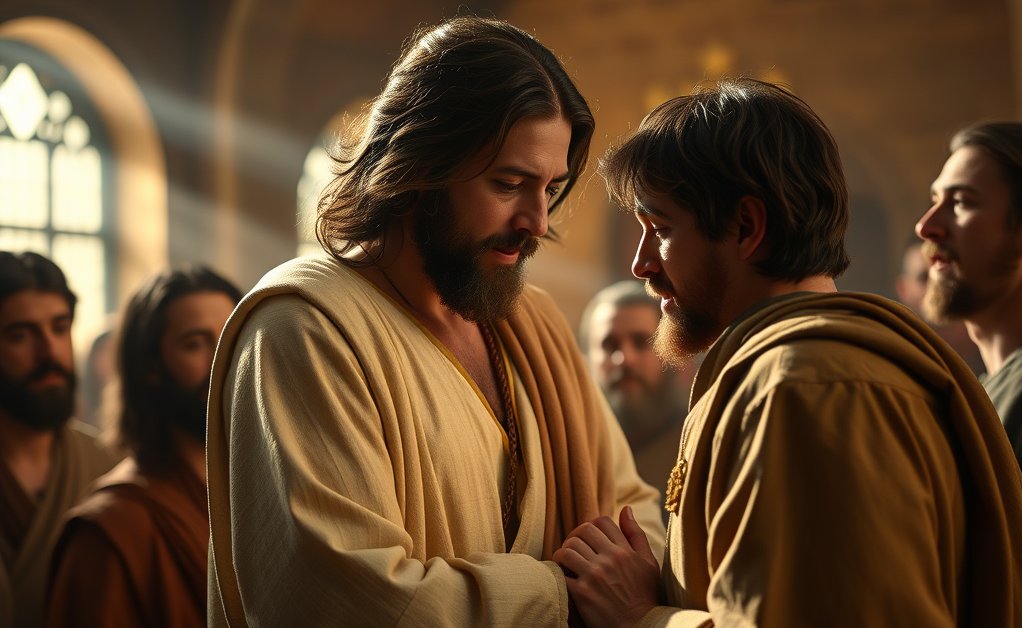
Peace be with you. (John 20:19)
That was a pretty common greeting in those days and still is among Jews.
But was that all it was? Considering Jesus said it twice, I’m kind of thinking not.
The disciples were in hiding, afraid of the future. And even Jesus appeared to them, how much angst did they have because they had failed him.
But Jesus said, “Peace be with you. I’m here. And despite your failings, I accept you.”
He then sent them out to bring his peace to people without it.
But it’s hard to bring peace into people’s lives if we don’t have God’s Spirit of peace living in us. And so he breathed on them and said, “Receive the Holy Spirit.”
Jesus wants to send you out too.
But do you have peace yourself? Or are you constantly worried about the future? Are you constantly worrying about what God thinks of you?
Remember: Jesus looks at you, and says, “Peace be with you.”
Jesus has already given you his Spirit. Not a spirit of fear, but one that cries out with us, “Abba, Father.”
We have peace with God now. (Romans 5:1, 5; 8:15)
So rest in his peace. And let’s take that peace out to those living without it.

Don’t let your heart be troubled. Believe in God; believe also in me. (John 14:1)
As I was thinking on Jesus’ words today, I asked myself, “When my heart is troubled, how often is it because I’m not trusting God?”
Trusting that he is for me.
Trusting that he is with me.
Trusting that he is in control even though my circumstances, and even this world seem out of control.
Trusting that he will never leave me an orphan. That he will always come to me when I cry out.
That nothing, not even death can separate me from his love. That when I leave this life, he will take me to be where he is.
When we find ourselves losing our peace, maybe that’s the question we all need to ask: Lord, do I trust you?

When Moses sent them to scout out the land of Canaan, he told them, “…Be courageous.” (Numbers 13:17, 20)
Those words really stuck out to me this morning.
One of the things Moses told the twelve scouts before they went out to spy out Canaan was to be courageous.
But only two of them, Joshua and Caleb, came back courageous.
Why? Because they had eyes of faith. They saw how big God is.
The rest of them came back with eyes filled with fear.
Why? They could only see how big the Canaanites were.
How often do we fear the future, how often do we fear where God is leading us because we forget how big he is?
And just as importantly, how good he is.
I happened to be praying through Psalm 16 today, and verses 5-8 seemed particularly appropriate.
Lord, you are my portion and my cup of blessing; you hold my future.
The boundary lines have fallen for me in pleasant places; indeed, I have a beautiful inheritance.
I will bless the Lord who counsels me—even at night when my thoughts trouble me.
I always let the Lord guide me. Because he is at my right hand, I will not be shaken. (Psalm 16:5-8)

Jesus came near and said to them, “All authority has been given to me in heaven and on earth.
Go, therefore, and make disciples of all nations, baptizing them in the name of the Father and of the Son and of the Holy Spirit, teaching them to observe everything I have commanded you.
And remember, I am with you always, to the end of the age.” (Matthew 28:18-20)
Honestly speaking, as I was thinking about all the things going on in the world this morning, it was hard not to feel anxiety.
But Jesus was reminding me today, “Hey, all authority has been given to me by my Abba. I’m still in control and always will be.
“Yes, this world is falling apart and eventually will come to an end. But I will come back and make all things new (2 Peter 3:10-13). So until that time, don’t fret. I will be with you.”
That’s our hope no matter what craziness may happen going forward.
So let’s put aside any fear or anxiety we may have concerning the future and keep faithfully doing the work God’s given us to do: make disciples for his kingdom.

And we have come to know and to believe the love that God has for us. God is love, and the one who remains in love remains in God, and God remains in him.
In this, love is made complete with us so that we may have confidence in the day of judgment, because as he is, so also are we in this world.
There is no fear in love; instead, perfect love drives out fear, because fear involves punishment. So the one who fears is not complete in love. We love because he first loved us.” (1 John 4:16-19)
Last Sunday, I gave a message on Revelation 4, and as I read John’s words, I was reminded of that passage.
When the Israelites and later Isaiah entered God’s presence, they were terrified. They thought they were going to die. (Exodus 19:16; 20:18-21; Isaiah 6:5).
But when John entered God’s throne room, though I’m sure he was trembling greatly, he was not crying out “I’m doomed!”
John was as sinful and imperfect as the Israelites and Isaiah were. Why didn’t he fear God’s punishment?
Because John had come to know and believe the love God had for him. God’s love had been made complete in him.
How about you? Can you say with John, “I have come to know and believe the love God has for me?”

A few months ago, in one of the junior high school English classes that I teach, we had a lesson about the song “Stand by Me.”
I suppose that’s why that song popped up in my head as I read these words:
The following night, the Lord stood by him and said, “Have courage!” (Acts 23:11)
Of course, there’s no way Paul was singing, “Stand by me” that night. But some of the lyrics in that song are based on Psalm 46, and it’s possible that Paul was singing those words that night.
God is our refuge and strength,
a helper who is always found
in times of trouble.Therefore we will not be afraid,
though the earth trembles
and the mountains topple
into the depths of the seas
though its water roars and foams
and the mountains quake with its turmoil. (Psalm 46:1-3)
So to borrow Ben E. King’s words,
Lord, I won’t be afraid.
No, I won’t be afraid.
Just as long as you stand by me.

But Jesus on hearing this answered him, “Do not fear; only believe, and she will be saved. (Luke 8:50)
Thinking on those words today.
The disciples feared during the storm because of their lack of faith.
Because their lack of faith, the people in Gerasene were so afraid of Jesus, they asked him to leave.
On the other hand, the woman with the bleeding problem feared how Jesus might respond to her. And yet, by her faith, she was accepted by Jesus and healed.
And by not fearing, but rather believing in Jesus, Jairus saw his daughter raised to life.
Where there is faith, there is no need for fear.
Not the storms. Not the demons. Not our health problems. Not death. And certainly not Jesus.
Rather, there is forgiveness (7:50). There is salvation. There is acceptance. There is peace. There is life.
That’s an awesome truth, isn’t it?

…and [Felix] sent for Paul and heard him speak about faith in Christ Jesus. And as he reasoned about righteousness and self-control and the coming judgment, Felix was alarmed. (Acts 24:24-25)
It’s interesting to me that Paul and Felix faced the idea of God’s judgment with completely different attitudes.
Paul faced judgment with hope (15).
Felix feared judgment. He feared it because deep down, he knew his sin. He feared it because deep down, he knew he was worthy of judgment.
Why could Paul face judgment with hope? Because there is no condemnation for those who are in Christ Jesus (Romans 8:1).
Jesus has already taken our punishment on the cross. So Paul didn’t fear God’s punishment. He rested in his Father’s love. He rested in the truth that he was a child of God.
As John would later write,
By this is love perfected with us, so that we may have confidence for the day of judgment, because as he is so also are we in this world.
There is no fear in love, but perfect love casts out fear. For fear has to do with punishment, and whoever fears has not been perfected in love. (1 John 4:17)
Father, thank you that I don’t have to fear your judgment. Rather, as your child, I stand confidently before you in your love and grace.
So Father, I draw near to you. I honor you. I love you. In Jesus’ name, amen.

Why are you afraid? Do you still have no faith? (Mark 4:40)
Those words struck me this morning.
How often do we look at our problems with fear or worry?
How often does Jesus say to us, “Why are you afraid? Why are you worrying? Don’t you trust me yet? Don’t you believe I love you and am working for your good?”
How much less stress would we have if instead of focusing on our problems, we looked at Jesus and said, “Who then is this? Even the wind and the sea obey him! If he is that powerful, and if he truly cares about me so much, then what am I worrying about?”
Lord, increase my faith. Teach me to trust you.

I don’t know about you, but Psalm 91 has always seemed to promise too much, as if we’ll never have any problems if we just trust in God.
Obviously, Satan tried to misuse this psalm to tempt Jesus. “Hey, jump off the building and the angels will catch you. That’s what God promised, right?”
And some Christians today misuse it to say that Christians should never get sick or have problems.
But as I read this passage today, it made me think of the Israelites’ experience in Egypt.
The Egyptians experienced a lot of the things the psalmist talked about as judgment from God. They experienced plague and pestilence. And of course they experienced terror at night as all their firstborn sons died.
On the other hand, the Lord protected all his people from experiencing that terrible judgment.
You see that pattern time and again in the Bible. The wicked are eventually judged, but God’s people are spared from God’s judgment (Ezekiel 9, 2 Peter 2:4-10, Revelation 7:1-3; 9:1-21)
In the same way, God will eventually judge this earth. But if we belong to him, if we have made him our refuge, putting our trust in him, we do not need to fear his judgment.
As John put it,
God is love, and the one who remains in love remains in God, and God remains in him.
In this, love is made complete with us so that we may have confidence in the day of judgment, because as he is, so also are we in this world.
There is no fear in love; instead, perfect love drives out fear, because fear involves punishment. So the one who fears is not complete in love. (1 John 4:16-18)
So if bad things are happening to you, and you think it must be because God is punishing you, understand that God isn’t. Jesus already took your punishment on a cross 2000 years ago.
But not only do we not have to fear God’s judgment, we also don’t have to fear the enemy’s attacks on us.
In scripture, Satan is depicted as a serpent and a lion. (Genesis 3, 1 Peter 5:8)
I find it interesting that when Satan tempted Jesus, he quoted verses 11-12, and skipped verse 13,
You will tread on the lion and the cobra;
you will trample the young lion and the serpent. (Psalm 91:13)
Maybe it reminded him too much of what God told the serpent about the Savior who would come.
He will strike your head,
and you will strike his heel. (Genesis 3:15)
Satan will strike us. But like the damage he did to Jesus, that damage will not be permanent. He can kill our bodies. But he cannot destroy our souls.
And the day will come when we will rejoice and worship God because of it. (Revelation 7:9-17)
So let’s not fear God’s judgment nor Satan’s attacks. Rather, let us remember God’s promises to us:
Because he has his heart set on me,
I will deliver him;
I will protect him because he knows my name.When he calls out to me, I will answer him;
I will be with him in trouble.I will rescue him and give him honor.
I will satisfy him with a long life
and show him my salvation. (Psalm 91:14-16)

We are facing troubled times in this world with the Corona virus and all it’s doing to people’s health and finances.
How do we face it?
The people Peter was writing to faced a different kind of problem: persecution. But his words to them are still quite applicable to us. What did he say?
Finally, all of you be like-minded and sympathetic, love one another, and be compassionate and humble, not paying back evil for evil or insult for insult but, on the contrary, giving a blessing, since you were called for this, so that you may inherit a blessing. (1 Peter 3:8-9)
Again, Peter here is talking about persecution and our response to it.
But in these times, people can get easily get edgy towards each other.
Other people rail at the government for not doing enough, or ironically for going too far in their restrictions on our movements.
But we are not to be this way. Rather we are called to bless others. Even when we feel ill-treated, we are to be sympathetic, loving, compassionate, and humble.
And again, we are to bless others, keeping our tongues from evil (10), whether it’s cursing, complaining, or whatever else it may be.
Peter then says,
Do not fear what they fear or be intimidated, but in your hearts regard Christ the Lord as holy, ready at any time to give a defense to anyone who asks you for a reason for the hope that is in you. (14-15)
In encouraging those Christians facing persecution, Peter told them not to fear the things those around them feared, nor to fear the threats of others. Instead, they were to regard Christ as holy in their lives.
What does that mean?
Peter was quoting from Isaiah 8:12-14.
The Israelites of that time were terrified of being attacked by the Assyrian army. But God told Isaiah,
Do not fear what they fear;
do not be terrified.You are to regard only the LORD of Armies as holy.
Only he should be feared;
only he should be held in awe.
He will be a sanctuary…(Isaiah 8:12-14)
What does it mean to honor God as holy? Fear him alone. Hold him in awe over anyone or anything else.
And if we do, he will be our sanctuary, whether we’re being attacked by people…or by the Corona virus.
We are not to fear what others fear. We are not to fear the virus. We are not to fear the financial difficulties that come from being unemployed.
Instead, we are to stand in awe of God and worship him. And he will be our sanctuary in the storm.
Does this mean that we won’t get sick? That we won’t struggle financially?
No. Some of us may go bankrupt. Some of us may even die because of the virus.
But maybe God is reminding us through all of this: “This world is not your home. You are only temporary residents here .(1 Peter 1:1)
You have a more permanent home, a more permanent inheritance awaiting you.”
That’s our hope.
And it’s the hope we are to pass on to others. If we refuse to give into anger or fear, if instead we are a blessing to those who are hurting now, people will ask why.
And should that time come, as Peter says, “be ready at any time to give a defense to anyone who asks you for a reason for the hope that is in you.” (1 Peter 3:15).
And if you yourself are starting to lose hope, remember the basis for our hope.
For Christ also suffered for sins once for all, the righteous for the unrighteous, that he might bring you to God. He was put to death in the flesh but made alive by the Spirit. (18)
Or as Bill Gaither once put it,
Because he lives I can face tomorrow.
Because he lives, all fear is gone.
Because I know he holds the future,
And life is worth the living just because he lives.

Yes, I know I’m going backward. Actually this year, I’m reading through each book of the Bible at least twice, using two different translations.
I’ve been thinking about leadership in the church, and how we are to be held to a higher standard. And this passage shows that in no uncertain terms.
It’s interesting to me that in chapters 9 and 10, the exact same words are used, “Fire came from the Lord and consumed…”
In the first case, it consumed the burnt offering, and all the people stood in awe of God’s glory and were blessed.
In the second case, it consumed two of Aaron’s sons, because unlike in chapter 9 where you repeatedly see them and Aaron doing things as the Lord commanded, these two sons offered “unauthorized fire” in contradiction to what the Lord commanded (Leviticus 10:1).
And as a result, the people stood in fear as God’s glory was displayed in his judgment of these two men.
And God told Aaron,
I will demonstrate my holiness
to those who are near me,
and I will reveal my glory
before all the people. (10:3)
The ESV shows another possible reading of the Hebrew.
Among those who are near me I will be sanctified, and before all the people I will be glorified.
If we take the ESV reading, God is saying this:
“I will be treated as holy by those who would draw near to me. I will not be treated as some common or unholy thing. And I will be glorified before all the people by those who draw near me. You cannot just take me lightly and expect me to stand by and do nothing.”
The CSB reading makes it even stronger.
“If you will not treat me as holy, I will demonstrate my holiness such that you will never make that mistake again. If you will not glorify me before the people by the way you treat me, I will glorify myself so that they will know who I am.”
Either way, as a leader in the church, it gives me pause. How do I treat God? In my actions, do I display his holiness to those around me? Do I glorify him in what I do?
Will God display his glory in my life in such a way that people stand in awe of him, and be blessed?
Or will God display his glory in my life in judgment, causing people to fear?
Both are possible. It happened in the New Testament days as well. Just look at the story of Barnabas, and Ananias and Sapphira. (Acts 4:34-5:11).
God will not be treated lightly, especially by those who are supposed to lead. One way or the other, God will display his holiness and glory in my life.
I prefer that it be in a way that people see it and are blessed, not see it and fear.

I mentioned a couple of blogs ago that these letters to the churches were meant to prepare us for the antichrists and tribulations to come .
And again, I know many of you who read this believe that we won’t see the final antichrist when he comes or have to endure the great tribulation.
But as I read through Revelation and the other books of the New Testament, I don’t see that at all. What comes through time and again is that we will go through trial and trouble in this world, and particularly when antichrist comes.
I don’t see anything in scripture that makes me believe we’ll escape these things entirely.
What I do see is that though we may not escape these things, that God will never abandon us. That these things are only for a time. And that God calls us to keep holding onto him no matter what happens.
And we see all these things in this passage.
Jesus is talking to a church called Smyrna. And as Jesus addresses them, he refers to himself as the first and the last, the one who died and came to life again. (8)
That latter is particularly interesting because Smyrna itself died and came to life again. It was destroyed in 600 BC and remarkably restored in 290 BC.
Now, the Christians in Smyrna were facing death because of their faith in Christ.
And so Jesus encourages them by reminding them that no matter what happens, he is in control for he is the first and the last. He had the first word when this world was created, and he will have the last when all is said and done.
More, he was the one who conquered death. And though these Christians were facing death, like Jesus, they too would rise again to eternal life.
He told them,
I know your afflictions and your poverty — yet you are rich!
I know the slander of those who say they are Jews and are not, but are a synagogue of Satan. (Revelation 2:9)
Apparently, these people were being persecuted by the Jews.
By this time in history, the Jews were starting to tell the Roman Empire, “These Christians are not a sect of Judaism. Many are not Jews at all. They’re Gentiles. So when they refuse to worship the emperor like your law requires, they are not under the same religious protections we are under. Go after them.”
As a result, persecution was starting to come to the Christians.
But Jesus tells them, “Don’t let them tell you that you are not true Jews. You are. You are the true descendants of Abraham because you have come to me by faith just as Abraham did.
“They are the false Jews. And their synagogue is not a synagogue of God, but of Satan.”
Then he tells them, “Don’t worry, persecution won’t come your way. I’ll rescue from all trouble that may come your way.”
Is that what he said? Hardly. He said,
Do not be afraid of what you are about to suffer. I tell you, the devil will put some of you in prison to test you, and you will suffer persecution for ten days. (Revelation 2:10a)
In short, “You will suffer. But don’t be afraid. Satan will have his way with you, but it won’t be forever. It will only be for a little while.”
The same is true today and the same will be true when we face antichrist. We will face suffering. But Jesus reminds us, “It’s only for a moment.”
And so he admonishes us,
Be faithful even to the point of death, and I will give you the crown of life.
He who has an ear, let him hear what the Spirit says to the churches.
He who overcomes will not be hurt at all by the second death. (Revelation 2:10b-11)
Jesus said pretty much the same thing to his disciples when he was still on earth. He said,
He said,
Don’t be afraid of those who can kill the body but cannot kill the soul. Rather, be afraid of the One (God) who can destroy both soul and body in hell. (Matthew 10:28)
If you fear God, you need not fear anything else, not even death. For though people can destroy your body, they can’t touch your soul. And Jesus says the second death, that is hell, won’t touch you.
Instead you will have life with him forever in heaven.
How about you? Are you facing persecution because of your faith? Remember that it is but for a short time. And no matter what people may say or do to you, they can’t touch what’s really important.
So be faithful. For even if you should die for his sake, yet shall you live. (John 11:25)
Judgment day.
It is coming for all of us. And it comes first and foremost for us who believe. This is something that we see from this passage to the end of chapter 3.
In his vision, John hears a voice call out to him, and when he turns, he sees Jesus walking among 7 lampstands with 7 stars in his hands.
But this is not the Jesus he remembers, at least not entirely. He sees Jesus in his glory.
One thing that I’m not sure of is if John literally saw Jesus as how he describes or if he is simply using figurative language to get across his meaning.
Either way, I think what he is saying is that we as the church are accountable to Jesus, and he will judge us.
There are a lot of symbols in Revelation. Some are explained clearly and some are not.
In this passage, the symbols of the lampstands and the stars are explained. Jesus is walking among the lampstands, which Jesus says are the 7 churches John was to write to, while the seven stars are their angels. (Revelation 1:20)
What he means by angels have been disputed since angels can simply mean “messengers.”
But considering that angels do seem to play some part in the churches (I Corinthians 11:10), I don’t think it’s too much of a stretch to say that there are angels assigned to each church.
But again, the picture is of Jesus walking among the churches, and as we shall see in chapters 2-3 he is inspecting them.
And though he has given charge to his angels to watch over these churches, these angels themselves are in his hands.
As we look at the description John gives of Jesus, we see certain things about our Judge.
First, he is wise. That’s what his white hair symbolizes. Not that he is some decrepit old man, but that he is infinitely wise in his judgments.
Second, his eyes like burning fire symbolize the fact that he sees through everything. (See 2:23). His eyes burn away all the veils that would cover the truth and lay bare the things that are hidden.
Third, his feet are like bronze, crushing everything that is beneath them. In other words, he brings judgment, and it can be hard judgment for those who refuse to repent of their sins. (See 2:21-23)
His voice like rushing waters speaks with the power and authority of the Almighty. (See Ezekiel 1:24).
From his mouth came a two-edged sword. Two-edged because Jesus’s words of judgment to us both cut and heal. They cut those who are in sin, but bring healing to those who are hurting. And we see both in chapters 2 and 3.
And in his face, we see the utter glory and holiness of God.
When John saw Jesus like this, he fell on his face in fear. Most people would when facing a holy judge who is all-wise, all-knowing, and all-powerful.
But Jesus comforted John as he does us, saying,
Do not be afraid. I am the First and the Last. I am the Living One; I was dead, and behold I am alive for ever and ever! And I hold the keys to death and Hades. (17-18)
Why did John not need to fear? Because through the cross of Christ, Jesus paid for our sin, and by his resurrection, God the Father showed that he accepted Jesus’ payment. And now he has set us free from death and we have eternal life in him.
So no matter what judgment we may face, we can know that nothing will separate us from his love.
But we will be judged. Jesus is walking among the lampstands. And even among the lampstands, as we shall see in his letters to the churches, Jesus sees each individual in them.
So as we look at these letters over the next several days, let us take them in. Let Jesus’ words cut you and heal you.
If you need to repent, it’s better to let those words cut you now than later. And if you are hurting, let his words comfort you.
But whatever your situation, remember the words of John in his first letter.
We know and rely on the love God has for us. God is love.
Whoever lives in love lives in God, and God in him. In this way, love is made complete among us so that we will have confidence on the day of judgment, because in this world we are like him.
There is no fear in love. But perfect love drives out fear, because fear has to do with punishment.
The one who fears is not made perfect in love. We love because he first loved us. (I John 4:16-19)

Sometimes, we tend to think of the apostles and other people in the Bible as superheroes. That they always faced death courageously and without fear.
Certainly there were times they were like that. (Shadrach, Meshach, and Abednego certainly seemed that way, among others).
But I don’t know if that was always the case. They were human just like us, after all.
And as I read this passage in Acts 23, I wonder what was going on in Paul’s heart.
He had just been involved in a situation that had become so violent that the Roman commander got him out of there thinking Paul was going to get torn to pieces by his accusers.
As Paul lay in bed that night, what was he thinking? Was he experiencing doubt? Fear? Was he worrying about if he could accomplish the things he had thought God desired him to do.
Whatever he was thinking, it says in verse 11,
The following night the Lord stood near Paul and said, “Take courage! As you have testified about me in Jerusalem, so you must also testify in Rome.” (Acts 23:11)
A few things strike me here.
First, the Lord stood near Paul. And it’s a reminder to me that even through our darkest times, through our trials, and through our doubts and fears, the Lord is always standing by us.
Second, the Lord told Paul, “Take courage.”
Why would you tell someone to take courage if they already had it?
Perhaps because of all his circumstances, Paul was wavering a bit. But the Lord steadied him and said, “Take courage.”
Sometimes we too waver a bit in our faith. We waver concerning the path God has put us on. But God gives us the same message he gave Paul. “Take courage.”
Why should we take courage?
Because God will accomplish his will in our lives and no power on this earth can stop him. He told Paul,
As you have testified about me in Jerusalem, so you must also testify in Rome.
In other words, “Don’t worry about all those opposing you. You will fulfill the purposes I have called you to. Just stand strong and keep trusting in me.”
How about you? Are you starting to lose faith because of your circumstances? Are you starting to give in to fear because of the opposition you’re facing?
Take courage. Know that the Lord is near. And keep trusting and following him, knowing that he will accomplish his will in your life.
Let us remember the words of Paul himself, who said,
The Lord is near. Do not be anxious about anything, but in everything, by prayer and petition, with thanksgiving, present your requests to God.
And the peace of God, which transcends all understanding, will guard your hearts and your minds in Christ Jesus. (Philippians 4:5-7)

Persecution.
Not a pleasant word. And not something that I really want to go through. But one thing that the Bible warns us is that it will come. Paul warns us in 2 Timothy 3:12,
In fact, everyone who wants to live a godly life in Christ Jesus will be persecuted.
Not might be. Not possibly will be. Will.
Like I said in the last blog, if your goal is to be like your Teacher, some people will hate you for it. Persecution is just the next step beyond that.
Jesus knew that, so he warned his disciples about it. He called them (and us) sheep among wolves. (16)
What instructions does he give about facing persecution?
First, as I mentioned before, be on your guard. Watch out for the people that would hurt you because of your faith.
Jesus was talking about physical harm, of course, but we could extend it to emotional harm as well. There are some people with vile tongues that will try to hurt you because of your faith. Know who they are.
And if you’re in danger of getting hurt either physically or emotionally, Jesus says to flee. Don’t feel like you have to keep preaching to them once you’ve fulfilled your duty.
Rather, Jesus says that if they reject your message to,
Shake the dust off your feet when you leave [them]. (Matthew 10:14)
Jews used to do that when leaving foreign lands because they felt to take the dirt from those lands into Israel would be to make Israel unclean.
And so Jesus was telling his disciples, “Make it clear to these Jews who reject you that they are the ones who are unclean because they have rejected your message, and that their blood is now on their own heads, because you have warned them.”
In the same way, we should let people know, “I’ve done my duty, but you’ve rejected my message, and now you’re persecuting me because of it. I feel sorry for you and love you, but I can’t make you believe.
“You are now responsible before God for what you do with what I’ve told you.”
And then leave. Once you’ve fulfilled your duty, there is no need to expose yourself to further abuse.
It is easy, however, once we’ve been exposed to persecution to become afraid that it will happen again. And because of that, we become hesitant to speak again to others who have not heard the message.
But Jesus tells us,
Do not be afraid of them. There is nothing concealed that will not be disclosed or hidden that will not be made known.
What I tell you in the dark, speak in the daylight; what is whispered in your ear, proclaim from the roofs. (Matthew 10:26-27)
In other words, “My words that I have told to you in private will eventually get out. Nothing can stop it, not even persecution. So don’t be afraid. Keep proclaiming boldly what I’ve told you.”
He then warns us not to fear those who can kill their body, but the one that can destroy body and soul in hell. (28).
That’s not Satan. Satan is a victim of hell, not the ruler.
But we are to remember that people are dying and going to hell every day because they have rejected God. God has no choice but to send them there, because no impure thing can enter heaven.
That fear for those we hold dear should be more than enough to keep us proclaiming boldly the message of the gospel no matter what persecution we may face.
But then he gives us words of comfort,
Are not two sparrows sold for a penny? Yet not one of them will fall to the ground apart from the will of your Father.
And even the very hairs of your head are all numbered. So don’t be afraid; you are worth more than many sparrows. (29-31)
Jesus tells us that though persecution will come, God will not forget you. He will see you though.
And if the time comes when you must die for his sake (Jesus never says that the sparrow won’t die, only that it never happens apart from God’s will), even in that God will be with you and you will see him shortly on the other side.
So let us not fear persecution. Rather let us proclaim boldly the Word of Life that he has given us.

Some Christians don’t like going through the Old Testament. Sometimes, they wonder why it’s even worth reading.
I have to admit, this is the longest period of time I’ve spent in the Old Testament for my quiet times.
I believe it’s been about a year and a half that I’ve spent here, and it could be another year and a half before I get to the New Testament. If I’m lucky.
But here, God tells the Israelites to look upon the legacy they inherited from their forefathers, to Abraham and Sarah who started the Israelite nation.
And he says,
Listen to me, you who pursue righteousness and who seek the Lord (Isaiah 51:1)
I don’t believe God is just talking to the Israelites here. He’s talking to all of us who are seeking the Lord. What does he tell us?
Look to the rock from which you were cut and to the quarry from which you were hewn; look to Abraham, your father, and to Sarah, who gave you birth.
When I called him he was but one, and I blessed him and made him many. (1–2)
While Abraham and Sarah were the literal father and mother of the nation of Israel, we have our own spiritual connection to them as Christians.
They were the first to illustrate a life of walking by faith. Of a righteousness that comes by faith.
This is not to say that no one before them ever walked by faith. But when the New Testament talks about those who were made righteous by their faith, it always starts with Abraham.
Paul wrote of Abraham, quoting the Genesis account,
Abraham believed God, and it was credited to him as righteousness. (Romans 4:3)
Why do we read the Old Testament? We’re looking at the rock from which we were cut. Where our legacy of the righteousness that comes by faith comes from.
Not only that, we see the God they put their trust in and his faithfulness to them.
Isaiah writes of Him, recalling his redemption of Israel from Egypt,
Was it not you who dried up the sea, the waters of the great deep, who made a road in the depths of the sea so that the redeemed might cross over? (10)
He also recalls how God was the one who brought all things into being, saying,
For I am the Lord your God, who churns up the sea so that its waves roar – the Lord Almighty is his name…
I who set the heavens in place, who laid the foundations of the earth, and who say to Zion, ‘You are my people.’ (15–16)
And so as we look back on who God is and this legacy of faith by people such as Abraham and Sarah, God charges us,
Hear me, you who know what is right, you people who have my law in your hearts: Do not fear the reproach of men or be terrified by their insults.
For the moth will eat them up like a garment; the worm will devour them like wool.
But my righteousness will last forever, my salvation through all generations…
I, even I, am he who comforts you.
Who are you that you fear mortal men, the sons of men, who are but grass, that you forget the Lord your Maker, who stretched out the heavens and laid the foundations of the earth, that you live in constant terror every day because of the wrath of the oppressor, who is bent on destruction? (Isaiah 51:7–8, 12–13)
If there is anything that can undermine faith, it’s fear. Fear of the future. Fear of others and what they think of us or what they might do to us if we follow God.
But the same God who watched over Abraham, Sarah, and the others who followed in their legacy of faith, watches over us.
The same God who created us and saved us from our sin is strong enough to deliver us from those who would destroy us, even the Enemy of our souls.
So let us remember the legacy of faith we’ve inherited. Let us remember the God who has given us this legacy. And let us put our trust in Him.

And so we hit Exodus.
I think that Moses must’ve gotten a kick out of writing this chapter, especially the part about Shiphrah and Puah, the Hebrew midwives.
Here is the most powerful man in Egypt, the Pharaoh, and he has commanded these midwives to kill all the baby boys born to the Hebrews.
But word gets back to him that the midwives haven’t been doing so, and so he summons them into the palace and asks, “Why haven’t you done what I commanded?”
And here are these two women, standing before him with a straight face saying, “Hebrew women are not like Egyptian women; they are vigorous and give birth before the midwives arrive.” (Exodus 1:19)
I can just see Pharaoh looking at these women saying, “I see. I didn’t know that. You learn something new every day. Vigorous. Hmm…”
What gave these women the courage to defy the most powerful man in Egypt?
They feared God more than Pharaoh.
It says in verse 17, “The midwives, however, feared God and did not do what the king of Egypt had told them to do; they let the boys live.”
And because they feared God more than Pharaoh, God blessed them. In verses 20–21, it says,
So God was kind to the midwives and the people increased and became even more numerous.
And because the midwives feared God, he gave them families of their own.
Who do you fear in your life? Who do you honor most in your life? Is it God? Or is it others?
Sometimes we fear the reactions of others in our lives, and it affects our relationship with God.
I know of one woman who for a long time put off baptism because she feared what her parents would think.
I know of another woman who put off becoming a Christian because she was afraid of what her husband would think.
And yet, they found that when they feared and honored God more than their own parents and husband, God blessed them.
I’m not saying that by fearing God more than people you’ll never get into trouble. There will be people who will get upset with you when you make that choice.
I know of one man who got in trouble with his coworkers because he wouldn’t put work ahead of God in his life.
They wanted him to work more overtime, but he refused because he felt God had other things for him to do outside of work.
Eventually, he had to leave his company.
But I believe that God was pleased with this man for fearing him above all others.
God once told the prophet Isaiah,
The Lord spoke to me with his strong hand upon me, warning me not to follow the way of this people.
He said: “…do not fear what they fear, and do not dread it.
The Lord Almighty is the one you are to regard as holy; he is the one you are to fear, he is the one you are to dread, and he will be a sanctuary…” (Isaiah 8:11–14)
God will be a sanctuary for you—a place to run to when times get tough and everyone is against you.
But he warns us, as he did Isaiah, not to follow the way of the world.
Rather, we are to fear and follow him.
And if we do, just as he blessed those Hebrew midwives, he will bless you.
Who do you fear?

It’s amazing how Isaac could do the exact thing to Rebekah that Abraham did to Sarah: deny that she was his wife, and say that she was his sister instead.
Amazing because Isaac wasn’t even born when Abraham had his two incidents with the Pharaoh and Abimelech.
Did Abraham give him this advice when going into foreign territories? And if Abraham did, why didn’t he warn Isaac of what had happened to him?
But ultimately, fear can cause us to do stupid things. That’s what happened to Abraham. And that’s what happened to Isaac.
The problem with fear is that it often blinds us to the possible consequences of our actions.
We fear our future, so we turn to astrology or fortune telling.
We fear being alone, and so we marry someone we know we shouldn’t.
We fear losing our boyfriend or girlfriend, so we sleep with them.
We fear rejection from our family and friends, so we deny our Lord in words and actions.
But that’s not how God wants us to live. He doesn’t want us to live in fear, wondering what will happen to us in the future.
He wants us to live trusting him.
He wants us to live knowing that he loves us and that he’ll take care of us.
He wants us to live knowing that he desires our best.
If only we would believe that.
As the writer of Psalm 91 penned,
He who dwells in the shelter of the Most High will rest in the shadow of the Almighty.
I will say of the LORD, “He is my refuge and my fortress, my God, in whom I trust.” (1–2)
 Moment to Moment (Bible blog)