One of tests of a true follower of Jesus is this: do we love our brothers and sisters?
If we don’t, there is something wrong.

Loving our brothers and sisters
Matthew 25
 Moment to Moment (Bible blog)
One of tests of a true follower of Jesus is this: do we love our brothers and sisters?
If we don’t, there is something wrong.
Matthew 25

Paul replied, “I am standing at Caesar’s tribunal…I appeal to Caesar!” (Acts 25:10-11)
The word “tribunal” is translated “judgment seat” in other passages in scripture, such as where they refer to God’s judgment seat (Romans 14:10) or Christ’s judgment seat (2 Corinthians 5:10).
And it made me think.
One day, we will all stand before God’s judgment seat as Paul was standing before Caesar’s. And there, Satan would throw all kinds of serious accusations against us.
But unlike the accusations thrown at Paul, Satan’s accusations would be quite legitimate. We have committed all kinds of sins, making us deserving of death.
Yet as God’s children, we can cry out, “I appeal to Jesus!”
And by Jesus’ blood shed on the cross, God will declare us righteous.
That’s an awesome thought.
So whenever Satan, or even our own consciences, are mercilessly hurling accusations at us, let us cry out boldly and with confidence, “I appeal to Jesus!”

Jesus, you are my King, But do I fully acknowledge your authority in my life?
The centurion recognized the authority of your Word. (Luke 7:7-8).
Do I?
Your word has the power to raise the dead. (Luke 7:14-15)
And one day, by your word, all the dead will be raised, and you will judge them. Including me. (John 5:25-29)
What will you say to me on that day? Will you be amazed at the faith I had? Will you rejoice that I so totally trusted and obeyed you?
Or will you say, “Why did you call me Lord, Lord, and not do what I said?” (Luke 6:46)
Lord, I do believe in you. But increase my faith and help me to obey you in all things.

For God loved the world in this way: He gave his one and only Son, so that everyone who believes in him will not perish but have eternal life. (John 3:16)
I reallly like this translation.
Most translations read, “For God so loved the world…” and it can be translated that way. But usually, the Greek word for “so” would be read not as “so much,” but as “in this way.”
John uses different words in his letter, but expresses the same idea.
God’s love was revealed among us in this way: God sent his one and only Son into the world so that we might live through him.
Love consists in this: not that we loved God, but that he loved us and sent his Son to be the atoning sacrifice, for our sins. (1 John 4:9-10)
Paul says something similar in Romans 5:8.
But God proves his own love for us in that while we were still sinners, Christ died for us.
The amazing thing is that God didn’t wait for us to turn to him before he showed us his love. Rather, he first turned to us. Not in judgment, but in mercy.
I wonder. How shocked was Nicodemus that Jesus said God demonstrated his love for the world by sending his Son.
It’s possible that his only concept of God sending his Son was to judge the world for its rebellion (Psalm 2).
Had Nicodemus ever considered that the blessed people in Psalm 2:12 could apply to those nations who had once been rebellious but had repented because of God’s love for them shown through his Son? Had the psalmist?
I don’t know. But let’s always remember the most amazing thing about John 3:16. God first loved an unrepentant, rebellious world, and sent his Son to save it.
And that includes us.
Take time to ponder that today. Ponder John 3:16. Ponder 1 John 4:9-10. Ponder Romans 5:8.
Ponder this truth and bathe in it: “God first loved me.”
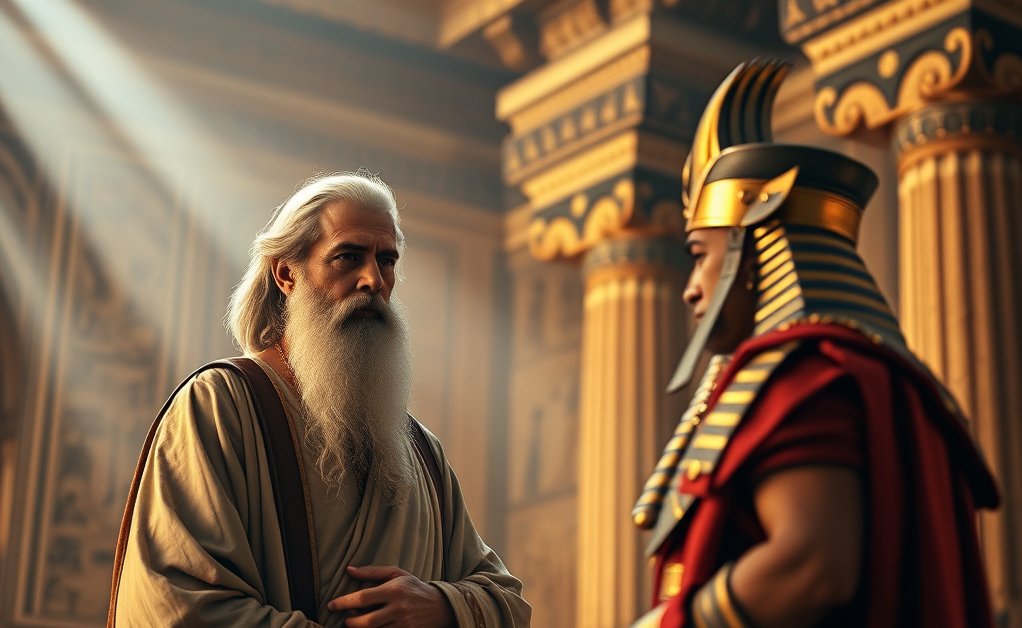
You must say whatever I command you; then Aaron your brother must declare it to Pharaoh so that he will let the Israelites go from his land…
The Egyptians will know that I am the Lord when I stretch out my hand against Egypt and bring out the Israelites from among them. (Exodus 7:2, 5)
Moses and Aaron were to speak God’s words so that Pharaoh and all the Egyptians would know he was the Lord.
As I read those words, it struck me that we too are to speak God’s words to those around us that they might know he is the Lord.
But whereas Moses’ and Aaron’s words were mostly words of judgment, ours is a message of reconciliation.
Paul put it this way,
Everything is from God, who has reconciled us to himself through Christ and has given us the ministry of reconciliation.
That is, in Christ, God was reconciling the world to himself, not counting their trespasses against them, and he has committed the message of reconciliation to us.
Therefore, we are ambassadors for Christ, since God is making his appeal through us. We plead on Christ’s behalf, “Be reconciled to God.”
He made the one who did not know sin to be sin for us, so that in him we might become the righteousness of God. (2 Corinthians 5:18-21)
So let’s take God’s message of reconciliation to those around us that they may know he is God…and be reconciled to him.

I have a hope in God, which these men themselves also accept, that there will be a resurrection, both of the righteous and the unrighteous.
I always strive to have a clear conscience toward God and men. (Acts 24:15-16)
Father, I have a hope.
A hope that death is not the end. That there will be a resurrection.
I have a hope, Father.
A hope that there will be a day of judgment. A day when every evil deed will be judged by you.
I have a hope, Father.
That on judgment day, I need not fear. That for me there is no condemnation because of the blood of Jesus.
I have a hope.
And so I strive to keep a clear conscience before you and and the people around you, not out of fear, but out of love and gratitude toward you.
Let my life be holy and acceptable to you today, a sweet smelling incense.
In Jesus’ name, amen.

Back when Ahab first killed Naboth, God passed judgment on Ahab and his family.
Yet when Ahab humbled himself, God in his mercy put off that judgment. (1 Kings 21:21-29)
Even so, it wasn’t long before Ahab rebelled against God one final time and he died. (1 Kings 22)
What’s remarkable to me, though, is how much grace God showed his son Joram. Over a period of twelve years, time and again, God helped him (2 Kings 3, 5-7).
God also showed his impeccable timing to Joram, leading him to help the Shunnamite woman. (2 Kings 8:1-6)
I don’t know if there was any other ungodly Israelite king that God had showed so much grace to.
And yet, in the end, we see no sign that Joram actually ever repented and started following God.
Instead, he clung to his sins and refused to turn from them (2 Kings 3:3).
And so in the end, judgment came.
What’s my point?
It’s easy to think of God as being harsh in his punishments in the Old Testament.
But I think it’s worth remembering that he was also very patient and gracious with even the most rebellious people.
As a just God, he can’t put off judgment forever. But he isn’t a God that delights in judgment. Rather he delights in mercy. And it’s his desire that people repent.
As God would tell the prophet Ezekiel,
As I live—this is the declaration of the Lord God—I take no pleasure in the death of the wicked, but rather that the wicked person should turn from his way and live. (Ezekiel 33:11)

In chapters 1 and 2 we see two incidences of God’s curse being invoked by Elijah and Elisha.
Probably for most readers, they’re hard to understand. It all seems very harsh.
Something that’s important to remember, however, is that when the Bible talks about God’s curse, it’s not talking about some magic formula to bring down disaster upon our enemies.
It’s God’s judgment on a rebellious people.
We see that in the first case with Elijah.
There was a definite arrogance and rebelliousness against God and his prophet shown by Israel’s king and the first two captains he sent.
The second case with Elisha shows a similar arrogance and rebelliousness against God and his prophet.
What makes it more difficult to swallow, though, is that most translations call the offenders “small boys” or “young boys.”
But the Hebrew word for “boys” is very broad and is often used to describe people who were young men.
Solomon uses that exact term for himself in 1 Kings 3:7 which different English Bibles translate “youth,” “small child,” or “young man.”
However you translate Solomon’s words, I think it’s clear he was putting himself down, admitting his inexperience and ignorance as a young man.
In the same way, I think the writer of Kings was criticizing the ignorance of these young men.
But the difference between Solomon and these young men was that Solomon was humble before God. The result was he found grace.
These young men accosting Elisha were arrogant and hostile against Elisha and the God he served.
As a result, they were judged.
James put it this way.
God resists the proud
but gives grace to the humble.Therefore, submit to God…
Draw near to God, and he will draw near to you.
Cleanse your hands, sinners, and purify your hearts, you double-minded.
Be miserable and mourn and weep.
Let your laughter be turned to mourning and your joy to gloom.
Humble yourselves before the Lord, and he will exalt you. (Jamess 4:6–10)

…and [Felix] sent for Paul and heard him speak about faith in Christ Jesus. And as he reasoned about righteousness and self-control and the coming judgment, Felix was alarmed. (Acts 24:24-25)
It’s interesting to me that Paul and Felix faced the idea of God’s judgment with completely different attitudes.
Paul faced judgment with hope (15).
Felix feared judgment. He feared it because deep down, he knew his sin. He feared it because deep down, he knew he was worthy of judgment.
Why could Paul face judgment with hope? Because there is no condemnation for those who are in Christ Jesus (Romans 8:1).
Jesus has already taken our punishment on the cross. So Paul didn’t fear God’s punishment. He rested in his Father’s love. He rested in the truth that he was a child of God.
As John would later write,
By this is love perfected with us, so that we may have confidence for the day of judgment, because as he is so also are we in this world.
There is no fear in love, but perfect love casts out fear. For fear has to do with punishment, and whoever fears has not been perfected in love. (1 John 4:17)
Father, thank you that I don’t have to fear your judgment. Rather, as your child, I stand confidently before you in your love and grace.
So Father, I draw near to you. I honor you. I love you. In Jesus’ name, amen.

Three times in these chapters, we see the phrase, “an evil spirit from God came upon Saul.” (1 Samuel 16:14, 23; 18:10; 19:9).
Let’s be honest. Those are hard words. God sends an evil spirit to torment people? How can a good and loving God do that?
The best answer I can give is that this was God’s righteous judgment on Saul for his rejection of God.
There are hints, however, that this is a last step to try to bring people to repentance.
In a similar story in 1 Kings 22, God sends a lying spirit to lead King Ahab to destruction. But as he does so, he sends a prophet to tell him exactly what is happening, giving Ahab one last chance to repent.
Sadly, unlike in an earlier story (1 Kings 21:27-29), Ahab refuses to do so. (1 Kings 22:17-28)
We also see this in the New Testament. In Paul’s letter to the Corinthians, he says concerning an unrepentant sinner,
hand that one over to Satan for the destruction of the flesh, so that his spirit may be saved in the day of the Lord. (1 Corinthians 5:5)
In Revelation 9, it talks about plagues God sends, some of which seem to imply demonly origins. Many people die, but many more survive, giving them a final chance to repent. But the people refuse to do so (Revelation 9:20-21)
And then there are Paul’s words in 2 Thessalonians 2.
God releases Antichrist into the world that they might be deceived and perish. Why? In Paul’s words, the reason for God doing this is made crystal clear:
They perish because they did not accept the love of the truth and so be saved.
For this reason God sends them a strong delusion so that they will believe the lie, so that all will be condemned—those who did not believe the truth but delighted in unrighteousness. (2 Thessalonians 2:10-12)
In short, the Antichrist and his deception is part of the judgment on this earth for their refusing to love the truth. It is essentially the same judgment that both Saul and Ahab received.
How about you? Do you love God? Do you love truth? Do you delight in righteousness? How will you respond to God?
If there is one thing we don’t often like to think about when we consider God, it’s his role as judge of the whole earth. As our judge.
But he is our judge and the day will come when we all will be judged.
As Hannah sang,
…the Lord is a God of knowledge, and actions are weighed by him… (1 Samuel 2:3)
And again,
The Lord will judge the ends of the earth. He will give power to his king; he will lift up the horn of his anointed. (10)
That ultimately will be fulfilled when Jesus returns and reigns as God’s anointed King, as our Messiah.
And ultimately, on the day of judgment, those who honor God will be honored, and those who despise him will be disgraced. (30)
We see a picture of that in the judgment God passed on Eli and his sons.
And we see it in the way he honored Samuel and his mother.
The truth is, though, we all sin. We all deserve to be judged, because all of us have sinned against God. Eli said,
If one person sins against another, God can intercede for him, but if a person sins against the Lord, who can intercede for him?” (25)
But the good news, is that when Jesus came, he was both God and man. And as both God and man, he can and does intercede for us before the Father.
He is our faithful priest, who always lives to intercede for us. And because of that he is able to save completely those who come to God through him. (Hebrews 7:24-25)
So let us fear and rejoice.
Let us fear God, honoring him as holy, knowing that he weighs our actions and will judge us.
But let us rejoice that in Jesus we have one who intercedes for us who love and honor him.
And because of him, we can say with confidence and joy that there is no condemnation for those who are in Christ Jesus. (Romans 8:1)

I will call Not my People, My People,
and she who is Unloved, Beloved.And it will be in the place where they were told,
you are not my people,
there they will be called sons of the living God. (Romans 9:25-26)
Lord, I don’t always understand your ways. I don’t understand why you choose to show mercy to some and harden others. We’re all sinners with hardened hearts. Why not judge us all?
I don’t understand why you would choose Jacob over Esau. Both were terribly flawed people. Why choose either of them to be the ancestor of the Messiah?
I don’t understand why you would choose to judge Pharaoh and the people of Egypt and to show mercy to Israel. Both rejected you time and again. Why not destroy both in the Red Sea?
And I don’t understand why you would choose me. I deserve to be destroyed like Sodom and Gomorrah were.
Yet for some reason, you chose to love me, to call me as one of your people, and to make me your son.
I don’t understand, Lord. But I’m grateful.

The blood on the houses where you are staying will be a distinguishing mark for you; when I see the blood, I will pass over you.
No plague will be among you to destroy you when I strike the land of Egypt. (Exodus 12:13)
Throughout the Bible, you see this theme of God judging people for their sin, and yet keeping his own people from that judgment.
You see it in Ezekiel 9:4. You see it also in Revelation 7:3 and 9:4.
But it is here that we see a picture of what that mark is which separates us from those being judged. It’s the blood of an innocent lamb.
For us, Jesus is our Passover lamb. (1 Corinthians 5:7)
You and I have been sealed with his blood shed for us on the cross.
And when this world is judged, God in his grace will pass over us.
So each day, let us draw near to him with no fear of punishment, but rather in full assurance of his love and grace toward us. (1 John 4:17-18, Hebrews 10:19-22)

One of the problems in the Corinthian church was that while they were supposedly remembering the Lord and his sacrifice on the cross through communion, at the very same time they were despising his body.
That is, they were despising the poor Christians in their church. As a result, some were being judged by the Lord, some getting sick, others even dying. (1 Corinthians 11:22, 30)
It was a very severe judgment they received, and so Paul warns the church, “Search your hearts before you take communion so that you can avoid such judgment.” (1 Corinthians 11:28, 31)
God’s discipline can be severe. But it would be good for us to remember something important: the judgment we receive from the Lord is different from the judgment unbelievers receive from the Lord.
Paul says,
but when we are judged by the Lord, we are disciplined, so that we may not be condemned with the world. (1 Corinthians 11:32)
No discipline we receive from the Lord, no matter how severe, leads to eternal death. In that sense, we do not need to fear the Lord’s wrath.
Still, make no mistake: God does not take sin lightly. Neither should we. When we do, his discipline can be quite painful. In that sense, we very much do need to fear the Lord.
God loves us, but that does not mean we can escape his discipline. So remember the words of the writer of Hebrews.
My son, do not take the Lord’s discipline lightly
or lose heart when you are reproved by him,
for the Lord disciplines the one he loves
and punishes every son he receives. (Hebrews 12:5-6)

I don’t know about you, but Psalm 91 has always seemed to promise too much, as if we’ll never have any problems if we just trust in God.
Obviously, Satan tried to misuse this psalm to tempt Jesus. “Hey, jump off the building and the angels will catch you. That’s what God promised, right?”
And some Christians today misuse it to say that Christians should never get sick or have problems.
But as I read this passage today, it made me think of the Israelites’ experience in Egypt.
The Egyptians experienced a lot of the things the psalmist talked about as judgment from God. They experienced plague and pestilence. And of course they experienced terror at night as all their firstborn sons died.
On the other hand, the Lord protected all his people from experiencing that terrible judgment.
You see that pattern time and again in the Bible. The wicked are eventually judged, but God’s people are spared from God’s judgment (Ezekiel 9, 2 Peter 2:4-10, Revelation 7:1-3; 9:1-21)
In the same way, God will eventually judge this earth. But if we belong to him, if we have made him our refuge, putting our trust in him, we do not need to fear his judgment.
As John put it,
God is love, and the one who remains in love remains in God, and God remains in him.
In this, love is made complete with us so that we may have confidence in the day of judgment, because as he is, so also are we in this world.
There is no fear in love; instead, perfect love drives out fear, because fear involves punishment. So the one who fears is not complete in love. (1 John 4:16-18)
So if bad things are happening to you, and you think it must be because God is punishing you, understand that God isn’t. Jesus already took your punishment on a cross 2000 years ago.
But not only do we not have to fear God’s judgment, we also don’t have to fear the enemy’s attacks on us.
In scripture, Satan is depicted as a serpent and a lion. (Genesis 3, 1 Peter 5:8)
I find it interesting that when Satan tempted Jesus, he quoted verses 11-12, and skipped verse 13,
You will tread on the lion and the cobra;
you will trample the young lion and the serpent. (Psalm 91:13)
Maybe it reminded him too much of what God told the serpent about the Savior who would come.
He will strike your head,
and you will strike his heel. (Genesis 3:15)
Satan will strike us. But like the damage he did to Jesus, that damage will not be permanent. He can kill our bodies. But he cannot destroy our souls.
And the day will come when we will rejoice and worship God because of it. (Revelation 7:9-17)
So let’s not fear God’s judgment nor Satan’s attacks. Rather, let us remember God’s promises to us:
Because he has his heart set on me,
I will deliver him;
I will protect him because he knows my name.When he calls out to me, I will answer him;
I will be with him in trouble.I will rescue him and give him honor.
I will satisfy him with a long life
and show him my salvation. (Psalm 91:14-16)
We live in a world that is hostile to God. They hate the idea that they are under his rule and are answerable to him.
And so Asaph recognizes that though the nations surrounding Israel hated them and wanted to destroy them, the ultimate reason for their hatred of Israel was that they hated God first.
It is a truth that Jesus himself recognized and applied to himself and his disciples. (John 15:18-25)
The day will come, though, when every knee shall bow and every tongue confess that Jesus Christ is Lord. (Philippians 2:10-11)
Some will do it in love and gratitude. Others will do it reluctantly and with hatred.
I think that’s what we see in this psalm.
All the world will one day recognize that God is sovereign over all, including them. (Psalm 83:18)
Some in their shame, will be destroyed, and justly so because of their sin. And so our prayer is that for those who refuse to repent, God will bring justice. After all, a God who never brings justice is not a good God.
But more than that, we pray that in their shame, they would repent and seek God’s face. (16)
Why? Because God in his grace showed mercy to us too. And he desires that no one should perish. (Ezekiel 33:11; 1 Timothy 2:3-4)
So let us pray for this world that is hostile to God. Pray that they would seek his face, and in his grace find him.
May they know that you alone—whose name is the Lord—are the Most High over the whole earth. (Psalm 83:18)

Say to the daughter of Zion,
Behold, your king is coming to you. (Matthew 21:5, ESV)
Those words struck me this morning.
“Behold, your king is coming to you.”
The first time Jesus came, he came humbly and mounted on a donkey, for the purpose of dying for our sins.
The next time he comes, it will be in power, to judge and to save. (Hebrews 9:27-28)
We see that throughout this chapter.
He brought judgment on those rejected him and his authority. But to the sinners who repented of their sins and believed in him, he gave salvation.
That is the message we need to preach.
“Your King is coming. He is coming to reap the fruit of faith, repentance, and righteousness. And if you do not produce that fruit, you will be judged.”
Lord, may we be people that bear your fruit each day, and preach your gospel to this lost and dying world.

It’s hard to miss the repetition Jesus uses here when he talks about the last days.
Three times, he says, “Be on your guard!”
All three times, it’s different things we are to be on our guard about.
The first time, Jesus warns us to be on our guard because persecution will come (Mark 13:9-13).
The time will come when we will be hated even by those closest to us because we love Jesus.
There will be times we will be punished by those in power for proclaiming Jesus.
You already see this in countries like China. But you also see it in the States as well: people punished for standing up for what scripture clearly teaches in terms of right and wrong.
Jesus then warns a second time: “Be on your guard (23)”.
Why? Because false messiahs, false prophets, and false teachers will come to deceive, even performing miraculous signs.
Do you test the teachings you hear from your pastor, from pastors on the internet, and famous Christian authors?
Hopefully, those you listen to are spiritually solid, but if you are not on our guard, you may be deceived.
Jesus warns a final time: “Be on your guard (33).”
Why? Because Jesus will come back some day and he will hold you accountable for how you are living. When Jesus comes back, will he be able to say to you, “Well done, good and faithful servant?”
How about you? Are you on your guard?

In this passage, we see that the Athenians worshiped an “unknown god.”
Basically, this was their way of covering their bases. They didn’t want to upset any god unintentionally.
But the truth was, when they actually heard who this God was and that they were accountable to him, many wanted nothing to do with him.
Many people today are the same way. They are comfortable with saying that there’s probably a God out there somewhere.
Unlike the Athenians, they tend to think that this God is generally benevolent, a doting grandfather in the sky, so to speak. But like the Athenians, they are content to think of him as someone that is basically unknowable.
“Oh, it’s all well and good to talk about God, but we can’t truly know him, can we?”
Why is it comfortable to think that way?
That kind of unknowable “God” is very convenient to “believe” in. You can basically shape him into whatever form you like. And in most cases, as I said, he is very non-threatening.
But do as Paul did, and present God as someone to whom we are accountable to and by whom will we be judged someday, and most people will run as fast as they can from him.
But as one song puts it,
You can’t package faith in some shrink-to-fit size.
You can’t market truth wrapped up in happy, happy lies. — Russ Taff
How about you? Are you content with an unknowable God? Or will you accept him as he truly is and submit to him?
Something struck me as I read Acts 10: the gospel message of Peter.
He talked about how Jesus had come with power, healing the sick and doing good. He then talked about how Jesus was crucified and subsequently resurrected. And then he said this,
He (Jesus) commanded us to preach to the people and to testify that… (Acts 10:42a)
Okay, you fill in that blank. What do you think they were commanded to preach and testify about to the people?
I’ll wait….
Ready?
Are you sure?
Okay, here’s the finish to that sentence.
…he is the one appointed by God to be the judge of the living and the dead. (42b)
Surprised?
I was. How many people, when they come to the crux of the gospel and what the death and resurrection of Christ mean, start off with that sentence?
“Judgment day is coming. And on that day, Jesus will judge you.”
It’s so easy for us to preach the love of God. But we also need to preach the judgment of God.
Yes, Jesus’ second coming is good news. After all, when he does, our good King will judge all evil, heal this broken world, and make all things right.
But the thing is, how many know that they are part of the evil that must be judged.
All of us are worthy of condemnation because of our sin, and like it or not, judgment day is coming not just for others, but for us.
But there is more good news for those facing that judgment. What is it?
All the prophets testify about him that through his name everyone who believes in him receives forgiveness of sins. (43)
The price for our sin has already been paid by Jesus on the cross. Our Judge is also our Savior. And if we will put our trust in him and the work he did on the cross, we will be forgiven.
That’s the whole gospel.
Let’s not sugarcoat the gospel. Let’s tell it as it is. Like Peter did. Like Paul did (Acts 17:30-31).
And by God’s grace, many will hear and be saved.

I love reading books. It became a lot more convenient to read when I got my Kindle Fire. Now, I can carry around any number of books, including a number of different Bibles without putting a strain on my back.
Here, though, we find two kinds of books.
John tells us that on the day of judgment, he saw all the dead both great and small standing before God’s throne with the books were opened. What is in those books? Apparently everything we have ever done in our lives.
In addition to those books, there is another book: the book of life. And in it is the name of every person who belongs to God; all those who have put their trust in Jesus and his work on the cross for their salvation.
And John tells us,
The dead were judged according to what they had done as recorded in the books.
The sea gave up the dead that were in it, and death and Hades gave up the dead that were in them, and each person was judged according to what he had done.
Then death and Hades were thrown into the lake of fire. The lake of fire is the second death.
If anyone’s name was not found written in the book of life, he was thrown into the lake of fire. (Revelation 20:12-15)
What do we learn from this?
We have a choice. We can either put our trust in ourselves and our works to get us to heaven or we can put our trust in Jesus and his work on the cross for our salvation.
If we do the latter, then our names are written in the book of life and we will be saved.
But if we choose to do the former, all of our works will be found lacking before God.
Lacking because he sees not just the good we do, but the evil.
Lacking because even when we do good, many times we do so with wrong motives and attitudes.
But most of all, lacking because we have rejected Jesus as King and Savior in our lives.
In short, if we insist on being judged for what we’ve done to get to heaven, none of us will ever make it. Every one of us will fall short.
I don’t know about you, but I do not want to be judged by what I’ve done to get me into heaven. I’d much prefer to rely on Jesus’ completed work on the cross for me.
The choice, however, is yours. Which will you choose?
We saw in chapter 14 the warning of eternal judgment that would fall on all those who rejected God, and instead took the mark of the beast. And like I said earlier, there are those who really get upset at this idea of eternal judgment.
But as we saw in Revelation 9, there is a reason that it is eternal.
The reason? There comes a point in people’s hearts where they reach the point of no return. They have so hardened their hearts, that no matter what judgment falls, no matter how painful it is, they simply refuse to repent. Instead, they simply curse God more and more.
That’s exactly what we see in this chapter.
Here we see the wrath of God being poured out in full strength. And whereas there had been limits in the seal judgments (one-fourth) and in the trumpet judgments (one-third), there are no limits now. Instead, the whole world is affected.
All the people who have the mark of the beast are covered with painful sores. (Revelation 16:2)
The sea turns to blood and every living thing in it dies. (3)
The rivers and springs of water all turn to blood because of the blood that they themselves shed in killing God’s people. (4-7)
The protections that we have to keep the sun from harming us are stripped away and people are burned by its intense heat. (8)
The people’s response?
They were seared by the intense heat, and they cursed the name of God, who had control over these plagues but they refused to repent and glorify him. (Revelation 16:9)
“Surely if these judgments keep up, they will repent, though, right?”
The whole world is thrown into darkness as Egypt once was. The people are are in total agony because of their pains and sores. (10-11a)
But they refused to repent of what they had done. (11b)
“Yes, but surely, they can’t keep holding out like this, can they? They must eventually come to the point where they will repent, right? Nobody could possibly be that stubborn not to repent.”
The Euphrates River is dried up, and with that barrier out of the way, now all the kings of the East come together for one last war against God. (12)
Evil spirits come performing miraculous signs, trying to give the kings of the earth hope that they will be able to stand against God. They gather at Armageddon, and the final bowl of wrath is poured out.
Lightnings, rumblings, peals of thunder and the worst earthquake in the world’s history hits the earth.
The cities of the nations collapse and this empire that stood against God is given the full fury of His wrath. Islands sink. Mountains fall. Huge hailstones fall to the earth crushing men. (20-21)
The result? Repentance?
No.
And they cursed God on account of the hail, because the plague was so terrible. (21)
What’s my point?
There can be no escape from hell without repentance. But all that we see from this chapter is that when people harden their hearts, there comes a point of no return. And when they go to hell, they have definitely reached that point.
Even if were theoretically possible for a person to repent in hell and escape, no one ever will.
So if you’ve been rejecting God to this point, soften your heart now before it’s too late. God has no desire to send you to hell.
He sent his Son to die for you so that you wouldn’t have to go to hell.
And now he says,
Do I take any pleasure in the death of the wicked…Rather, am I not pleased when they turn from their ways and live…Repent and live. (Ezekiel 18:23, 32)
Yesterday, I asked the question: how does heaven see judgment? And the answer was, “not with joy, but with solemnity.”
When the 7th seal was about to be opened, all of heaven, usually a place of joyful celebration, fell silent.
Today’s question is, “How do we view God’s judgment?”
Here in chapter 10, we see a mighty angel coming from heaven, holding a little scroll. (Revelation 10:1-2)
What is on the scroll? Probably what we see in chapters 11 and following. Words describing the persecution of God’s church, the coming of Christ, and God’s final judgment.
This angel stands on the land and the sea. It’s interesting that the two beasts (antichrist and his prophet) that join with the dragon (Satan) in chapters 13, come from the land and the sea, to form an unholy trinity.
So in standing on the land and the sea, and radiating with God’s glory, perhaps this angel symbolizes the fact that there is still only one God who’s in control, no matter what Satan tries to do. And judgment is coming.
You see that in the 7 thunders that John hears, which appear to be words of judgment, though John is told not to reveal those words. (3-4)
Then the angel proclaims, “There will be no more delay.” (6)
In other words, “the 7th angel is about to blow his trumpet, final judgment is coming, and all of God’s plans will now come to fruition.”
Then John is told,
Go, take the scroll that lies open in the hand of the angel who is standing on the sea and on the land. (8)
He obeys, and the angel tells him,
Take it and eat it. It will turn your stomach sour, but in your mouth it will be as sweet as honey. (9)
John does so, and the scroll indeed tastes sweet, but then becomes sour in his stomach.
Then the angel told him,
You must prophesy again about many peoples, nations, languages, and kings. (11)
What is this all about?
We see a similar occurrence in Ezekiel 2-3.
Ezekiel is given a scroll to eat and it is as sweet as honey. And he is told to prophesy what is on the scroll, words of lament, mourning and woe.
He is told however, that the people will not listen to him, and Ezekiel leaves the presence of God in bitterness and in the anger of his spirit (3:14).
Why is he bitter? Why is he angry? Perhaps he is angry at how the people will respond. And he is bitter because these are people he loves who will be judged.
I think John felt the same way. When he took in the words of God, they were sweet to him, as God’s words usually are. It’s such a privilege to have the living God speak to you, to understand his plans, especially his plan of salvation, and to be part of them.
But when people reject these very words you find sweet, and you realize that these people you love are facing judgment as a result, it is a bitter thing indeed.
And that’s how we as Christians ought to see judgment. Not as a sweet thing. But a bitter thing.
It’s bitter especially when we see people we love facing judgment. But remember: to God, it’s bitter for him to see anyone facing judgment, because he loves us all.
Sometimes, we look at passages like Luke 19 and the parable of the minas, and we think God almost delights in the destruction of his enemies. (Luke 19:27)
But we forget that shortly after teaching this parable, Jesus stood outside Jerusalem weeping over the destruction that would fall over Jerusalem, saying,
If you, even you, had only known on this day what would bring you peace. (Luke 19:42)
So let us never rejoice over God’s judgment of the wicked. Rather, let us weep.
And like John and Ezekiel, let us pray and reach out to these people in love that they may never have to face God’s condemnation.
How does heaven see injustice? And how does heaven see judgment when it comes?
I think we find both answers here. Normally, heaven rings with the worship of the cherubim, seraphim, the elders, and all the saints. But when the Lamb opened the seventh seal, there was dead silence.
Why? Judgment was coming.
Oh, it had already come in part by the opening of the earlier seals. But from here on out, the judgments only grow in intensity and awfulness, as we shall see.
But it all starts with an angel coming with much incense to the altar of God. And he offers it to God along with the prayers of the saints.
What prayers? Most likely the prayers we saw in chapter 6; the prayers of the martyrs crying for justice.
At that time, God said, “Wait a little while.”
But now the time for justice had come.
Seven angels are given seven trumpets. And one by one, they are blown.
Again, a lot of this language is fantastic and highly figurative, so it’s hard to know exactly what it’s talking about.
But the hail and fire coming after the first trumpet is reminiscent of the plagues God sent down on Egypt. (Exodus 9:23-25)
That could very well be literal hail and fire considering that it happened to Egypt.
Anyway, as a result, a third of the earth and the trees are burned, and all the grass as well.
The “third” may be literal or not, but considering how they often use that number throughout these two chapters, I think it merely has the idea of a significant number.
The second trumpet is blown and a great mountain burning with fire was thrown into the sea, perhaps referring to volcanic eruptions and their after-effects.
(There was an eruption of Mount Vesuvius in AD 79 which destroyed ships and killed marine life).
The third trumpet is blown and a great star fell from heaven making a third of the waters bitter, and killing many people. Whether this is some kind of meteorite, or simply a symbol of something that contaminates the water, I don’t know.
Again, this and the death of the those in the sea from the second trumpet are reminiscent of the plague on Egypt when God turned the Nile to blood. (Exodus 7:20-24)
The fourth angel blows his trumpet and a third of the sun, moon, and stars are struck.
This is why I says the number 1/3 is probably symbolic. How in the world do you strike a third of the sun. And even if you do, do you really reduce it’s light by exactly one-third?
At any rate, like with Egypt, an unexplained darkness falls upon the earth.
And then things get worse, what the eagle calls the three woes. (Revelation 8:13)
The fifth trumpet is blown, and swarms of locust from hell itself come out to devastate the earth, again a reference to one of the plagues on Egypt (Exodus 10:12-15)
But these are not literal locust. They seem to be demons. Why? Their king is an angel whose name is Abaddon or Apollyon, Hebrew and Greek for “destroyer.”
Second, their attack is not on the plant-life, but on people, to torture them. Third, the attack is specifically on those who are not sealed and protected by God (see chapter 7).
Then the sixth trumpet is blown, and the four angels from chapter 7 that were held back from wrecking destruction on the earth are released.
And the picture seems to be that of full-scale war, with a third of mankind being wiped out as a result (an increase from the fourth that were killed in chapter 6 verse 8).
And yet, people do not repent. Rather, they continue in their sin for which they were being judged.
Sometimes people wonder why hell has to be eternal. After all, wouldn’t some, if not all, repent after being sent there?
I think we find the answer here and later in chapter 16. And the answer is a resounding no. Despite their suffering, they continue in their sinful attitudes and even curse God.
Is it any wonder that all heaven was silent at the opening of the seven seals?
God does not delight in judgment. But he is a God of justice. And he will not put off the cries of his saints forever. He hears their prayers. And he will bring judgment.
So remember: If you’re a Christian crying out wondering where justice is in this world, God hears. And the time for justice will come.
But also remember that judgment is not something to be taken lightly. Heaven doesn’t. Neither should we.
I am now officially in deep waters.
For that matter, so is everyone else who starts trying to comment on these passages. The number of interpretations for these passages are legion. All I can I say is that many of my interpretations are at best tentative.
In Revelation, you see three categories of judgment, the 7 seals, the 7 trumpets, and the 7 bowls.
Some people think they are all concurrent judgments. Some think they are chronological. One thing is certain: things will go from bad to worse before our Lord comes.
My guess, is that these judgments are chronological with a possibility of overlap between them.
These seal judgments in particular seem to be what Jesus refers to as not the end itself, but rather the “beginning of the birth pains.” (Matthew 24:8)
And I think there’s a good chance that a lot of what’s written here is happening even as I write this.
Jesus opens the first seal, and out comes a white horse with a rider who has a bow and a crown and who is bent on conquest. (Revelation 6:2)
To me, this symbolizes what Jesus speaks of in Matthew 24:6-7. Wars. Rumors of wars. Nation rising against nation, and kingdom against kingdom. Sound familiar at all?
Jesus opens the second seal and a fiery red horse comes out, and its rider is given power to take peace from the earth and make men slay each other. (4)
In other words, not only will people will die because of war, but people will start murdering each other. Not to say that this had never happened before in history, but it will become almost epidemic.
Again, does this sound familiar? Just read the news everyday with all the terrorism, murders and mass murders.
He opens a third seal and a black horse comes out with scales saying,
A quart of wheat for a day’s wages, and three quarts of barley for a day’s wages, and do not damage the oil and the wine. (6)
This seems to indicate famine, where a small amount of food costs an inordinate amount of money. This famine is not as bad as it could be, however, as the oil and wine are not touched.
Again this seems to refer to Matthew 24:7 where Jesus tells us there will be famines as part of the birth pains.
Jesus opens the fourth seal, and a pale horse comes out representing death. And this seems to to sum up the previous three seals with two additional things: plague and even the wild beasts of the earth turning against people.
I’ll come back to the fifth seal tomorrow, but for now will go to the sixth seal.
Here we see a great earthquake, the sun turns black and the moon turns to blood with stars falling from the sky. The sky recedes like a scroll and every mountain and island is removed from its place.
Is all this literal? I don’t know.
Perhaps the main point of all this is that there is a great earthquake; everything else is figurative of how things feel to the people of the earth after experiencing the earthquake.
That is, because of the the earthquake’s awesomeness, the whole world seems to be falling apart.
Here in Japan, we have suffered two great earthquakes in 1995 and 2011, and I wouldn’t be surprised if most of those who went through it would look at these passages and say, “Yes, that’s what it felt like.”
So what do we get from all this?
A theologian named D.A. Carson once said something like this: We can look at all the problems the earth has. War. Murder. Famine. Earthquakes. Plagues.
And when asked about the cause, we can point to a lot of of sociological and natural explanations.
Or we can say God has allowed all these things.
Both are true, but what is more fundamental?
The truth is, because of sin in this world, judgment is coming. And all these things we see on earth now are a mere prelude to the final judgment. God has allowed them all. Why? Is it just to judge us?
No. It is also in part to drive people to him.
If there were never any trouble in this world, I guarantee you that a majority of people would never turn to Christ because they would never see their need for him.
But because of the judgments of God, they see their sinfulness and their need for his salvation, and repent.
The question is, when you see these judgments, how will you respond? Will you merely cringe in fear? (15-16)
Will you scream in defiance? (Revelation 16:9)
Or will you repent?
Judgment is coming. Are you ready?
We now come to the first admonition to the church in Ephesus.
Jesus actually has a lot to praise them for. They were working hard for him. In the face of hardships, they persevered and didn’t grow weary. (Revelation 2:2a)
More, they were quite vigilant against false teachers, testing those who claimed to be apostles but weren’t. And when they were found to be false, the church kicked them out. (2b)
They simply wouldn’t tolerate any kind of false teaching. (6)
But still there was a problem. Jesus told them,
Yet I hold this against you: You have forsaken your first love. Remember the height from which you have fallen. Repent and do the things you did at first. (Revelation 2:4-5)
Too many churches are like this today. They work hard in their ministries. When persecution comes, they endure.
More, they are very vigilant in their doctrine. They are quick to warn against false teachers. And they refuse to tolerate sin in their midst.
But they’ve lost what is most important: their love for God and their love for others. And without that love they become a shell of what God wants them to be.
And God tells them, “Repent. I don’t want you to simply be hardworking servants. I don’t want you to simply be patient martyrs. I don’t want you to simply be vigilant soldiers.
“I want you to be a people who actually love me. And I want you share the love I’ve given you with those I’ve put around you.”
If we don’t?
I will come to you and remove your lampstand from its place. (5b)
Remember here that the lampstand represents the church, not salvation.
So when he says this, he’s saying, “If you, my church, don’t return to its first love, I will remove you from its place. Oh, you may still have your church services, but I will no longer use you as a light in this world.”
I think of I Corinthians 13 as I read this. Let me paraphrase.
If our churches are sound in their doctrine, calling out false teachers and kicking them out, preaching holiness and denouncing sin, but they have not love, they are only a resounding gong or clanging cymbal.
If our churches are hardworking, giving to the poor and doing all sorts of ministry within the church and without, but have not love, they are nothing.
If our churches endure persecution and stand fast in the midst of it, but have not love, they gain nothing.
Antichrists are here. The antichrist is coming. And many troubles will come along with him. But if we have not love, we are not ready to deal with any of these things.
How is your church? Is it ready to deal with these things? Or is it about to be removed from its lampstand?
And how about you? Have you lost your first love?
Jesus says,
He who has an ear, let him hear what the Spirit says to the churches. (7)
This word is for you and your church.
If you can overcome antichrists, troubles, and persecution, all without losing your love for him and others, Jesus says he will give you the right to eat from the tree of life, which in the paradise of God. (7b).
What will Jesus say to us when we stand before him on judgment day?
I was intending to dive straight into chapter 2 today, but I felt there was something that I needed to say before we started.
By far, the parts of Revelation that are preached most often in churches are chapters 2 and 3. Why? Because they’re probably the “easiest” to understand. They sound very much like the other epistles that Paul and the other apostles wrote to the churches.
But I think there’s something we all need to keep in mind. There was a reason that Jesus spoke these messages to the church. The reason? The end is near.
I’ve mentioned before that we are in the last days, and we’ve been in the last days since the days of the apostles. (Acts 2:16-17, Hebrews 1:2, I John 2:18).
And as John mentioned in his letter, while an ultimate antichrist will someday come, there will be many antichrists in the meantime. In fact, many antichrists had already come in John’s time. (I John 2:18)
And we are warned that with these antichrists will come false prophets and teachers. People will go about deceiving and being deceived. If that weren’t enough, God’s people will be persecuted for their faith.
Because of all these things, God will pour out his judgment on the earth. Some of it will come through people, as in wars and violence. Some of it will come through natural means, such as natural disasters and plagues.
These are things that are mentioned time and time again in the book of Revelation.
Does any of this sound familiar to you? It should. We’ve seen it throughout the history of the church. And it’s happening even now.
And God’s word to the church in John’s time is the same as it is now. Because the problems plaguing the church then in the face of their antichrists are basically the same problems that plague us now as we face ours.
So these letters to the churches are not just meant to be ordinary “peacetime” admonitions.
These are admonitions to prepare us for the antichrists we face now, and the ultimate antichrist we will face in the future.
They are to prepare us for the tribulations we face now, and the tribulations we’ll face when the ultimate antichrist comes.
As we look at these letters in the next several days then, keep this in mind. I know many of you who read this don’t think we’ll face the antichrist or the great tribulation. I hope we don’t.
But even if you believe that, remember that the church has always faced antichrists and tribulations.
So even if God in his grace pulls us out before the antichrist shows up and the great tribulation starts, we will face other antichrists and tribulations before then. And these letters are meant to prepare us for them.
Are you prepared? To be prepared, we need to listen to what Jesus has said.
So as Jesus says time and again in these letters,
He who has an ear, let him hear what the Spirit says to the churches. (Revelation 2:7)
Judgment day.
It is coming for all of us. And it comes first and foremost for us who believe. This is something that we see from this passage to the end of chapter 3.
In his vision, John hears a voice call out to him, and when he turns, he sees Jesus walking among 7 lampstands with 7 stars in his hands.
But this is not the Jesus he remembers, at least not entirely. He sees Jesus in his glory.
One thing that I’m not sure of is if John literally saw Jesus as how he describes or if he is simply using figurative language to get across his meaning.
Either way, I think what he is saying is that we as the church are accountable to Jesus, and he will judge us.
There are a lot of symbols in Revelation. Some are explained clearly and some are not.
In this passage, the symbols of the lampstands and the stars are explained. Jesus is walking among the lampstands, which Jesus says are the 7 churches John was to write to, while the seven stars are their angels. (Revelation 1:20)
What he means by angels have been disputed since angels can simply mean “messengers.”
But considering that angels do seem to play some part in the churches (I Corinthians 11:10), I don’t think it’s too much of a stretch to say that there are angels assigned to each church.
But again, the picture is of Jesus walking among the churches, and as we shall see in chapters 2-3 he is inspecting them.
And though he has given charge to his angels to watch over these churches, these angels themselves are in his hands.
As we look at the description John gives of Jesus, we see certain things about our Judge.
First, he is wise. That’s what his white hair symbolizes. Not that he is some decrepit old man, but that he is infinitely wise in his judgments.
Second, his eyes like burning fire symbolize the fact that he sees through everything. (See 2:23). His eyes burn away all the veils that would cover the truth and lay bare the things that are hidden.
Third, his feet are like bronze, crushing everything that is beneath them. In other words, he brings judgment, and it can be hard judgment for those who refuse to repent of their sins. (See 2:21-23)
His voice like rushing waters speaks with the power and authority of the Almighty. (See Ezekiel 1:24).
From his mouth came a two-edged sword. Two-edged because Jesus’s words of judgment to us both cut and heal. They cut those who are in sin, but bring healing to those who are hurting. And we see both in chapters 2 and 3.
And in his face, we see the utter glory and holiness of God.
When John saw Jesus like this, he fell on his face in fear. Most people would when facing a holy judge who is all-wise, all-knowing, and all-powerful.
But Jesus comforted John as he does us, saying,
Do not be afraid. I am the First and the Last. I am the Living One; I was dead, and behold I am alive for ever and ever! And I hold the keys to death and Hades. (17-18)
Why did John not need to fear? Because through the cross of Christ, Jesus paid for our sin, and by his resurrection, God the Father showed that he accepted Jesus’ payment. And now he has set us free from death and we have eternal life in him.
So no matter what judgment we may face, we can know that nothing will separate us from his love.
But we will be judged. Jesus is walking among the lampstands. And even among the lampstands, as we shall see in his letters to the churches, Jesus sees each individual in them.
So as we look at these letters over the next several days, let us take them in. Let Jesus’ words cut you and heal you.
If you need to repent, it’s better to let those words cut you now than later. And if you are hurting, let his words comfort you.
But whatever your situation, remember the words of John in his first letter.
We know and rely on the love God has for us. God is love.
Whoever lives in love lives in God, and God in him. In this way, love is made complete among us so that we will have confidence on the day of judgment, because in this world we are like him.
There is no fear in love. But perfect love drives out fear, because fear has to do with punishment.
The one who fears is not made perfect in love. We love because he first loved us. (I John 4:16-19)

We talked a couple days ago about the complaint people have that God seems to be doing nothing about all the evil and injustice in this world.
And we saw that justice will come, and that it is certain. It is the hope of those who believe and the fear of those who have rejected Christ.
But there are some for whom thoughts of judgment hold neither fear nor hope. And Peter addresses them here. He says,
First of all, you must understand that in the last days, scoffers will come, scoffing and following their own evil desires.
They will say, “Where is this ‘coming’ he promised? Ever since our fathers died, everything goes on as it has since the beginning of creation.” (2 Peter 3:3-4)
Two thousand years later, things have not changed. And perhaps, the reason for scoffing has only increased for unbelievers. But Peter tells us,
But they deliberately forget that long ago by God’s word, the heavens existed and the earth was formed out of water and by water. By these waters also the world of that time was deluged and destroyed.
By the same word the present heavens and earth are reserved for fire, being kept for the day of judgment and destruction on ungodly men. (5-7)
In other words, though the people of Peter’s day said that God never seems to intervene and that nothing seems to change, they were wrong. For in creation, God intervened and brought all of the continents out of water, and created an atmosphere that was conducive to life.
And then when evil permeated throughout the earth, God once again intervened, destroying all the people of the earth through the great flood, saving only Noah and his family.
And now Peter warns us that God will intervene yet again. But this time the judgment will come through fire.
He says,
But the day of the Lord will come like a thief. The heavens will disappear with a roar; the elements will be destroyed by fire, and the earth and everything in it will be laid bare. (10)
And again,
That day will bring about the destruction of the heavens by fire, and the elements will melt in the heat. (12)
How literal this is, I don’t know. What is clear is that all that we know will be done away with. Either completely transformed, or destroyed and recreated. For Peter goes on to say,
But in keeping with his promise we are looking forward to a new heaven and a new earth, the home of righteousness. (13)
Why then the long wait? Why hasn’t God long since done away with this world and made all things new?
Peter tells us,
But do not forget this one thing, dear friends: With the Lord a day is like a thousand years, and a thousand years are like a day.
The Lord is not slow in keeping his promise, as some understand slowness. He is patient with you, not wanting anyone to perish, but everyone to come to repentance. (8-9)
And again,
Bear in mind that our Lord’s patience means salvation. (15)
Basically, Peter is telling us God is giving more time because of his patience. But that patience is a double-edged sword.
On one hand, it gives more time for people to believe, and many more will believe and be saved before the day of judgment.
But by waiting, God is also giving people more rope to hang themselves with. By giving them more time, they truly have no excuse when he comes and passes judgment on them for their unbelief.
The question is, what will you do with the time has given you?
The choice is yours.

Sometimes we wonder why God allows so much evil in the world. We wonder why God doesn’t do something now about the people who are doing evil.
And in addressing the false teachers and their fate, Peter gives us an answer to this.
He says,
In their greed, these teachers will exploit you with stories they have made up. Their condemnation has long been hanging over them, and their destruction is not sleeping. (2 Peter 2:3)
In short, though it seems like God isn’t doing anything and that justice will never come, it will come. Condemnation is hanging over the wicked, ready to drop. And their destruction is sure.
Peter then gives three illustrations of this from the Old Testament.
First there were the angels that sinned whom God sent straight to hell.
This is actually kind of unusual, because for the most part, demons are not bound. They are free to roam the earth and wreck havoc.
But apparently some demons were so bad that they were bound up and are now being held for final judgment. (We’ll talk more about this when we come to Jude).
Second, there were all the people on the earth in the time of Noah. People who were so bad that, “every inclination of the thoughts of [their] hearts was only evil all the time.” (Genesis 6:5)
And for all the years that Noah built the ark, warning these people to repent, they continued on in their sin, seemingly unpunished. But when the flood came, judgment fell and they all perished. Noah and his family, however, were saved.
Third was the story of Sodom and Gomorrah. For years they lived in utter depravity, such that Lot was afraid that two visitors to the city (who turned out to be angels) would be raped if they stayed out in the open.
Ultimately, his neighbors’ actions proved him correct. And so God judged that city, destroying it. But again he spared Lot from that destruction.
And so Peter concludes,
If this is so, then the Lord knows how to rescue godly men from trials and to hold the unrighteous for the day of judgment, while continuing their punishment. (9)
Some points here.
First, though it says that the Lord knows how to rescue godly men from trials, it does not mean we will never go through them. That bad things will never happen to us.
But through them all, God will be with us and see us through. And ultimately, we will find rest with him in heaven.
But as for the evil, they will be judged. Peter tells us that they are being held for the day of judgment, and in the meantime, their punishment has already started.
Nobody likes the idea of hell and eternal punishment. I certainly don’t. But it is reality.
Now, the final judgment won’t come until after the millennium in which Christ reigns. But until that time, those who have died apart from God are undergoing punishment for their sins.
And on the day of final judgment, John tells us that they will be thrown into a lake of burning fire.” (Revelation 20:15)
Sadly, if the judgment of Satan is any indication, they will be tormented day and night for ever and ever. (Revelation 20:10)
It’s not a pretty picture. But it’s the truth. And it’s justice.
Justice will be done someday. That’s the hope of judgment. And that’s the fear of judgment.
It’s the fear of those who have rejected Christ.
But for those who have put their faith in him, Jesus says,
I tell you the truth, whoever hears my word and believes him who sent me has eternal life, and will not be condemned; he has crossed over from death to life. (John 5:24)
How do you see judgment day? With hope? Or fear?

I’ve been reading Luke 19:11-27 in preparation for a message I’ll be giving in a few weeks at church. And as I read this passage in II Peter, it caused me to reflect on that passage in Luke.
In Luke 19, Jesus tells the parable of the minas. And in it, Jesus talks about three servants who were given money by their master to invest. Two did, and were richly rewarded. The third merely hid the money. And in giving his excuse, he showed just how little he knew his master.
He portrayed his master as a hard man, a man who exacted much from his servants, and who profited off of others’ labors while doing nothing himself. And for these reasons, he refused to do anything with the money his master had entrusted him with.
Many people today are the same way. They may go to church and call themselves Christians, and yet they carry grave doubts about the very character of God. They think him harsh and unfair. And they find it hard to believe that God actually knows what is best and is looking out for their best.
In short, they doubt in their hearts that God is good. And because of that, they refuse to live for him and his purposes. Instead, they live only for themselves.
But for the person who truly knows and loves God, can they live that way?
No.
Certainly, as a young believer, you don’t know God very well, and your love for him is far from developed. But as you grow in your faith, these things should change.
And as Peter says in this passage, as you come to know God more, grace and peace will be multiplied to you. Why? Because you will see that God is good. And you’ll see all the gifts that he has given you. The gift of forgiveness. The gift of eternal life. The gift of his Spirit.
And as you see these things, you can’t help but to love him all the more and to long to be like him.
And Peter says,
If you possess these these qualities in increasing measure, they will keep you from being ineffective and unproductive in your knowledge of Jesus Christ. (Nahum
2 Peter 1:8)
And like the faithful servants in Jesus’ parable, Peter says,
You will receive a rich welcome into the eternal kingdom of our Lord and Savior Jesus Christ. (11)
But Peter also tells us,
If anyone does not have them, he is nearsighted and blind, and has forgotten that he has been cleansed of his past sins. (9)
That’s what the third servant was like. He had forgotten all about the goodness of his master. And because of that he was nearsighted and blind, totally oblivious to the cliff he was about to fall off of when his master returned.
How about you? How do you see God? Do you see him as he truly is? Or do you have a warped view of him?
How you see him will shape your life. And it will show in your attitude toward him on judgment day.
What will God see in you on that day?

When people mock us for our faith, it can be disheartening. And when we are persecuted for our faith, it can be easy to ask why.
“Why does God allow this? Why does he let us suffer? And how long will we have to endure it?”
I think we can find at least some of the answers to that here as Peter compares our experience of suffering and persecution to that of Christ’s and Noah’s. He says,
For Christ died for sins once for all, the unrighteous for the unrighteous, to bring you to God.
He was put to death in the body, but made alive by the Spirit, through whom also he went and preached to the spirits in prison who disobeyed long ago when God waited patiently in the days of Noah while the ark was being built.
In it, only a few people, eight in all, were saved through water, and this water symbolizes baptism that now saves you also — not the removal of dirt from the body but the pledge of a good conscience toward God.
It saves you by the resurrection of Jesus Christ, who has gone into heaven and is at God’s right hand — with angels, authorities, and powers in submission to him. (1 Peter 3:18-22)
Noah was undoubtedly mocked and possibly persecuted for warning the people about the coming judgment, and the salvation that God was providing through the ark. He suffered for many years like this before the flood came.
Why?
Because God was showing patience, giving people the chance to repent.
Ultimately, they did not and died in the waters of judgment.
In the same way, many Christians suffer for Jesus sake, and that suffering may seem long. But the reason for this is that God even now is waiting for people to repent.
But just as judgment eventually fell on the unbelievers in Noah’s day, it will fall once again when Jesus returns to judge all people. And their judgment is certain. That, I think, is the point of Peter talking about the “spirits in prison.”
It’s a little unclear who these “spirits in prison” were.
Some think they were demons who had had sexual relations with human women. Others think they were the humans living at the time of Noah who rejected God.
I tend to think it’s the latter, but whoever they were, they are now in some kind of prison, apart from God, and awaiting judgment.
Some people think that when Christ went to preach to them, he was preaching one last chance at salvation. But as I said yesterday, the scriptures are clear that there is no second chance after death.
The word “preach” can also be translated “proclaim.” (The new NIV translates it “made proclamation.”)
And I think what Christ did was proclaim his final victory to those who had rejected God in the past, and to let them know that their fate is now sealed.
But just as Noah was saved through the waters of judgment, so all who put their trust in Christ will be saved through judgment as well.
Peter points out that this is one of the things that water baptism symbolizes, our salvation through judgment.
And that’s the hope that we have. That ultimately justice will come to those who persecute us and don’t repent. But more importantly, mercy and grace will be shown to us and all those who have put their faith in Christ.
But until that time, God is patiently waiting in order that he might show the mercy and grace he gave to us to as many people as possible.
Our suffering is but for a little while. So let us not lose heart. When we suffer for the sake of the gospel and of Christ, it will not be in vain. For Jesus is the king, with angels, authorities, and powers in submission to him.
We may not see that now. But we will some day.
So remember the words of the writer of Hebrews.
In just a little while, “He who is coming will come and will not delay. But my righteous one will live by faith. And if he shrinks back, I will not be pleased with him.”
But we are not of those who shrink back and are destroyed, but of those who believe and are saved. (Hebrews 10:37-39)

Throughout this letter, Peter has been encouraging his readers to follow the example of Christ in suffering. To not be afraid of people, but to instead set apart Christ as Lord in their lives.
One thing that struck me as I read this is that one of our goals in living for Christ, even to the point of suffering for him, is that others may live. That others may find the life we ourselves have found in Jesus.
That’s why Peter tells us to always be prepared to give a reason for the hope that we have. Because when people see us being willing to even suffer for the sake of Christ, they will ask why, and that opens up a door for God to work in their lives. (1 Peter 3:15)
So Peter encourages us, “If it’s God’s will, then be willing to suffer for doing good, because by doing so, others may find their way into God’s kingdom too.”
He then shows how Jesus was the ultimate example of this in verse 18. He says,
For Christ died for sins, once for all, the righteous for the unrighteous, to bring you to God. (1 Peter 3:18)
Peter’s saying here, “Don’t you see? It was through Christ’s suffering that the door was opened for you to come into God’s kingdom. So be willing to do the same for others.”
Then after reminding us of our ultimate victory through suffering (we’ll get into this tomorrow), he tells us,
Therefore, since Christ suffered in his body, arm yourselves with the same attitude, because he who has suffered in the body is done with sin. (1 Peter 4:1)
In short, since Christ was willing to suffer in order that you may be saved, take on that same attitude. Be done with sin in your lives. Stop living for yourselves and your own comfort and start living for God. (4:2)
Peter presses on, saying, “You’ve wasted enough of your life living for yourself, indulging in debauchery, lust, drunkenness, orgies, carousing, and idolatry.
“And all your non-Christian friends think you’re strange because your priorities have changed so much and you don’t want to join in with them any longer.” (1 Peter 4:3)
Not only that, but again, we may face mocking and persecution because we refuse to do so. But Peter reminds us,
But they will have to give account to him who is ready to judge the living and the dead. (1 Peter 4:5)
Judgment day is coming. People will be judged for rejecting Christ. And so Peter again reminds us of our mission while we are here.
For this reason, the gospel was preached even to those who are now dead, so that they might be judged according to men in the body, but live according to God in regard to the spirit. (1 Peter 4:6)
This is a little difficult to interpret, but I strongly doubt it’s saying that people get another chance after they die. Other scriptures argue against it (Hebrews 9:27, Luke 16:26).
What it seems to be saying is that there are people who now dead who had the gospel preached to them. And the reason the gospel was preached to them is that though they might die physically as all do because of Adam’s sin, nevertheless, they will find life with God forever.
And that’s what we need to keep in mind. A day of judgment is coming. We may be saved, but others aren’t.
What are we doing about them? Are we reaching out to them with the love of Christ? Can they even see a difference in us which makes them question why?
Or are we simply living for ourselves, not caring that many are going to hell each day.
God cared. He cared enough to send his Son for us.
The question is, do we?

There are two sides to every coin.
And we see that in this passage. On one hand, there is the inheritance that God offers to us if we will become his children and heirs.
On the other hand, there’s judgment if we refuse.
Considering the awesomeness of the inheritance that could be ours, and the great love Christ showed by paying the price for it on the cross, how can we refuse?
Yet many do. They trade the temporal for the eternal. And instead of living for God, they live for themselves.
This despite the fact that in doing so, they end up hurting God, others, and even themselves. And because of this, when they die, they will be judged.
As long as we have breath, we have the chance to turn and repent.
But once we die, there is no turning back, no repentance, and no chance of blessing. As with Esau, many will seek God’s blessing with tears, but will not be able to gain it.
As the writer of Hebrews said earlier,
Man is destined to die once, and after that to face judgment. (Hebrews 9:27)
And so now he warns,
See to it that you do not refuse him who speaks.
If they did not escape when they refused him who warned them on earth, how much less will we, if we turn away from him who warns us from heaven…for our “God is a consuming fire.” (Hebrews 12:25, 29)
Often times, the picture of God as a consuming fire is a picture of his holiness and judgment.
You see it on Mount Sinai when he gave his law to Moses. You see it when he judged Aaron’s sons and the enemies of Israel. And you see it here.
If you refuse him and his offer of life, only judgment remains.
Nobody likes to hear that. They like to hear only of God’s love.
But God must judge rebellion and sin. Either you let Jesus pay the price for you, or you pay it yourself. There are no other options.
What will you choose?
Judgment day.
It’s not a subject that people like to talk about. Particularly non-Christians. Oh, they don’t mind the thought of criminals and other “evil” people being judged by God.
But somehow, when they think of “evil” people, they never seem to include themselves in that number. They somehow fail to see just how evil their sin is in God’s sight, or they brush it off as trivial.
But judgment day is coming.
And for us as Christians, true faith recognizes that and prepares for it.
We see that in the life of Noah. The writer of Hebrews tells us,
By faith Noah, when warned about things not yet seen, in holy fear built an ark to save his family.
By his faith he condemned the world and became heir of the righteousness that comes by faith. (Hebrews 11:7)
God told Noah that a day of judgment was coming. That a flood would come that would wipe out the entire population of the earth. And because of that, he was to prepare.
So Noah did. Despite the jeers of his neighbors for building an ark in the desert, despite the mocking he took for warning them that the day of judgment was coming, he prepared. And by doing so he was saved.
More, through his actions, the world’s lack of faith was highlighted, and so when judgment came for them, there was no excuse.
The question for us then is, do we have that same faith that Noah had? Do we really believe a day of judgment is coming?
Are we doing what we can to save our family, preaching the gospel to them? And are we warning those around us of the judgment to come no matter what abuse we may take for doing so?
Will God be able to say of us on judgment day that our faith stood out in a world that was lacking in it?
What will God say of you when judgment day comes?
What will you do with Christ?
When all is said and done, that is the ultimate question that everyone has to answer.
For those who decide to put their trust in him, they find life, both here in this world and in the world to come.
But for those who hear the message of Christ and reject it, there is no hope for them in this life or in the life to come.
And that’s what the writer of Hebrews warns in this passage. He says,
If we deliberately keep on sinning after we have received the knowledge of the truth, no sacrifice for sins is left, but only a fearful expectation of judgment and of raging fire that will consume the enemies of God.
Anyone who rejected the law of Moses died without mercy on the testimony of two or three witnesses.
How much more severely do you think a man deserves to be punished who has trampled the Son of God under foot, who has treated as an unholy thing the blood of the covenant that sanctified him, and who has insulted the Spirit of grace? (Hebrews 10:26-29)
What is the writer saying here?
If we deliberately sin by rejecting Christ’s sacrifice on the cross, there is no other way of salvation. There is no other sacrifice God will accept, whether it be animal sacrifice, the sacrifice of “good” deeds, of money, or anything else.
The writer tells us that even with the Mosaic law, a law brought by angels (2:2), people would perish for their rebellion against God on the testimony of two or three witnesses.
How much more then will people be punished for continuing to rebel against God when Christ himself offers us this salvation bought with his own blood?
It’s as if we are treating the precious blood he shed on the cross as if it were nothing. As if it were just ordinary blood as common as a bull’s or a goat’s.
And in rejecting Christ, we trample him under foot and insult the Holy Spirit himself.
The consequences of such behavior?
For we know him who said, “It is mine to avenge; I will repay,” and again, “The Lord will judge his people.”
It is a dreadful thing to fall into the hands of the living God. (30-31)
In short, we will be judged. If we will not let Christ pay the penalty for our sin, we will have to pay it ourselves for all eternity. And there will be no escape.
How about you? What will you do with Christ? Will you accept the gift of grace he offers that he paid for with his own blood?
Or will you spit on his gift, and continue to rebelliously walk your own way?
You can receive his grace or you can receive his wrath. Which will you choose?
How would you like to have your whole life exposed for all to see? Nothing hidden. Your life an open book for the world to see?
Now think of standing before God on judgment day with that book open before him and him asking, “What do you have to say for yourself?”
The writer of Hebrews tells us,
For the word of God is living and active. Sharper than any double-edged sword, it penetrates even to dividing soul and spirit, joints and marrow; it judges the thoughts and attitudes of the heart.
Nothing in all creation is hidden from God’s sight. Everything is uncovered and laid bare before the eyes of him to whom we must give account. (Hebrews 4:11-13)
That is a scary thought. Not only will every action will be exposed, but every thought, every attitude will be laid bare before God. There will be no hiding of anything on the day of judgment.
If you’re totally honest with yourself, that ought to scare you to death. And yet, we can dare to draw near to God. Why? Because of Jesus.
The writer continues,
Therefore, since we have a great high priest who has gone through the heavens, Jesus the Son of God, let us hold firmly to the faith we profess.
For we do not have a high priest who is unable to sympathize with our weaknesses, but we have one who has been tempted in every way, just as we are–yet was without sin. (4:14-15)
We saw before that Jesus blazed the path to salvation before us as our pioneer. And now he goes before us into heaven before the Father to intercede for us.
And when the Father sees him, he delights in him. He’s not like some judges who have an adversarial relationship with criminal defenders. Rather, he himself appointed Jesus as our priest. (Hebrews 5:4-6)
More, when Jesus stands before the Father, he intercedes for us with compassion because he understand all we go through.
He understands temptation. He understands how difficult it is to follow the Father’s will in a world as broken as we live in.
While he was on earth, daily he offered up prayers with loud cries and tears before the Father. And at the garden of Gethsemane, he sweated blood in his anguish to obey the Father’s will.
He knows how hard it is. And yet, he obeyed his Father in everything, to the point of going to the cross. And now, he has become our source of salvation if we will just follow in the path of faith that he has blazed for us (Hebrews 5:7-10)
And when we falter, when we act ignorantly and waywardly, he deals with us gently, picking us up and setting us back on the right path. (5:2-3)
For all these reasons, the writer of Hebrews now tells us,
Let us then approach the throne of grace with confidence, so that we may receive mercy and find grace to help us in our time of need. (Hebrews 4:16)
Do you have that confidence standing before God? Or do you feel like God is always looking down on you, ready to blast you for your sins?
Cast those fears aside. Jesus stands with you. He took your punishment for you. Punishment is no longer waiting for you. Rather, mercy and grace await you.
So draw near to the Father, knowing he loves you and will welcome you as his precious child.

A lot of people wonder when Jesus will come back. The Thessalonians wondered about it back in Paul’s day. People wonder about it today.
But Paul essentially reiterates what Jesus said: “We don’t know when Jesus will come back. So be ready for his return every day. That way you’ll never be surprised.”
Paul says,
Now, brothers, about times and dates we do not need to write to you, for you know very well that the day of the Lord will come like a thief in the night.
While people are saying, “Peace and safety,”destruction will come on them suddenly, as labor pains on a pregnant woman, and they will not escape.
But you, brothers, are not in darkness so that this day should surprise you like a thief. You are all sons of the light and sons of the day.
We do not belong to the night or to the darkness. So then, let us not be like others, who are asleep, but let us be alert and self-controlled.
For those who sleep, sleep at night, and those who get drunk, get drunk at night.
But since we belong to the day, let us be self-controlled, putting on faith and love as a breastplate, and the hope of salvation as a helmet.
For God did not appoint us to suffer wrath but to receive salvation through our Lord Jesus Christ. (1 Thessalonians 5:1-9)
One thing we learn about the last days before the Lord returns is that people will have a feeling of security. That all is well, and that without God.
Jesus said people will be feasting, marrying, buying and selling, planting and building. Such were the times before the flood. Such were the days before the destruction of Sodom and Gomorrah.
These things in themselves, of course, are not evil in themselves. But these people had turned their backs on God and had become completely immoral, calling good “evil” and evil “good.”
Sound familiar?
And just as God swept down on them in judgment, so God will sweep down on judgment once again when Jesus returns. Only those like Noah and Lot will be spared.
Why were they spared? Because they were ready for the Lord’s coming in judgment.
So Paul tells us, don’t live in the darkness of sin, but live as children of light. Live lives such that if your actions are exposed, you have nothing to be ashamed of.
Put on faith, believing in the love God has for you, and believing that his way is best.
Put on love, love for God and love for others, letting it shape your attitudes and your actions.
Put on the hope of your salvation, so that you don’t get discouraged by the hardships you face. Rejoice in knowing that God hasn’t called you to suffer his wrath, but to receive his salvation.
And know that though you will be with the Lord forever someday, that starts today. He desires that we live in relationship with him…today…as we live here on earth. (1 Thessalonians 5:10)
Finally, remember that though the Day of the Lord, the day of his return to earth, is still in the future, for you, the “Day of the Lord,” the day he comes back for you personally, could happen at any time.
You could die in an accident. You could have a sudden heart attack. You could die in an earthquake. Tomorrow is not promised to you. So be ready.
How about you? If the Lord came for you today, would you be ready?

In Paul’s warning to the Corinthians in this passage, I see a warning to us as well.
Paul told them,
I already gave you a warning when I was with you the second time.
I now repeat it while absent: On my return I will not spare those who sinned earlier or any of the others,since you are demanding proof that Christ is speaking through me.
He is not weak in dealing with you, but is powerful among you.For to be sure, he was crucified in weakness, yet he lives by God’s power.
Likewise, we are weak in him, yet by God’s power we will live with him in our dealing with you. (2 Corinthians 13:1-4)
When Paul had last visited the Corinthians, he came in weakness.
In other words, he didn’t come exercising his authority, but rather with tears, suffering rejection by the Corinthians and grieved by their sinful attitudes. This, though he had laid down his life for them.
But now he was saying that when he came back, he would not come in weakness, but in the power of God, exercising the authority God had given him to judge the Corinthians.
And he warned them, “I will not spare those who sinned earlier or any of the others.” (2 Corinthians 13:2)
Jesus says the same thing to us. When last he came, he came in weakness.
He came as a man, a poor carpenter and itinerant teacher. He came not as a conquering king, but as a crucified Savior.
But by the power of God he was resurrected and the day will come when he will come back. And when he comes back, it will not be in weakness, but in power.
More importantly, when he comes back, he will not spare those who continue to reject him. Rather, he will bring judgment.
The problem with many people today is that they simply see Jesus as the loving Son of God who sacrificed everything for us to show us how much he cares for us.
That’s true. He did.
But they forget that when he comes back, he will come back in judgment. The time for mercy for those who reject him will be past.
He will no longer simply be the Lamb of God, but the Lion of Judah, the king who will reign forever. And those who continue to rebel against his rightful rule will face his wrath.
And like Paul with the Corinthians, he will not spare any who continue in their rebellion. (See Luke 19:11-27, in particular verses 14 and 27)
So the question you and I have to ask ourselves is this: Have we submitted to Christ’s rule in our lives? Or will we continue to live in rebellion to him?
God is patient with us. But that patience will not last forever.
Let us not test the patience of God in our lives but rather accept his mercy and grace while we still can.
What do you live for? And why?
For Paul, the answer was very clear. The thing he always kept in mind was that a day of judgment was coming, not only for himself but for others (2 Corinthians 5:10). And so he wrote,
Since, then, we know what it is to fear the Lord, we try to persuade men. (2 Corinthians 5:11a)
Put another way, to stand before God is a fearful thing.
It’s going to be bad enough for us who are Christians and know we won’t be condemned for our sin. But it’s going to be a million times worse for those who don’t know Christ.
Because of that Paul says, “We do our best to persuade men to turn to Christ while they can.”
Again, he reiterates that he does so with sincerity and good conscience before God and men (2 Corinthians 5:11b-12), because he knows that God will judge him not only for what he’s done but for his motives as well.
What were Paul’s motives? Why did he care enough to share the gospel despite persecution?
If we are out of our mind, it is for the sake of God; if we are in our right mind, it is for you.
For Christ’s love compels us, because we are convinced that one died for all, and therefore all died.
And he died for all, that those who live should no longer live for themselves but for him who died for them and was raised again. (2 Corinthians 5:13-15)
Paul says here that Christ’s love compels him. Actually, the Greek reads, “the love of Christ compels us.” And it can be understood two ways.
One is how the NIV translates it: Christ’s love for him and others compelled Paul.
The other is that Paul’s love for Christ compelled him.
I think if you asked Paul, he would have said both were true. We see both ideas in the next two verses.
Paul says in verse 14 he was convinced Christ died for all.
Why did Christ die for us? Why did he sacrifice all to go to the cross? Because of his great love for us.
And now in response to his love, we no longer live for ourselves. Rather we die to our old, selfish way of living and start living each day for Christ.
As John wrote,
We love because he first loved us. (1 John 4:19)
How about you? Are you living for yourself? Or are you living for God?
And if you are living for God, is it merely because of fear of judgment? Or is it because of Christ’s love for you and your love for Christ?
Is Christ’s love flowing through you such that you feel like you simply have to share it with others no matter the cost?
Who and what are you living for? And why?
In this passage, Paul continues his thought on why he had hope in the midst of trial.
He says,
Now we know that if the earthly tent we live in is destroyed, we have a building from God, an eternal house in heaven, not built by human hands. (2 Corinthians 5:1)
Whereas Paul compared our bodies to jars of clay in chapter four, he now compares our bodies to tents. And he says these bodies we live in are just as temporary and flimsy as a tent. It will not last.
But even if they’re destroyed, we have hope. Why? Because we know that we will have another dwelling that is much stronger and will endure forever.
Here he is talking about our resurrection bodies which he talks about in 1 Corinthians 15, bodies that will never get sick or die. But he says that while we have this hope,
We groan, longing to be clothed with our heavenly dwelling because when we are clothed, we will not be found naked.
For while we are in this tent, we groan and are burdened, because we do not wish to be unclothed but to be clothed with our heavenly dwelling, so that what is mortal may be swallowed up by life. (2 Corinthians 5:2-4)
In other words, we have hope that we’ll not be mere spirits after we die but will actually have new bodies.
But until then, we groan. And as we suffer in this body we are in now, we long to have our new body, knowing that when we receive it, all our weaknesses and sufferings will be gone.
Why in the midst of our troubles can we have this hope? Because God has given us his guarantee on it.
Paul says,
Now it is God who has made us for this very purpose and has given us the Spirit as a deposit, guaranteeing what is to come. (2 Corinthians 5:5)
In short, it was God’s purpose from the very beginning to give us this new life in him, and to assure us that it will happen, he has sent his Spirit into our hearts.
And each day, the Spirit whispers to us that we are God’s children and works in us each day to transform us into the likeness of Christ.
It is as we hear his voice and see his work in us, then, that we find hope.
Because of this, Paul writes,
Therefore we are always confident and know that as long as we are at home in the body we are away from the Lord. We live by faith, not by sight. (2 Corinthians 5:6-7)
I like the way the ESV puts verse 6. We are always “of good courage.”
We know that we are only away from the Lord for just a little while. We will see him. And so each day, we live by faith with these things in mind. That in turn affects the way we live each day.
So we make it our goal to please him, whether we are at home in the body or away from it.
For we must all appear before the judgment seat of Christ, that each one may receive what is due him for the things done while in the body, whether good or bad. (2 Corinthians 5:9-10)
Because we know that we will see Christ some day, because we know that we will one day be judged for how we live our lives, we make it our goal to please him.
We no longer live to please ourselves, but to please him.
So though we may groan through our trials and struggles, let us keep the end in mind. We will be with the Lord some day and all things will be made new.
Knowing that, let us make it our goal to please him each day. If we do, on judgment day, we will have no need to be ashamed.
How are you living your life? With temporary things in view? Or with the eternal?
I know this tends to get lost in some of the newer translations, but it seems to me that while Paul is talking to all Christians in this letter (1 Corinthians 1:2), he does specifically address the men in this passage.
He said,
Be on your guard; stand firm in the faith; be men of courage; be strong. Do everything in love. (1 Corinthians 16:13-14)
That word man is literally “man.” And literally speaking, it’s saying “Be men” or “Act like men.”
It’s very similar in fact to King David’s words to Solomon.
So be strong, show yourself a man. (1 Kings 2:2)
What does that mean? Essentially it means to be courageous. But I think it also incorporates everything else that Paul talks about here.
Be on your guard.
Against who? Against Satan and his demons. Against those who would persecute you. Against those who would arise from among you in the church spouting off false doctrine.
We are in a spiritual war, and we will face enemies both from within the church and without. So Paul calls us to be on our guard.
Stand firm in the faith.
When the storms come, when trials and tribulations hit, don’t waver. Don’t fall. Stand firm.
Be strong.
Not in your own strength, but in the Lord’s. And in the face of opposition, stand with courage, knowing that God is with you.
Do everything in love.
Not out of arrogance or pride. Not out of a desire for power or respect. But out of love.
Should women also be this way? Certainly. But if men are to be truly men, this is how God calls us to live.
So if you are a man…are you acting like one?
It’s interesting pulling this whole passage together. Usually when I have read it in the past, I’ve taken different parts of it and looked at them individually, but I’ve never really read it as a whole.
What is Paul talking about here? He’s talking about how we are building up our churches, and he warns us that we need to be careful how we build.
He reminds us first of all that Christ alone is the foundation of the church. (1 Corinthians 3:11)
But with what do we build on that foundation? The charisma of this pastor or this leader? Jealousy? Backbiting? Pride?
Charisma isn’t bad, but you can’t truly build a church on a pastor’s charisma.
And the rest? It will tear a church apart.
And so as each person, from the pastor all the way down the chain to the newest Christian, does their work within the church, they need to ask, with what materials am I trying to build this church up?
And depending on what we use, we will be judged.
Paul says,
If any man builds on this foundation using gold, silver, costly stones, wood, hay or straw, his work will be shown for what it is, because the Day will bring it to light.
It will be revealed with fire, and the fire will test the quality of each man’s work.
If what he has built survives, he will receive his reward.
If it is burned up, he will suffer loss; he himself will be saved, but only as one escaping through the flames. (1 Corinthians 3:12-15)
In other words, none of us will go to hell because we fail in the duties that God has given us. But we can lose our reward. And some will literally get into heaven with nothing to show for all they did here on earth.
Why? Their hearts were not right before him. And again, Paul is pointing specifically to hearts of pride, jealousy, and division, things that can destroy the church.
It is with this in mind that he says,
Don’t you know that you yourselves are God’s temple and that God’s Spirit lives in you?
If anyone destroys God’s temple, God will destroy him; for God’s temple is sacred, and you are that temple. (1 Corinthians 3:16-17)
The “you”s here are all plural in the Greek.
And Paul is saying, “You Christians collectively are God’s temple.”
Put another way, “The church is God’s temple.” And if we do things that destroy the church, God will bring judgment upon us. If our pride, jealousy, and divisive spirits tear apart the church, God will hold us accountable.
So Paul tells us to get rid of these things. Get rid of the “wisdom” of this world that leads to pride, jealousy, and division.
Instead, embrace the “foolishness of the cross,” that would lead us to be humble and grateful to God, and accepting of those around us.
How about you? Whether you’re a pastor or the newest Christian in the church, you have a part in building up Christ’s church. With what are you building it up?
One thing that many people can’t seem to understand is how God could reject a person just because they don’t believe in Christ.
“After all, there are a lot of good people in this world who don’t believe in Jesus. I can understand sending murderers and rapists to hell.
But what about people like Ghandi? He was a pretty good guy. You can’t tell me God would send him to hell just because he didn’t believe in Jesus.”
The problem with that way of thinking is that we have a warped view of what “good” is. “Good” is what God is. “Good” is not a thing we can define on our own.
“Good” is God in all his essence. So in order to see what is truly good, we need to look at God. And we need to look at how he says he created life to be lived.
That’s what the law was for. It was to show us what God is like, and how he designed us to be.
So if we are going to measure our goodness, we can’t measure ourselves on a sliding scale of how good we are compared to other people.
Nor can we measure ourselves based on a standard that we have set up or even our own cultures have set up.
We need to measure our goodness by what God says is good. And by that standard, no one measures up.
Paul puts it this way.
We have already made the charge that Jews and Gentiles alike are all under sin.
As it is written: “There is no one righteous, not even one; there is no one who understands, no one who seeks God.
All have turned away, they have together become worthless; there is no one who does good, not even one. (Romans 3:9-12)
What is Paul saying? He’s saying that there is no one whom God considers righteous on their own merits.
Why not? Because they don’t even understand what’s right.
And the reason they don’t understand what’s right is that they don’t seek God; rather they have turned their backs on him.
And that is the ultimate evil. Not murder, not rape, nor anything else. Rather, the ultimate evil is turning your back on God.
Why? Because as I said, God is good. And what is evil but turning your back on what’s the ultimate Good.
What happens when you turn your back on the source of all that’s good? It starts to creep out in your words, and in your actions.
How often have you lied? Or slandered someone? Or cursed someone? How often have bitter things come out of your mouth? Do those kinds of things come out of a good heart?
How often have you messed up your life by your decisions?
How often have you hurt others because of your actions?
How often have you said, “I know this is what God has said, but I’m going to do things my way anyway?”
If you’re completely honest with yourself, you have to plead guilty on all charges. And that’s what Paul tells us here.
Now we know that whatever the law says, it says to those who are under the law, so that every mouth may be silenced and the whole world held accountable to God.
Therefore no one will be declared righteous in his sight by observing the law; rather, through the law we become conscious of sin. (Romans 3:19-20)
When Ghandi stands before God, there’s not a word he will be able to say when God judges him. God will lay out all his sins before him, things that Ghandi knows were wrong. And he will be without excuse.
Why? Because even when he didn’t know the Bible, his own conscience smote him.
And when he came to a knowledge of the Bible, he became even more responsible because it showed him his sin, just as a mirror shows us the dirt on our face.
And you’ll be in the same position if you face God, having rejected Christ.
So let’s not kid ourselves by trying to convince ourselves we’re not so bad. All of us are sinners in need of grace.
It’s better to realize and admit that now than to do so when we stand before God on judgment day.

As Christians, we often talk about salvation. But what are we being saved from? What have we done that is so bad that we require salvation?
We find the answer in this passage, one of the darkest in all of scripture, because it describes just how desperate our condition is.
Paul starts by saying,
The wrath of God is being revealed from heaven against all the godlessness and wickedness of men who suppress the truth by their wickedness. (Romans 1:18)
The wrath of God.
If you really think about those words, they’re pretty scary. We all love to talk about the love of God. No one ever likes to talk about his wrath. Why is his wrath being poured out?
Two reasons: godlessness and wickedness, both of which are described in much further detail as we go along.
What is godlessness? Essentially, it’s a turning of our backs on God.
Paul tells us in this passage that God has revealed himself to everyone. Not just to the Jews. Not to just a select few. But to everyone.
How? Through his creation. All of creation screams out that there is an intelligent creator.
Even those who reject that idea, in honest moments admit, “You know, just by looking at everything, you’d almost think there was an intelligent designer behind all this.”
They then of course do everything to bury that idea behind their arguments and theories.
And that’s what Paul talks about here. Through his creation, we see God’s power and his divine nature.
Just by looking at his creation, we see just how big he must be. We see his mind. We see his creativity. We see his goodness. We see his beauty. God makes all of these things plain through his creation.
But what do people do? They suppress the truth of all this by their wickedness.
If you look closely at the motives of most if not all of those who would argue against the existence of God, at its root, it comes down to the fact that they don’t want to believe that they are accountable to him.
They know that if God truly exists, they can’t just live as they desire but are responsible to him.
By turning their backs on God, though, what happens?
Their thinking became futile and their foolish hearts were darkened.
Although they claimed to be wise, they became fools. (Romans 1:21-22)
We can see this in literal idol worshipers. They make things with their own hands. They are the “creator.” And yet they bow down and worship what they themselves created.
But people set up other idols as well. Their own intelligence. Their own wisdom. Their own money. Their own lusts.
By trusting these things, they become blind. They become blind to what’s truly good and right. And they become blind to how these things they are worshiping are destroying them.
But worse than all of this, because they turned their backs on God, he has turned his back on them.
God says, “You don’t want to follow my will? Fine. Your will be done.”
What’s the result of our will? We see the ugly results from verses 24-31. Not only our godlessness. But our wickedness. All the things that we do that hurt others and ourselves.
I don’t need to go into them all. All you have to do is look at the world around you, and you’ll see what happens when people turn their backs on God.
Verse 32 also very much describes the world today.
Although they know God’s righteous decree that those who do such things deserve death, they not only continue to do these very things but also approve of those who practice them. (Romans 1:32)
People know in their hearts they deserve to be punished for what they’re doing. But not only do they continue doing them, they cheer on those who practice them.
I don’t think I even have to comment on what that means. In America, we see the media constantly doing this.
They celebrate when those who do what is evil in God’s sight are open about it. They celebrate when laws are passed that are contrary to the Word of God.
And because of that, we are condemned.
That is the problem of sin. And that’s why we all need salvation.
How about you? Do you recognize the world’s need for salvation? More importantly, do you recognize your need for salvation?
Paul once told the Ephesians,
I testify to you this day that I am innocent of the blood of all of you, for I did not shrink from declaring to you the whole counsel of God. (Acts 20:26-27, ESV)
What did he mean by “the whole counsel of God?” I think we catch a glimpse of it here.
Paul was brought before the Roman governor Felix to face his accusers. After the initial hearing was held, Felix called in Paul more than once to chat, and Paul took the opportunity to talk about his faith in Christ.
But Paul didn’t stop at talking about God’s love, the cross, and the salvation that comes by faith. Rather,
Paul discoursed on righteousness, self-control and the judgment to come. (Acts 24:25a)
In short, Paul told Felix, “You know that your life is not right before God. You know that you have sinned, and unless you turn from your sin, you will be judged someday.”
The result?
Felix was afraid and said, “That’s enough for now! You may leave. When I find it convenient, I will send for you.” (Acts 24:25b)
The gospel is not all God’s love and good, warm, fuzzy feelings.
The gospel also is, “There is a serious problem. The true King is coming, and he is going to judge this world and make all things right. But you’re not ready to meet him. You have sinned against your rightful king and are facing his righteous judgment.”
If we fail to tell people this, we are not giving people the whole counsel of God, and we will be responsible for their blood if they go to hell.
I’m not saying we should literally “scare the hell out of them.”
The Gospel is “good news.”
Our King is good and he loves us despite all we’ve done.
Through Jesus’ death on the cross, God made a way, not only for us to escape hell, but to live a life that’s full and complete. To have a life filled with his joy and peace.
That’s where our main focus should be when preaching the gospel.
But we do need to warn people, “If you refuse your King, you will face his judgment.”
Some people, like Felix, may become fearful as a result.
They may chase us away until a more “convenient time.”
But how they respond is not our responsibility. All we can do is share the message God has given us.
How about you? Are you giving the people the full counsel of God?
It’s interesting to me that while Paul was trying to clear up a misunderstanding between the Jewish Christians and himself, he caused another misunderstanding in the process.
Apparently, the Jews, both Christian and non-Christian, were under the impression that Paul taught that if you were a Jew, you should just abandon the law of Moses completely.
Because of this, James and the other church elders suggested he join in on a purification rite along with four other Jewish Christians.
More, they suggested to Paul that he should pay their expenses so that their heads could be shaved as part of a vow they had taken. (They had perhaps taken a Nazirite vow as described in Numbers 6).
Paul assented. Some commentators claim this was a mistake, that Paul should not have compromised in this way.
It’s hard to make a definitive statement on this, but my guess is that he didn’t. That rather, he was becoming as a Jew to save the Jews. (1 Corinthians 9:19-23)
Mistake or not, while it may have helped his standing among the Jewish Christians, he was still accused by the other Jews of not only teaching against the law of Moses, but of defiling the temple by bringing a Gentile into it.
(Paul never did, but they made that assumption based on seeing him hang around with an Ephesian in Jerusalem).
The point is that when you follow Christ and do the things he’s called you to, you are always in a position where you could be misunderstood.
You can be misunderstood by people inside the church, or even outside the church. And regardless of what you say or do to clear up the misunderstandings, some people simply will not understand you.
So what can you do?
Keep following Christ. Keep doing the things you feel he’s asked you to do. That’s really all any of us can do. And leave the judgments up to him.
This is not to say that we shouldn’t take a close look at our own actions. Maybe the criticisms made of us are completely without basis.
But maybe, just maybe, there’s something in those criticisms that we need to take a closer look at.
So take a look at your actions and motives. Then act according to what you feel God is telling you.
But in the end, take the attitude of Paul himself who said,
I care very little if I am judged by you or by any human court; indeed, I do not even judge myself. My conscience is clear, but that does not make me innocent. It is the Lord who judges me.
Therefore judge nothing before the appointed time; wait until the Lord comes. He will bring to light what is hidden in darkness and will expose the motives of the heart.
At that time each will receive their praise from God. (1 Corinthians 4:3-5)
Jesus told his disciples before he went to the cross that they would do greater things than he did.
You see some of that in this passage where handkerchiefs and aprons that Paul had touched were taken to the sick and they were healed, while those who were demon-possessed were set free.
Apparently, however, there were some men (who were sons of a priest) who fancied themselves as exorcists and attempted to use the name of Jesus “whom Paul preaches,” to cast out demons.
But the demon replied, “Jesus, I know and Paul too. But who are you?” The demon-possessed man then beat and utterly humiliated them.
What can we get from this? When it comes to God, a second-hand relationship means nothing.
It doesn’t matter if everyone in your family is a Christian. It doesn’t matter if you go to church and hang around Christians. If you don’t have a first-hand relationship with God, you have nothing.
Satan and his demons certainly won’t recognize you as God’s child, but even more importantly, neither will God.
When you appear before him on judgment day, you can say, “Don’t you know me? I went to church every Sunday. My dad and mom knew you. So did all my friends.”
But God will say, “I know your parents, and I know your friends, but who are you?” And you will be separated from him for all eternity.
How about you? Do you have a true relationship with God? Do you truly know him?
Or do you only have a second-hand relationship with him?
Well, Christmas has come and gone here in Japan. I hope you enjoyed yours as much as I did mine.
As I read this passage though, it strikes me that there is still a Christmas we are yet waiting for.
The first Christmas marked Jesus’ first coming. His purpose? To bear our sins on the cross. To take the punishment that we deserved that our sins might be forgiven.
But Paul tells us here that Jesus is coming again. And this time, he will be coming for judgment. Paul said,
For he has set a day when [God] will judge the world with justice by [Jesus whom] he has appointed. He has given proof of this to all men by raising him from the dead. (Acts 17:31)
To those who reject him will come condemnation for all eternity. But to those who receive him as Lord, their ultimate salvation from this fallen, broken world will come, and all things will be made new.
The writer of Hebrews puts it this way:
Just as man is destined to die once, and after that to face judgment, so Christ was sacrificed once to take away the sins of many people; and he will appear a second time, not to bear sin, but to bring salvation to those who are waiting for him. (Hebrews 9:27-28)
The question is, are you ready? There is only one way to be ready. Paul told the Athenians and us,
Now [God] commands all people everywhere to repent. (Acts 17:30)
To repent means to turn around. To stop going your own way and to start going God’s way. To stop putting your trust in yourself, and start putting it in Jesus Christ.
And if you do, you will be ready when “Christmas” truly rolls around again.
Are you ready?
Jesus finishes his dialogue on the end times with this last story. And it talks about the final judgment following the tribulation.
At that time, God will judge the nations, separating the people as a shepherd separates the sheep from the goats.
Considering the context, it seems God will specifically judge the nations for how they treat his people during the tribulation.
Some, who out of their love for God and faith in Jesus, work to help them in their time of need will be blessed and welcomed into the kingdom.
But those who participate in their persecution, or who simply turn a blind eye to them will be condemned.
But there’s a broader application that we can get from this. For as much as people will be judged for how they treat God’s people during that time, we will be judged for how we treat them in the here and now.
Jesus said,
The King will say to those on his right, ‘Come, you who are blessed by my Father; take your inheritance, the kingdom prepared for you since the creation of the world.
For I was hungry and you gave me something to eat, I was thirsty and you gave me something to drink, I was a stranger and you invited me in, I needed clothes and you clothed me, I was sick and you looked after me, I was in prison and you came to visit me.’ (Matthew 25:34-36)
And when these people asked when they did such a thing for him, the King will reply,
I tell you the truth, whatever you did for one of the least of these brothers of mine, you did for me. (Matthew 25:40)
But to those who did not help others in their time of need, he will say,
I tell you the truth, whatever you did not do for one of the least of these, you did not do for me. (Matthew 25:45)
When we see our brothers and sisters in Christ in need, how do we react? Do we reach out to them in the love of God? If we do, we do so to Christ.
But Jesus says that if we instead turn a blind eye to them, we are turning a blind eye to Christ and we will be held accountable for it.
John wrote,
This is how we know what love is: Jesus Christ laid down his life for us. And we ought to lay down our lives for our brothers.
If anyone has material possessions and sees his brother in need but has no pity on him, how can the love of God be in him?
Dear children, let us not love with words or tongue but with actions and in truth. (1 John 3:16-18)
Jesus has given us so much. He laid down his own life to give us life. How then can we not do the same for others?
Let us turn a blind eye to Jesus no longer, but reach out and touch the lives of those he loved enough to die for.
Jesus continues his scathing of the Pharisees and teachers of the law by saying,
Woe to you, teachers of the law and Pharisees, you hypocrites! You clean the outside of the cup and dish, but inside they are full of greed and self-indulgence.
Blind Pharisee! First clean the inside of the cup and dish, and then the outside also will be clean.
Woe to you, teachers of the law and Pharisees, you hypocrites! You are like whitewashed tombs, which look beautiful on the outside but on the inside are full of dead men’s bones and everything unclean.
In the same way, on the outside you appear to people as righteous but on the inside you are full of hypocrisy and wickedness. (Matthew 23:25-28)
Scathing indeed. The Pharisees and teachers of the law were held up as so righteous by the people. But Jesus exposes every filthy thing in their hearts, their greed, their self-indulgence, and their utter hypocrisy.
He called them whitewashed tombs which look so beautiful on the outside, but are filled with rotting bones on the inside.
How about you? What would Jesus say about you if he saw you? Would he call you a whitewashed tomb? A cup that is clean on the outside and filthy on the inside?
It is so easy to put up a front. In fact the word “hypocrite” originally came from the word for “actor.”
But God looks beyond your exterior to your heart. And when he does, what does he see?
For that matter, what do you see? Can you even see the areas in your heart that are ugly in the sight of God? Or are you so blind that while you can see everyone else’s sin, you can’t even see your own?
I suppose the real test is this: Do you feel compassion for those “sinners” around you because you know just how much mercy you yourself have received from God, and continue to receive day by day?
Or do you just feel utter contempt for them, thinking, “I would never do something like that!”
What is in your heart? What needs to be cleaned out from your cup?

So many people say, “I believe in God,” but refuse to put their faith in Jesus.
But if you truly believe in God, that is exactly what you cannot do. Jesus says here,
Whoever believes in me does not believe in me only, but in the one who sent me.
The one who looks at me is seeing the one who sent me.
I have come into the world as a light, so that no one who believes in me should stay in darkness. (John 12:44-46)
Jesus is saying here that to believe in him is to believe in God. To see him is to see God.
He then said,
For I did not speak on my own, but the Father who sent me commanded me to say all that I have spoken.
I know that his command leads to eternal life. So whatever I say is just what the Father has told me to say. (John 12:49-50)
So to hear Jesus also means to hear God, because he speaks the very words of God. And to reject Jesus’ words is to reject God’s words. More, to reject Jesus means to reject God himself.
And Jesus says,
There is a judge for the one who rejects me and does not accept my words; the very words I have spoken will condemn them at the last day. (John 12:48)
All of us will be held accountable for what we have heard Jesus say.
If you believe him, you will find light and life. But if you reject him, you will find only judgment and darkness.
What will you choose?

Lots going on in these passages, and as you look at all four gospels, you really get an idea of the frenzy going on due to Jesus’ entrance in Jerusalem. People are shouting,
Hosanna to the Son of David!
Blessed is he who comes in the name of the Lord!
Hosanna in the highest heaven! (Matthew 21:9)
And,
Blessed is the coming kingdom of our father David! (Mark 11:10)
And again,
Peace in heaven and glory in the highest! (Luke 19:38)
And ultimately,
Blessed is the king of Israel! (John 12:13)
Because of the frenzy some people were asking, “What’s going on? Who is this guy?” And others replied, “This is Jesus, the prophet from Nazareth in Galilee.” (Matthew 21:11)
We see from John that one of the reasons for all this frenzy was that people were still talking about Jesus’ raising Lazarus from the dead. (John 12:17-18)
At first, the Pharisees tried to stop all of this, even trying to get Jesus to stop his disciples from crying out all these words of praise. But when Jesus refused, they muttered to themselves,
This is getting us nowhere. Look how the whole world has gone after him! (John 12:19)
But for all the frenzy surrounding Jesus’ coming the most poignant moment comes just before Jesus enters the city. In the midst of all the cries of joy from the people, Jesus wept when he saw Jerusalem, saying,
If you, even you, had only known on this day what would bring you peace—but now it is hidden from your eyes.
The days will come upon you when your enemies will build an embankment against you and encircle you and hem you in on every side.
They will dash you to the ground, you and the children within your walls.
They will not leave one stone on another, because you did not recognize the time of God’s coming to you. (Luke 19:42-44)
And that’s exactly what happened in AD 70 when Titus came and destroyed Jerusalem and its temple.
Why did this happen? Because they “did not recognize the time of God’s coming” to them.
And because of that, they missed the peace that could have been theirs. Peace within themselves. But more importantly, peace with God.
The same is true with us. God comes to each of us at some time in our lives.
According to Romans chapter 1, even the one who has never heard of God knows about him.
And when they gaze into the sky or see all the nature around them, I believe the Spirit speaks to them saying, “This cannot be an accident. This was designed. You were designed. Seek the Designer.”
For others, the call is much more direct. It comes at church or through a friend telling them about Christ.
And at that point people reach a crossroad. What will they do with this call? Will they listen and follow? Or will they reject it? To follow is to find peace with God and eternal life. To reject it means judgment and eternal death.
How about you? If you are reading this, God is calling you now. Now is the day of salvation. Won’t you receive him today?

It says that Jesus told this next parable because,
He was near Jerusalem and the people thought that the kingdom of God was going to appear at once. (Luke 19:11)
In other words, there was an idea that he wanted to dispel from their minds, but there was another idea that he wanted to plant. And so he said,
A man of noble birth went to a distant country to have himself appointed king and then to return.
So he called ten of his servants and gave them ten minas.
‘Put this money to work,’ he said, ‘until I come back.’ (12-13)
The idea that Jesus wanted to dispel? That his kingdom was imminent.
Before becoming king, he had to first die on the cross to deal with the problem with sin. And after he had done so, he ascended to heaven and sat down at the Father’s side.
Now the Bible says,
Since that time, he waits for his enemies to be made his footstool… (Hebrews 10:13).
And to this day we await our Lord’s return.
So until that day, what are we to do?
We are to serve him until he returns. That’s the idea he wanted to plant in their minds. That there is still much work to be done.
In the story, the king-to-be called ten of his servants in and gave them each an equal amount of money and said, “Put this to work until I come back.”
What is Jesus talking about here? I believe he’s talking about the salvation we have received.
Notice that these men didn’t work to obtain the money. They were simply given it. But they were to invest what they were given.
In the same way, we never worked for our salvation, rather we received it by God’s grace. But we are to take what we’ve been given from God, and put it to work.
Paul puts it this way,
Continue to work out your salvation with fear and trembling, for it is God who works in you to will and to act according to his good purpose. (Philippians 2:12-13)
What does it mean to invest this salvation we have been given?
It means to take this salvation we have received and invest it in the lives of others. To not hoard this salvation we have received to ourselves, but to share it with others.
It means to pray for them. To minister to them as the mouth, ears, and hands of Jesus in their lives. And we are to do this until Jesus returns.
If we do, we will be rewarded. How? By being given more responsibilities in his kingdom.
So many people want to do great things for God. But if they fail in the task of sharing this salvation they’ve been given, can they expect God to give them more responsibilities?
What’s more, if they fail to invest in the kingdom, as the last man in the story did, all they can expect is rebuke from Jesus when he returns.
Paul says of such people,
He will suffer loss; he himself will be saved, but only as one escaping through the flames. (1 Corinthians 3:15)
How about you? What are you doing with this gift of salvation you have received?
After addressing the Pharisees on God’s kingdom, Jesus turns to his disciples with a word of warning.
He told them that there would be times of trouble when they would long for his coming, and because of that, it would be easy to go after any rumor that may arise.
But Jesus makes several things clear about his second coming.
First, there will be no mistaking it. When he comes, everyone will know. Jesus said,
For the Son of Man in his day will be like the lightning, which flashes and lights up the sky from one end to the other. (Luke 17:24)
Second, it will come with a suddenness that no one expects.
That day will start like any ordinary day. People will be eating, drinking, getting married, buying, selling, planting, and building.
Then Jesus will appear and judgment will come.
Third, the righteous will be spared that judgment that ends in death. Jesus said,
But the day Lot left Sodom, fire and sulfur rained down from heaven and destroyed them all.
It will be just like this on the day the Son of Man is revealed. (Luke 17:29-30)
Note that it says after Lot left Sodom, judgment fell. Jesus said the same would be true on the day of his return.
The righteous will be taken out from among the unrighteous, and then judgment will fall.
Next, it doesn’t matter who you are associated with, judgment will fall on you if you are not right with God when Jesus comes. Jesus warned,
I tell you, on that night two people will be in one bed; one will be taken and the other left.
Two women will be grinding grain together; one will be taken and the other left. (Luke 17:34-35)
Finally, judgment is certain. Jesus closed by saying,
Where there is a dead body, there the vultures will gather. (Luke 17:37)
Just as the vultures will fall upon dead corpses, so judgment will fall upon those who are spiritually dead.
So ultimately, the question is, are you ready?
Where is your heart? Are you in love with the things of this world, or with God? For the day of judgment will show what’s truly in your heart.
When Jesus comes, those who truly love him will gladly go out to meet him in the air. But those who are instead in love with the things of earth, will instead be dreading the loss of what they have.
So Jesus warned his disciples,
Remember Lot’s wife! Whoever tries to keep his life will lose it, and whoever loses his life will preserve it. (Luke 17:32-33)
Lot’s wife, when judgment fell on the city, looked back with sadness on the life she was forced to leave, and as a result, judgment fell on her.
The same will happen to you if your heart belongs to this world when Jesus comes.
What’s in your heart today?
I suppose it’s only natural that after Jesus talked about the need for being reconciled to God before the coming judgment, that someone would bring up an incident that had just happened.
Apparently, the Roman governor Pontius Pilate had just ordered the deaths of a number of Galileans as they were offering their sacrifices. He then mixed their blood with that of the sacrifices.
The implied question: “Are you talking about people like this, Jesus? They must have been pretty bad to have been judged by God like this.”
But Jesus replied,
Do you think that these Galileans were worse sinners than all the other Galileans because they suffered this way?
I tell you, no! But unless you repent, you too will all perish. (Luke 13:2-3)
He then pointed out another disaster that had recently occurred, this one an accident. He continued,
Or those eighteen who died when the tower in Siloam fell on them–do you think they were more guilty than all the others living in Jerusalem?
I tell you, no! But unless you repent, you too will all perish. (Luke 13:4-5)
What is Jesus saying? We could waste a lot of time trying to figure out why things happen.
“Were these people that perished worse sinners than others? Why did God allow this to happen?”
But ultimately, the real question we need to ask ourselves is this:
“Just like these people who perished, one group at the hand of a wicked man, and the other group in a seemingly meaningless accident, all of us will die someday. And none of us know when.
We may think we have all the time in the world, but our life can be taken in an instant. Am I ready?”
The rich man in Jesus’ parable in Luke 12 was not. The people who had just died in those two tragedies may or may not have been ready. But it’s too late to worry about them.
What about you? Are you ready?
Jesus then told a parable of a man who had planted a fig tree but which after three years had yet to bear fruit.
He determined to cut it down, but the man in charge of the vineyard asked him to give it a bit more time. He would do everything he could to make it bear fruit (fertilize it, etc.) and after another year, if it bore no fruit, then they would cut it down.
We see here two things, God’s judgment and mercy.
God desires to see fruit in our lives, the fruit of salvation that he bought with his Son’s blood. And it would be easy for him to quickly just chop down any tree, any person that does not quickly bear fruit.
But he is patient, continually working in people’s hearts that they might be saved.
But ultimately, the day will come when judgment cannot be put off any longer. And if you are not ready, if you are not bearing fruit, you will perish for all eternity.
So let us not worry about, “Why did this atrocity happen? Or why did this disaster occur?”
Instead, let us realize that our life could be cut short at any time. And let us ask ourselves, “Am I ready?”
It’s been interesting going through the gospels and looking at the teachings of Jesus, because as I’ve mentioned before, Jesus often repeats what he says, but in different contexts.
In the Sermon on the Mount, he admonished the people to make things right with others as soon as possible. Otherwise, they might get dragged into court and judged, and at that point, it will be too late to make things right. (Matthew 5:25-26)
Jesus basically uses the exact same words here, but this time, he’s using it on a much higher plane. Here, he is not talking about our relationship with others, but with God.
He first criticizes the people because they could tell what the weather would be like by the signs that they saw.
But when the clearest sign of God’s presence was right there in front of them, Jesus Christ himself, they couldn’t recognize him.
Not only that, they were fighting against the very things he was teaching. But in doing so, they were putting themselves at odds with God, and were in very real danger of judgment.
So Jesus told them,
As you are going with your adversary to the magistrate, try hard to be reconciled to him on the way, or he may drag you off to the judge, and the judge turn you over to the officer, and the officer throw you into prison.
I tell you, you will not get out until you have paid the last penny. (Luke 12:58-59)
Here Jesus is warning them, “Make your peace with God now. Because if you don’t judgment is coming.”
How about you? Are you at peace with God? There’s only one way: through a relationship with Jesus Christ.
He died on the cross to take the punishment for our sins, and only if we put our trust in him and his work will we be reconciled with God.
And so as the apostle Paul said,
We implore you on Christ’s behalf: Be reconciled to God.
God made him who had no sin to be sin for us, so that in him we might become the righteousness of God. (2 Corinthians 5:20-21)
I mentioned in the last blog that there will be people that hate us because of the truth that we represent.
I also said it’s important how we consider how we say it, and the spirit with which we talk to people.
We see the importance of this in this passage.
After Jesus’ brothers went to Jerusalem for the Feast of Tabernacles, Jesus stayed behind for a while. For how long, we don’t know, but finally he went up.
From this time forward, most of his ministry appears to be done in Jerusalem and Judea, and it would be about six months before he would be crucified.
Before he reached Jerusalem, however, he passed one last time through Samaria. He had previously gone through Samaria, and had had great success early on in his ministry. (John 4)
But this time, the reception was much different. When he sent messengers ahead of him to prepare for his coming, the people rejected him because he was headed for Jerusalem.
There was still much antipathy between the Jews and Samaritans, and this was perhaps the main reason for their rejection of him.
The disciples were outraged. Here Jesus deigned to reach out to these Samaritans who, in the disciples’ minds, deserved nothing from him. And yet, they rejected him.
The disciples put up with the Samaritans from the other village (John 4) because they had accepted Jesus. But when this village rejected him, James and John said to Jesus,
Lord, do you want us to call fire down from heaven to destroy them? (Luke 9:54)
They were perhaps thinking of Elijah in the Old Testament, and how he had called down fire on those who had showed utter contempt for the prophet of God. (2 Kings 1)
But Jesus rebuked them. The New King James Version and (KJV) adds the words,
You do not know what manner of spirit you are of. For the Son of Man did not come to destroy men’s lives but to save them. (NKJV vs. 55-56)
Whether Jesus actually said those words are up for debate, but they do capture his spirit.
There would be a time of judgment coming for the Samaritans who rejected him. But the time was not now. He had come to die for their sins, not to destroy them for theirs.
And that’s the spirit we need to have now. Yes, there will be a time of judgment coming for those who reject Jesus and the truth he gives.
But that time is not now. So until that time, we need to be praying and working for people’s salvation. We need to keep reaching out in love with the truth that Jesus has given us.
And by God’s grace, some will be saved.
By no means should we delight in or desire people’s destruction, no matter how vile their sin. Jesus certainly didn’t. He died so that they wouldn’t have to.
What spirit do you have as you deal with the people around you, even those who reject Jesus?
It has been said that Jesus spoke more on hell than he did about heaven. And here we see one of his teachings on the coming judgment.
As I’ve mentioned before, it can get frustrating to see all the evil in the world and wonder why God doesn’t do more about it.
But here, we see the day is coming when he will. All will be caught up and brought before him to be judged, both the living and the spirits of those who have died.
On that day, those who are evil will be weeded out from those who are righteous. While the righteous will be rewarded and go on to live with God forever, it is the wicked that Jesus focuses on here.
And he says of them,
The angels will come and separate the wicked from the righteous and throw them into the fiery furnace, where there will be weeping and gnashing of teeth. (Matthew 13:49-50)
Why does he tell us this? I think more than anything, it’s to give us hope. It’s to remind us that evil will not last forever, and that it will be dealt with for all eternity. And in a world full of evil, we need that hope.
But I think he also tells us this as a warning. That God’s patience will not last forever.
God does not desire that any should perish, but if they stubbornly reject him despite all his entreaties to them, he will let them have what they desire. A life without him forever.
Unfortunately, what they will find out is that a life without God is a life of despair. And that’s what they will have for all eternity.
So many people run from God because they think he’s trying to kill their joy. But the reality is that there is no joy apart from him.
So as you look at the evil around you, remember a day of judgment is coming. And ask yourself, “Am I ready?”
If you are, if you have received God’s salvation by faith, ask yourself the next question: “Are those I love ready?”
If they aren’t, are you doing everything you can to make sure that they are.
Hell is a reality. Jesus taught it. Do you believe it? Do you believe it enough that you are working for the salvation of those you love?
The problem of evil is one that many people in this world struggle with. They wonder how a good God could allow evil in this world.
In this parable, we see at least part of the reason.
I think the first thing we should note is that God is not responsible for the evil in this world. God is holy. He never does anything wrong. All the seeds he sows are good seeds.
But there is an enemy. And Satan sows his seeds in the hearts of people as well, causing them to grow as weeds in this world, causing much damage to those around them.
God could pull them out, but Jesus says here that if he were to do so, it would be impossible to do so without wrecking havoc with those God has called to salvation.
How is that possible? I’m not sure. But there are, for example, some people that are so indifferent to God, that it takes something painful to shake them up and turn them to God.
It might be a natural disaster. It might be some hurt that another causes to them.
But through these things, they come to God. And God knows that if they never went through these experiences, they would never come to him. And so he allows the “weeds” to remain in the world.
In short, there are many things that God sees that we don’t. There are many things that God knows that we don’t.
But remember this. There will be a day of judgment. For the murderer or rapist. For everyone who rebels against God.
And on that day, people will see the difference between those who serve God and those who reject him.
So as I’ve said before, when you see the evil around you, don’t lose hope. Wait patiently, for the time is coming when all will be made right.
And on that day, God’s justice and wisdom will be known to all.
It is so easy to judge others for their shortcomings. To rail on them for their character or their deeds. It’s especially easy to do so when they’ve hurt us.
I think it’s very interesting that in the Lukan account, Jesus puts this teaching right after talking about loving your enemies and showing mercy to those who curse you or mistreat you. He says concerning them,
Be merciful, just as your Father is merciful. (Luke 6:36)
Right after that, he talks about judging others, saying,
Do not judge, and you will not be judged. Do not condemn, and you will not be condemned. Forgive, and you will be forgiven. (Luke 6:37)
In other words, when people hurt you, don’t condemn them. It’s quite frankly, not your place. That’s God’s place. Instead, God says to forgive them.
Forgiveness, in a lot of ways, is more for you than it is for another person.
As I think I’ve mentioned before, when you hold on to unforgiveness in your life, it chains you to your past. It keeps you from moving into the future God desires for you.
So God says to let go of your hurt and forgive. That the other person would actually change because of your forgiveness would be a bonus but is not guaranteed.
(The Pharisees and Sadducees certainly didn’t change despite Jesus’ prayer for their forgiveness.)
And of course, this comes back to the Lord’s prayer where we say, “Forgive us as we forgive those who sin against us.”
Jesus then tells us exactly what will happen if we don’t. If instead we pour out judgment and condemnation on others for what they’ve done to us.
He said,
Give, and it will be given to you. A good measure, pressed down, shaken together and running over, will be poured into your lap.
For with the measure you use, it will be measured to you. (Luke 6:38)
A lot of people take this verse and use it in reference to giving offerings. But this is not what Jesus is talking about at all. The whole context of this passage is judging others and showing mercy.
The picture here is of a farmer pouring out grain into a bag to sell it.
It’s a little hard to picture for us nowadays, but think about trash bags. How do we fill them?
Well, first we put some trash in. When it starts getting full, what do we do? We shake it a bit to let the trash settle to the bottom, and then put in more trash.
When shaking no longer works, we push down the trash so that we can get more of it in. Of course the point comes where we can’t put in any more trash and it starts to overflow.
So what Jesus is saying is that if you pour out judgment and condemnation on others, it will be poured out on you.
It will be pressed down and shaken so that more judgment and condemnation can be poured out in your life to the point of overflow.
If, on the other hand, you pour out mercy and forgiveness on others, mercy and forgiveness will be pressed down, shaken, and overflow in your life.
What do you want poured into your life?
Here we catch a glimpse of the relationship between the Father and the Son.
One thing we cannot say, as some cults do, is that the Father is the Son. They are clearly distinct from each other, though they are the one God (along with the Holy Spirit).
We see that while Jesus was on earth, there was a dependency that Jesus had on the Father. He was constantly watching for what his Father was doing and joining in on his work. (John 5:19)
More than that, he was always looking to please his Father, not himself, and all he said and did was based on the Father’s strength and counsel. (John 5:30)
But on the other hand, we see the tremendous power and authority that the Father gave Jesus.
Why was this given? So that all would honor the Son as they honor the Father. To dishonor the Son is to dishonor the Father. (John 5:23)
So in this sense, we also see the equality that Jesus had with his Father. (John 5:18)
What power and authority does Jesus have?
First, he has the power of life. He has the power to raise all who are dead to life. Jesus said,
For just as the Father raises the dead and gives them life, even so the Son gives life to whom he is pleased to give it. (John 5:21)
We see this throughout his ministry, most notably in Lazarus (John 11). But not only that, Jesus said,
I tell you the truth, a time is coming and has now come when the dead will hear the voice of the Son of God and those who hear will live.
For as the Father has life in himself, so he has granted the Son to have life in himself…
Do not be amazed at this, for a time is coming when all who are in their graves will hear his voice and come out. (John 5:25-26, 28-29)
One thing to remember is that Jesus will ultimately raise all people back from the grave, not just the believers. Why? For judgment. And that’s the second point.
Jesus has the authority to judge all people. Jesus said,
Moreover, the Father judges no one, but has entrusted all judgment to the Son. (John 5:22)
What kind of judgment will Jesus pass?
Those who have done good will rise to live, and those who have done evil will rise to be condemned. (John 5:29)
In other words, Jesus’ judgment will have eternal consequences and will determine who will go to heaven and hell.
And he has the right to judge and condemn, because he himself became the Son of Man, and yet never sinned. (John 5:27)
How will Jesus judge who goes to heaven or hell? Jesus tells us.
I tell you the truth, whoever hears my word and believes him who sent me has eternal life and will not be condemned; he has crossed over from death to life. (John 5:24)
In other words, we need to hear the words of Jesus, believe them, and put our faith in the Father who sent him.
Those who do, will have eternal life. But those who reject Jesus will be condemned for all eternity.
How about you? Have you put your faith in the person who has the authority to judge and the power to give life?
We leap approximately 18 years in time from when Jesus was 12 years old to when he turned 30. And just before he began his ministry, his cousin John started his own.
The apostle John makes very clear who John the Baptist was and was not, saying,
There came a man who was sent from God; his name was John.
He came as a witness to testify concerning that light (i.e. Jesus), so that through him all men might believe.
He himself was not the light; he came only as a witness to the light. (John 1:6-8)
Or as John the Baptist himself put it when questioned by the priests, the Pharisees, and the Sadducees,
I am not the Christ…I am the voice of one calling in the desert, “Make straight the way for the Lord.” (John 1:20, 23)
His whole purpose in life was to pave the way for Jesus. To prepare people’s hearts to receive him.
It strikes me that as followers of Jesus, God has passed on that mission to us. To prepare people’s hearts for Jesus. We cannot make them follow him. All we can do is plant the seed.
Our message, really, isn’t much different from John’s. The main difference, of course, was that he was preaching that they needed to prepare their hearts because God’s salvation was coming. (Luke 3:6)
We preach that God’s salvation has already come in Jesus Christ.
But the other thing that strikes me is that John really didn’t mince words. When he saw the Pharisees and Sadducees coming down towards him, he said,
You brood of vipers! Who warned you to flee from the coming wrath? Produce fruit in keeping with repentance.
And do not think you can say to yourselves, “We have Abraham as our father.”
I tell you that out of these stones God can raise up children for Abraham.
The ax is already at the root of the trees, and every tree that does not produce good fruit will be cut down and thrown into the fire.
I baptize you with water for repentance. But after me will come one who is more powerful than I, whose sandals I am not fit to carry.
He will baptize you with the Holy Spirit and with fire.
His winnowing fork is in his hand, and he will clear his threshing floor, gathering his wheat into the barn and burning up the chaff with unquenchable fire. (Matthew 3:7-12)
Why did John come down so hard on these people? Because for the most part, they were hypocrites that looked good on the outside, keeping the letter of the law, while on the inside, they were utterly corrupt.
They thought they were in with God because they were Jews. Not only that, unlike the “ignorant,” they knew God’s law.
But on the inside, they were filled with pride and were utterly devoid of the mercy of God in their lives.
And though he was less harsh with the rest of the people, even the most hated of people in Israel, the tax collectors and astonishingly enough the Roman soldiers (although some would argue that the soldiers were Jewish soldiers), nevertheless, he called them to repentance as well.
He warned them that they could not just keep living the way that they were. Because as he told all of them, a day of judgment is coming.
We need to do the same. We need to tell people like it is.
The King is coming back to this earth someday, and when he does, he will judge all evil and make all things right.
That’s good news, but most people don’t recognize the evil in their own lives. And because of their sin, they too will be judged unless they repent, welcoming their King from their hearts and accepting his reign in their lives.
If we don’t warn people about that, God will hold us accountable. (Ezekiel 3:16-21; Acts 20:26-27)
How about you? Are you telling it like it is?
I must admit that upon first reading, Psalm 149 can be a bit disturbing, particularly from verses 6 on.
It is a psalm that first calls on God’s people to praise him. To rejoice in him because he is our Maker and our King. It then says to praise him with dancing and musical instruments.
It’s always cool for me to see people praise God through dance, although personally it’s not something I think I could ever do. But to see the joy of people as they dance is such a blessing for me just watching them.
And to hear the beauty of instruments played for the glory of God helps draw me close to God as well.
At our church, we sometimes have a professional violin player join in with the worship band, and it really adds something to the experience that I can’t properly express in words.
But as much as I delight in these things, God delights in them even more. Even for those who can’t keep a tune, or play an instrument, or dance, the psalmist says,
The LORD takes delight in his people;
he crowns the humble with salvation. (Psalm 149:4)
The Lord doesn’t delight so much in what we can do. He delights in what he sees in our hearts. When he sees people who love him and rejoice in him, that’s what he takes pleasure in.
And when we humble ourselves before him, putting our trust in him, he crowns us with his salvation.
The psalmist tells us that we should rejoice in this honor he has given us. Though we deserve nothing from him, he has given us life.
But then comes the disturbing part. For while the psalmist calls people to worship, it also calls them to war. To war against those who would set themselves against God and carry out his judgment.
Now for the Israelites coming into Canaan, that is exactly what God called the people to do.
For years, God waited with patience for the Canaanites to turn from their sin, but instead the situation became worse and worse.
And when they reached their “full measure of sin” (Genesis 15:16), God sent his people to exercise his judgment on them.
But we are not the Israelites, for whom this psalm was originally written. So what does this mean for us?
The thing we need to remember is that we are in a spiritual war. And as I’ve mentioned before, our battle is no longer against flesh and blood. People are not our enemies.
But there are spiritual powers and forces out there using people as their pawns. This is what we are fighting.
And ours is not a literal two-edged sword that we hold, but rather the two-edged sword of the Word of God, a sword that,
penetrates even to dividing soul and spirit, joints and marrow; it judges the thoughts and attitudes of the heart. (Hebrews 4:12)
We use it not to fight against people, but to fight for their souls that they may be saved.
And we bring a message of salvation and judgment.
To those who believe, Jesus has given us the authority to proclaim their forgiveness in his name.
To those who reject his word, he has given us the authority to proclaim their coming judgment if they do not repent. (John 20:23).
So let us never forget. We are called to worship, that is true. But we are also called to fight. To fight for the lives of those who are lost.
So as I’ve said before, let us run to the battle.
Psalm 98 is anonymous, so it could’ve been written in any number of contexts.
It could’ve been written following the Israelites’ deliverance from Egypt, or perhaps it was written by David after his reign was firmly established.
Or it could’ve been written after the exile to Babylon when God brought his people back to the promised land.
We simply do not know, but as I read it, I see in it the joy of salvation.
The psalmist starts out by singing,
Sing to the Lord a new song (Psalm 98:1).
Recently, I’ve been picking up my guitar again and have been playing some of the songs I played back when I was in university, and when I first moved to Japan. It’s nice to go retro at times.
But at the same time, I love it when we have new songs at church. As great as the old songs are, they can get stale if sung too much.
We stop thinking about what we’re singing, and we start just doing karaoke, instead of singing prayers to God.
But with the new songs, we have to think about what we’re singing and can remember anew all that God has done for us.
And that’s what the psalmist does with this new song. He sings,
For he has done marvelous things;
his right hand and his holy arm
have worked salvation for him.The Lord has made his salvation known
and revealed his righteousness to the nations.He has remembered his love
and his faithfulness to Israel;
all the ends of the earth have seen
the salvation of our God. (Psalm 98:1–3)
This passage reminds me of what Isaiah wrote in Isaiah 59.
The Lord looked and was displeased
that there was no justice.He saw that there was no one,
he was appalled that there was no one to intervene;
so his own arm achieved salvation for him (Isaiah 59:15–16).
God saw the evil in this world, and that there was no one to deal with it. And so he himself did something.
When we weren’t even looking to be saved, blinded by our sin as we were, God worked his salvation. As Paul wrote,
But God demonstrates his own love for us in this:
While we were still sinners, Christ died for us. (Romans 5:8)
Now salvation has come not just to the Jews, but to all who would believe. As the psalmist put it,
All the ends of the earth have seen
the salvation of our God. (3)
He then cries out,
Shout for joy to the Lord, all the earth,
burst into jubilant song with music;
make music to the Lord with the harp,
with the harp and the sound of singing,
with trumpets and the blast of the ram’s horn—
shout for joy before the Lord, the King. (4–6)
The psalmist concludes the psalm by calling for creation itself to praise the Lord for the salvation that is to come.
It is good to rejoice in our salvation. We should do it. But let us also remember the final words of the psalmist.
For he comes to judge the earth.
He will judge the world in righteousness
and the peoples with equity. (9)
We can rejoice in the judgment to come because we who believe in Jesus as our Savior are no longer condemned.
But are all those we know and love as ready for judgment as we are?
Let us rejoice in our salvation. But let us also be sure to share our joy and hope with those around us, that they may know the joy of salvation too.
Judgment and discipline. I think a lot of times we get confused about which God is doing in our lives, particularly when bad things happen to us. It’s easy to think, “God must be judging and punishing me for what I did.”
But is that how God thinks?
I think in Psalm 94, we see a distinction between the two. Judgment comes for those who have rejected God, while discipline comes to those who are his own.
In the beginning of this psalm, the psalmist cries out for God’s judgment to come upon the wicked, saying,
Rise up, Judge of the earth;
pay back to the proud what they deserve.How long, Lord, will the wicked,
how long will the wicked be jubilant? (Psalm 94:2–3)
He then talks about all the evil they committed, and how in their hearts, they say, “God doesn’t see all that I’m doing.”
And the psalmist rebukes them saying,
Take notice, you senseless ones among the people;
you fools, when will you become wise?Does he who fashioned the ear not hear?
Does he who formed the eye not see?Does he who disciplines nations not punish?
Does he who teaches mankind lack knowledge?The Lord knows all human plans;
he knows that they are futile. (8–11)
He concludes the psalm by saying of them,
He will repay them for their sins
and destroy them for their wickedness;
the Lord our God will destroy them. (23)
But what of those whom God calls his children? How does he deal with their sin? The psalmist writes,
Blessed is the one you discipline, Lord,
the one you teach from your law;
you grant them relief from days of trouble,
till a pit is dug for the wicked.For the Lord will not reject his people;
he will never forsake his inheritance. (12–14)
I think there are two things we learn about God’s discipline here.
First, it’s meant for our good. God disciplines us to save us from trouble, not bring us into it.
Second, no matter how much we fail, God will never reject us. He will never disown us as his children.
More than that, he will stand for us. The psalmist writes,
Who will rise up for me against the wicked?
Who will take a stand for me against evildoers?Unless the Lord had given me help,
I would soon have dwelt in the silence of death.When I said, “My foot is slipping,”
your unfailing love, Lord, supported me.When anxiety was great within me,
your consolation brought me joy. (16–19)
In other words, while the wicked would attack us and accuse us, God will stand up for us. When Satan himself comes to condemn us, God defends us. And so the psalmist writes,
The wicked band together against the righteous
and condemn the innocent to death.But the Lord has become my fortress,
and my God the rock in whom I take refuge. (21–22)
So as God’s children, let us never mistake God’s judgment for his discipline.
When we sin, God will bring discipline into our lives. But it’s to help us, not to harm us. It’s to save us, not to destroy us.
And remember that no matter how much we fall, he will never leave us nor forsake us.
Psalm 19 is another one of my favorite psalms and it powerfully shows how God reveals himself to us.
First, David shows us how God reveals himself through creation. He sang,
The heavens declare the glory of God; the skies proclaim the work of his hands. Day after day they pour forth speech; night after night they display knowledge.
There is no speech or language where their voice is not heard. Their voice goes out into all the earth, their words to the ends of the world. (Psalm 19:1–4)
I think this passage is primarily what Paul was thinking of when he wrote,
What may be known about God is plain to [all], because God has made it plain to them.
For since the creation of the world God’s invisible qualities — his eternal power and divine nature — have been clearly seen, being understood from what has been made, so that men are without excuse. (Romans 1:19–20)
Sometimes people ask, “What will happen to those who have never heard about God? Will God judge them too, when they’ve never even heard the name of Christ?”
The answer to this is, yes they will be judged, but not on the basis of never hearing about Christ.
They’ll be judged on the basis that when they looked at creation, they knew in their hearts that it couldn’t have been an accident, nor could it have been created by the idols made by their own hands. And yet they rejected that knowledge.
When people reject the knowledge that God gives them, he is under no obligation to give them any more.
If he chooses to do so, it’s purely a matter of grace, not of some right to knowledge that we have.
(Actually, any knowledge of himself that God gives to us is purely a matter of grace, anyway).
I will say, however, that if a person, say in Africa, who has never heard the gospel looks up at the sky and says, “I didn’t make this world. No one I know could have made this. It’s impossible that the things I created with my own hands have made this. Whoever you are that made all this, please show yourself to me,” that God will respond one way or another.
Why? Because it is his desire that all be saved. (1 Timothy 2:4)
If you have any doubts about that, just look at the story of Cornelius in Acts 10.
He knew nothing of his need for Christ. Yet because he acted on the knowledge that he did have, God reached down to him and gave him the knowledge of Jesus that he needed for salvation.
God reveals himself to us through creation, but he also reveals himself through his Word. And just as with creation, people need to choose to believe his word or reject it.
We can either say that it’s perfect and trustworthy, or that it’s not. (Psalm 19:7)
We can either say it’s right, or that it’s not. (Psalm 19:8)
We can believe it gives joy and light to our lives, or that it doesn’t. (Psalm 19:8)
David, of course, chose to believe the former. Many others do not. But how we view God’s Word shapes our view of God for the good or bad. And if we reject his Word, then we come out with a distorted view of who God really is.
But when we see God for who he is, we love him, and want to please him as David did. And so David closes this psalm with a prayer, saying,
Who can discern his errors? Forgive my hidden faults.
Keep your servant also from willful sins; may they not rule over me. Then will I be blameless, innocent of great transgression.
May the words of my mouth and the meditation of my heart be pleasing in your sight, O LORD, my Rock and my Redeemer. (Psalm 19:12–14)

Many times people ask, “If God is good, why is this world so bad? If he’s so just, where’s the justice?”
It’s not a new question. People were asking it in Malachi’s day. God told them,
You have wearied the Lord with your words.
“How have we wearied him?” you ask.
By saying, “All who do evil are good in the eyes of the Lord, and he is pleased with them” or “Where is the God of justice?” (Malachi 2:17)
How did God answer this charge?
“I will send my messenger, who will prepare the way before me.
Then suddenly the Lord you are seeking will come to his temple; the messenger of the covenant, whom you desire, will come,” says the Lord Almighty. (Malachi 3:1)
In other words, “You’re asking where I am. You’re wondering why I don’t do anything about the injustice in this world.
Well, I will be coming soon. I will appear in your midst right in your very temple.”
This was fulfilled when Jesus came, while the messenger who prepared the way for him was John the Baptist.
But then, God asks a very piercing question.
But who can endure the day of his coming? Who can stand when he appears? For he will be like a refiner’s fire or a launderer’s soap. (Malachi 3:2)
Here he’s saying, “You’re waiting for me to come and bring justice and are complaining that I am long in coming. But when I come, will you be ready?
Because when I come, I will be like the fire that purifies gold and silver. I will be like the soap that washes away all the sin that I see.
Can you stand when I come with this cleansing fire? Can you stand when I come to wash away all the evil in this world?”
For those who belong to him, his priests, he said that he would purify and refine them. (Remember that as Christians, we too are called his priests).
But then he said,
“So I will come to put you on trial.
I will be quick to testify against sorcerers, adulterers and perjurers, against those who defraud laborers of their wages, who oppress the widows and the fatherless, and deprive the foreigners among you of justice, but do not fear me,” says the Lord Almighty. (Malachi 3:5)
In short, the time of judgment will come. And all who have done evil will be condemned. So the question again is, will you be able to stand before him when he comes?
When people challenge you on the justice of God, that’s the question you need to put to them.
“Think about what you’re asking. You’re asking him to wipe out all evil now. But that means that if there’s any evil in you at all, you need to be wiped out too (unless you’re going to claim to be perfect). Is that what you really want?”
The only reason God hasn’t come to bring judgment yet is simple. He’s waiting for as many people as possible to repent. And so he closes this passage by saying,
I the Lord do not change. So you, the descendants of Jacob, are not destroyed.
Ever since the time of your ancestors you have turned away from my decrees and have not kept them. (Malachi 3:6–7)
In other words, “I should have wiped you out a long time ago because you have broken my laws and commands.
It is only because I am unfailingly patient and merciful that you have not been destroyed.
But don’t mistake my patience for injustice. Because the time of judgment is coming.”
The question is, are you ready?

God loves word pictures. Jesus showed this through his parables. You also see this throughout the prophets.
And in this chapter, we see yet another example of this.
It starts with a picture of the devastation of Israel represented by the falling of the forests and trees.
From the forest of Lebanon to the oaks of Bashan to the thickets of the Jordan, all would fall and be ruined.
(The forest of Lebanon is linked by rabbis with the second temple that was built in Ezra’s time as it was built of cedars from Lebanon. Bashan was a land east of the Jordan, which had been taken over by the Israelites after the king of that land, Og, had attacked them.)
Why? The answer is given in the rest of the chapter. The people had rejected their Messiah. Zechariah apparently took on the role of a shepherd to illustrate all of this to the people.
God told him to take charge of a flock marked for slaughter, which represented Israel. They were marked for judgment because they had rejected God.
This judgment is probably seen in the intertestamental period all the way down through the Roman empire.
And then in the midst of this, appears the Messiah, as represented by Zechariah. He comes wielding two staffs, “Favor” referring to God’s favor on the people, and “Union” representing the unity of Israel as a nation.
He gets rid of the bad shepherds that had hurt the flock (perhaps the false prophets, priests, and wicked kings that Israel had had), and looks after the flock, especially the oppressed.
But his flock detests him, and so he lets them go their own way. He takes away his favor from them, and the result is the destruction of the nation under Titus in A.D. 70.
In pay for his services, he is paid thirty pieces of silver, the price for a slave, and considered a trifling amount. (When it says “a handsome price,” it’s said sarcastically).
This was then thrown to the potter at the house of the Lord.
All of this, of course, points to the betrayal of Jesus and how he was sold for thirty pieces of silver, and how that silver was used to buy a potter’s field that was used for a burial ground.
The unity of the nation was thus shattered and not restored until the twentieth century. And the time will come, when another false shepherd will arise who cares nothing for the flock.
This probably refers to Antichrist, who will eventually be cast down and punished for his treatment of Israel.
In this passage, we see not only the results of Israel’s rejection of the Messiah, our Savior, but what happens when we do so.
God reached down to us through Jesus to save us from Satan’s oppression. But if we reject him, he will leave us to the consequences of our sin, and judgment will come.
We will not know his favor, nor the strength that comes from the unity of his people. Instead, there will only be destruction and death.
The writer of Hebrews puts it this way,
If we deliberately keep on sinning after we have received the knowledge of the truth, no sacrifice for sins is left, but only a fearful expectation of judgment and of raging fire that will consume the enemies of God.
Anyone who rejected the law of Moses died without mercy on the testimony of two or three witnesses.
How much more severely do you think someone deserves to be punished who has trampled the Son of God underfoot, who has treated as an unholy thing the blood of the covenant that sanctified them, and who has insulted the Spirit of grace?
For we know him who said, “It is mine to avenge; I will repay,” and again, “The Lord will judge his people.”
It is a dreadful thing to fall into the hands of the living God. (Hebrews 10:26–31)

This passage starts with the people’s eyes upon the Lord, looking to see what he would do.
And here we see how God would bring Alexander the Great to bring judgment upon Syria, Tyre and Sidon, and Philistia.
The prophecies here detail the route Alexander took in his campaigns. He started with Hadrach (probably a place in Syria) and Damascus. Then he conquered Tyre and Sidon.
Tyre had been a place that even the Assyrians and Babylonians could not conquer, despite sieges of five and thirteen years respectively. But Alexander managed to conquer it within seven months.
Alexander then went on to conquer the Philistines (Gaza, Ashkelon, Ekron, and Ashdod were all cities there).
He ended the Philistine monarchy, and depopulated the cities before bringing in other people to live there in the Philistines’ place.
But then it says in verse 8,
But I will encamp at my temple to guard it against marauding forces.
Never again will an oppressor overrun my people, for now I am keeping watch. (Zechariah 9:8)
In the midst of Alexander’s campaigns, Jerusalem was spared.
Josephus tells the account of how God appeared to the high priest in a dream and told him not to fear but to open the city gates and to go meet Alexander when he came.
The high priest went out with purple and gold clothing, while the rest of the priests went out in white linen.
When they did, Alexander approached the high priest, and kissed the name of God that was on the golden plate that was on the priest’s headpiece.
When asked why he did so, he said that he had had a dream in which he had seen a person wearing the same clothing bidding him to cross Asia and conquer the Persian empire.
Alexander then allowed the Jews to keep living according to their own laws, and also made them exempt from taxes every seven years.
What can we get from this? God is truly the one who watches over all and is in control.
To those who defy him will eventually come judgment. But to those who humble themselves before him, he will protect them.
He did so for the Jews and he will do so for us. As David wrote,
The angel of the Lord encamps around those who fear him, and he delivers them.
Taste and see that the Lord is good; blessed is the one who takes refuge in him. (Psalm 34:7–8)
One of my favorite Easter songs is “Rise Again,” by Dallas Holm. In the last verse of the song, it says,
Go ahead
Say I’m dead and gone.
But you will see that you were wrong.Go ahead,
Try to hide the Son.
But all will see that I’m the one.’Cause I’ll come again.
Ain’t no power on earth can keep me back.
’Cause I’ll come again.
Come to take my people back.
In this passage, we see something of Christ’s return.
In verses 1–8, we see the judgment that will come upon the earth and its kingdoms.
If we compare this passage to Revelation 6, we see that the white horses represent war; the red horses, violence and bloodshed; the black horses, famine and death.
The dappled horses probably correspond to the pale horses of Revelation, perhaps symbolizing death by plagues.
But terrible as these things are, God is in control.
Until now, believe it or not, this judgment has actually been held in check by the hand of God.
But the time will come when he fully releases it upon all the earth and we’ll experience a time of trouble beyond what we’ve ever known.
But after all this, Jesus will come again, and he is represented here by someone of the same name, Joshua (which as I’ve mentioned before is the Hebrew version of the Greek name Jesus).
Joshua, as we’ve seen, was the high priest at the time. But Zechariah was told to make a crown for him and to put it on his head. And as he did, he was to make a prophecy of the one he symbolized, the coming Messiah.
Unlike Joshua, who was merely a priest, and unlike Zerubbabel who was merely a governor (not even a king, though he was of royal blood), one was coming who would be both king and high priest.
Zechariah said of him,
It is he who will build the temple of the Lord, and he will be clothed with majesty and will sit and rule on his throne. And he will be a priest on his throne.
And there will be harmony between the two. (Zechariah 6:13)
The temple mentioned here is probably the temple written about in Ezekiel 40–43, not the one Joshua and Zerubbabel were building. And Zechariah says that at the time this new temple is built, Jesus will be the perfect king and priest.
What do we take from all this? Hope.
We look at the world around us and see all the trouble surrounding us. We look at our political leaders, and we see people that cannot be fully trusted. The words “honest politician” are seen as an oxymoron.
Ministers of Christ don’t always have the greatest reputations either. Many are often scoffed at with all the scandals that we have seen in the church, and people often look for the first sign of hypocrisy in them.
But when Jesus comes, he will reign in righteousness, and his holiness will be beyond reproach. Through him, we will all see what the Father is truly like.
So let us not get discouraged by all the wars, disease, famines, and natural disasters that we see. God is in control.
And let us not be disheartened by the corrupt political and spiritual leaders that we see either. Jesus is coming back.
So let us focus on him, rather than all these other things. If we focus on these other things, it’s easy to lose hope. But when we focus on him, our hope can never be taken from us.

We now come to the end of the Babylonian empire in this chapter as Daniel had prophesied in chapters 2, 7, and 8.
Belshazzar, the co-regent of Nabonidus, was reigning in Babylon at the time, and was holding a party while his city was under siege by the Medes and Persians.
Why were the Babylonians partying? Basically they were so confident in their defenses that they thought they were invincible.
Little did they know that the Medo-Persian army had diverted the Euphrates River that flowed through the city and had thus created a path for themselves through the river gates.
Belshazzar, totally ignorant of this, was partying with the rest of his court. In his arrogance, he took the gold goblets that had been taken from the temple in Jerusalem and used them to worship his own gods.
At that point, he suddenly saw a hand writing on the wall of the banquet room. (Yes, this is where we get the phrase, “see the handwriting on the wall.”)
Upon seeing this, Belshazzar was terrified and called for his wise men to interpret it, but none could. At this point, Belshazzar’s mother heard the commotion and suggested that they call in Daniel.
When Daniel came in, Belshazzar asked him to interpret it, offering him the third highest position in the empire (after Nabonidus and himself) if he could do so.
Daniel rejected the offer, but did say he would interpret the writing.
He recounted to Belshazzar the history of Nebuchadnezzar and how God had raised him up, but also humbled him until he recognized God as sovereign over all.
“You knew all this, Belshazzar,” accused Daniel.
“And yet, you did not humble yourself before God. Rather you set yourself up against him by using the goblets from his temple to worship your own gods. You failed to honor him, though he holds your life and all your ways in his hand.
So now he says this:
Mene (meaning numbered) — Your days as king are numbered and have now come to an end.
Tekel (meaning weighed) — You have been weighed on the scales and found wanting.
Peres (meaning divided) — Your kingdom has been divided and given to the Medes and Persians. (Daniel 5:26–28)
Belshazzar’s reign did come to an end that night, and though he gave Daniel what he had promised, Daniel’s new position lasted all but a few hours.
What can we learn from this?
As with Belshazzar, our days are numbered. We will only be on this earth for a short time. And at the end of this time, our life will be weighed.
God will hold us accountable for what we have done on this earth. And if we are found wanting, we will lose everything.
If you’re not a Christian, this means that if, as with Belshazzar, you refuse to humble yourself before God and honor him in your life—namely, if you reject Jesus as Lord of your life, refusing to believe in his work on the cross—you will be condemned for all eternity.
As John wrote,
Anyone who does not believe God has made him out to be a liar, because he has not believed the testimony God has given about his Son.
And this is the testimony: God has given us eternal life, and this life is in his Son.
He who has the Son has life; he who does not have the Son of God does not have life. (1 John 5:10–12)
For the Christian, it would be well to remember that God will hold us accountable for how we live as well. Paul wrote,
But each one should be careful how he builds [upon the life God has given us].
For no one can lay any foundation other than the one already laid, which is Jesus Christ.
If any man builds on this foundation using gold, silver, costly stones, wood, hay or straw, his work will be shown for what it is, because the Day will bring it to light.
It will be revealed with fire, and the fire will test the quality of each man’s work.
If what he has built survives, he will receive his reward. If it is burned up, he will suffer loss; he himself will be saved, but only as one escaping through the flames. (1 Corinthians 3:10–15)
So let us pray each day as Moses did,
The length of our days is seventy years—or eighty, if we have the strength; yet their span is but trouble and sorrow, for they quickly pass, and we fly away…
Teach us to number our days aright, that we may gain a heart of wisdom. (Psalm 90:10, 12)

And so we continue jumping through Jeremiah to somewhat keep our chronological order.
It’s a bit unclear when these events happened, but it appears to be before Jeremiah was put in prison. (Chapters 32–33)
Jeremiah first warns Zedekiah that Nebuchadnezzar would triumph over Jerusalem, although Zedekiah would not be put to death by the sword.
While it’s not clear, it appears this caused at least some repentance on the part of Zedekiah and Judah.
For years, they had broken God’s law against the Israelites keeping their own brother Israelites as slaves.
According to the law, every seven years they were to release any Israelite serving them. (Most of these people were forced into labor because of debt problems.)
But instead of doing this, the Israelites forced their brothers to keep serving them as slaves.
With the Babylonians threatening to overrun them, however, and with all of Jeremiah’s warnings of what was to come, Zedekiah convinced the people of Israel to make a covenant with God in which they promised to release all the slaves.
And they did. But only for a short time.
While the timing is not clearly stated, it appears that sometime after they had done this, Nebuchadnezzar withdrew his army from Jerusalem’s walls to fight against the Egyptians. (Jeremiah 34:21)
With the threat of Nebuchadnezzar now gone, the people had gone back on their promise to God and forced their brothers back into slavery.
As a result, God pronounced judgment on them, telling them that Nebuchadnezzar would be back and would lay waste to Jerusalem.
What can we learn from this? Sometimes people go through troubles in their lives and as a result turn to God. God works in their lives and forgives them, bringing restoration to them.
But when things go well, they forget the goodness of God in their lives, and start living their own way again. As a result, they fall right back into a life of turmoil and destruction.
I’m not saying they will lose their salvation, but I am saying they will reap the consequences of their sin here on earth.
How about you? Having been forgiven and restored, are you now turning back to your old way of life?
May our repentance from sin not be temporary. Rather, let us always turn our face to God, fleeing from sin.
Only in doing so will we find blessing.

I’ve mentioned this before, but going through the prophets can be somewhat wearying at times, the reason being that much of their messages seem to be the same—namely, messages of judgment.
The same can be said here. The elders of Israel came “to inquire of the Lord,” but probably more as people seeking the advice of a fortune teller than as people who were truly seeking God.
And so God basically tells Ezekiel, “I have nothing to say to them. But if you want, then recount to them their history, and all the evil they have committed. Let them know exactly why I have nothing to say to them.”
But in the midst of all of this is something that we should always remember when going through these passages of judgment: God is also a God of mercy.
As he recounts Israel’s history, he shows this again and again, telling Ezekiel how despite Israel’s rebellion, he had refused to destroy them completely.
He showed them mercy, not because of what they did, but rather because of who he was.
Time and again, he says, “It was for my own name’s sake that I spared them.
“I continued to work with my people, that the nations around them might see that I am a God who is faithful to his promises, even when my people are not faithful to theirs.
“That I am a God who is merciful and forgiving despite their actions.”
I’m so glad that God doesn’t treat me as I deserve. Because I deserve God’s judgment in my life for the things that I do.
But as God showed mercy to Israel, he shows mercy to me. He took me from the kingdom of darkness into his marvelous light. And for that I’m grateful.
Lord, I thank you that you don’t treat me as I deserve. But that you forgive me. Not only that, you’re continuing to shape me into your image.
Lord, help me to loathe the evil in my life. Help me to take on your character each day, that I may become more like you.
And as you’ve extended your mercy to me, let me extend your mercy to those around me. In Jesus’ name, amen.
“God’s not fair.”
It is a little ironic that people sometimes say this. Why? Basically because God’s way of thinking is perfect and holy, and ours has been corrupted by sin.
Yet we dare, with our corrupted judgment, to disagree with God’s decisions of judgment and mercy, claiming that he isn’t fair.
I read about a group of Christians who were discussing Jeffrey Dahmer, a man who had committed some pretty hideous murders in the ’90s. While in prison, however, he became a Christian.
Upon his death (he was murdered by another prisoner), the group was divided on how they saw him.
Some had seen an interview in which Dahmer had talked about his conversion, and believed he had truly repented.
The ones who had not only saw him as a monster, and dismissed the idea that he had truly repented.
“Crimes that bad can never be forgiven. He couldn’t be sincere,” one person said.
Many people would agree with the latter group. Yet these same people bitterly complain about being forced to suffer the consequences of their own sin.
“God! Why are you punishing me?” they cry, all the while ignoring the fact that it was their own actions that brought the consequences upon their heads.
That’s what God was saying to the Israelites here in this passage. He said,
Yet you say, ‘The way of the Lord is not just.’
Hear, O house of Israel: Is my way unjust? Is it not your ways that are unjust?
If a righteous man turns from his righteousness and commits sin, he will die for it; because of the sin he has committed he will die.
But if a wicked man turns away from the wickedness he has committed and does what is just and right, he will save his life.
Because he considers all the offenses he has committed and turns away from them, he will surely live; he will not die.
Yet the house of Israel says, ‘The way of the Lord is not just.’
Are my ways unjust, O house of Israel? Is it not your ways that are unjust? (Ezekiel 18:25–29)
Here were the people of Israel, criticizing God for being unjust because of all they were suffering. Yet they totally ignored that it was their own sin that caused God’s judgment to come.
How about you? Do you get angry when God allows judgment to come into your life? Or do you get angry when God shows mercy in others’ lives?
Remember that God is totally just. He always does what is right, and if you disagree with him, it is not he who is wrong, but your own warped sense of justice that is.
So let us be humble before God, showing mercy to those who repent of their sins and repenting of our own sins when God’s discipline comes into our lives.
When I was a kid, there was a Japanese superhero show I used to always watch called Kikaida.
If you think he looks cheesy, you should’ve seen the monsters and special effects. (I’m sure you can find this on YouTube somewhere.)
Anyway, in the climax of each show, Kikaida would battle the villain and finish it with a special super blow that would destroy the monster.
In the English translation, Kikaida always shouted, “The end!” as he did so.
That’s basically what God tells the Israelites in this passage. He said,
The end has come! The end has come! It has roused itself against you. It has come!
Doom has come upon you—you who dwell in the land. The time has come, the day is near; there is panic, not joy, upon the mountains.
I am about to pour out my wrath on you and spend my anger against you; I will judge you according to your conduct and repay you for all your detestable practices. (Ezekiel 7:6–8)
In other words, “This is the end for you. You’ve rebelled against me time and again. Now the day of judgment has come and Babylon will come and wipe you out.”
As we look at this passage, I think we see several things about God’s judgment.
First, we will be judged for the evil that we have done. We may think that we have gotten away with our sin, because God hasn’t done anything yet.
But when the day of judgment comes, all that we have done will be put on the table.
Second, God’s love does not prevent him from passing judgment. He told the Israelites,
I will not look on you with pity or spare you; I will repay you in accordance with your conduct and the detestable practices among you. (Ezekiel 7:4)
So many people say, “How can a loving God send anyone to hell?”
But while God is a God of love, he is also a God of justice. And because God is pure, he must punish sin.
More than that, he cannot stand in the presence of sin. All who are stained from sin will be banished from his presence.
Essentially, that’s what hell is. It’s a life apart from God. And when you’re apart from God, ultimately only hopelessness and despair remain.
God doesn’t want that for us, but when we choose to live a life of sin, that’s all that’s left for us.
Third, nothing that we accumulate here on earth can spare us from judgment. God said of the Israelites,
They will throw their silver into the streets, and their gold will be an unclean thing. Their silver and gold will not be able to save them in the day of the Lord’s wrath. (Ezekiel 7:19)
You can accumulate money. You can accumulate land. You can accumulate things.
But all of them will mean nothing when the day of judgment comes. You cannot buy off God’s judgment.
Finally, each will be judged by what they know, not by what they don’t. God told them,
I will deal with them according to their conduct, and by their own standards I will judge them. (Ezekiel 7:27)
God says here that the standards that the people themselves set up will condemn them.
Nobody is completely lawless. While laws may get corrupted over time, there is still some semblance of the moral code that God set in motion at the beginning of time.
And corrupted though people’s laws or sense of morals may be, deep down, they still have an idea of what God has said is right.
Yet people don’t even live up to their corrupted version of God’s code. Men will be condemned by the code that they know. And God says, “You are without excuse, because your own code will condemn you.”
Is there no hope then? Is there only judgment waiting for us all?
Not at all. Jesus came to this earth and died on a cross to take the punishment for our sin.
And now the Bible says that if we will put our trust in him, his blood will purify us from all sin. (1 John 1:7)
So let us turn from our sin and turn to Jesus. With him, there is hope. Without him, there is no hope at all.
In this passage God turns from pronouncing judgment on the conquered nations to pronouncing judgment on their conqueror Babylon.
Here, God tells them that their reign will come to a crashing end by nations from the North, that is, the Medes and the Persians.
But in the midst of this judgment, God gives a command to his people: Run!
Time and again, we see him saying things like
Flee out of Babylon; leave the land of the Babylonians (Jeremiah 50:8),
and,
Flee from Babylon! Run for your lives! (Jeremiah 51:6)
and again,
Come out of her, my people! Run for your lives! Run from the fierce anger of the Lord. (Jeremiah 51:45)
This is in sharp contrast to chapter 29 where he told the Jews to make their home in Babylon, to multiply there, and seek the peace and prosperity of the cities they were living in.
Why the contrast? Because when the Medes and Persians came, Babylon’s own time of judgment would come. And so God commanded the people to leave so that they would not get caught in Babylon’s doom.
In the same way, it would be well for us to remember not to get too comfortable as we live in this world. To keep our hearts softened to God. To remember that he is our true pasture and our hope in this world. (Jeremiah 50:7)
To remember he is our creator, the one who made everything by his power and wisdom. (51:15–16)
And to remember that there will be a day of reckoning for all who live on this earth. (51:6, 56)
So let us leave our life of sin, and not linger in the evil that others do.
Instead, let us “remember the Lord in a distant land, and think on Jerusalem.” (51:50)
Or as Paul said,
Since, then, you have been raised with Christ, set your hearts on things above, where Christ is seated at the right hand of God.
Set your minds on things above, not on earthly things. For you died, and your life is now hidden with Christ in God.
When Christ, who is your life appears, then you also will appear with him in glory. (Colossians 3:1–4)
Jeremiah continues to rip the people here in this passage. He starts with an allusion to Sodom and Gomorrah.
As you may recall, Abraham asked if God would spare them if he found just ten righteous people in the city, and while God agreed, ten righteous people were not to be found.
Here, God says that if he found just one righteous person, he would spare Jerusalem, but there was none.
Either none of the prophets lived in Jerusalem, or this is a bit of hyperbole. Jeremiah was certainly one man that sought God, and there were other prophets as well, such as Zephaniah and perhaps Nahum.
King Josiah had also started seeking the Lord as well, although perhaps he hadn’t started at the time this prophecy was written. But the point is that there were precious few who were seeking God, from the high on down to the low.
What was the problem? Nobody feared the Lord. Everyone took him lightly, and thought that even if he noticed what they were doing, that he wouldn’t do anything about it.
Jeremiah said of them,
They have lied about the Lord; they said, “He will do nothing! No harm will come to us; we will never see sword or famine.
The prophets are but wind and the word is not in them; so let what they say be done to them. (Jeremiah 5:12–13)
So many people live that way today. They live their own way, believing that God will not ever bring judgment.
“God’s a God of love. Surely he wouldn’t bring judgment down on us, would he? All those people that talk about his judgment are just trying to scare us. Don’t pay any attention to what they say.”
And so instead of listening to those who bring God’s word and warnings of judgment, they listen only to those who make them feel good.
As Jeremiah said,
The prophets prophesy lies, the priests rule by their own authority, and my people love it this way.
But what will you do in the end? (31)
Everyone loves to hear about God’s love and mercy. No one likes to hear about God’s judgment. But if we refuse to listen to those warnings, we are deceiving ourselves because judgment is coming.
He judged the people of Judah through the Babylonians. And the day will come when Jesus will come back and judge each person both the living and the dead. All will stand before him and give an account to him.
How about you? Are you living your own way, deceiving yourself into thinking that judgment will never come?
God is patient, but judgment will come. You may like to only hear words of God’s love and mercy, but if you ignore his warnings of judgment and refuse to repent, what will you do when you stand before him?
There’s only one way to be ready for judgment day. To turn from your sins, and receive Jesus as your Lord.
As Paul wrote,
If you confess with your mouth, “Jesus is Lord,” and believe in your heart that God raised him from the dead, you will be saved.
For it is with your heart that you believe and are justified, and it is with your mouth that you confess and are saved. (Romans 10:9–10)
Let us not deceive ourselves. Judgment is coming. Let us get ready now before it’s too late.

I sometimes wonder when I’m ever going to finish 2 Kings and 2 Chronicles. I seriously have just a handful of chapters to finish with these two books, but these prophets keep getting in the way. 🙂
I suppose the Israelites felt the same way. The prophets kept getting in the way of the people’s sinful way of life, and so the people probably just wished they would shut up.
In this case, however, the Israelites probably took great comfort in this book. In fact, Nahum’s very name means “comfort” or “consolation.”
And in this book, Nahum predicts the fall of Israel’s oppressors, the Assyrians, namely their capital city of Nineveh.
As we’ve already read in Jonah, God had been about to judge the Ninevites for their sin.
Initially, they had humbled themselves and repented. But they soon reverted to their old ways, and God was once again about to bring judgment upon them.
This time, however, there would be no repentance, and judgment did come.
It’s not exactly clear when this prophecy was written.
It was probably written sometime between the reign of Manasseh and his grandson Josiah. So putting the prophecy here is a bit arbitrary.
But anyway, the book starts with portraying God as a God of wrath, a picture people commonly associate with the “God of the Old Testament” (as if he were different from the God of the New Testament).
Nahum writes,
The Lord is a jealous and avenging God; the Lord takes vengeance and is filled with wrath.
The Lord takes vengeance on his foes and maintains his wrath against his enemies. (Nahum 1:2)
“Sounds pretty wrathful to me, Bruce,” you may say.
True, but it also says in verse 3 that “the Lord is slow to anger.”
And that was very true for Nineveh. God was quick to spare the Ninevites when they repented earlier. And he gave them much more time after they started sinning again to repent.
If this book was written in the time of Manasseh, they had at least 50 years, and if it was written in the time of Josiah, they may have had as many as 30 years to repent.
And yet they didn’t, despite God’s warning that,
The Lord will not leave the guilty unpunished. (Nahum 1:3)
Ultimately that’s the whole of this book. To those who put their trust in him and follow him,
The Lord is good, a refuge in times of trouble. He cares for those who trust in him. (Nahum 1:7)
But of Nineveh, Nahum says,
He will make an end of Nineveh; he will pursue his foes into darkness. (Nahum 1:8)
And again,
It is decreed that the city be exiled and carried away. Its slave girls moan like doves and beat upon their breasts. Nineveh is like a pool, and its water is draining away.
“Stop! Stop!” they cry, but no one turns back.
Plunder the silver! Plunder the gold! The supply is endless, the wealth from all its treasures!
She is pillaged, plundered, stripped! Hearts melt, knees give way, bodies tremble, every face grows pale. (Nahum 2:7–10)
Why was God doing this? He makes it very clear in chapter 3.
Woe to the city of blood, full of lies, full of plunder, never without victims!
The crack of whips, the clatter of wheels, galloping horses and jolting chariots! Charging cavalry, flashing swords and glittering spears!
Many casualties, piles of dead, bodies without number, people stumbling over the corpses—all because of the wanton lust of a harlot, alluring, the mistress of sorceries, who enslaved nations by her prostitution and peoples by her witchcraft. (Nahum 3:1–4)
For years the Ninevites had preyed on other nations, killing many and plundering their cities out of their lust for power and wealth.
Not only that, they had prostituted themselves to false gods and taught other nations to do the same.
So God said,
I am against you…I will pelt you with filth, I will treat you with contempt and make you a spectacle.
All who see you will flee from you and say, ‘Nineveh is in ruins—who will mourn for her?’
Where can I find anyone to comfort you?” (Nahum 3:5–7)
Because of their atrocities, no one would ever mourn Nineveh. Nahum concludes by saying,
Nothing can heal your wound; your injury is fatal.
Everyone who hears the news about you claps his hands at your fall, for who has not felt your endless cruelty? (Nahum 3:19)
What can we take from this?
Judgment is certain.
God is a God of patience and mercy. He waits far longer than I would for people to repent. He takes no pleasure in seeing people die.
But the time will come when God’s patience runs out, and then judgment will come.
It came for the Ninevites, and it will come for each one of us.
The writer of Hebrews said,
Man is destined to die once, and after that to face judgment. (Hebrews 9:27)
The question you need to ask yourself is: “Are you ready?”

The gospel has, from the beginning, been a double-edged sword. Salvation for those who will receive Jesus, and judgment for those who reject him.
You see both in this passage.
First you see the judgment of Christ on the nations, his garments red with the blood of those who rebelled against and fought against God. He said,
I trampled them in my anger and trod them down in my wrath; their blood spattered my garments, and I stained all my clothing. For the day of vengeance was in my heart. (Isaiah 63:3–4)
And again,
I trampled the nations in my anger; in my wrath I made them drunk and poured their blood on the ground. (6)
It’s a picture of Christ that no one wants to think about. But it shows very clearly what Paul says in the book of Romans.
For the wages of sin is death. (Romans 6:23)
If we refuse to turn from our sin, and persist in our rebellion against God, we will face judgment and death.
But God is also the God who brings salvation. Isaiah asks,
Who is this, robed in splendor, striding forward in the greatness of his strength? (Isaiah 63:1)
God answers,
It is I, speaking in righteousness, mighty to save…the year of my redemption has come.
I looked, but there was no one to help, I was appalled that no one gave support; so my own arm worked salvation for me. (1, 4–5)
It is very reminiscent of what Paul also wrote in Romans.
You see, at just the right time, when we were still powerless, Christ died for the ungodly.
Very rarely will anyone die for a righteous man, though for a good man someone might possibly dare to die.
But God demonstrates his own love for us in this: While we were still sinners, Christ died for us. (Romans 5:6–8)
When there was no one who could save us, when we were powerless to save ourselves, God came down as a man and died for our sins.
He didn’t wait for us to make ourselves righteous. We couldn’t.
Instead, while we were still steeped in our sin, unable to help ourselves, Christ died for us.
Now all we have to do is receive the gift he offers. That’s the other side of the gospel.
But the gift of God is eternal life in Christ Jesus our Lord. (Romans 6:23)
Salvation or judgment. For each person, it’s one or the other.
Which will you choose?
Judgment and redemption.
These two ideas are seen throughout scripture and they are very evident here in these two chapters.
First, God metes out judgment against the nations in chapter 34 as all those who come against his people Israel shall be judged and destroyed.
And then in chapter 35, we see the redemption of his people.
How does it come? Through Jesus Christ.
Isaiah encouraged the people saying,
Strengthen the feeble hands, steady the knees that give way; say to those with fearful hearts, “Be strong, do not fear; your God will come, he will come with vengeance; with divine retribution he will come to save you.” (Isaiah 35:3–4)
“Your God will come.”
In the short term, God came and brought judgment against the Assyrians and then the Babylonians. But not only did he bring judgment, he brought salvation. He says in verses 5–6,
Then will the eyes of the blind be opened and the ears of the deaf unstopped. Then will the lame leap like a deer, and the mute tongue shout for joy. (Isaiah 35:5–6)
When John the Baptist was in prison, he sent his disciples to ask Jesus if he really was the Messiah. Jesus answered them,
“Go back and report to John what you hear and see: The blind receive sight, the lame walk, those who have leprosy are cured, the deaf hear, the dead are raised, and the good news is preached to the poor.” (Matthew 11:4–5)
I can’t help but think that this passage in Isaiah is what Jesus was referring to when he sent his message.
He was saying, “Do you remember what Isaiah said about God coming and the blind seeing, the lame walking, and the deaf hearing? Well that’s what’s happening now.
“So strengthen your feeble hands, John. Steady your knees that are giving way. Be strong. I, the Messiah, have come. Do not be afraid, and do not lose hope.”
We, like John, may have times of doubt. Our faith seems dry, and we start to wonder if God’s really there. If he really cares. If our redemption is really coming.
But as Jesus told John, don’t give in to doubt. Cling instead to our Savior. He has come and he will come to you. And in time,
Water will gush forth in the wilderness and streams in the desert. The burning sand will become a pool, and the thirsty ground bubbling springs. (Isaiah 35:6–7)
And always remember that the day will come when you enter Zion with singing, and everlasting joy will crown your head.
Gladness and joy will overtake you, and sorrow and sighing will flee away. (10)
One theme that we often see in science fiction movies is the devastation of the earth where everything is laid waste. Terminator and Matrix come to mind.
That’s the kind of picture I get as I read this passage where the whole world is laid waste.
There will be a time when God’s judgment will come on this earth, and Isaiah says of that time,
See the Lord is going to lay waste to the earth and devastate it; he will ruin its face and scatter its inhabitants…
The earth dries up and withers, the exalted of the earth languish…
The earth is broken up, the earth is split asunder, the earth is thoroughly shaken. The earth reels like a drunkard. (Isaiah 24:1, 4, 19–20)
Why must it be this way? Why must the world go through this? Isaiah answers this in verse 5.
The earth is defiled by its people; they have disobeyed the laws (of God), violated the statutes and broken the everlasting covenant.
Isaiah adds in verse 6,
Therefore a curse consumes the earth; its people must bear their guilt.
God created a perfect world. When God created mankind, we were perfect. But then we turned our backs on God, living our own way and defiled the perfect earth God created.
It is no longer the beautiful place God intended; it has been ruined by sin.
So God will have to tear everything down, and make everything new.
And in the process of tearing everything down, he must deal with the sin of the people that caused the damage before making everything new. After all, if sin is left undealt with, a new world would soon be defiled all over again.
And so the guilty will be punished. All who have turned their backs on God, living their own way, will be dealt with permanently.
But all who belong to God will be preserved and saved. Isaiah says of them,
They raise their voices and shout for joy; from the west they acclaim the Lord’s majesty… From the ends of the earth we hear singing: “Glory to the righteous One!” (Isaiah 24:14, 16)
So in this passage, we have both warning and hope. Warning that a time of judgment is coming. Hope that those who belong to him will be preserved and will once again sing his praises.
Let us take God’s warning so that we may avoid his judgment and find the hope that he desires for all of us.
Sometimes as we look at all the evil that is around us, we wonder where God is. Why doesn’t he do something? Is he doing anything at all? Does he even care?
And indeed, that seems to be the case in this passage. In the face of a people who “were feared far and wide, who were an aggressive nation,” God remained quiet, looking down on events from his dwelling place, seemingly with disinterest. (Isaiah 18:4)
But then God says, the time will come when he will no longer just sit back and watch. Instead,
[God] will cut off the shoots with pruning knives, and cut down and take away the spreading branches.
They will all be left to the mountain birds of prey and to the wild animals; the birds will feed on them all summer, the wild animals all winter. (Isaiah 18:5–6)
In other words, although God may be sitting back now, he will bring judgment. He brought judgment on this aggressive nation, and the time will come when he will bring judgment on those who oppose him and his people.
But here’s the interesting part: God is working that even his enemies would turn to him and repent.
It says in verse 7 that this same aggressive people that used to be feared and who were hostile to God and his people would bring gifts to God and submit to his Lordship.
I think it’s important to remember the words of Peter who wrote,
The Lord is not slow in keeping his promise, as some understand slowness. He is patient with you, not wanting anyone to perish, but everyone to come to repentance.
But the day of the Lord will come like a thief. The heavens will disappear with a roar; the elements will be destroyed by fire, and the earth and everything in it will be laid bare. (2 Peter 3:9–10)
Always remember that God’s will is to save, not destroy. The day will come when people who refuse to repent will eventually be destroyed. But God desires their repentance, and that’s why he’s putting off his judgment.
So as his people, how should we respond?
Let us pray for the people around us, even those who hate us, that they may escape the judgment to come and find the life that we ourselves have found in Christ.
As God’s children trying to be like our Father, how can we do any less?
This chapter starts a series of judgments that God proclaims against the different nations.
Isaiah starts with Babylon, but as he does, we also see in it the judgment that is yet to come.
Isaiah wrote,
See, the day of the Lord is coming – a cruel day, with wrath and fierce anger – to make the land desolate and destroy the sinners within it.
The stars of heaven and their constellations will not show their light. The rising sun will be darkened and the moon will not give its light.
I will punish the world for its evil, the wicked for their sins. I will put an end to the arrogance of the haughty and will humble the pride of the ruthless.
I will make man scarcer than pure gold, more rare than the gold of Ophir.
Therefore I will make the heavens tremble; and the earth will shake from its place at the wrath of the Lord Almighty, in the day of his burning anger. (Isaiah 13:9–13)
If verse 10 looks familiar, it should be.
Jesus quotes this passage when talking about the last days in Matthew 24:29.
And what Isaiah makes clear is this: God’s patience will not last forever. Right now, we are in the age of grace. And as Peter wrote,
The Lord is patient with you, not wanting anyone to perish, but everyone to come to repentance. (2 Peter 3:9)
But then Peter adds,
But the day of the Lord (there’s that phrase again) will come like a thief.
The heavens will disappear with a roar; the elements will be destroyed with fire, and the earth and everything in it will be laid bare. (2 Peter 3:10)
The words in Isaiah strike me, “cruel day,” “wrath,” “anger,” “destroy,” “desolate,” “burning anger,” and “punish.”
We all like to think of God as a God of love, and that’s true. He is. But he is a God of justice as well. And a just God must eventually deal with sin.
Sometimes we think God is late in dealing out justice. But God makes clear here that that day is coming.
That was the warning God gave to Babylon and its king. And that’s the warning God gives us today. The question is, are you ready for the day of judgment?
Don’t fool yourself into thinking that God will just overlook your sin. That it’s beneath his notice.
The day is coming when God will punish the world for its evil, and the wicked for their sins.
The only hope we have is to turn to him and beg for his mercy and forgiveness while we still have time. And that time is now.
Paul wrote this,
I tell you, now is the time of God’s favor, now is the day of salvation. (2 Corinthians 6:2)
Won’t you turn to him today?

I suppose the tough thing about going through these prophets is that for many of them, especially during this time in the books of Kings and Chronicles, they seem to be beating the same drum—namely that of judgment.
I sometimes wonder if I can say much more on the topic without people getting bored.
But just a few things here. There was a very interesting dialogue in chapter 7 between Amos and the Lord, very reminiscent of the dialogue between God and Abraham in Genesis 18.
In both cases, God is preparing to judge the people, and in each case, he shows a willingness to relent when someone intercedes.
But in both cases, there comes a point when God says, “No more. There is no turning back for these people anymore. Judgment must come.”
Twice Amos, through his intercession, causes the Lord to relent from his judgment on the people of Israel. But the third time, God said,
Look, I am setting a plumb line (a kind of tool used to make sure a wall was built straight, similar to a modern-day level) among my people Israel.
I will spare them no longer. (Amos 7:8)
In other words, God had measured this wall that was Israel, and found it so crooked that he had no choice but to tear it down.
He called them in chapter 8 a basket of ripe fruit—ripe, that is, for judgment. (Amos 8:1–2)
How did the people get so crooked?
We’ve talked about this before. They had stopped really listening to the Lord.
As long as the prophets God sent told them pleasant things, they were willing to listen. But as soon as the prophets warned about God’s judgment, the people told them to shut up.
You see this in the last part of chapter 7 where a “priest” from Israel accused Amos of treason for predicting King Jeroboam’s fall, and told him,
“Get out, you seer! Go back to the land of Judah. Earn your bread there and do your prophesying there.
Don’t prophesy anymore at Bethel, because this is the king’s sanctuary and the temple of the kingdom.” (Amos 7:12–13)
When we take away the “level” of God’s word in our lives, we can no longer tell what is crooked or not, what is evil or not.
We see that very clearly in the world today. People call what is crooked, straight; what is evil, good.
And when we willfully ignore the word of God, there comes a point where God will no longer speak. In chapter 8, he told the people,
“The days are coming,” declares the Sovereign Lord, “when I will send a famine through the land—not a famine of food or a thirst for water, but a famine of hearing the words of the Lord.
Men will stagger from sea to sea and wander from north to east, searching for the word of the Lord, but they will not find it.” (Amos 8:11–12)
God, in fact, would be silent for 400 years between the time of Malachi until John the Baptist came.
Is it any wonder that the people flocked to hear John when he came?
But as was usually the case with the prophets, God finishes with some words of hope in chapter nine, once again illustrating his faithfulness.
He promised that though he would punish Israel, he would also restore it. That though it would lie in ruins, it would be rebuilt.
He would do so, not because of their righteousness, or anything that they did, but rather out of his mercy and love for them.
As Paul wrote,
He saved us, not because of righteous things we had done, but because of his mercy. (Titus 3:5)

Why is there evil in this world? Why is there so much tragedy?
That is one of the haunting questions that people have asked throughout the ages.
And as we take a look at the book of Joel, that’s what we see here. A swarm of locusts swept down upon Judah and stripped the land of its harvest.
It’s uncertain when Joel wrote this prophecy, but there are a number of people who believe that Joel wrote this right about the time of King Joash.
He was probably still an infant or young child at the time, with the priest Jehoiada serving as his mentor and perhaps as his regent as well.
It was a time when the people were coming out of the rule of three ungodly leaders—Jehoram, Ahaziah, and Athaliah—all three of whom had led the people of Judah into idol worship.
And now this tragedy hit. And into this tragedy, the prophet Joel spoke. What did Joel tell the people to do?
Basically he told them to turn to the Lord, to wake up from their spiritual slumber and repent. He said,
Wake up, you drunkards, and weep! Wail, all you drinkers of wine; wail because of the new wine, for it has been snatched from your lips. (Joel 1:5)
He particularly called on the priests, the spiritual leaders of Judah, to lead the people in repentance, saying,
Put on sackcloth, O priests, and mourn; wail, you who minister before the altar. Come, spend the night in sackcloth, you who minister before my God… declare a holy fast, call a sacred assembly.
Summon the elders and all who live in the land to the house of the Lord your God and cry out to the Lord. (Joel 1:13–14)
Why did he call them to do this?
For the day of the Lord is near; it will come like destruction from the Almighty. (Joel 1:15)
Why is there evil in this world? Why do we see earthquakes, hurricanes, typhoons, and tsunamis?
I think one reason God allows these things is to wake people up from their spiritual slumber. And I’m not just talking about unbelievers, but believers as well.
If there were no evil in this world, people would probably just live their lives in comfort, not even thinking of the judgment that is looming because of their sins. God would not even cross most of their minds.
But that judgment to come is far worse than any earthquake, typhoon, or natural disaster that hits. Because once judgment is passed, there is no remedy, and the consequences are forever.
And that’s what Joel was saying to the people.
“Wake up! Do you think this tragedy is bad? It’s nothing compared to the judgment to come. Repent from your sins. Turn your face towards God, lest something worse happen to you.”
It reminds me of the words of Jesus that he spoke to a man he had healed. He said, “See, you are well again. Stop sinning or something worse may happen to you.” (John 5:14)
In other words, “The suffering you endured from your disability is nothing compared to the suffering you will endure if you don’t repent of your sins. Being condemned to hell is far worse than suffering from being lame.
So repent that your soul and spirit may be restored, not just your body.”
How do you respond when you see tragedy in this world? May the tragedies we see bring us to our knees. As it was in Joash’s day, so it is today.
God calls us, his priests, to pray and repent of our own sins, and then to pray for the people around us, calling them out of the kingdom of darkness into God’s marvelous light.
Let us not be, as Keith Green once put it, asleep in the light.
Let us be awake and call the people around us to awaken too.
And let us all turn our faces to God before the true day of judgment comes.
 Moment to Moment (Bible blog)