
Moses took half the blood and set it in basins; the other half of the blood he splattered on the altar.
He then took the covenant scroll and read it aloud to the people.
They responded, “We will do and obey all that the Lord has commanded.”
Moses took the blood, splattered it on the people, and said, “This is the blood of the covenant that the Lord has made with you concerning all these words.” (Exodus 24:6-8)
Having taken communion yesterday, it’s hard not to think of Jesus’ words at the last supper.
This cup is the new covenant in my blood. Do this, as often as you drink it, in remembrance of me. (1 Corinthians 11:25)
In a lot of ways, the old covenant was a covenant of grace. It brought an undeserving people into a relationship with God.
But in a lot of ways, it was an imperfect covenant.
It was built on promises by the people to obey God’s law, something they could never do perfectly. (Hebrews 8:7-9, 10:1-4)
Morever, even with the blood sprinkled on them, they could not draw near to God. Only Moses, the priests, and the elders could eat and drink in God’s presence.
And even then, only Moses could truly approach God on Sinai.
But the new covenant is not based on our efforts to keep God’s law. It’s not based on any vows we make to “be good.”
It’s based on Jesus’ work on the cross for us and his blood that he shed for us.
A blood that cries out, not for vengeance, as Abel’s did (Genesis 4:10), but a blood that cries out, “Father, forgive them.”
And because of Jesus, all of us can draw near to God, joyfully, boldy, and without fear. (Hebrews 10:19-22)
The writer of Hebrews sums up the difference between the Old and New covenant this way.
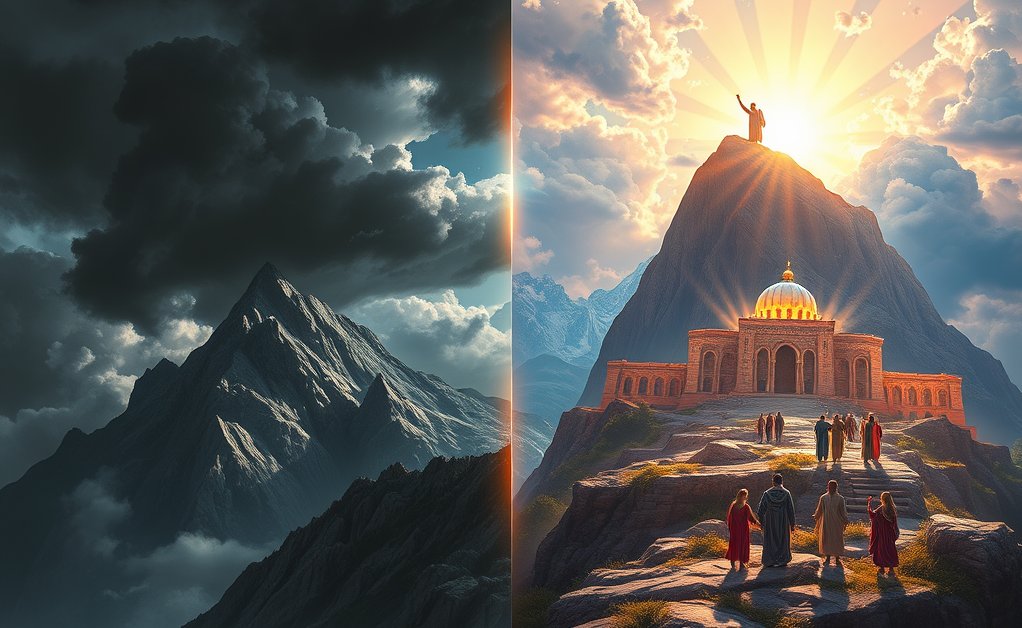
For you have not come to what could be touched, to a blazing fire, to darkness, gloom, and storm, to the blast of a trumpet, and the sound of words.
Those who heard it begged that not another word be spoken to them, for they could not bear what was commanded: If even an animal touches the mountain, it must be stoned.
The appearance was so terrifying that Moses said, I am trembling with fear.
Instead, you have come to Mount Zion, to the city of the living God (the heavenly Jerusalem), to myriads of angels, a festive gathering, to the assembly of the firstborn whose names have been written in heaven, to a Judge, who is God of all, to the spirits of righteous people made perfect, and to Jesus, the mediator of a new covenant, and to the sprinkled blood, which says better things than the blood of Abel. (Hebrews 12:18-24)
That’s awesome to think about.
Therefore, since we are receiving a kingdom that cannot be shaken, let us be thankful.
By it, we may serve God acceptably, with reverence and awe, for our God is a consuming fire. (Hebrews 12:28-29)

 Moment to Moment (Bible blog)