Categories
Bible Original

Tagging along? Or following?

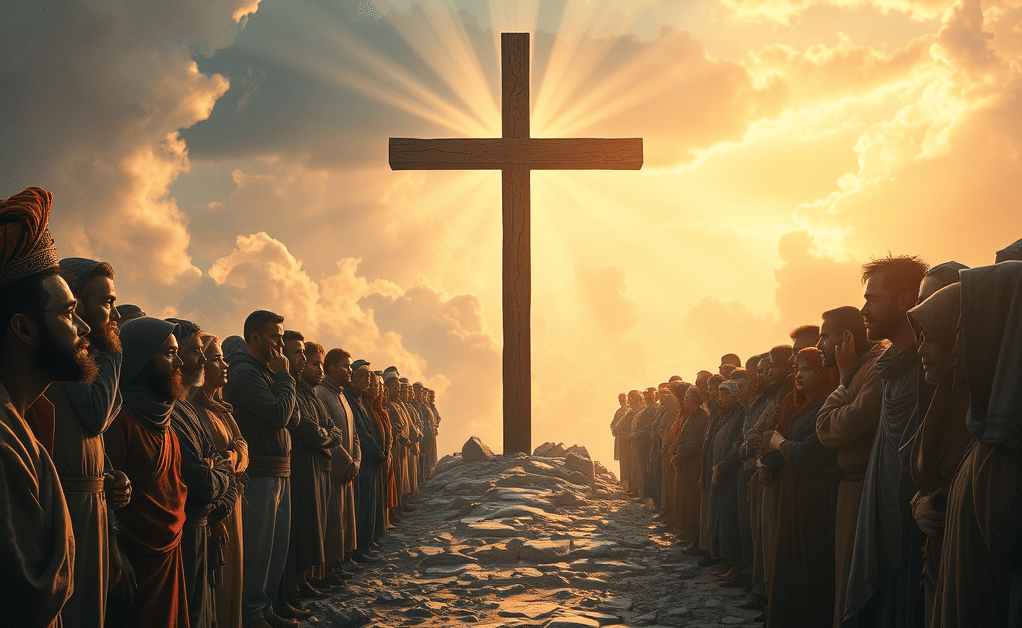
Now great crowds were traveling with him. So he turned and said to them, “If anyone comes to me and does not hate his own father and mother, wife and children, brothers and sisters—yes, and even his own life—he cannot be my disciple. Whoever does not bear his own cross and come after me cannot be my disciple.” (Luke 14:25-27)

Jesus’ words are very hard here, but I think he wanted to know, “Are you truly following me? Or are you just tagging along? Are you truly interested in joining my kingdom or not?”

That was one of the points of his parable earlier. People initially showed interest in a man’s banquet (symbolizing God’s Kingdom), but ultimately, they valued other things more. (16-20)

What’s the main difference between a disciple and one who simply tags along? Disciples love Jesus so much that they value him and his kingdom over everything else: their families, their possessions, even their very lives.

Jesus, of course, isn’t literally asking us to hate our families or to sell everything we have. But he is asking us, “What am I worth to you? Do I have top priority in your life?”

Jesus loved us so much that he gave up everything for us. Will we value him as much? Do we believe that if we do, that he is good, and we will ultimately find life, not lose it?

Love so amazing, so divine,
Demands my soul, my life, my all.

O the wonderful cross
Bids me come and die and find that I may truly live.

–Isaac Watts, Chris Tomlin

Categories
Luke Devotionals

What hinders us from following Jesus

If anyone would come after me, let him deny himself and take up his cross daily and follow me. (Luke 9:23)

What is it that hinders us from following Jesus?

For many Pharisees, it was pride. Specifically, pride in their own righteousness and complete blindness to their own sin. Such people don’t see their need for God’s mercy nor for a Savior. (Luke 18:9-14)

For the ruler, it was his possessions. He prioritized his wealth and the comfort and security it gave him over following Jesus. (Luke 18:18-25)

For the disciples, it was their dreams for the future. Dreams that Jesus would conquer the Roman Empire and giving them positions of power.

They had given up everything else to follow Jesus. But they couldn’t seem to let go of those dreams. And as a result, whenever Jesus talked about how he had to die, they could never understand.

In Peter’s case, it even led him to even argue with Jesus. (Mark 8:32)

God, be merciful to me a sinner.

Forgive me for the times I’ve been proud, making light of my own sin, while looking down on others for theirs. Help me to see my sin and my utter need for your grace.

Forgive me for idolatry. For prioritizing other things over following you.

Forgive me for closing my eyes and ears to what you’re telling me because I’m clinging so tightly to my own hopes and dreams.

You are a good God. And whatever I may lose in following you, I know I’ll find so much more. (Luke 18:29-30)

Father, to change is so hard for me, if not impossible. But what is impossible with man is possible with you. You already achieved the impossible: saving me from my sin.

Now complete what you have started in me. (Philippians 1:6)

In Jesus’ name, amen.

Categories
Genesis Devotions

Putting ourselves in bad situations

This is one of the ugliest stories in the Bible, from the rape of Dinah to the response of her brothers.

All of it might have been avoided, though, if Jacob had done one thing: go back to Bethel to fulfill his vows to God (Genesis 28:18-22).

Instead, he stopped a day’s journey away from Bethel, and purchased land outside the city of Shechem.

They apparently lived there long enough for his young children (33:13-14) to grow up into young adults.

It was probably more convenient for them living near a city. And maybe Jacob felt they were close enough to Bethel and he could fulfill all his vows there.

But apparently, he never really did until after the incident at Shechem. (35:1-4)

How often do we put ourselves in bad situations because we don’t put God first in our lives?

God is the God of second chances. God gave Jacob another chance after Shechem.

But how much pain would we be spared if we gave God our whole hearts from the beginning?  

Categories
Ecclesiastes Devotionals

Rethinking our priorities

Again, I saw futility under the sun: There is a person without a companion, without even a son or brother, and though there is no end to all his struggles, his eyes are still not content with riches.

“Who am I struggling for,” he asks, “and depriving myself of good things?” This too is futile and a miserable task.” (Ecclesiastes 4:7-8)

How often do we take a step back and think about our priorities? 

The person Solomon describes here is essentially a workaholic, seeking wealth and financial security.

But in doing so, he has no loving relationships and can’t even enjoy the wealth he has because he’s working so hard. More, he is already rich, but he still can’t seem to find satisfaction in it. 

What are we prioritizing in life? Life is not worth living without God and people around us who love us. 

One person can easily fall. But a cord of three strands, God, you, and those you love, is not easily broken. (12)

Categories
Luke Luke 12

When our time comes

Our life is fragile. And in an instant, it can be taken from us. Whether it be in a car accident, an earthquake, or whatever it may be.

And on that day, when we see God, what will he say to us?

Jesus was asked by a man to make his brother divide the family inheritance.

Apparently, there was some dispute on how it should be divided, but the main point was, the man was in love with money.

Perhaps his father was rich, and for years, he had dreamed of the money he would inherit when his father died. But when that day came, he found himself on the short end of the stick, and all his dreams of comfort and luxury were dashed.

And so he came up to Jesus to try to rectify the situation.

But Jesus quickly rebuffed him, saying,

Man, who appointed me a judge or an arbiter between you? (Luke 12:14)

In short, “Forget it.”

And then Jesus gave the second warning in this chapter.

Earlier he had given a severe warning about hypocrisy. Now he warns us against greed, saying,

Watch out! Be on your guard against all kinds of greed; a man’s life does not consist in the abundance of his possessions. (Luke 12:15)

What was he telling the man? Life isn’t all about things, and the comfort and luxury they might bring.

He then told a story about a man whose life was all about money and luxury. He had had a very successful crop one year, and wondered what to do with it.

He could have given some to feed the poor. He could have used his profit to help others in need. But instead, he had only one thought: Himself.

He said,

This is what I’ll do. I will tear down my barns and build bigger ones, and there I will store all my grain and my goods.

And I’ll say to myself, “You have plenty of good things laid up for many years. Take life easy; eat, drink and be merry.” (Luke 12:18-19)

That’s the dream of a lot of people. Retire early, and then live for themselves. Eat, drink, and be merry!

But God told the man,

You fool! This very night your life will be demanded from you. Then who will get what you have prepared for yourself. (Luke 12:20)

And Jesus said,

This is how it will be with anyone who stores up things for himself but is not rich toward God. (Luke 12:21)

So we get back to my original question. When your time comes, what will God say to you? Will he say, “You fool. You totally wasted your life on things that were not important.”

Or will he say, “Well done, good and faithful servant. Come and share your master’s happiness!”

Categories
Luke Luke 9 Mark Mark 8 Mark 9 Matthew Matthew 16

What’s really important

What are you living for? What are you seeking in life?

Comfort? Money? Things?

Here Jesus challenges us to really consider our priorities. He told his disciples and would-be disciples something really difficult.

If anyone would come after me, he must deny himself and take up his cross daily and follow me. (Luke 9:23)

The interesting thing to me is that Jesus asks us no less than what he did himself.

He denied himself.

He could have stayed in heaven. He could have let us all suffer in hell for all eternity. But he denied himself.

He gave up all he had in heaven, his glory, the worship of the angels, and he took on human flesh. While here on earth, he gave of himself, surrendering his own needs to meet the needs of others.

He took up his cross.

He suffered greatly, first having to carry his own cross to the place of his death, though he had already been beaten and was weak from the loss of blood. And then agonizing in pain while hanging on the cross. Why?

In order to follow his Father, and the plan he had set in motion for our salvation.

In the same way that Jesus denied himself, we too are to deny ourselves.

This doesn’t mean that we can’t enjoy life. Jesus certainly enjoyed his life here on earth. But there will be times when we need to sacrifice our needs and desires to fulfill the purpose God has for us.

Sometimes, it will require suffering. Our family rejects us because of our faith. We lose our jobs because we refuse to work on Sundays. Or we go through other kinds of persecution because we put Christ first in our lives.

But through it all, we need to keep following after Christ.

Why? Because in him, we find what’s most important. What’s most important? A relationship with him. And to fulfill the purpose for which he has created us.

Some people, however, sacrifice these things for what they want. And if following Christ will require them to let go of what they want, they let go of Christ instead. But Jesus tells them,

For whoever wants to save his life will lose it, but whoever loses his life for me will find it.

What good will it be for a man if he gains the whole world, yet forfeits his soul? Or what can a man give in exchange for his soul?

For the Son of Man is going to come in his Father’s glory with his angels, and then he will reward each person according to what he has done. (Matthew 16:25-27)

The bitter irony of letting go of Christ to hold on to the things we seek is that in the end, we’ll lose it all.

But if we let go of everything in order to follow Christ, that’s when we’ll find true satisfaction and peace. For when the day of judgment arrives, Christ will reward us.

And even before that, we’ll catch glimpses of the glory that is to come here on earth. Jesus indeed promised that to his disciples, saying,

I tell you the truth, some who are standing here will not taste death before they see the kingdom of God come with power. (Mark 9:1)

Though the disciples did go through suffering for the sake of Christ, nevertheless, they saw the kingdom of God come with power, as they saw miracles coming by their own hands, but more than that, the miracle of transformed lives as the gospel spread.

And though many died martyrs’ deaths, they did find reward as they stepped into God’s kingdom.

How about you? Are you willing to let go of what you have, in order to grasp what’s really important?

Categories
Song of Solomon

Still captivated

As I look at these passages, I can’t help but think of the words of Solomon when he wrote,

May you rejoice in the wife of your youth.  A loving doe, a graceful deer — may her breasts satisfy you always, may you ever be captivated by her love.  (Proverbs 5:18-19)

And that’s what you see in these passages.

Though some time has passed since the wedding, Solomon is still captivated by his wife.

If anything, he is even more captivated.  Along with the metaphors that he used previously to describe his love for her, he adds more.

He compares her to the cities of Tirzah and Jerusalem.  (Song of Solomon 6:4)

Just as it takes time to explore a city to discover all its glory, so it takes time to explore your spouse, and all the depths that make them what they are.  It is in fact, a lifelong process.

He tells her that when he looks into her eyes, they still overwhelm him.  (5).

After years of marriage, I can say the same when I look into my wife’s eyes and see the love that she has for me there.

He calls her his perfect one.

I think that as time passes, we can see that our spouses are not perfect.  But the eyes of love are willing to overlook their faults.  Indeed, the eyes of love often cause people to rise above what they are.

Some look at verse 8 and conclude that Solomon must have had other wives and concubines by this time, and that may be true.

It’s also possible that at this time, he was still monogamous and was simply throwing out a hypothetical situation (though one wishes it had remained hypothetical).

The main point, though, was of all the women in his life, she had a special place in his heart.

Men may have different women in their lives, mothers, daughters, sisters, and friends.  But as God intended it, his wife is to trump them all.  She is to take priority over all other women in his life.

Even when Solomon went out to conduct business, he found his thoughts drifting back to his wife, and they soon had him in his chariot racing back to her (11-12)

That should be a husband’s attitude.

Certainly, work is necessary, and hopefully enjoyable.

But his desire for his wife should outweigh his love for his work.  If we love our work more than our wives, this is never a good thing.

The same can be said for the working woman concerning her husband.

How about you?  Are you still captivated by your spouse?

It’s not simply an ideal.  It’s certainly not intended to be just a dream awoken by “reality.”

It’s what God intended for you and your spouse from the beginning.

Categories
Ezra Haggai

Getting our priorities straight

Before I go on, I should make some comments on the chronology of events going forward.

I’ve mentioned before that there is a lot of dispute among scholars about the timing of events, and the more I dig, the more I see why.

I also see why there is dispute about the starting date for the prophecy in Daniel 9. I have already given my position, but I will admit it’s not without its problems. One is the list of events as set out in Ezra.

Basically, if we go with the idea that Xerxes and Artaxerxes were the ones noted in history (as I do), then we have to say that Ezra 4:6–23 is one long parenthetical comment.

The reason that it’s put there is not because it’s in chronological order, but because thematically it fits in with the idea of the opposition the Jews faced in Jerusalem.

The events of Ezra 7 to the end of the book actually happen before Ezra 4, and the events of Nehemiah occur after it.

One thing to note is that in Ezra 4, it says nothing of the rebuilding of the temple, only the city walls and foundations, the reason being that the temple was already built as seen in chapters 5–6 of Ezra.

At any rate, because of the opposition they faced in Ezra 4:4–5, they stopped work on the temple. But we see in the book of Haggai, there was another reason they stopped the work. It simply wasn’t important enough to them.

And so Haggai confronted the people, saying,

This is what the Lord Almighty says: “These people say, ‘The time has not yet come to rebuild the Lord’s house.’”

Then the word of the Lord came through the prophet Haggai: “Is it a time for you yourselves to be living in your paneled houses, while this house remains a ruin?” (Haggai 1:2–4)

In other words, the people were so concerned about their own personal lives and trying to rebuild them, that they neglected the Lord’s temple.

How often do we do the same in our own lives? We know that our spiritual lives and our relationship with the Lord are important, but there are so many other things we’re concerned about, our finances, our job, our families, etc.

Not to say that these things are unimportant. They are. They have their place in our lives. But when they usurp God’s place in our lives, something’s wrong.

God told the people, “Look at your lives right now. You plant much, but harvest little. You eat, but are not satisfied. You drink, but are not filled. You put on clothes, but aren’t warm, and you earn money but see it all slip through your fingers.” (Haggai 1:5–6)

He then told them the reason for all this was because their priorities were messed up. They had ignored him, and so he had withdrawn his hand of blessing on them. So he told them,

This is what the Lord Almighty says: “Give careful thought to your ways. Go up into the mountains and bring down timber and build my house, so that I may take pleasure in it and be honored,” says the Lord. (Haggai 1:7–8)

God tells us the same. Give careful thought to your ways. Make your relationship with God your top priority. Give priority to God and his kingdom above all else. And if we do, we’ll find blessing.

Jesus put it this way,

But seek first his kingdom and his righteousness, and all these things will be given to you as well. (Matthew 6:33)