Categories
Mark Devotionals

The One who takes away our guilt and shame

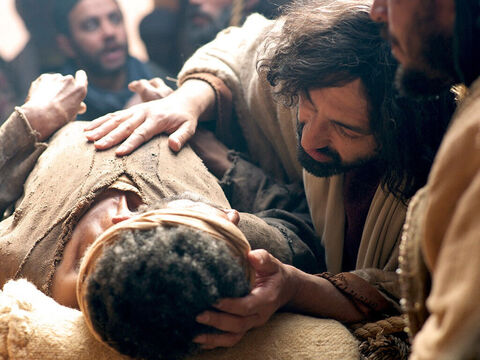
Seeing their faith, Jesus told the paralytic, “Son, your sins are forgiven.” (Mark 2:5)

I’d never thought of this before, but how many people had been telling this paralytic, “It’s your fault you’re this way. God must be punishing you for some sin in your life.”

It was a very common way of thinking in those days. (John 9:1-2, Luke 13:1-4)

How long had this man carried this burden of guilt and shame? How often had he loathed himself for his sin every time he saw his paralyzed body?

Whether or not his condition was directly connected to his sin, I don’t know. But his sin and the shame that came from it were very real.

But then this man heard about Jesus. He heard his teaching. And it sparked faith in both him and his friends. I don’t think this was just faith that Jesus could heal him. I think he took Jesus’ message to heart.

The time is fulfilled, and the kingdom of God has come near. Repent and believe the good news! (Mark 1:15)

And when Jesus saw his faith, he said, “Your sins are forgiven.”

In an instant, all the man’s guilt and shame were gone.

How about you? Are you burdened by your guilt and shame?

Jesus is the one who takes away our guilt and shame.

And when we come to him with a heart of faith and repentance, he looks at us and says to us the same thing he told that man. “My child. Your sins are forgiven.”

Categories
Mark Devotionals

Ashamed?

For whoever is ashamed of me and my words in this adulterous and sinful generation, the Son of Man will also be ashamed of him when he comes in the glory of his Father with the holy angels. (Mark 8:38)

There is a certain irony in Jesus’ words that I had never noticed before. He calls the people in our world, “an adulterous and sinful generation.”

That is something they should find great shame in. But the truth is, nowadays, many people boast about their sin. Not only that, they cheer on those who engage in it. (Romans 1:21-32)

And if that weren’t enough, they try to put to shame those who follow Christ and his words.

But Jesus said,

If anyone wants to follow after me, let him deny himself, take up his cross, and follow me. (34)

The cross was perhaps the most painful and shameful kind of death ever. People were nailed naked on a cross. And when Jesus was on the cross, people mocked him.

To be a disciple of Christ means taking up our cross and experiencing the suffering and shame he did.

Not everyone will like us.

Some will mock us.

But Jesus said in our shame, we find blessing. (Matthew 5:10-12)

More, through our boldness, some of the very people that mock us now may find salvation.

So let us say with Paul:

I am not ashamed of the gospel, because it is the power of God for salvation to everyone who believes… (Romans 1:16)

Categories
2 Corinthians

Why we need never be ashamed

I touched on this yesterday, but I want to look at it much more deeply today.

We saw yesterday that when Moses received the ten commandments, his face initially glowed with the glory of the Lord.

At first, because the people were frightened by this glowing, he covered his face with a veil. But then, he kept it on much longer than he needed to. Why?

Probably because he was ashamed that the glory was fading from his face. And probably because he realized that his own sinfulness caused that glory to fade.

And therein, as we have seen the last couple of days, lies the problem with the law. While it tells us what God is like and what we are meant to be, it cannot change us. We remain sinful in God’s sight and condemned by the law.

But Paul tells us that doesn’t have to be us anymore. Rather, when we come to Christ, we find a new glory that far surpasses the glory that shone from Moses’ face.

Why? Because the law is no longer simply written on tablets of stone or on sheets of paper for that matter.

Rather, when we become Christians, the Spirit writes his laws upon our hearts and transforms us day by day into Christ’s likeness. Each day, we are being transformed from one degree of glory to another.

There is no fading of our glory. Rather, it is an ever increasing glory.

As a result, Paul can tell us,

Therefore, since we have such a hope, we are very bold.

We are not like Moses, who would put a veil over his face to keep the Israelites from gazing at it while the radiance was fading away. (2 Corinthians 3:12-13)

We don’t have to worry that the glory that God has bestowed on us will fade. Rather we can know with confidence that he will continue to work in us until we are conformed to the likeness of his Son, shining in radiance.

Because of this, Paul says we have freedom (2 Corinthians 3:17).

Freedom from guilt for failing to keep the law.

Freedom from punishment.

Freedom from trying to keep a law by our own efforts.

This was something that even Moses never had. He was bound under law, and as a result, he experienced guilt and shame despite all the sacrifices (Hebrews 10:2-4).

He experienced the pains of judgment in that he could not enter the promised land because of his sin. And so he covered his face as the glory of the law faded away.

But we don’t have to do that. Let us take off the veil and show the world who we are. People saved by grace. People who though we are not perfect, are nevertheless being transformed day by day in the likeness of Christ.

And let us live each day remembering what God has told us,

“See, I lay a stone in Zion, a chosen and precious cornerstone (Jesus), and the one who trusts in him will never be put to shame.” (1 Peter 2:6)

Categories
Isaiah

The one who takes away our disgrace

Disgrace.

Shame.

These are things that can cling to a person, and more times than not, they are things that we have brought upon ourselves by our own choices and actions.

In the midst of it all, we sometimes wonder how we can ever escape the trap that we are in.  And it seems hopeless.

That’s what the women in verse 1 were facing.  They had previously been women of wealth, with a good position in society. Yet they, along with their husbands, were utterly sinful.

And when judgment came, they were left without husbands, who were now dead because of their sins.

Now these women were desperate to find any man that would take them as their wives. They were even telling them:

“Just give me your name in marriage.  You don’t need to give me anything else.  You don’t even need to provide for me.  I’ll provide for myself.  Just take away my disgrace.  Take away my disgrace as a woman unloved, with no family to call her own.”

But while these women were asking for husbands that would just take them in, God was offering them so much more.

And for the first time in scripture, we see a reference to the Branch of the Lord, which refers to Jesus.

Isaiah wrote,

In that day the Branch of the LORD will be beautiful and glorious, and the fruit of the land will be the pride and glory of the survivors in Israel.

Those who remain in Zion, who remain in Jerusalem, will be called holy, all who are recorded among the living in Jerusalem.  (Isaiah 4:2-3)

In other words, Jesus would come and set apart the people for himself once more to be his bride.  Isaiah then says,

The Lord will wash away the filth of the women of Zion; he will cleanse the bloodstains from Jerusalem by a spirit of judgment and a spirit of fire. (Isaiah 4:4)

In other words, he would convict the people of their sin, and purge them of all the filth that was in their hearts.

It’s very similar to what Paul wrote about Christ as the bridegroom, who,

loved the church and gave himself up for her to make her holy, cleansing her by the washing with water through the word, and to present her to himself as a radiant church, without stain or wrinkle, or any other blemish, but holy and blameless.   (Ephesians 5:25-27)

Isaiah added,

Then the Lord will create over all of Mount Zion and over those who assemble there a cloud of smoke by day and a glow of flaming fire by night; over all the glory will be a canopy.

It will be a shelter and shade from the heat of the day, and a refuge and hiding place from the storm and rain.  (5-6)

Unlike the husbands the women of Israel were seeking who could not provide for them or shelter them, God was promising his presence, protection, and provision for them, just as he did for the Israelites in the desert as they were heading for the promised land.

And he said over all the glory would be a canopy.

That word “canopy” in the Hebrew is the same one Jews use today to refer to a wedding canopy.

The picture here is very clear.  God would purify his people, wash them clean of their sins, set them apart for himself once again, and be their husband.

He would take away their disgrace, providing for them and being their shelter and comfort through the storms of life.

How about you?  Are you covered by your own disgrace, ashamed of who you are and what you’ve done, seeking desperately to have even the veneer of respectability?

God can wash away the filth from your heart, and not only will he forgive you, he’ll take you in as his own, a bride radiant, without stain or wrinkle, or any other blemish, holy and blameless in his sight.

Categories
Genesis

No shame

When I look at this passage, I’m struck by the goodness of God. How as he created man, he took such care to provide for him.

He plants a garden with trees that he made sure were good for food and not only that, but pleasing to the eye as well. He also gives him pleasant work to do within the garden.

Then, perhaps even before the man realized his own need, God realized that the man needed a companion, one who would be “just right” (NLT) for him. So God created Eve.

And the reaction by Adam is instantaneous. “WOW! This is what I’ve been looking for. This is the one for me!”

And the Bible says that both were naked, but not ashamed. (Genesis 2:25)

That’s what marriage should be. Complete nakedness. I’m not just talking about sex. But nakedness of the soul. And complete acceptance. Knowing each part of the other person, and accepting them, and even celebrating who they are.

How many marriages fail because they lack this. All of us long to know and to be known. And be accepted.

The ability to laugh. To play. To share. To be intimate. How much has the thief of John 10:10 taken away from what marriage is? And all because we refuse to bare our souls completely to each other because we’re too afraid of rejection.

Maybe we’ve already suffered the scars of rejection and that prevents us from trying again.

But as we turn to the Author of Life, as we learn about his unconditional acceptance of us and find his healing.

And as we learn how to accept the people around us as he does, he is able to breathe new life into our dead marriages and relationships and make them as they were in the beginning: naked, but not ashamed.