Categories
1 Samuel Devotionals

A warrior, not a wimp

But David found strength in the Lord his God. (1 Samuel 30:6)

It occurred to me this morning that David did what the apostle Paul would talk about hundreds of years later.

Finally, be strengthened by the Lord and by his vast strength. (Ephesians 6:10)

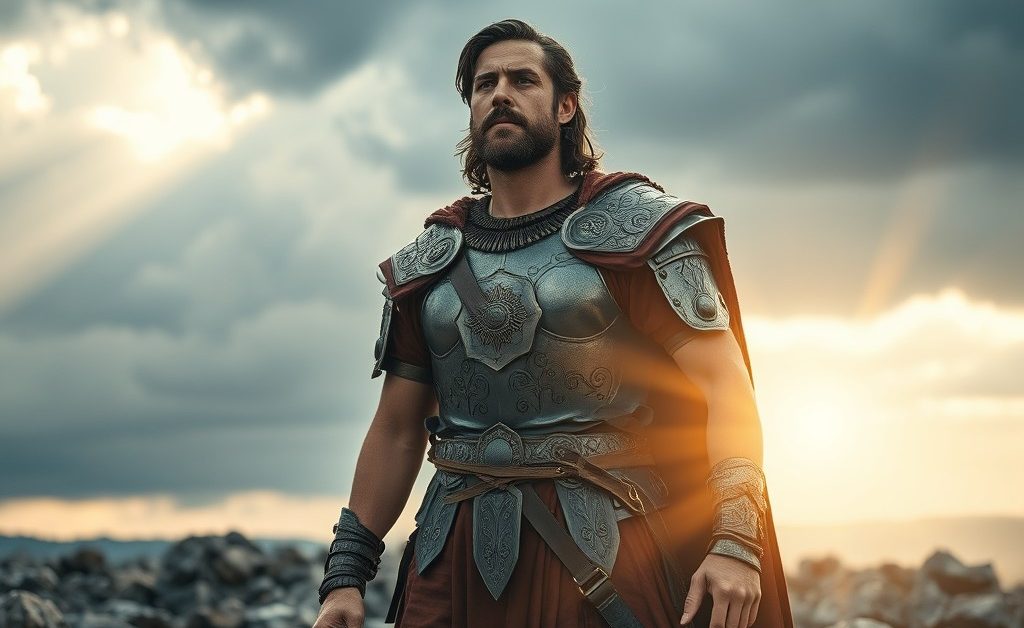
When hard times come, I want to be a warrior, not a wimp.

I don’t want to throw pity parties, feeling sorry for myself.

Nor do I want to give into bitterness, frustration, or anger at my situation.

Honestly, though, that’s how I act sometimes.

No longer.

I want to be like David, strengthened by God’s might, strapping on his armor, and fighting back against the Enemy.

Categories
Bible Original Judges Devotionals

What’s important

The LORD is with you, valiant warrior.” (Judges 6:12)

Lord, let me not be a spiritual wimp, but a valiant warrior for you.

What’s important is not how strong I am or what my pedigree is.

What’s important is that you’re with me.

And you’re sending me into spiritual battle to set those I love free from the Enemy.

I am not competent in myself to accomplish anything. You make me competent. (2 Corinthians 3:5)

And your strength is made perfect in my weakness. (2 Corinthians 12:9-10)

So help me to remember what’s important and run to the battle.

Categories
Judges Devotionals

No regrets

There was great searching of heart among the clans of Reuben. Why did you sit among the sheep pens listening to the playing of pipes for the flocks?

There was great searching of heart among the clans of Reuben. Gilead remained beyond the Jordan. Dan, why did you linger at the ships? Asher remained at the seashore and stayed in his harbors. (Judges 5:15-17)

Father, may I have no regrets when I look back upon my life.

Regrets because I just sat, content with my own life, while people around me were being oppressed by the Enemy.

Regrets because I lingered, and remained where I was, while people were in spiritual need.

Give me your heart. A heart that cares. And a heart that will fight the Enemy that is destroying people’s lives.

Give me a heart that is passionate for you and for those for whom your Son died. In Jesus’ name amen.

Categories
Psalms Devotionals

A prayer to our Priest and King

Jesus, you were David’s Lord, and you are my Lord. (Matthew 22:41-45)

You sit at your Father’s right hand, and you reign. (Hebrews 1:3, 8:1, 10:12, 12:2)

Not only that, you are my priest forever. You are able to save me completely because you always live to intercede for me. (Hebrews 7:24-25)

So Lord, I freely offer myself to you in this spiritual war we are in.

We are not fighting people. But we are fighting spiritual forces that would destroy people. (Ephesians 6:12)

Use me today to touch those around me with your love.

Here I am, Lord. Send me.

In your name, amen.

Categories
1 Timothy

Where our battle starts

In chapter 1, Paul starts by condemning those who were stirring up all kinds of controversies based on false doctrine that were taking the Ephesian church away from its main mission: to spread the gospel to those around them (1 Timothy 1:3-6).

He then ends the chapter by charging Timothy to fight the good fight for God’s kingdom, or as the ESV puts it, to “wage the good warfare.”

Part of that was dealing with the false teachers. But part of that was getting back to doing God’s work which the church had been distracted from doing by all these false teachings and controversies.

And so in chapter 2, he lays down the groundwork for where our work and battle begins. Where does it start? Paul tells us.

I urge, then, first of all, that requests, prayers, intercession and thanksgiving be made for everyone — for kings and all those in authority, that we may live peaceful and quiet lives in all godliness and holiness. 

This is good, and pleases God our Savior, who wants all men to be saved and to come to a knowledge of the truth. (1 Timothy 2:1-4)

Here we see what our work is. It’s to see that all are saved and come to a knowledge of the truth of the gospel. That’s God’s will. This is not to say that all will be saved, but that it is his desire. And his desire should be ours.

But our work starts with prayer. To see the needs of those around us for Christ and intercede for them.

So many times we pray for people’s physical needs, and that’s important. But do we do so at the neglect of their greatest need, their need for salvation?

I think one reason why we don’t prioritize it is because we don’t really believe in hell. We don’t believe in its reality. And even if we believe in its reality, we don’t really believe in eternal punishment.

If we did, and we realized that’s where many of our loved ones are headed, would we be so indifferent to where they are spiritually?

God certainly isn’t. And so he did something about it. Paul tells us,

For there is one God and one mediator between God and men, the man Christ Jesus, who gave himself as a ransom for all men–the testimony given in its proper time. 

And for this purpose I was appointed a herald and an apostle–I am telling the truth, I am not lying–and a teacher of the true faith to the Gentiles. (5-7)

We were all slaves to sin and headed for eternal death. But God bought us out of slavery by sending his Son to pay for our sin on the cross. That’s the meaning of “ransom,” here. It’s the payment given to buy someone out of slavery.

The work is done. All people need to do is to receive it by faith. But before they can receive it, they need to hear about it. That’s why God sent Paul out, to announce this salvation to the world. And that’s why God sends you now.

But again, it starts with prayer.

Praying that God would open the eyes and ears of those we love that they may see their need for him.

Praying that God would work in our leaders in government and open their eyes and ears as well so that the path of the gospel will be that much smoother.

But there’s one last thing. Paul says that we are to give thanks for everyone.

It’s easy to do that for those we love. It’s not so easy for those we don’t. Why are we to give thanks for them?

I think it’s to remind us that no matter how hateful or depraved they may be, they are still precious in God’s eyes. We need to see past their exterior and see people that Christ died for.

And by giving thanks for them, we are forced to see them more as He does.

God has called us to battle. So let us march into battle…on our knees.

Categories
Ephesians

Standing in the face of attack…together

We are in enemy territory. I don’t know if you know that, but we are. Paul says,

For our struggle is not against flesh and blood, but against the rulers, against the authorities, against the powers of this dark world and against the spiritual forces of evil in the heavenly realms. (Ephesians 6:12)

“This dark world.”

This world occupied by the enemy. But not human enemies. Spiritual ones. Satan and all his demons occupy this territory, and it’s because of them that we dwell in “this present darkness.” (ESV)

You don’t have to look far to see it. Morals are collapsing. What is right is considered wrong, and what is wrong is considered right. Exactly as Isaiah once talked about when he wrote,

Woe to those who call evil good and good evil, who put darkness for light and light for darkness, who put bitter for sweet and sweet for bitter. (Isaiah 5:20)

Paul said something similar to Timothy.

For the time will come when men will not put up with sound doctrine.

Instead, to suit their own desires, they will gather around them a great number of teachers to say what their itching ears want to hear. (2 Timothy 4:3)

We are here. This is the world we live in. This is why Paul admonishes us,

Put on the full armor of God, so that when the day of evil comes, you may be able to stand your ground, and after you have done everything, to stand. (Ephesians 6:13)

The day of evil. What does he mean by this?

I can’t help but think that he’s talking about a time of persecution. A time when Christianity will no longer be tolerated.

Already, we find it under attack in America. In Canada, there are things Christians simply cannot say on the radio or be shut down for violating “hate crime” laws.

The question is, as a church, how do we fight back?

Not through our own strength. Rather, Paul says,

Finally, be strong in the Lord and in his mighty power. (Ephesians 6:10)

Nor are we to rely on human weapons to fight, whether it’s literal weapons, political weapons, or weapons of mere human rhetoric. Instead, Paul says,

Put on the full armor of God so that you can take your stand against the devil’s schemes. (Ephesians 6:11)

Again, we’re not fighting humans. We’re fighting the spiritual powers behind this present darkness we are facing.

The thing I keep coming back to throughout the book of Ephesians, though, is vitally important here as well.

While certainly God calls us individually as Christians to take up the armor of God and take our stand against the devil, Paul is telling the church to do this.

Put another way, “All of you. Put on the full armor of God so that all of you, standing together, can take your stand against the devil’s schemes.”

Jesus said,

Any kingdom divided against itself will be ruined, and a house divided against itself will fall. (Luke 11:17)

And if the church is divided against itself, we have no chance to stand against the enemy.

So again we come to the question of unity. God has joined us together as one body under Christ.

Satan, however, is trying to tear us apart. It’s much easier to destroy a church that is coming apart at the seams already than to destroy one that is in complete unity.

And it’s much easier to pick off a lone Christian than it is a group of Christians supporting and protecting one another.

So as we face attack in this dark world, how will we do it?

Divided? Weak? Fighting in our own strength with human weapons?

Or united as one, fighting with spiritual weapons in the strength of the Lord?

Categories
Psalms

A time to sing, a time to fight

I must admit that upon first reading, Psalm 149 can be a bit disturbing, particularly from verses 6 on.

It is a psalm that first calls on God’s people to praise him.  To rejoice in him because he is our Maker and our King.  It then says to praise him with dancing and musical instruments.

It’s always cool for me to see people praise God through dance, although personally it’s not something I think I could ever do.  But to see the joy of people as they dance is such a blessing for me just watching them.

And to hear the beauty of instruments played for the glory of God helps draw me close to God as well.

At our church, we sometimes have a professional violin player join in with the worship band, and it really adds something to the experience that I can’t properly express in words.

But as much as I delight in these things, God delights in them even more.  Even for those who can’t keep a tune, or play an instrument, or dance, the psalmist says,

The LORD takes delight in his people;
he crowns the humble with salvation.  (Psalm 149:4)

The Lord doesn’t delight so much in what we can do.  He delights in what he sees in our hearts.  When he sees people who love him and rejoice in him, that’s what he takes pleasure in.

And when we humble ourselves before him, putting our trust in him, he crowns us with his salvation.

The psalmist tells us that we should rejoice in this honor he has given us.  Though we deserve nothing from him, he has given us life.

But then comes the disturbing part.  For while the psalmist calls people to worship, it also calls them to war.  To war against those who would set themselves against God and carry out his judgment.

Now for the Israelites coming into Canaan, that is exactly what God called the people to do.

For years, God waited with patience for the Canaanites to turn from their sin, but instead the situation became worse and worse.

And when they reached their “full measure of sin” (Genesis 15:16), God sent his people to exercise his judgment on them.

But we are not the Israelites, for whom this psalm was originally written.  So what does this mean for us?

The thing we need to remember is that we are in a spiritual war.  And as I’ve mentioned before, our battle is no longer against flesh and blood.  People are not our enemies.

But there are spiritual powers and forces out there using people as their pawns.  This is what we are fighting.

And ours is not a literal two-edged sword that we hold, but rather the two-edged sword of the Word of God, a sword that,

penetrates even to dividing soul and spirit, joints and marrow; it judges the thoughts and attitudes of the heart.  (Hebrews 4:12)

We use it not to fight against people, but to fight for their souls that they may be saved.

And we bring a message of salvation and judgment.

To those who believe, Jesus has given us the authority to proclaim their forgiveness in his name.

To those who reject his word, he has given us the authority to proclaim their coming judgment if they do not repent.  (John 20:23).

So let us never forget.  We are called to worship, that is true.  But we are also called to fight.  To fight for the lives of those who are lost.

So as I’ve said before, let us run to the battle.

Categories
Psalms

Deliver me from evil

And so we come down to the homestretch for the book of Psalms.  It’s taken about 4 months to get this far, and we have just under two more weeks to complete it.

Anyway, as I look at Psalm 140, I’m reminded of how Jesus taught us to pray.  One thing that he told us to pray was,

Deliver us from evil.  (Matthew 6:13)

That’s what David prays throughout this psalm, and for that matter, through the next few psalms.

This psalm was probably written either during his flight from King Saul or his son Absalom.  And he prays,

Rescue me, O LORD, from evil men;
protect me from men of violence,
who devise evil plans in their hearts
and stir up war every day.

They make their tongues as sharp as a serpent’s;
the poison of vipers is on their lips.

Keep me, O LORD, from the hands of the wicked;
protect me from men of violence who plan to trip my feet.

Proud men have hidden a snare for me;
they have spread out the cords of their net
and have set traps for me along my path. (Psalm 140:1-5)

From his prayer, David seems to be in a pretty bleak situation, with people looking to destroy him.  So he prays, “rescue me,” “keep me,” and “protect me.”

Yet in the midst of his trouble, we see David’s confidence in the Lord.  He says in verse 6,

O LORD, I say to you, “You are my God.”

and again in verse 7,

O Sovereign LORD, my strong deliverer, who shields my head in the day of battle.  (7)

He then prays that God would bring justice on those who would destroy him, and he concludes by praying,

I know that the LORD secures justice for the poor and upholds the cause of the needy.

Surely the righteous will praise your name and the upright will live before you.  (12-13)

Some of us are going through trials right now as people, who for whatever reason, are fighting against us and trying to bring us down.

But though people may hate us, let us be like David laying out our problems before God, and letting him deal out the justice, while we ourselves show mercy to our enemies, as David did with Saul, and desired to do with Absalom.

For some of us, we may not have anyone fighting against us right now.  But it would be well for us to remember that we are in a spiritual war.  That there are forces out there that are hostile to us and want to bring us down.

Jesus himself knew this.  That was why he told his disciples to pray, “Deliver me from evil.”

It should be part of our prayers too.  We’re in a broken world, filled with broken people, and the Enemy who first brought sin into the world is still running around loose.

So let us clothe ourselves with prayer.  More than that, let us not simply live in defensive mode, but in attack mode.

As one minister put it, all the armor we’ve been given is for the front, not the back.

So let us always be moving forward with God before us.  As the old hymn goes,

Onward Christian soldiers!
Marching as to war,

With the cross of Jesus
Going on before.

Christ, the royal Master,
Leads against the foe;

Forward into battle,
See, His banners go!

Categories
Nehemiah

Lies, discernment, and strength

With the walls near completion, the enemies of the Jews made one last attempt to stop the work.

First, they tried to lure Nehemiah out of the city where they could ambush and kill him.

Four times they tried to get him to come out, and when Nehemiah refused, they threatened to report him to King Artaxerxes, that he was planning to become king  of Jerusalem.

Perhaps they looked at the prophesies of Zechariah (Zechariah 9) and pointed to them as proof that Nehemiah was seeking to become king.

But Nehemiah rebuffed the accusation, secure in the knowledge that one, he had no such plans, and two, that King Artaxerxes trusted him.  So he called their bluff, and indeed, that’s exactly what it was.

Next they bribed one of the priests of God to tell him to hide within the temple for sanctuary against his enemies.  But Nehemiah refused for two reasons.

First, as the leader, he couldn’t be seen as hiding from his enemies as it would have hurt the confidence the people had in him.

Second, it was against God’s law that he enter the Holy Place, and by doing so, he would’ve sinned against God, again discrediting him among the people.

They then tried in turn to weasel their way into his confidence by sending their spies to speak well of them to Nehemiah, and when that didn’t work, to intimidate him.

But Nehemiah prayed to God, saying,

Now strengthen my hands.  (Nehemiah 6:9)

And God did.  Despite all the efforts of their enemies, the wall was completed.  And everyone, even these enemies, acknowledged that it was through God’s help that the wall was rebuilt.

What can we learn from this?

Satan will often try to keep us from God’s work.  He’ll try to throw lies at us to tempt us to sin or to cause us harm.

How do we combat that?

We need discernment and wisdom from God.  And the way we do that is through his Word and through constantly being connected to him through prayer.

As we read his word and pray, not only can we discern the truth from lies, but we can discern what the will of God is in our lives.

And when Satan attacks us and tries to intimidate us, we need to come before God as Nehemiah did, and ask for his strength.

So each day, as we go out into this world to do God’s will, let us seek his discernment and wisdom, and look to him for our strength.

If we do, there is no way Satan can stop us.

Categories
Esther

The God who defends us

Now we come to the dramatic scene in which Esther reveals her identity and makes her plea for her people before Xerxes.

I’m guessing that by this time, most of her fears are gone, as Xerxes has by this point shown her great favor.

Still, perhaps there was a little doubt in her heart whether he would side with Haman or with her.

It must have warmed her heart to see the concern Xerxes showed when she told him that she and her people were in great danger.  Xerxes answered hotly,

Who is he? Where is he—the man who has dared to do such a thing?  (Esther 7:5)

Haman must have been stunned to hear himself named, and in the next instant must have realized that Esther was a Jew.

Xerxes made the same realization at the same time, and was so upset that he walked out of the room to clear his mind.

Haman knew he was in deep trouble and so he went to Esther to plead for his life.

Esther meanwhile, must have been terrified, thinking that Haman was coming to attack her, and it was at this point, that Xerxes came back into the room.

And when he saw Haman near Esther (a serious breach of Persian protocol; no man was to ever come within 7 steps of the queen), and perhaps seeing a look of terror on her face, he immediately exclaimed,

Will he even molest the queen while she is with me in the house?  (Esther 7:8)

One of Xerxes’ servants spoke up at that moment, telling the king about how Haman had built gallows to hang Mordecai, who had saved Xerxes’ life.

At which point, Xerxes said, “Hang him on it.”

Esther then brought Mordecai before Xerxes, and he made Mordecai prime minister in Haman’s place.

Once again Esther pleaded for her people, and though Xerxes couldn’t repeal the law he had made (he was not above the law), nevertheless, he gave Mordecai and Esther the authority to at least nullify its effects.

Mordecai and Esther made a new law that said that the Jews had the right to defend themselves.

Some people have interpreted this law to mean that the Jews also had the right to exterminate the women and children of those who tried to destroy them.

But it likely means (as the NIV reflects) that the Jews could defend themselves against those who tried to attack them, their wives, and their children.

The right to take plunder was also probably added as an extra deterrent to those who would think about trying to attack the Jews.

Despite this provision, it should be noted that none of the Jews actually did plunder their enemies.

Some people have also criticized the hanging of Haman’s sons.

I should point out however, that they were actually killed while trying to destroy the Jews.  (9:5-10)

Their dead bodies were then hung as an example to all those who would try the atrocities they had tried to commit.

What can we get from all this?  Two things.

First, just as Xerxes rose up to defend his wife and her people, so God rises up to defend us.

When the Enemy comes up against us to destroy us, God doesn’t leave us helpless.  Instead he fights for us and he will cast down the enemy.  Such is the great love God has for us.

Second, although Xerxes was on their side, the Jews still had to fight.

In the same way, though God is on our side, we still have a spiritual battle to fight.  Because of this, God calls us to arm ourselves with his armor (Ephesians 6:10-18).

So when we’re under spiritual attack, let us take heart.  God is with us.

And let us gird ourselves with his armor, fighting the good fight of the faith. (1 Timothy 6:12)

Remember that because of him, we have already won the victory.

Categories
Daniel 3

War

A long time ago, a book came out called “This Present Darkness,” by Frank Peretti.

It was a fictional book, but after reading it, it really made me think about the spiritual warfare that goes on that we can’t see with our eyes and about the necessity of prayer.

I can’t help but think that the book was inspired by this passage, because this is the first time you get a behind the scenes view of the spiritual war that goes on in the Bible.

Here we see Daniel in a time of mourning.  Why he was mourning is uncertain.

It could be that he was hearing of the troubles that his people were having back home in Israel, with all the opposition to the rebuilding of the temple and the city walls.

Or he might have been mourning the fact that his people were still more interested in themselves than the things of God (something that Haggai would later criticize them for).

Whatever the reason, he was fasting and seeking God.  Yet for 3 weeks, this man of God heard nothing.

How often do we feel the same way.  We’re troubled, we’re seeking God, and yet God seems to be ignoring us.

But was God ignoring him?  Not at all.  An angel appeared to Daniel saying,

Do not be afraid, Daniel.  Since the first day that you set your mind to gain understanding and to humble yourself before your God, your words were heard, and I have come in response to them.

But the prince of the Persian kingdom resisted me twenty-one days.  Then Michael, one of the chief princes, came to help me, because I was detained there with the king of Persia. (Daniel 10:12-13)

After strengthening Daniel to hear his message, he then said,

Do you know why I have come to you?

Soon I will return to fight against the prince of Persia, and when I go, the prince of Greece will come; but first I will tell you what is written in the Book of Truth.

(No one supports me against them except Michael, your prince.)  (20-21)

What should we get from tall of this?

When we think of all the problems in this world, when we think of the times that God sometimes seems silent in the midst of it all, there’s a lot going on that we cannot see.

There is, in fact, a spiritual war going on.

Paul wrote,

For our struggle is not against flesh and blood, but against the rulers, against the authorities, against the powers of this dark world and against the spiritual forces of evil in the heavenly realms.  (Ephesians 6:12)

This is not a war in which we’re fighting people, although at times, it sure seems that way.  We’re fighting spiritual forces who influence those around us.

And if we’re going to fight these forces, then we need spiritual armor and spiritual weapons, all of which are described in Ephesians 6.

I won’t comment on them right now except to point out that all these pieces of armor that Paul mentions are for the front of the body.  There’s nothing for the back.

Why?  Because we are meant to fight going forward, not running away.

But the thing to remember after arming ourselves is that we also need to be praying.  Paul wrote,

And pray in the Spirit on all occasions with all kinds of prayers and requests.

With this in mind, be alert and always keep on praying for all the Lord’s people.   (Ephesians 6:18)

We cannot fight this fight alone and in our own strength.  We need the Spirit of God himself, fighting for us.

And so we should not only pray for ourselves, but for all of the Lord’s people, for our brothers and sisters in Christ.

Pray for your pastor. Pray for those brothers and sisters who are hurting.

Let us not be complacent.  Let us not be caught unaware by the enemy.

Let us always be alert and praying as God has called us to.

And let us fight the good fight of faith in this war we’re in.